Thank you for visiting SNEWPapers!
Sign up free
Editorial
August 6, 1954
The People's Voice
Helena, Lewis And Clark County, Montana
What is this article about?
Congressman Lee Metcalf criticizes the Eisenhower administration for failing to reduce the national debt, which has risen from $260 billion in 1952 to nearly $270 billion, despite campaign promises to cut spending, taxes, balance the budget, and reduce debt. The administration seeks to raise the debt ceiling to $290 billion amid projected deficits.
Clipping
OCR Quality
98%
Excellent
Full Text
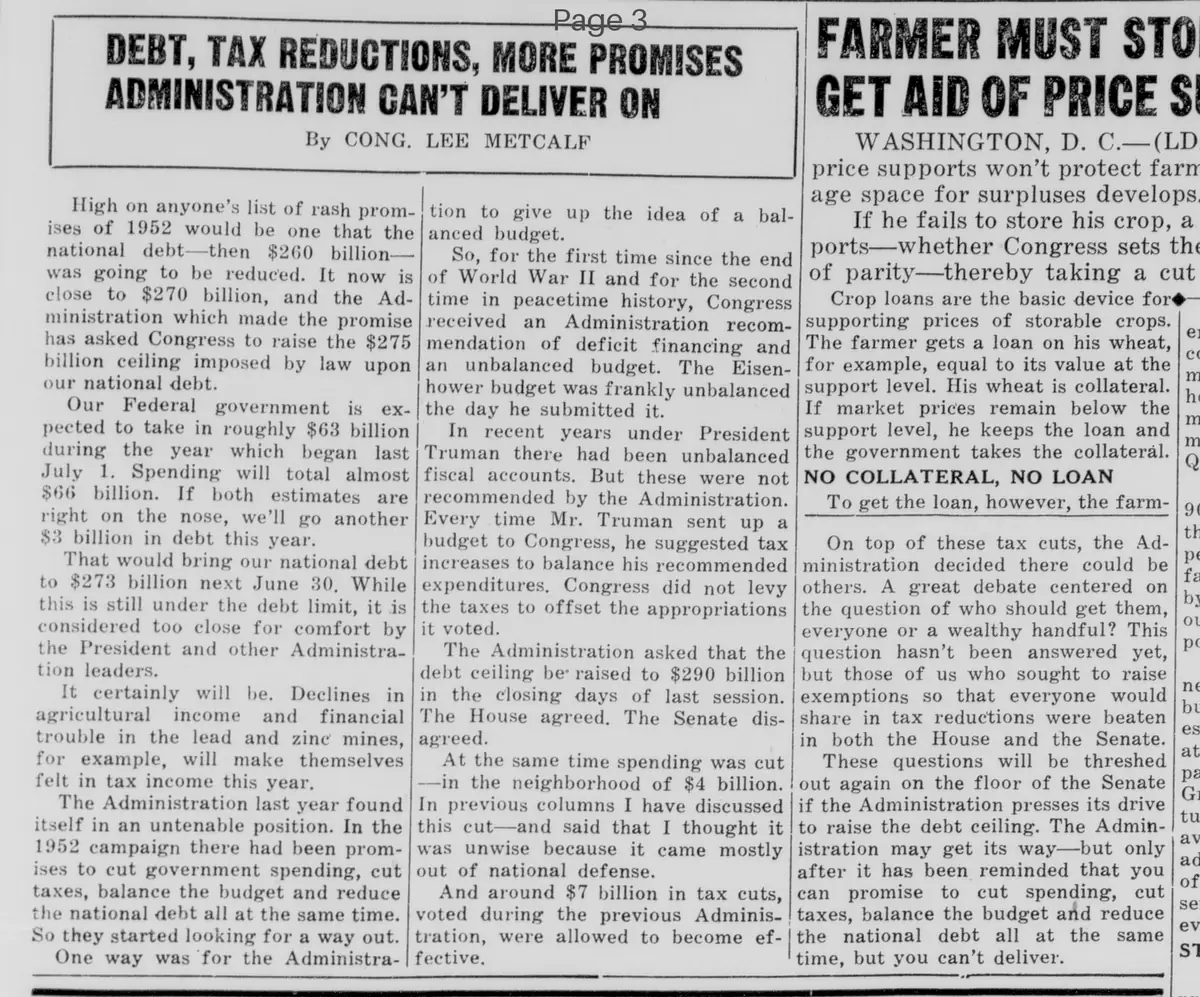
DEBT, TAX REDUCTIONS. MORE PROMISES
ADMINISTRATION CAN'T DELIVER ON
By CONG. LEE METCALF
High on anyone's list of rash promises of 1952 would be one that the national debt—then $260 billion—was going to be reduced. It now is close to $270 billion, and the Administration which made the promise has asked Congress to raise the $275 billion ceiling imposed by law upon our national debt.
Our Federal government is expected to take in roughly $63 billion during the year which began last July 1. Spending will total almost $66 billion. If both estimates are right on the nose, we'll go another $3 billion in debt this year.
That would bring our national debt to $273 billion next June 30. While this is still under the debt limit, it is considered too close for comfort by the President and other Administration leaders.
It certainly will be. Declines in agricultural income and financial trouble in the lead and zinc mines, for example, will make themselves felt in tax income this year.
The Administration last year found itself in an untenable position. In the 1952 campaign there had been promises to cut government spending, cut taxes, balance the budget and reduce the national debt all at the same time.
So they started looking for a way out. One way was for the Administration to give up the idea of a balanced budget.
So, for the first time since the end of World War II and for the second time in peacetime history, Congress received an Administration recommendation of deficit financing and an unbalanced budget. The Eisenhower budget was frankly unbalanced the day he submitted it.
In recent years under President Truman there had been unbalanced fiscal accounts. But these were not recommended by the Administration.
Every time Mr. Truman sent up a budget to Congress, he suggested tax increases to balance his recommended expenditures. Congress did not levy the taxes to offset the appropriations it voted.
The Administration asked that the debt ceiling be raised to $290 billion in the closing days of last session. The House agreed. The Senate disagreed.
At the same time spending was cut—in the neighborhood of $4 billion.
In previous columns I have discussed this cut—and said that I thought it was unwise because it came mostly out of national defense.
And around $7 billion in tax cuts, voted during the previous Administration, were allowed to become effective.
On top of these tax cuts, the Administration decided there could be others. A great debate centered on the question of who should get them, everyone or a wealthy handful? This question hasn't been answered yet,
but those of us who sought to raise exemptions so that everyone would share in tax reductions were beaten in both the House and the Senate.
These questions will be threshed out again on the floor of the Senate if the Administration presses its drive to raise the debt ceiling. The Administration may get its way—but only after it has been reminded that you can promise to cut spending, cut taxes, balance the budget and reduce the national debt all at the same time, but you can't deliver.
ADMINISTRATION CAN'T DELIVER ON
By CONG. LEE METCALF
High on anyone's list of rash promises of 1952 would be one that the national debt—then $260 billion—was going to be reduced. It now is close to $270 billion, and the Administration which made the promise has asked Congress to raise the $275 billion ceiling imposed by law upon our national debt.
Our Federal government is expected to take in roughly $63 billion during the year which began last July 1. Spending will total almost $66 billion. If both estimates are right on the nose, we'll go another $3 billion in debt this year.
That would bring our national debt to $273 billion next June 30. While this is still under the debt limit, it is considered too close for comfort by the President and other Administration leaders.
It certainly will be. Declines in agricultural income and financial trouble in the lead and zinc mines, for example, will make themselves felt in tax income this year.
The Administration last year found itself in an untenable position. In the 1952 campaign there had been promises to cut government spending, cut taxes, balance the budget and reduce the national debt all at the same time.
So they started looking for a way out. One way was for the Administration to give up the idea of a balanced budget.
So, for the first time since the end of World War II and for the second time in peacetime history, Congress received an Administration recommendation of deficit financing and an unbalanced budget. The Eisenhower budget was frankly unbalanced the day he submitted it.
In recent years under President Truman there had been unbalanced fiscal accounts. But these were not recommended by the Administration.
Every time Mr. Truman sent up a budget to Congress, he suggested tax increases to balance his recommended expenditures. Congress did not levy the taxes to offset the appropriations it voted.
The Administration asked that the debt ceiling be raised to $290 billion in the closing days of last session. The House agreed. The Senate disagreed.
At the same time spending was cut—in the neighborhood of $4 billion.
In previous columns I have discussed this cut—and said that I thought it was unwise because it came mostly out of national defense.
And around $7 billion in tax cuts, voted during the previous Administration, were allowed to become effective.
On top of these tax cuts, the Administration decided there could be others. A great debate centered on the question of who should get them, everyone or a wealthy handful? This question hasn't been answered yet,
but those of us who sought to raise exemptions so that everyone would share in tax reductions were beaten in both the House and the Senate.
These questions will be threshed out again on the floor of the Senate if the Administration presses its drive to raise the debt ceiling. The Administration may get its way—but only after it has been reminded that you can promise to cut spending, cut taxes, balance the budget and reduce the national debt all at the same time, but you can't deliver.
What sub-type of article is it?
Economic Policy
Partisan Politics
Taxation
What keywords are associated?
National Debt
Tax Reductions
Budget Deficit
Eisenhower Promises
Debt Ceiling
Fiscal Policy
Unbalanced Budget
What entities or persons were involved?
Eisenhower Administration
President Truman
Congress
Cong. Lee Metcalf
Editorial Details
Primary Topic
Failure Of Eisenhower Administration To Reduce National Debt And Deliver On Fiscal Promises
Stance / Tone
Critical Of Administration's Fiscal Policies And Unfulfilled Promises
Key Figures
Eisenhower Administration
President Truman
Congress
Cong. Lee Metcalf
Key Arguments
National Debt Rose From $260 Billion In 1952 To Nearly $270 Billion Despite Reduction Promises
Projected $3 Billion Deficit For The Fiscal Year Ending June 30, 1956
Administration Recommends Unbalanced Budget And Deficit Financing, First Since Wwii
Truman Suggested Tax Increases For Balance, Unlike Eisenhower
Debt Ceiling Raise To $290 Billion Sought After House Approval And Senate Rejection
$4 Billion Spending Cut Mostly From Defense, Deemed Unwise
$7 Billion In Prior Tax Cuts Allowed To Take Effect
Debate Over Broader Tax Cuts Favoring Everyone Over Wealthy, But Exemptions Not Raised