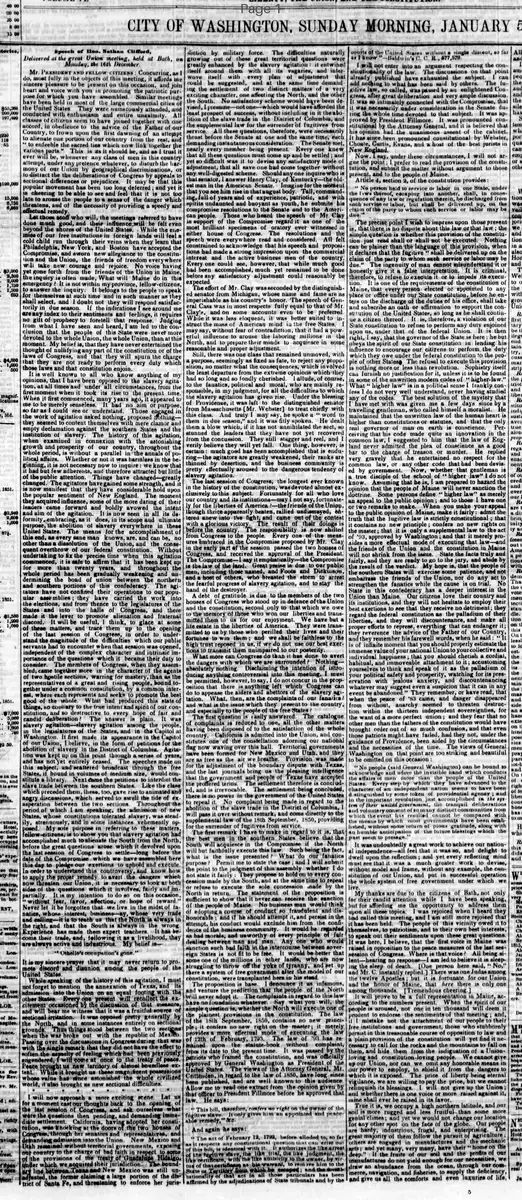
Mr. President and fellow-citizens: Concurring, as I do, most fully in the objects of this meeting, it affords me sincere pleasure to be present on this occasion, and join heart and voice with you in promoting the patriotic purpose for which you have assembled. Similar meetings have been held in most of the large commercial cities of the United States. They were numerously attended, and all classes of citizens seem to have joined together with one accord, in obedience to the advice of the Father of our Country, to frown upon the first dawning of an attempt to alienate one portion of our country from the rest, and to enfeeble the sacred ties which now link together the various parts. This is as it should be, and as I trust it ever will be, whenever any class of men in this country attempt, under any pretence whatever, to disturb the harmony of our Union by geographical discriminations, or to distract the deliberations of Congress by appeals to sectional differences or prejudices. It may be that this popular movement has been too long deferred; and yet it is cheering to be able to see and feel that it is not too late to arouse the people to a sense of the danger which threatens, and of the necessity of providing a speedy and effectual remedy. Let those scoff who will, the meetings referred to have done much good, and their influence will be felt even beyond the shores of the United States. While the enemies of our free institutions in foreign lands will feel a cold chill run through their veins when they learn that Philadelphia, New York, and Boston have accepted the Compromise, and sworn new allegiance to the constitution and the Union, the friends of freedom everywhere will take new courage and rejoice. No voice having yet gone forth from the friends of the Union in Maine, the inquiry is often made, What will Maine do in this emergency? It is not within my province, fellow-citizens, to answer the inquiry. It belongs to the people to speak for themselves at such time and in such manner as they shall select, and I doubt not they will respond satisfactorily in due season. If the indications I see around me are any index to their sentiments and feelings, it requires no gift of prophecy to foretell that response. Judging from what I have seen and heard, I am led to the conclusion that the people of this State were never more devoted to the whole Union, the whole Union, than at this moment. My belief is, that they have never entertained the thought of nullifying any part of the constitution or of the laws of Congress, and that they will spurn the charge that they are not ready to perform every duty which those laws and that constitution enjoin. It is well known to all who know anything of my opinions, that I have been opposed to the slavery agitation, at all times and under all circumstances, from the first moment when it took its rise to the present time. When it first commenced, many years ago, it appeared to me to be merely senseless. It had no aim or purpose, so far as I could see or understand. Those engaged in the work of agitation asked nothing, proposed nothing—they seemed to content themselves with mere clamor and empty declamation against the southern States and the institution of slavery. The history of this agitation, when examined in connexion with the astonishing growth and prosperity of our country, throughout the whole period, is without a parallel in the annals of political affairs. Whether or not it was harmless in the beginning, it is not necessary now to inquire: we know that it had but few adherents, and therefore attracted but little of the public attention. Things have changed—greatly changed. The agitators have gained some strength, and it is now manifest that they have considerable hold upon the popular sentiment of New England. The moment they acquired influence, some of the more daring of their leaders came forward and boldly avowed the intent and aim of the agitation. It is now seen in all its deformity, embracing, as it does, in its scope and ultimate purpose, the abolition of slavery everywhere in these United States. The means for the accomplishment of this end, as every sane man knows, are, and can be, no other than a dissolution of the Union, and the consequent overthrow of our federal constitution. Without undertaking to fix the precise time when this agitation commenced, it is safe to affirm that it has been kept up for more than twenty years, and throughout the whole period has been gradually weakening and undermining the bond of union between the northern and southern portions of this confederacy. The agitators have not confined their operations to our popular assemblies; they have carried the work into the elections, and from thence to the legislatures of the States and into the halls of Congress, and there made it the lever to promote alienation and fraternal discord. It will be useful, I think, to glance at some of these matters, and trace them up to the opening of the last session of Congress, in order to understand the magnitude of the difficulties which our public servants had to encounter when that session was opened, independent of the complex character and intrinsic importance of the questions which it became their duty to consider. The members of Congress, when they assembled, came together more in the character of the agents of two hostile sections, warring for mastery, than as the representatives of a great and rising people, bound together under a common constitution, by a common interest, where each represents and seeks to promote the best good of the whole. What had produced this state of things, so contrary to the true intent and spirit of our constitution, and so destructive to every hope of fair and candid deliberation? The answer is plain. It was slavery agitation—slavery agitation among the people, in the legislatures of the States, and in the Capitol at Washington. It first made its appearance in the Capitol of our Union, I believe, in the form of petitions for the abolition of slavery in the District of Columbia. Agitation was kept up on this point through a series of years, and has not yet entirely ceased. The speeches made on this subject, and scattered broadcast through the free States, if bound in volumes of medium size, would constitute a library. Next came the petitions to interdict the slave trade between the southern States. Like the class which preceded them, these, too, gave rise to animated and angry discussions, which served to swell the tide of exasperation between the two sections. Throughout the period of which I am speaking, the admission of new States, whose constitutions tolerated slavery, was steadily, strenuously, and in some instances vehemently opposed. My sole purpose in referring to these matters, fellow-citizens, is to show you that slavery agitation had accomplished much to alienate the South from the North, before the great questions arose which it devolved upon the last session of Congress to settle—long before the date of the Compromise which we have assembled here this day to pledge our exertions to uphold and execute. In order to understand this controversy, and know how to apply the proper remedy to avert the dangers which now threaten our Union, it is necessary to look at both sides of the questions which it involves, fairly and impartially. It is my intention to do so on this occasion without fear, favor, affection, or hope of reward. Never let it be forgotten that we live in the midst of fanatics, whose interest, business—ay, whose very trade and calling—it is to teach us that the North is always in the right, and that the South is always in the wrong. Experience has made them expert teachers. It has become their trade, and, following it as a livelihood, they are always active and industrious. My belief is—Othello's occupation's gone. It is my sincere prayer that it may never return to promote discord and disunion among the people of the United States. While speaking of the history of this agitation, I must not forget to mention the annexation of Texas, and its admission into the Union on an equal footing with the other States. Every one present will recollect the excitement occasioned by the discussion of that measure, and will bear me witness that it was a fruitful source of sectional irritation. It was opposed pretty generally by the North, and in some instances entirely on sectional grounds. Thus things stood between the two sections when the war broke out with the republic of Mexico. Passing over the discussions in Congress during that war with the single remark that they did not have the effect to soften the asperity of feeling which had been previously engendered, I will come at once to the treaty of peace. Peace brought us new territory of almost boundless extent. While it brought us these magnificent possessions whose value has since astonished the whole civilized world, it also brought us new sectional difficulties. I will now approach a more exciting scene. Let us for a moment cast our thoughts back to the opening of the last session of Congress, and ask ourselves what were the questions then pending, and demanding immediate settlement. California, having adopted her constitution, was knocking at the doors of the two houses of Congress, through her senators and representatives, and demanding admission into the Union. New Mexico and Utah remained without territorial governments, exposing our country to the charge of bad faith in respect to some of the provisions of the treaty of Guadalupe Hidalgo, under which we acquired their jurisdiction. The boundary between Texas and New Mexico was still unadjusted, the former claiming a large portion of the district of Santa Fe, and threatening to enforce her jurisdiction by military force. The difficulties naturally growing out of these great territorial questions were greatly enhanced by the slavery agitation: it entwined itself around them with all its vagaries, and interwove itself with every plan of adjustment that could be suggested, and at the same time demanding the settlement of two distinct matters of a very exciting character, one affecting the North, and the other the South. No satisfactory scheme would have been devised, I presume—not one—which would have afforded the least prospect of success, without including in it the abolition of the slave trade in the District of Columbia, and the supplemental law for the surrender of fugitives from service. All these questions, therefore, were necessarily thrust before the Senate at one and the same time, each demanding instantaneous consideration. The Senate met, nearly every member being present. Every one knew that all these questions must come up and be settled; and yet so difficult was it to devise any satisfactory mode of adjustment, that all save one had come together without any well-digested scheme. Should any one inquire who is that senator, I answer Henry Clay, of Kentucky—the oldest man in the American Senate. Imagine for the moment that you see him rise in that august body. Tall, commanding, full of years and of experience, patriotic, and with spirits undaunted and buoyant as youth, he submits his compromise resolutions to the Senate and to the American people. Those who heard the speech of Mr. Clay in support of the Compromise regard it as one of the most brilliant specimens of oratory ever witnessed in either house of Congress. The resolutions and the speech were everywhere read and considered. All felt constrained to acknowledge that his speech and propositions had made a strong impression upon the commercial interest and the active business men of the country. Every one could see, however, that while much good had been accomplished, much yet remained to be done before any satisfactory adjustment could reasonably be expected. The effort of Mr. Clay was seconded by the distinguished senator from Michigan, whose name and fame are as imperishable as his country's honor. The speech of General Cass was in most respects fully equal to that of Mr. Clay's, and on some accounts even to be preferred. While it was less eloquent, it was better suited to instruct the mass of American mind in the free States. I may say, without fear of contradiction, that it had a powerful influence to arouse the laboring millions in the North, and to prepare their minds to acquiesce in some reasonable and proper adjustment. Still, there was one class that remained unmoved, with a purpose, seemingly as fixed as fate, to reject any proposition, no matter what the consequences, which involved the least departure from the extreme opinions which they had so long and so fondly cherished. I allude, of course, to the fanatics, political and moral, who are mainly responsible, in my judgment, for all the difficulties to which the slavery agitation has given rise. Under the blessing of Providence, it was left to the distinguished senator from Massachusetts [Mr. Webster] to treat chiefly with this class. And truly I may say, he spoke a "word to them in due season," and it was fitly spoken. He dealt them a blow which, if it has not annihilated the sect, so stunned the leaders that they have not yet recovered from the concussion. They still stagger and reel, and I verily believe they will yet fall. One thing, however, is certain: much good has been accomplished that is enduring—the agitators are greatly weakened, their ranks are thinned by desertion, and the business community is pretty effectually aroused to the dangerous tendency of slavery agitation. The last session of Congress; the longest ever known in the history of the constitution, was devoted almost exclusively to this subject. Fortunately for all who love our country and its institutions—may I not say, fortunately for the liberties of America ?—the friends of the Union, though thrice apparently beaten, rallied undismayed, entered anew into the fight, and came out of the contest with a glorious victory. The result of their doings is before the country. The responsibility is now shifted from Congress to the people. Every one of the measures embraced in the Compromise proposed by Mr. Clay in the early part of the session passed the two houses of Congress, and received the approval of the President. The Compromise—I say it emphatically—the Compromise is the law of the land. Great praise is due to our public men, including those named, and Foote and Dickinson, and a host of others, who breasted the storm to arrest the fearful progress of slavery agitation, and to stay the hand of the destroyer. A debt of gratitude is due to the members of the two houses of Congress who stood up in defence of the Union and the constitution, second only to that which we owe to the memory of those who won our liberties and transmitted them to us for our enjoyment. We have but a life estate in the liberties of America. They were transmitted to us by those who perilled their lives and their fortunes to win them; and we shall be faithless to the high trust reposed in us, if we do not use our best exertions to transmit them unimpaired to our posterity. What more can Congress do than it has done to avert the dangers with which we are surrounded? Nothing—absolutely nothing. Disclaiming the intention of introducing anything controversial into this meeting, I must be permitted, however, to say, I do not concur in the proposition that there is anything left which Congress can do to appease the aiders and abettors of the slavery agitation. What, then, are the complaints of our fanatics? and what is the issue which they present to the country, and especially to the people of the free States? The first question is easily answered. The catalogue of complaints is reduced to one, all the other matters having been disposed of to the satisfaction of the whole country. California is admitted into the Union, and constitutes one of the constellation adorning our national flag now waving over this hall. Territorial governments have been formed for New Mexico and Utah, and they are as free as the air we breathe. Provision was made for the adjustment of the boundary dispute with Texas, and the last journals bring us the pleasing intelligence that the government and people of Texas have accepted the proffered terms. The settlement therefore is concluded, and is irrevocable. The settlement being concluded, there is no power in the government of the United States to repeal it. No complaint being made in regard to the abolition of the slave trade in the District of Columbia, will pass it over without remark, and come directly to the supplemental law of the 18th September, 1850, providing for the surrender of fugitives from service. The first remark I have to make in regard to it is, that the best men in the southern States believe that the South will acquiesce in the Compromise if the North will but faithfully execute this law. Such being the fact, what is the issue presented? What do our fanatics purpose? Permit me to state the case; and I will submit the point to the judgment of this assembly whether I do not state it fairly: They propose to hold on to every concession made by the South, and at the same time to repeal or refuse to execute the sole concession made by the North in return. The statement of the proposition is sufficient to show that it never can receive the sanction of the people of Maine. No business man would think of adopting a course of conduct so fraudulent and dishonorable; and if he should attempt it, and persist in the attempt, his conduct would exclude him from the confidence of the business community. It would be regarded as bad morals; and unworthy of every principle of fair dealing between man and man. Any one who would sanction such bad faith in the intercourse between sovereign States is not fit to be free. It would be better that some one of the millions in other lands, who are now struggling to throw off the yoke of tyranny, and set up there a system of free government after the model of our constitution, were transplanted here in his stead. The proposition is base. I denounce it as infamous, and venture the prediction that the people of the North will never adopt it. The complaints in regard to this law have no foundation whatever. Say what you will, the simple question is, whether the North will execute one of the plainest provisions in the constitution. The law of the 18th September, 1850, contains no new principle; it confers no new right on the master; it merely provides a more effectual mode of executing the law of 12th of February, 1793. The law of '93 has remained, upon the statute-book without complaint, from its date to the present time. It was passed by the patriots who framed the constitution, and was officially approved by General Washington as President of the United States. The views of the Attorney General, Mr. Crittenden, in regard to the law of 1850, have long since been published, and are well known to this audience. Allow me to read one extract from the opinion given by that officer to President Fillmore before he approved that law. He says: This bill, therefore, confers no right on the owner of the fugitive slave. It only gives him an appointed and peaceable remedy. And again he says: The act of February 12, 1793, before alluded to, so far as it respects any constitutional question that can arise out of this bill, is identical with it. It authorizes the like arrest of the fugitive slave, the like trial, the like judgment, the like certificate, with the like authority to the owner, by virtue of that certificate as his warrant, to remove him to the State or Territory from which he escaped; and the constitutionality of that act in all those particulars has been affirmed by the adjudications of State tribunals and by the courts of this United States without a single dissent, so far as I know.
I will not enter into an argument respecting the constitutionality of the law. The discussions on that point already published have exhausted the subject. I can add nothing to what has been said by others. The fugitive law, so called, was passed by an enlightened Congress, after great deliberation and very ample discussion. It was so intimately connected with the Compromise, that it was necessarily under consideration in the Senate during the whole time devoted to that subject. It was approved by President Fillmore. It was pronounced constitutional by the Attorney General, and it is believed that his opinion had the unanimous assent of the cabinet. It has since been pronounced constitutional by Webster, Choate, Curtis, Evans, and a host of the best jurists in New England. Now, I say, under these circumstances, I will not argue the point; I prefer to read the provision of the constitution, and submit the matter without argument to those present, and to the people of Maine. Article 4, section 2, of the constitution provides: No person held to service or labor in one State, under the laws thereof, escaping into another, shall, in consequence of any law or regulation therein, be discharged from such service or labor, but shall be delivered up, on the claim of the party to whom such service or labor may be due. The precise point I wish to impress upon those present is, that there is no dispute about this law or that law; the simple question is whether this provision of the constitution just read shall or shall not be executed. Nothing can be plainer than the language of this provision, when it declares that the fugitive "shall be delivered up on the claim of the party to whom such service or labor may be due." The ingenuity of man cannot misunderstand it or honestly give it a false interpretation. It is criminal, therefore, to refuse to execute it or to impede its execution. It is one of the requirements of the constitution of Maine, that every person elected or appointed to any place or office under our State constitution, before he enters on the discharge of the duties of his office, shall take and subscribe an oath or affirmation to support the constitution of the United States, so long as he shall continue a citizen thereof. It is, therefore, a violation of our State constitution to refuse to perform any duty enjoined upon us, under that of the federal Union. It is then right, I say, that the governor of the State is here; he but obeys the spirit of our State constitution in lending his influence to encourage our citizens to perform the duty which they owe under the federal constitution to the people of other States. The refusal to execute this provision is nothing more or less than revolution. Sophistry itself can furnish no justification for it, unless it is to be found in some of the unwritten modern codes of "higher-law." What "higher law" is in a political sense I frankly confess I do not very well understand, never having studied any of the codes. The best solution of the mystery that I have met with was given me a few days since by a travelling gentleman, who called himself a moralist. He maintained that the unwritten law of the human heart is higher than constitutions or statutes, and that the only real governor of man on earth is conscience. Perceiving that his code made quite an innovation in the common law, I suggested to him that the law of England never admitted the plea of conscience as a good bar to the charge of treason or murder. He replied very gravely that he entertained no respect for the common law, or any other code that had been devised by government. Now, whether that gentleman is a true disciple of the school of "higher law" I do not know. Assuming that he is, I am prepared to hazard the opinion that the people of Maine will never sanction the doctrine. Some persons define "higher law" as merely an appeal to the public opinion; and to those I have one or two remarks to make. When you make your appeal to the public opinion of Maine, make it fairly: admit the truth that the fugitive law is strictly constitutional; that it contains no new principle; confers no new rights on the master; that it is only a supplemental law to the act of '93, approved by Washington; and that it merely provides a more effectual mode of executing that law—and the friends of the Union and the constitution in Maine will not shrink from the issue. State the facts truly and fairly, and they are ready to go to the jury, and abide by the result of the verdict. My hope is, that the people of the southern States will exercise some patience, and not embarrass the friends of the Union, nor do any act to strengthen the fanatics while the cause is on trial. No State in this confederacy has a deeper interest in the Union than Maine. Our citizens love their country and its institutions, and they will not hesitate to employ their best exertions to see that they receive no detriment; they regard the federal constitution as the palladium of their liberties, and they will discountenance, and make all proper efforts to repress, everything that can endanger it; they reverence the advice of the Father of our Country, and they remember his farewell words, when he said: It is of infinite moment that you should properly estimate the immense value of your national Union to your collective and individual happiness; that you should cherish a cordial, habitual, and immovable attachment to it; accustoming yourselves to think and speak of it as the palladium of your political safety and prosperity, watching for its preservation with jealous anxiety, and discountenancing whatever may suggest even a suspicion that it can in any event be abandoned. They remember, or have read, that when the peace of '83 came, and danger disappeared from without, anarchy seemed to threaten destruction within the thirteen independent sovereignties, for the want of a more perfect union; and they fear that no other men than the fathers of the constitution would have brought order out of so much confusion, and that even those patriots might have failed, had they not, under the guidance of Providence, been aided by the circumstances and the necessities of the time. The views of General Washington on that point are too striking and beautiful to be omitted on this occasion: No people (said General Washington) can be bound to acknowledge and adore the invisible hand which conducts the affairs of men more than the people of the United States. Every step by which they have advanced to the character of an independent nation seems to have been distinguished by some token of providential agency; and in the important revolution just accomplished in the system of their united government, the tranquil deliberations and voluntary consent of so many distinct communities from which the event has resulted cannot be compared with the means by which most governments have been established, without some return of pious gratitude, along with an humble anticipation of the future blessings which the past seem to presage. It was undoubtedly a great work to achieve our national independence—all feel that it was so, and delight to dwell upon the reflection; and yet every reflecting mind must see that it was a much greater work to devise, without model and frame, without any example, the constitution of our Union, and put in successful operation the whole system of free government under which we live. My thanks are due to the citizens of Bath, not only for their candid attention while I have been speaking, but for affording me the opportunity to address them upon all these topics. I was rejoiced when I heard they had called this meeting, and I am still more rejoiced that it has been held. The people of this vicinity owed it to themselves, to patriotism, and to their own best interests, to speak out their sentiments upon these great questions. It was here, I believe, that the first voice in Maine was raised in opposition to the peace measures of the last session of Congress. Where is that voice? All being silent—hearing no response—I am led to believe it is sleeping the sleep of death. [One person here said, "No," and Mr. C. instantly replied.] There was one Judas among the twelve Apostles; but it is fortunate for our Union and the honor of Maine, that here there is only one among thousands. [Tremendous cheering.] It will prove to be a full representation in Maine, according to the numbers present. When the spirit of our people is aroused, not one in ten thousand will deem it prudent to endorse the sentiments of that meeting; and, if I mistake not the attachment of our people to their free institutions and government, those who stubbornly persist in this treasonable course of opposition to law and a plain provision of the constitution will yet find it necessary to call for the rocks and the mountains to fall on them, and hide them from the indignation of a Union-loving and constitution-loving people. We cannot give up our Union, nor can we omit any honorable means in our power to employ, to shield it from the dangers to which it is exposed. The price of liberty being eternal vigilance, we are willing to pay the price, but we cannot relinquish its blessings. I will not give up the Union; and whether there is one voice or more raised against it, mine shall ever be raised in its favor. True it is, we occupy a high northern latitude, and our soil is more rugged and less fruitful than some more genial climes; and yet we would not change our location for any other spot on the face of the globe. Our people are hardy, industrious, frugal, and enterprising. The great majority of them follow the pursuit of agriculture; others are engaged in manufactures and the mechanic arts; and yet many, very many, have their "home on the deep." If the fruits of our soil and the profits of our manufactures do not yield enough for our necessities, we draw an abundance from the ocean, through our commerce, navigation, and fisheries, to supply the deficiency, and give us all the comforts and even luxuries of life. All these great interests are made valuable by our Union, and without it they would languish and die. It is time, therefore, I think, that slavery agitation among us should cease—and it is only necessary that the people should will it to be so, and it will be done. Let the people speak out and say to our fanatics, "thus far and no farther," and let the press echo their sentiments, and I pledge you, fellow-citizens, my sincere belief that the voice of one class of fanaticism will be hushed into silence. Our modern fanatics are exceedingly selfish, and have little taste for martyrdom. Show the agitators that in their efforts to pull down the temple of our Union they have nothing to expect from whig or democrat—that opposition to the South is no passport to your favor—and they will soon retire to winter quarters, and prepare for some other more promising campaign. Show them that in following agitation as an employment it will afford no hope of either honor, profit, or success, and they will soon turn their attention to some other pursuit.