Thank you for visiting SNEWPapers!
Sign up free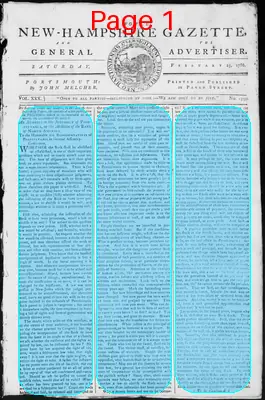
Fowle's New Hampshire Gazette And General Advertiser
Portsmouth, Rockingham County, New Hampshire
What is this article about?
An address to the Pennsylvania General Assembly argues against abolishing the Bank of North America, questioning the legislature's power to do so, the prudence of violating property rights, potential damage to credit and reputation, and highlighting economic benefits of the bank amid post-war money scarcity.
Clipping
OCR Quality
Full Text
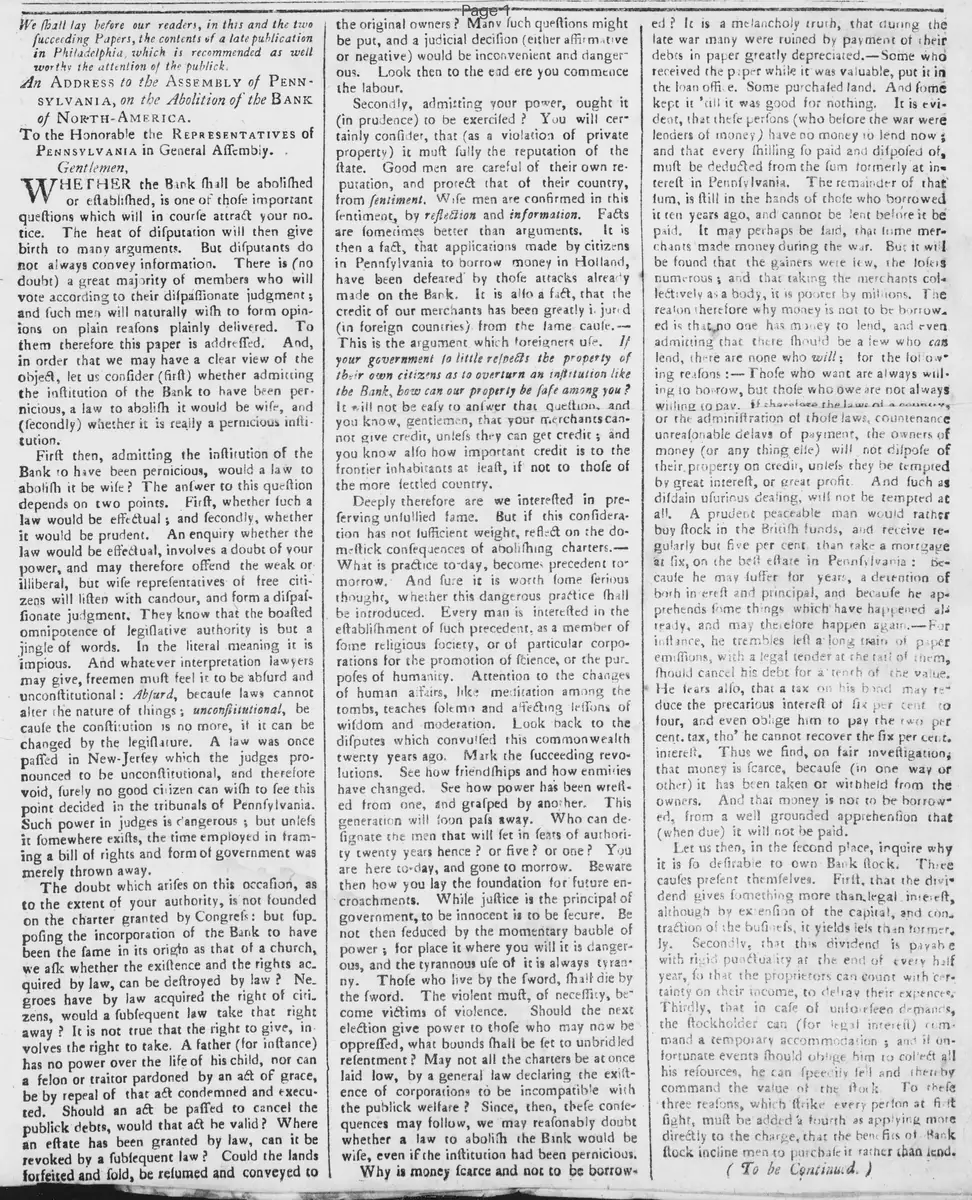
An Address to the Assembly of PENNSYLVANIA, on the Abolition of the BANK of NORTH-AMERICA.
To the Honorable the Representatives of Pennsylvania in General Assembly.
Gentlemen,
Whether the Bank shall be abolished or established, is one of those important questions which will in course attract your notice.
The heat of disputation will then give birth to many arguments. But disputants do not always convey information. There is (no doubt) a great majority of members who will vote according to their dispassionate judgment: and such men will naturally wish to form opinions on plain reasons plainly delivered. To them therefore this paper is addressed. And in order that we may have a clear view of the object, let us consider (first) whether admitting the institution of the Bank to have been pernicious, a law to abolish it would be wise, and (secondly) whether it is really a pernicious institution.
First then, admitting the institution of the Bank to have been pernicious, would a law to abolish it be wise? The answer to this question depends on two points. First, whether such a law would be effectual: and secondly, whether it would be prudent. An enquiry whether the law would be effectual, involves a doubt of your power, and may therefore offend the weak or illiberal, but wise representatives of free citizens will listen with candour, and form a dispassionate judgment. They know that the boasted omnipotence of legislative authority is but a jingle of words. In the literal meaning it is impious. And whatever interpretation lawyers may give, freemen must feel it to be absurd and unconstitutional: Absurd, because laws cannot alter the nature of things; unconstitutional, because the constitution is no more, if it can be changed by the legislature. A law was once passed in New-Jersey which the judges pronounced to be unconstitutional, and therefore void. Surely no good citizen can wish to see this point decided in the tribunals of Pennsylvania. Such power in judges is dangerous; but unless it somewhere exists, the time employed in framing a bill of rights and form of government was merely thrown away.
The doubt which arises on this occasion, as to the extent of your authority, is not founded on the charter granted by Congress: but supposing the incorporation of the Bank to have been the same in its origin as that of a church, we ask whether the existence and the rights acquired by law, can be destroyed by law? Negroes have by law acquired the right of citizens, would a subsequent law take that right away? It is not true that the right to give, involves the right to take. A father (for instance) has no power over the life of his child, nor can a felon or traitor pardoned by an act of grace, be by repeal of that act condemned and executed.
Should an act be passed to cancel the publick debts, would that act be valid? Where an estate has been granted by law, can it be revoked by a subsequent law? Could the lands forfeited and sold, be resumed and conveyed to the original owners? Many such questions might be put, and a judicial decision (either affirmative or negative) would be inconvenient and dangerous. Look then to the end ere you commence the labour.
Secondly, admitting your power, ought it (in prudence) to be exercised? You will certainly consider, that (as a violation of private property) it must sully the reputation of the state. Good men are careful of their own reputation, and protect that of their country, from sentiment. Wise men are confirmed in this sentiment, by reflection and information. Facts are sometimes better than arguments.
It is then a fact, that applications made by citizens in Pennsylvania to borrow money in Holland, have been deferred by those attacks already made on the Bank. It is also a fact, that the credit of our merchants has been greatly injured (in foreign countries), from the same cause.-- This is the argument which foreigners use. Your government so little respects the property of their own citizens as to overturn an institution like the Bank, how can our property be safe among you? It will not be easy to answer that question, and you know, gentlemen, that your merchants cannot give credit, unless they can get credit: and you know also how important credit is to the frontier inhabitants at least, if not to those of the more settled country.
Deeply therefore are we interested in preserving unsullied fame. But if this consideration has not sufficient weight, reflect on the domestic consequences of abolishing charters.-- What is practice to-day, becomes precedent to-morrow. And surely it is worth some serious thought, whether this dangerous practice shall be introduced. Every man is interested in the establishment of such precedent, as a member of some religious society, or of particular corporations for the promotion of science, or the purposes of humanity. Attention to the changes of human affairs, like meditation among the tombs, teaches solemn and affecting lessons of wisdom and moderation. Look back to the disputes which convulsed this commonwealth twenty years ago. Mark the succeeding revolutions. See how friendships and how enmities have changed. See how power has been wrested from one, and grasped by another. This generation will soon pass away. Who can designate the men that will sit in seats of authority twenty years hence? or five? or one? You are here to-day, and gone to-morrow. Beware then how you lay the foundation for future encroachments. While justice is the principle of government, to be innocent is to be secure. Be not then seduced by the momentary bauble of power; for place it where you will it is dangerous, and the tyrannous use of it is always tyranny. Those who live by the sword, shall die by the sword. The violent must, of necessity, become victims of violence. Should the next election give power to those who may now be oppressed, what bounds shall be set to unbridled resentment? May not all the charters be at once laid low, by a general law declaring the existence of corporations to be incompatible with the public welfare? Since, then, these consequences may follow, we may reasonably doubt whether a law to abolish the Bank would be wise, even if the institution had been pernicious.
Why is money scarce and not to be borrowed? It is a melancholy truth, that during the late war many were ruined by payment of their debts in paper greatly depreciated.--Some who received the paper while it was valuable, put it in the loan office. Some purchased land. And some kept it till it was good for nothing. It is evident, that these persons (who before the war were lenders of money) have no money to lend now; and that every shilling so paid and disposed of, must be deducted from the sum formerly at interest in Pennsylvania. The remainder of that sum, is still in the hands of those who borrowed it ten years ago, and cannot be lent before it be paid. It may perhaps be said, that some merchants made money during the war. But it will be found that the gainers were few, the losers numerous; and that taking the merchants collectively as a body, it is poorer by millions. The reason therefore why money is not to be borrowed is that no one has money to lend, and even admitting that there should be a few who can lend, there are none who will: for the following reasons:--Those who want are always willing to borrow, but those who owe are not always willing to pay. if therefore the laws of a country or the administration of those laws, countenance unreasonable delays of payment, the owners of money (or any thing else) will not dispose of their property on credit, unless they be tempted by great interest, or great profit. And such as disdain usurious dealing, will not be tempted at all. A prudent peaceable man would rather buy stock in the British funds, and receive regularly but five per cent than take a mortgage at six, on the best estate in Pennsylvania: Because he may suffer for years, a detention of both in interest and principal, and because he apprehends some things which have happened already, and may therefore happen again.--For instance, he trembles lest a long train of paper emissions, with a legal tender at the tail of them, should cancel his debt for a tenth of the value. He fears also, that a tax on his bond may reduce the precarious interest of six per cent to four, and even oblige him to pay the two per cent. tax, tho he cannot recover the six per cent. interest. Thus we find, on fair investigation, that money is scarce, because (in one way or other) it has been taken or withheld from the owners. And that money is not to be borrowed, from a well grounded apprehension that (when due) it will not be paid.
Let us then, in the second place, inquire why it is so desirable to own Bank stock. Three causes present themselves. First, that the dividend gives something more than legal interest, although by extension of the capital, and contraction of the business, it yields less than formerly. Secondly, that this dividend is payable with rigid punctuality at the end of every half year, so that the proprietors can count with certainty on their income, to defray their expenses. Thirdly, that in case of sudden demands, the stockholder can (for legal interest) demand a temporary accommodation: and if unfortunate events should oblige him to collect all his resources, he can speedily sell and thereby command the value of the stock. To these three reasons, which strike every person at first sight, must be added a fourth as applying more directly to the charge, that the benefits of Bank stock incline men to purchase it rather than lend.
(To be Continued.)
What sub-type of article is it?
What themes does it cover?
What keywords are associated?
Where did it happen?
Story Details
Location
Pennsylvania
Story Details
The address argues that even if the Bank of North America is pernicious, abolishing it by law would be unwise due to doubts on legislative power, violation of property rights, damage to state reputation and credit abroad, setting dangerous precedents for other charters, and post-war economic conditions making money scarce; it also highlights benefits of owning Bank stock like reliable dividends and liquidity.