Thank you for visiting SNEWPapers!
Sign up free
The National Intelligencer And Washington Advertiser
Washington, District Of Columbia
What is this article about?
Analysis in Bell's London Messenger attributes Austrian military defeats to French superiority in tactics and discipline, not treachery, though Napoleon reportedly used corruption with two million crowns in Germany. Compares to English naval reforms under Lord Rodney.
Merged-components note: Continuation of the article on causes of Austrian misfortunes from Bell's Messenger, sequential reading order and text flows directly.
Clipping
OCR Quality
Full Text
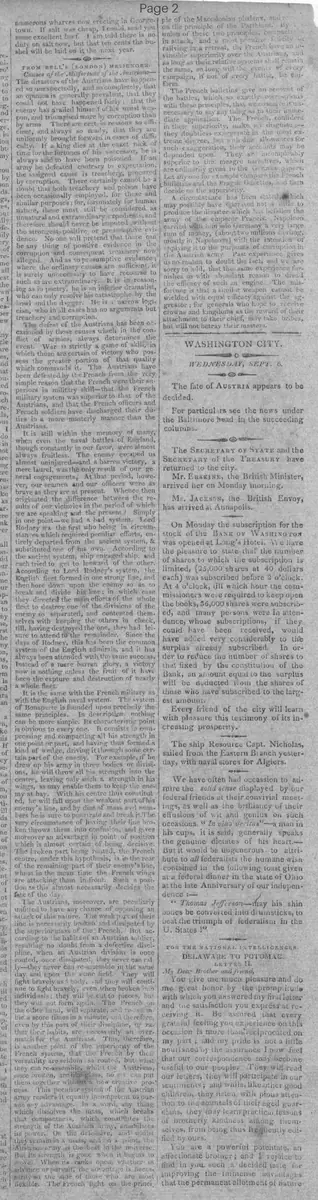
Causes of the Misfortune of the Austrians—
The disasters of the Austrians have happened so unexpectedly, and so completely, that an opinion is generally prevalent, that they could not have happened fairly; that the enemy has availed himself of his usual weapon, and triumphed more by corruption than by arms. There are certain reasons so efficient, and always so ready, that they are uniformly brought forward in cases of difficulty. If a king dies at the exact nick of time for the fortunes of his successor, he is always said to have been poisoned. If an army be defeated contrary to expectation, the assigned cause is treachery, procured by corruption. There certainly cannot be a doubt that both treachery and poison have been occasionally employed, for these and similar purposes; for, fortunately for human nature, these must still be considered as unnatural and extraordinary expedients, and therefore should never be imputed without the strongest positive or presumptive evidence. No one will pretend that there can be any thing of positive evidence in the corruption and consequent treachery now alleged. And as to presumptive evidence; where the ordinary causes are sufficient, it is surely unnecessary to have recourse to such as are extraordinary. It is in reasoning as in poetry, he is an inferior dramatist, who can only resolve his catastrophe by the bowl and the dagger. He is a narrow logician, who in all cases has no arguments but treachery and corruption.
The defeat of the Austrians has been occasioned by those causes which in the conflict of armies, always determines the event. War is strictly a game of skill, in which those are certain of victory who possess the greater portion of that quality which commands it. The Austrians have been defeated by the French from the very simple reason that the French were their superiors in military skill—that the French military system was superior to that of the Austrians, and that the French officers and French soldiers have discharged their duties in a more masterly manner than the Austrians.
It is still within the memory of many, when even the naval battles of England, though constantly in our favor, were almost always fruitless. The enemy escaped us almost uninjured—and a barren victory, a mere laurel, was the only result of our general engagements. At that period, however, our seamen and our officers were as brave as they are at present. Whence then originated the difference between the results of our victories in the period of which we are speaking and the present? Simply in one point—we had a bad system. Lord Rodney was the first who being in circumstances which required peculiar efforts, entirely departed from the ancient system, & substituted one of his own. According to the ancient system, ship engaged ship, and each tried to get to leeward of the other. According to Lord Rodney's system, the English fleet formed in one strong line, and then bore down upon the enemy so as to break and divide his line; in which case they directed the main efforts of the whole fleet to destroy one of the divisions of the enemy so separated, and contented themselves with keeping the others in check, till, having destroyed the one, they had leisure to attend to the remainder. Since the days of Rodney, this has been the common system of the English admirals, and it has always been attended with the same success. Instead of a mere barren glory, a victory now is nothing unless the fruit of it have been the capture and destruction of nearly a whole fleet.
It is the same with the French military as with the English naval system. The system of Bonaparte is founded upon precisely the same principles. In description nothing can be more simple. Its characteristic point is obvious to every one. It consists in compressing and compacting all his strength in one point or part, and having thus formed a kind of wedge, driving it through some certain part of the enemy. For example, if he drew up his army in three bodies or divisions, he will throw all his strength into the centre, leaving only such a strength in his wings, as may enable them to keep the enemy at bay. With his centre thus constituted, he will fall upon the weakest part of his enemy's line, and by dint of mass and numbers he is sure to penetrate and break it. The very circumstance of having their line broken throws them into confusion, and gives moreover an advantage in point of position which is almost certain of being decisive. The broken part being routed, the French centre, under this hypothesis, is in the rear of the remaining part of their enemy's line, whilst in the mean time the French wings are attacking them in front. Such a position as this almost necessarily decides the fate of the day.
The Austrians, moreover, are peculiarly unfitted to have any chance of opposing an attack of this nature. The weak part of their line is necessarily broken and dissipated by the superior mass of the French. But according to the habits of an Austrian soldier, resulting no doubt from a defective discipline, when an Austrian division is once routed, once dissipated, they never rally—they never can re-assemble in the same day and upon the same field. They will fight bravely as a body, and they will continue to fight bravely, even when broken into individuals; they will be cut to pieces, but they will not form again. The French on the other hand, will separate, and re-assemble a score times in a minute, and therefore, even by this part of their discipline, or rather their habits, are necessarily an over-match for the Austrians. Thus, therefore, is another point of the superiority of the French system, that the French by their versatility are seldom so routed, but what they can re-assemble, whilst the Austrians, once broken, are like glass, which cannot be put together without a new creative process. This peculiar system of the Austrian army renders it equally incompetent to pursue any advantage. In a word, any thing which dissolves the mass, which breaks that compactness, which constitutes the strength of the Austrian army, annihilates its power. On the defensive, and whilst they remain in a mass, and in a joint, the Austrian army is the best in the universe. But its strength is gone when it begins to move. When its ranks open, whether in advance or pursuit, the advantage is necessarily on the side of those who are most flexible. The French fight on the principle of the Macedonian phalanx, and in on the principle of the Parthians. By union of these two principles, compactness in attack, and almost peculiar facility in rallying in a retreat, the French have unrivalled superiority over the Austrians, and as long as their relative systems shall remain the same, so long will the events of every campaign, if not of every battle, be uniform.
The French bulletins give an account of the battles, which so exactly corresponds with these principles, that we conceive it unnecessary to say any thing as to their immediate application. The French, confident in their superiority, make no disguise; they doubtless exaggerate in the most extreme degree, but with due allowances for such exaggeration, their accounts may be depended upon. They are incomparably superior to the meagre narratives, which are ordinarily given in the German papers. Let any one for example compare the French bulletins and the Prague Gazettes, and then decide on the superiority.
A circumstance has been stated, which may possibly have operated not a little to produce the disaster which has befallen the army of the emperor Francis. Napoleon carried with him into Germany a very large sum of money, (about two millions crowns, mostly in Napoleons) with the intention of applying it to the purposes of corruption in the Austrian army. Past experience gives us no reason to doubt the fact, and we are sorry to add, that the same experience furnishes us with abundant reason to dread the efficacy of such an engine. The misfortune is that a similar weapon cannot be wielded with equal efficacy against the aggressor; for generals who hope to receive crowns and kingdoms as the reward of their attachment to their chief, may take bribes, but will not betray their masters.
What sub-type of article is it?
What keywords are associated?
What entities or persons were involved?
Where did it happen?
Foreign News Details
Primary Location
Austria
Key Persons
Outcome
austrian defeats due to french tactical superiority; possible corruption with two million crowns.
Event Details
The article analyzes Austrian military disasters against the French as resulting from inferior military systems and discipline, not primarily treachery. It describes French tactics of concentrating force to break enemy lines, Austrian inability to rally, and analogies to English naval reforms. Notes Napoleon's use of money for corruption in the Austrian army.