Thank you for visiting SNEWPapers!
Sign up free
Story
December 6, 1823
Edwardsville Spectator
Edwardsville, Madison County, Illinois
What is this article about?
George Gibbs details the impact of a wet and cold 1823 season on various grape vines at Sunswick, NY, highlighting successes of white grapes like Chasselas, American varieties such as Dorchester and Scuppernong, and European imports including Tokay and Carter, with ripening order from September to October.
Clipping
OCR Quality
95%
Excellent
Full Text
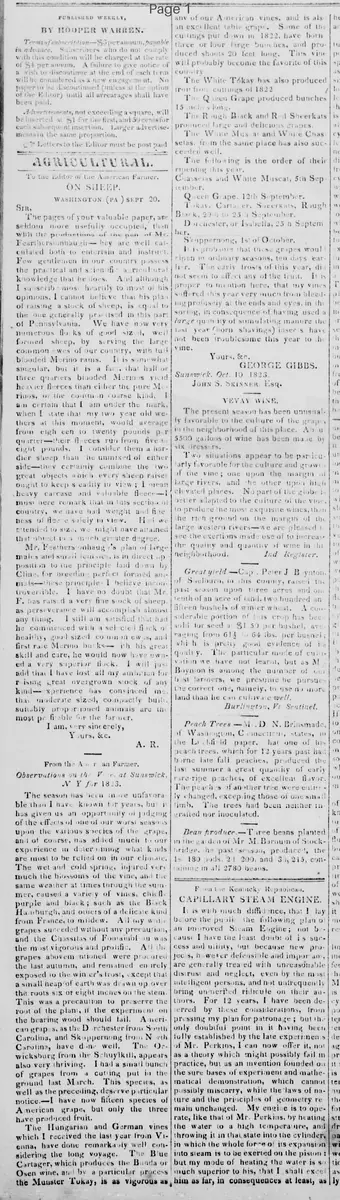
Observations on the Vines at Sunswick, N. Y. for 1823.
The season has been in some unfavorable than I have known for years, but has given us an opportunity of judging of the effects of one of our worst seasons upon the various species of the grape, and of course, has added much to our experience in determining what kinds are most to be relied on in our climate.
The wet and cold spring, injured very much the blossoms of the vine, and the same weather at times through the summer, caused a variety of vines, chiefly purple and black; such as the Black Hamburg, and others of a delicate kind from France, to mildew. All my white grapes succeeded without any precaution, and the Chasselas of Fontainebleau was the most vigorous and prolific. The grapes above mentioned were procured the last autumn, and remained entirely exposed to the winter's frost, except that a small heap of earth was drawn up over the roots six or eight inches on the stem.
This was a precaution to preserve the root of the plant, if the experiment on the bearing wood should fail. American grapes, as the Dorchester from South Carolina, and Scuppernong from North Carolina, have done well. The Catawba from the Schuylkill, appears also very thriving. I had a small bunch of grapes from a cutting put in the ground last March. This species, as well as the preceding, deserve particular notice. I have now fifteen species of American grape, but only the three have produced fruit.
The Hungarian and German vines which I received the last year from Vienna, have done remarkably well considering the long voyage. The Blue Carter, which produces the Bunda or Ozen wine, and by a particular process the Munster Tokay, is as vigorous as any of our American vines, and is also an excellent table grape. Some of the cuttings put down in 1822, have borne three or four large bunches, and produced shoots 20 feet long. This vine will probably become the favorite of this country.
The White Tokay has also produced fruit from cuttings of 1822. The Green Grape produced bunches 15 inches long. The Rough Black and Red Shederkats produced large and delicious grapes. The White Muscat and White Chasselas from the same place has also succeeded well.
The following is the order of their ripening this year.
Chasselas and White Muscat, 5th September.
Queen Grape, 12th September.
Tokay, Carter, Shederkats, Rough Black, 20th to 25th September.
Dorchester, or Isabella, 25th September.
Scuppernong, 1st of October.
It is probable that these grapes would ripen in ordinary seasons, ten days earlier. The early frosts of this year, did not seem to affect any of the fruit. It is proper to mention here, that my vines suffered this year very much from bleeding profusely at the ends and eyes, in the spring, in consequence of having used a large quantity of stimulating manure the last year (horn shavings) insects have not been troublesome this year to my vine.
Yours, &c.
GEORGE GIBBS.
Sunswick, Oct. 10, 1823.
JOHN S. SKINNER Esq.
The season has been in some unfavorable than I have known for years, but has given us an opportunity of judging of the effects of one of our worst seasons upon the various species of the grape, and of course, has added much to our experience in determining what kinds are most to be relied on in our climate.
The wet and cold spring, injured very much the blossoms of the vine, and the same weather at times through the summer, caused a variety of vines, chiefly purple and black; such as the Black Hamburg, and others of a delicate kind from France, to mildew. All my white grapes succeeded without any precaution, and the Chasselas of Fontainebleau was the most vigorous and prolific. The grapes above mentioned were procured the last autumn, and remained entirely exposed to the winter's frost, except that a small heap of earth was drawn up over the roots six or eight inches on the stem.
This was a precaution to preserve the root of the plant, if the experiment on the bearing wood should fail. American grapes, as the Dorchester from South Carolina, and Scuppernong from North Carolina, have done well. The Catawba from the Schuylkill, appears also very thriving. I had a small bunch of grapes from a cutting put in the ground last March. This species, as well as the preceding, deserve particular notice. I have now fifteen species of American grape, but only the three have produced fruit.
The Hungarian and German vines which I received the last year from Vienna, have done remarkably well considering the long voyage. The Blue Carter, which produces the Bunda or Ozen wine, and by a particular process the Munster Tokay, is as vigorous as any of our American vines, and is also an excellent table grape. Some of the cuttings put down in 1822, have borne three or four large bunches, and produced shoots 20 feet long. This vine will probably become the favorite of this country.
The White Tokay has also produced fruit from cuttings of 1822. The Green Grape produced bunches 15 inches long. The Rough Black and Red Shederkats produced large and delicious grapes. The White Muscat and White Chasselas from the same place has also succeeded well.
The following is the order of their ripening this year.
Chasselas and White Muscat, 5th September.
Queen Grape, 12th September.
Tokay, Carter, Shederkats, Rough Black, 20th to 25th September.
Dorchester, or Isabella, 25th September.
Scuppernong, 1st of October.
It is probable that these grapes would ripen in ordinary seasons, ten days earlier. The early frosts of this year, did not seem to affect any of the fruit. It is proper to mention here, that my vines suffered this year very much from bleeding profusely at the ends and eyes, in the spring, in consequence of having used a large quantity of stimulating manure the last year (horn shavings) insects have not been troublesome this year to my vine.
Yours, &c.
GEORGE GIBBS.
Sunswick, Oct. 10, 1823.
JOHN S. SKINNER Esq.
What sub-type of article is it?
Curiosity
What themes does it cover?
Nature
What keywords are associated?
Grape Vines
Sunswick
1823 Season
Ripening Order
American Grapes
European Vines
Viticulture
What entities or persons were involved?
George Gibbs
John S. Skinner Esq.
Where did it happen?
Sunswick, N. Y.
Story Details
Key Persons
George Gibbs
John S. Skinner Esq.
Location
Sunswick, N. Y.
Event Date
1823
Story Details
Observations on grape vine performance in an unfavorable 1823 season, noting mildew on purple and black varieties, success of white and American grapes, vigorous growth of European imports like Blue Carter and Tokay, and ripening order from early September to early October.