Thank you for visiting SNEWPapers!
Sign up free
The Portland Daily Press
Portland, Cumberland County, Maine
What is this article about?
Detailed report on the opening of Portland's first Industrial Exhibition at City Hall, showcasing local manufacturing growth since the 1866 fire. Includes speeches by Hon. W.W. Thomas Jr., C.P. Kimball, and Gov. Dingley praising industrial progress, plus descriptions of exhibits and exhibitors.
Clipping
OCR Quality
Full Text
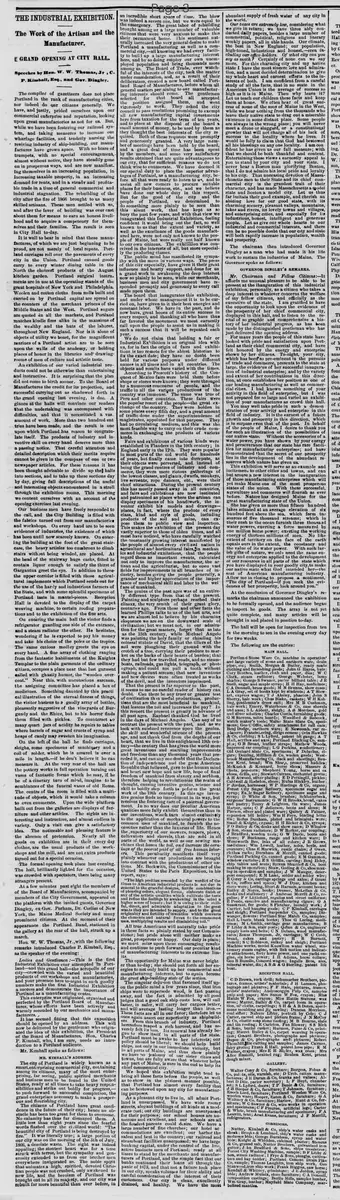
The Work of the Artisan and the Manufacturer.
THE GRAND OPENING AT CITY HALL.
Speeches by Hon. W. W. Thomas, Jr., C. P. Kimball, Esq., and Gov. Dingley.
The compiler of gazetteers does not place Portland in the rank of manufacturing cities, nor indeed do our citizens generally. We have, and justly, prided ourselves upon our commercial enterprise and reputation, looking upon great manufactories as not for us. But, while we have been fostering our railroad system, and taking measures to increase our wharfage facilities, and tenderly pursuing the reviving industry of ship-building, our manufactures have grown apace. With no blare of trumpets, with no special encouragement, almost without notice, they have steadily gone on in prosperous ways, and are now manifesting themselves in an increasing population, in increasing taxable property, in an increasing demand for rents, and in a steady and profitable trade in a time of general commercial and industrial stagnation. The rebuilding of the city after the fire of 1866 brought to us many skilled artisans. These men settled with us, and after the fever of building was over cast about them for means to earn an honest livelihood and to acquire a competency for themselves and their families. The result is seen in City Hall to-day.
It is well to bear in mind that these manufactures, of which we are just beginning to be proud, are not merely of local repute. Portland carriages roll over the pavements of every city in the Union. Portland canned goods carry to every winter dining table in the North the choicest products of the August kitchen garden. Portland surgical instruments are in use at the operating stands of the great hospitals of New York and Philadelphia. Woolen and cotton cloths from mills built and carried on by Portland capital are spread on the counters of the merchant princes of the Middle States and the West. Portland sugars are quoted in all the markets, and Portland matches kindle fires alike in the mansions of the wealthy and the huts of the laborer, throughout New England. Nor is it alone of objects of utility we boast, for the magnificent marines of a Portland artist are to be seen upon the walls of the academy, or holding places of honor in the libraries and drawing rooms of men of culture and artistic taste.
An exhibition of our varied industrial products could not be otherwise than entertaining and instructive. It is surprising that the plan did not come to birth sooner. To the Board of Manufactures the credit for its projection and successful carrying out as shadowed forth in the grand opening last evening, is due. A glance at the halls will convince our readers that the undertaking was encompassed with difficulties, and that it necessitated a vast amount of work. More than two hundred entries have been made, and the result is one upon which Portland has reason to congratulate itself. The products of industry and inventive skill on every hand deserve more than a passing notice. That careful attention and detailed description which their merits require cannot be given in the compass of one or two newspaper articles. For these reasons it has been thought advisable to divide up the halls into sections, and to take up these sections day by day, giving full descriptions of the useful and interesting objects encountered in a stroll through the exhibition rooms. This morning we content ourselves with an account of the opening exercises last evening.
Our business men have freely responded to the call, and the City Building is filled with the fabrics turned out from our manufactories and workshops. On every hand are to be seen evidences of industries, the existence of which has been until now scarcely known. On entering the building at the foot of the great staircase, the heavy articles too cumbrous to climb stairs without being winded, are placed. At the head of the stairway huge casks, fitted to contain liquor enough to satisfy the thirst of Gargantua greet the eye. In addition to these the upper corridor is filled with those agricultural implements which Portland sends out for the use of the hardy and industrious farmers of the State, and with some splendid specimens of Portland taste in mantel-pieces. Reception Hall is devoted to the display of the carpet weaving machine, to certain roofing preparations and to the exhibition of the fine arts.
On entering the main hall the visitor finds a refrigerator guarding one side of the entrance, and a steam radiator the other. He hesitates wondering if he is expected to pay his money and take his choice of the poles or the tropics. The same curious medley greets the eye on every hand. A fine array of clothing ranging from the fantastic habiliments of the Knights Templar to the plain garments of the ordinary citizen, occupies a place near that last garment called with ghastly humor, the "wooden overcoat." Near this, with unconscious sarcasm, the assigning committee has placed a box of medicines. Something daunted by this practical illustration of the eternal fitness of things, the visitor hastens to a goodly array of bottles, pleasantly suggestive of the vineyards of Burgundy and the Rhine, but to his horror finds them filled with pickles. To counteract so many quart jars of acidity he repairs to tables where barrels of sugar and cruets of syrup and heaps of candy may sweeten his imagination.
On the left of the hall he finds carriages sleighs, some specimens of machinery and a coil of solder, which he is assured is over a mile in length—if he don't believe it he can measure it. At the very rear of the hall are the pottery works in full operation turning out vases of fantastic forms which he may, if he be of a cinerary turn of mind, imagine to be semblances of the funeral vases of old Rome. The centre of the room is filled with a multitude of objects, which it would take a column to even enumerate. Upon the wide platform built out from the galleries are displays of furniture and other articles. The sights are interesting and instructive, and almost endless in variety. Only a visit can give a satisfactory idea. The noticeable and pleasing feature is the absence of pretension. Nearly all the goods on exhibition are in their every day clothes, are the usual products of the workshops and the mill, and are not extra products turned out for a special occasion.
The formal opening took place last evening. The hall, brilliantly lighted for the occasion, was crowded with spectators, there being many strangers present.
At a few minutes past eight the members of the Board of Manufactures, accompanied by members of the City Government, appeared on the platform with the invited guests, Governor Dingley, ex-Gov. Perham, Dr. Corliss of New York, the Maine Medical Society and many prominent citizens. At the moment of their appearance the Portland Band, stationed in the gallery at the rear of the hall, struck up a march.
Hon. W. W. Thomas, Jr., with the following remarks introduced Charles P. Kimball, Esq., as the speaker of the evening:
Ladies and Gentlemen:—This is the first Industrial Exhibition ever attempted in Portland—and this grand hall—the acropolis of our city—crowded with the varied and beautiful products of our workshops and manufactories, and your presence here to-night in such goodly numbers make the first Industrial Exhibition a success and demonstrate the importance of Portland as a manufacturing centre.
This enterprise was originated, organized and perfected by the Portland Board of Manufactures, whose efforts have been actively and warmly seconded by our mechanics and manufacturers.
It has seemed fitting that this exposition should be opened by an address. This will now be delivered by the gentleman who originated the idea of this exhibition, the President of the Board of Manufactures, Hon. Charles P. Kimball, who, I am sure, needs no introduction to a Portland audience.
Mr. Kimball spoke as follows:
MR. KIMBALL'S ADDRESS.
The city of Portland is widely known as a smart, enterprising commercial city, containing among its citizens many of the most enterprising, far seeing, public spirited merchants and business men to be found in the United States, ready at all times to take heavy responsibilities and strike out boldly for progress,—to push forward to successful completion the grand enterprises necessary to make a prosperous and flourishing city.
The citizens of Portland have great confidence in the future of their city; hence no obstacle has been too great for them to overcome. No calamity has thus far dismayed them. A little less than eight years since the fearful words flashed over the civilized world: "The beautiful city of Portland is being destroyed by fire." It was literally true; a large portion of our city was on the morning of the 5th of July, 1866, a desolate waste. The sight was indeed appalling; the stoutest heart was for a time struck with terror, but the sympathy and generosity extended to us from our brother men everywhere invigorated us. The noble spirit that animates a high, spirited, devoted Christian people was not crushed, only awakened to new life, and the heroism of Portland was brought out in all its majesty, and our city was rebuilt far more beautiful than ever before, in an incredible short space of time. The blow was indeed a severe one, but we were equal to the emergency brought among us a large number of valuable citizens that were very anxious to make this their permanent home. This sentiment naturally increased the very general desire to make Portland a manufacturing as well as a commercial city all knowing had every facility to build up a large manufacturing interest here, and by so doing employ our own unemployed population and bring thousands more among us. The Board of Trade, ever watchful of the interests of the city, took the matter under consideration, and, as a result of their deliberation, created a new board called Portland Board of Manufactures, before whom all general matters pertaining to our manufacturing interests should come. The gentlemen selected for that board all accepted the position assigned them, and went vigorously to work. They asked the city council to pass resolutions promising to exempt all new manufacturing capital investments here from taxation for the term of ten years, and to place at the disposal of the board a small amount of money, to be used by them as they thought the best interests of the city required. Both of these requests were promptly and generously granted. A very large number of meetings have been held by the board, and a great deal of time has been spent by the members, and some very satisfactory results obtained that are quite advantageous to our city, that for sufficient reasons we do not think wise to enumerate. We have deemed it our special duty to place the superior advantages of Portland, as a manufacturing city, before all that were ready to listen to us, and to assist all new comers to procure suitable places for their business, etc., and we believe have done our whole duty in this respect.
But for the good of the city and the people of Portland, we determined to do something more plainly to be seen than this silent work, that has kept us so busy the past few years, and with that view we inaugurated this Industrial Exhibition, feeling confident it would bring out the fact, so well known to us that the extent and variety, as well as the excellence of the goods manufactured here, were not only not known to the people of Maine, but were really not half known to our own citizens. The exhibition was conceived in the interests of all, but more especially the producing classes.
The public mind has manifested its sympathy with the move in various ways. The press of this city especially, have given it their great influence and hearty support, and done for us a grand work in awakening the deep interest now so plainly to be seen, while our merchants, business men and city government have responded promptly and generously to every call made upon them.
The board that inaugurates this exhibition and under whose management it is to be carried on, have given to it their best energies and constant labor. We have in the past, and do now have, great hopes of its entire success in every respect, and thanking all who have thus far favored the movement we most earnestly call upon the people to assist us in making it such a success that it will be repeated each year.
We do not claim that holding a fair or Industrial Exhibition is an original idea with us, for in fact the origin of fairs and exhibitions is too remote for the ablest historian to fix the exact date; they have no doubt been held for various purposes under different names in all times and in all countries. The objects and results have varied with the times. According to Prescott's history of the Conquest of Mexico fairs were held there before shops or stores were known; they were thronged by a numerous concourse of people, and the traffic in all the various productions of the country was immense. The same was true of Peru and other countries. These fairs were the popular resort of the people—the great exchange of the country. They were holden in some places every fifth day, and a great amount of traffic done under the superintendence of magistrates, appointed for that purpose. They had no circulating medium, and this was the most feasible way to carry on their crude commerce in exchanging the products of various kinds.
Fairs and exhibitions of various kinds were established in Flanders in the 10th century; in England early in the 12th. They were popular in most parts of the old world for hundreds of years, but finally came into disrepute, as their objects were perverted, and instead of being the grand centres of industry and commerce, they were mere riotous gatherings of the lowest classes, and giants, dwarfs, monkeys, live serpents, rope dancers, etc., were their chief attractions. During the present century this has mostly passed away in all countries and fairs and exhibitions are now instituted and patronized as places where the artisan can display specimens of his handiwork, the inventor exhibit his models and drawings—places, in fact, where the produce of every class, kind and style of goods, including products of the soil and mine, can expose them to public view and inspection.
This makes the exhibition of the present day vastly superior to those of olden times, and all must have noticed, who have carefully watched the constantly growing interest manifested by the people of almost every civilized nation in agricultural and horticultural fairs, in mechanics and industrial exhibitions, that the people regard them as important events, calculated not only to improve the manufacturer, the artisan and the agriculturist, but to open vast fields for improvements in all branches of industry, besides giving the people generally, a grander and higher appreciation of the importance of mechanical skill and labor to the welfare of mankind.
The genius of the past ages was of an entirely different type from that of the present. Painting and sculpture perhaps reached their climax, the very zenith of their great glory centuries ago. From these and other facts the learned Phillips talks to us of the lost arts, and we are almost led to believe by his charming eloquence we are on the downward scale of civilization: but we must not, in our admiration for the great masters, forget that as late as the 15th century, while Michael Angelo was painting the holy family or chiseling his colossal statute of David, that the tillers of the soil were ploughing their ground with the crotch of a tree, carrying their produce to market on the backs of their beasts of burden; that they had but few travelled roads, and no steamboats, railroads, gas lights, telegraph, or photograph, and could not pull a tooth without making a patient scream; that new inventions and new devices were often treated as works of the devil, and the inventors imprisoned.
That the present is far superior to the past, it seems to me no careful reader of history can doubt. Can there be any truer or greater test of civilization than in useful productions, productions that are the most beneficial to mankind, that lessens the toil and increases the pay? In this respect the present is greatly in advance of all past ages, Raphael thanked God he lived in the days of Michael Angelo. Can any of us contrast the present with the past, and as we look with subdued reverence upon the genius, the skill and wonderful science of the present age, and not thank God from the depths of our heart, that we live in this enlightened 19th century—the century that has given the world more great inventions and startling improvements and freedom than any thousand years that preceded it, and can any one doubt that the Declaration of Independence and the great American Republic that followed, gave to the human mind and heart new hope and new life, hope of final freedom of mankind from slavery and serfdom, therefore helping to revolutionize the realm of thought, causing inventive genius, science and skill to boldly step forth to perform the great work of the 19th century. In this age inventive genius finds no impediment in its way, but receives the fostering care of a paternal government. In no way does our peculiar American qualities more fully exhibit themselves than in our inventions, which turn almost exclusively to the application of mechanical powers to the commonest uses of mankind, to furnish the necessities rather than the luxuries of life. Hence the superiority of our mowers, reapers, plows, cultivators and shovels, that are sold in all parts of the world, as well as our sewing machines that lessen the toil and increase the earnings of the poorest paid of all free human laborers.
This peculiarity manifests itself very plainly whenever our productions are brought into contrast with the productions of other nations. Mr. Beckwith, the Commissioner of the United States to the Paris Exposition, in his report, says:
"The high position conceded by the verdict of the times to American industrial products is not due in general to the graceful designs, fertile combinations of pleasing colors, elegant forms, elaborate finish or any of the artistic qualities which cultivate the taste and refine the feelings by awakening in the mind a higher sense of beauty; but it is owing to their skillful, direct, and admirable adaptation to the great wants they are intended to supply, and to the great originality and fertility of invention which converts the elements and natural forces to the commonest uses, multiplying results and diminishing toil."
All true Americans will naturally take pride in these facts so plainly stated by our Commissioner; but pride alone will neither make us great, prosperous or happy. Our duty is plain; we must seize upon these encouraging results and continue to push forward our peculiar kind of manufacturing interests to its extreme limits.
The opportunity for Maine was never brighter than to-day; she should put forth all her energies to not only build up her commercial and manufacturing interests, but to again become the great ship-building state of the nation. The singular delusion that fastened itself upon the public mind a few years since, that iron ships were to supersede wood, is fast passing away, and the fact is admitted by all good judges that a good oak ship costs less, will sail faster, is safer, will carry her cargoes better, and will average lasting longer than iron.—These facts are all in our favor; therefore let us once again assert our superiority as shipbuilders. From this branch of industry, Portland heretofore reaped rich harvest and has severely felt its loss. Its renewal has already begun Portland show must itself be awake in all parts to her interests of the state our policy should be liberal; we should help build ships, not only in our immediate vicinity, but in all parts of Maine, and thus show plainly we have no jealousy of our sister cities and towns, but are fully aware that whatever helps any part of Maine, is sure in the end to help its chief commercial city.
We hoped this exhibition might tend to bring all these facts before the people, as well as to show in the plainest manner possible, that Portland has almost every facility that can be bestowed upon any city for manufacturing purposes.
As a pleasant city to live in, all admit Portland is unsurpassed. We have wide roomy streets, elegant buildings of all kinds at a moderate cost; our city buildings are unsurpassed for their purposes; our school houses are numerous and excellent, and our schools are all the fondest parents could desire. We have a large number of fine churches; our hotel accommodations are excellent; our harbor the safest and best in the country; our railroad and steamboat facilities unsurpassed; we have large banking capital, under the control of the live, active business men of Portland; ready at all times to stand by the merchants and manufacturers of Portland, and the simple fact that our banks continued their loans all through the panic of 1873, and that not a failure took place in our city, speaks volumes for their ability and careful consideration of the interest of their customers. Our city is clean, excellently drained, and healthy.
We have the most abundant supply of fresh water of any city in the world, Our taxes are extremely low, considering what we give in return; we have three ably conducted daily papers, besides a large number of commercial, political, religious and literary weekly papers, all in able hands. Our climate, the best in New England; our population, high-toned, industrious and honest,—even including our office-holders. Of what city can you say as much? Certainly of none can we say more, For this charming city and my native state I have the most sincere love and admiration, and a most decided determination to give my whole heart and earnest efforts to the interests of both. I am confident from a careful study of all the facts, that in no state in the American Union is the average of success so high as it is in Maine. Then why leave it? Let us teach our children these facts and keep them at home. We often hear of great success of some of the sons of Maine in the West, while we hear nothing from the thousands who leave their native state to drag out a miserable existence in some distant place. Some people are always in the wrong place; you will never meet a drone or sluggard, or a constitutional growler that will not charge all of his lack of success to the locality where he lives. It would be folly to claim that God had bestowed all his blessings on any one locality. I am confident he has given us our full measure; with that we should be both thankful and content.
Entertaining these views I earnestly appeal to you to stand by your city and your state. I never hear a Boston man glorifying Boston, that I do not admire his local pride and loyalty to his city. That unceasing devotion of Massachusetts men to their State and its chief commercial city is the grandest trait of their character, and has made Massachusetts a model state and Boston a model city. Let us thus far imitate their good example, and cherish an abiding love for our good state, with its charming scenery, pleasant valleys, mountains, lakes and rivers, its lovely towns and villages, and enterprising cities, and especially for its industrious, honest, intelligent and generous people, Let us give our whole hearts to our industrial and commercial interests, and there can be no possible doubt that our city and state will both rapidly increase in population, wealth and prosperity.
The chairman then introduced Governor Dingley as a man who had made it his life work to sustain the industries of Maine, The Governor spoke as follows:
GOVERNOR DINGLEY'S REMARKS
Mr. Chairman and Fellow Citizens: It affords me unusual pleasure to be able to be present at the inauguration of this industrial exhibition, personally, as a citizen who takes a deep interest in whatever concerns the welfare of my fellow citizens, and officially as the executive of the state. I am gratified to have the opportunity to look upon the evidences of the prosperity of her chief commercial city, displayed in this hall, and to listen to the recital of so graphic and comprehensive a history of her industrial progress, as has been made by the distinguished gentleman who has just delivered the opening address
For many years the people of this state have looked with pride and satisfaction upon Portland as their chief commercial city, and have felt honored by the energy and enterprise shown by her citizens. To-night, your city, which has been so pre-eminent in the pursuits of trade and commerce, presents to the state at large, the evidences of her successful inauguration of industrial enterprise; and by the variety and extent of her contributions in this direction, at once establishes her position as one of our leading manufacturing as well as commercial cities. I had known something of your activity in this field of enterprise, but I was not prepared for so large and varied an exhibition of your manufactures as crowd this hall
You may well take pride in such a demonstration of your activity and enterprise in this field of industry. It is the earnest of a future growth and prosperity in this direction, which is to surpass even that of the past. In behalf of the people of Maine, I desire to thank you for such an illustration of the possibilities of our native state. Without the accessories of a water power, you have shown by your energy and perseverance that our state has rare facilities for manufacturing enterprises; and have demonstrated that the secret of our prosperity lies in the development of the abundant resources which nature has given us.
This exhibition will serve as an example and incitement to other cities and towns, and can but arouse a new interest in the inauguration of those manufacturing enterprises which will yet make Maine one of the most prosperous states of the union. With these successful manufacturing interests agriculture and commerce will flourish as ever before. Nature has designed Maine for the great manufacturing state of the Union. She has given us more than fifteen hundred lakes situated at an average elevation of six hundred feet above the sea, which form the sources of five thousand streams: which in their rush to the ocean furnish three thousand water powers, exerting a force measured by one million horse power; exerting the working energy of thirteen millions of men. No like extent of territory on the face of the earth equals ours in the extent, the constancy and the value of its water power.
With such lavish gifts of nature, we only need the same energy and enterprise applied to the development of our resources in all parts of the state which you have displayed in your goodly city, to make our native state what God intended her—the seat of American manufacturing industry.
Allow me in closing to propose a sentiment,
"The city of Portland—if you seek the evidences of her prosperity, look around you."
At the conclusion of Governor Dingley's remarks the chairman announced the exhibition to be formally opened, and the audience began to inspect the goods. The array is not yet quite complete, and many articles will be brought in and placed in position to-day. The hall will be open for inspection from ten in the morning to ten in the evening every day for two weeks.
The following are the entries:
MAIN HALL
Portland Stone Ware Co. machine in operation and large variety of stone and earthen ware, drain pipes, etc; Smith, Morgan & Butler, ready made clothing and furnishing goods; John G Hayes, hats; Cary Brothers, leather, cloth and paper, dies; W C Clark, steam radiator; George Webster, lamp shades; George S Swazey, parlor billiard table; J E Snell, sugar and maple syrup; H H Hay, medicines; C A Donnell, brass goods; M N Bruns, show cases L A Gray, set of books kept by students; A T Stewart, express wagon; T J Akeley, phaeton; John S Sherry, hair work; Chas Blake, caskets; W H Kolling, gentleman's dress suit; Mrs M B Cushman, hair work; Emery, Waterhouse & Co, case shovels and axes; S L Abbott, sleigh; A B Morrison, gold and silver solution; Charles Custis, furnishing goods; G M Stevens, mitre boards; Woodford & Babcock watch maker's tools; Maine State Slate Co, specimens; Geo C Offin, safety attachment for rail cars; Benj Dodge, earthen ware; E Newcomb, car replacers; Francis Loring, dirigo cement; Orin Hawkes & Co, clothing; S L Lyford, patent bit gauge; A T Hall, scythes and axes; Portland Blacking Co, samples; G B Broad, leather straps; Mathew Woods, improved car coupling; L G Perkins, confectionery; Old Orchard Slate Co, specimens; F Delavina, cigars; Deering, Milliken & Co, woolen goods; Westbrook Manufacturing Co, duck and sheetings; Reuben Kent, bread; Wm Sharp, preserved haddies; McKusick & Kennard, horse shoes; Massure Ojeda, pop-corn; Shepherd Young, horse and ox shoes, drills, etc; Stewart Cairnes, enchanted grotto; A H Atwood, silver plating; E D Pettingill, pickles Caldwell & Hodsdon, shoes; Rufus Hinkley, leather P Jordan, harnesses; W P Hastings & Co, organs Forest City Sugar Refinery, specimens sugar and syrup; Eagle Sugar Refinery, specimens sugar and syrup; D White & Son, brushes; Schlotterbeck surgeons'instruments; G W H Brooks, bread, cakes and pastry; Tenny & Leighton, tin ware; James Harper, jasts; C F Jellerson, boots and shoes; M Pierson, silver and plated ware; Quincy & Palmer, expansion bill holder; Wm H Foye, binding letter file; Rufus Dunham, plated and britannia ware; Small & Knight, organs; H H Ricker & Co, syrups; F O Bailey & Co, desks and show cases; D Winslow & Son, steam radiators; D W Barker, car coupling; J Bradford, wooden tools; G W Davie, boots and shoes; F Bucknam, range and kitchen ware; D Wentworth Bro. inks of all colors; J R Grows medicines; Wm Lowell, leather, soles, heels, and counters; Chas E Marwick, rustic chairs; J Owen clothes racks; Burnham & Merrill, canned goods; Portland Packing Co. canned goods; E M Gammon, window curtains; E S Griffin, carving; Benj Ilsley, ship tables and seats; Sylvan Shurtleft & Co, boot making in operation; Shaw, Goding & Co, shoe making in operation and samples; J W Munger, detergent compound; E M Land, solder and solder wire; E Corey & Co, carriage springs and axles; J Grant & Co, coffees and spices; W J Dyer, kitchen and stove ware; Loring, Short & Harmon, account books; Bailey & Noyes, books; Dresser, McLellan & Co, books and stationery; J Ambrose Merrill & Co, regalias; F Littlefield, regalias and street uniforms; E Ponce, samples and manufacturing cigars; G A Susskraut, fur goods; S Fletcher, laundry work; J Currier, bell hanging goods; C P Kimball, carriages and sleigh; Portland Suspender Co, samples; Dirwanger, flowers; Portland Star Match Co, samples; Hall L Davis, blank books; Thos G Loring, medicines; M L Smith, carriage gear manufactures; B F Libby & Son, stair posts; Quinn & Co, engineers supply tools and belts; C N Delano, wood manufactures; Zenas Thompson, Jr, carriages; W C Cobb, bread, cakes and pastry; H R Burnett, stencil; S C Robinson, sulkey and sleigh; Portland Machine works, model Knowlton water wheel, stationary steam engine, with link motion and indicator attachment, forty horse power, and one yacht engine, six horse power; I H Adams, horse collars; Geo B Buzelle, Concord wagon; Ingalls Bros, ales, mineral water, &c; A S & A G Sterling, patent life boat.
RECEPTION HALL.
C D Brown, rock drill; Schumacher Brothers, pictures, frames, artists' materials; J H Lamson, photograph and pictures; F F Hale, pictures, frames, artists' materials; Androscoggin Pulp Co, samples pulp and paper; Mrs Susan W Fox, crayon; Miss Hattie W Fox, crayon; Miss Hattie Stevens, wax cross; Marret, Bailey & Co, carpet loom in operation, oil cloths, carpetings; S H & A R Doten, specimens moulding and jig sawing; Duncan Morrison, coal sifter; Nahum Libby, portrait by Cole; C J Carter, carved ship and picture frame; J N McCoy & Co, elastic soap stone roofing; M B Bourne, slate and tin roofing; E Carleton, Fan Blower; S S Rich & Sons, burial casket; Harmon, Paine & Co, printing; Marret Bailey & Co, carpet weaving in operation; Conant Brothers, photographs and pictures; Dupee & Co, photographs and pictures; Robert Thomhill, file cutting and samples; James Cairnes, fairy grotto; Frank E Hall, patent hose pipe; E M Haines, crayon; Mrs E H Ripley, wax cross; Mrs Alice Haskell, braided rug; Reuben Kent, patent dough mixer.
GALLERY.
Walter Cony & Co, furniture; Burgess, Fobus & Co, paints, oils, varnish, etc; D Urch, rattan manufactures; J R Duran & Co, trunks and valises; Albert D Dix, parlor secretary; L F Hoyt, chamber set; S L Lyford, doors; T P Beale & Co, furniture; Hooper furniture Johnson furniture; Enoch Lord, furniture; Portland Wooden Ware Co, wooden ware; Hooper, Eaton & Co, furniture; G A Whitney Co furniture Harlow niture; W C Sawyer & Co, wire works in operation and specimens Pingree artificial legs Carter & White, brush manufacturing and specimens; F A Leavitt, tent; Arad Evans, furniture; J F Merrill, refrigerators.
CORRIDORS.
Nutter, Kimball & Co, ship's water casks and shook; Brooks & Lombard, ship's water casks and molasses bbls; George Burnham, syrup and water bbls; Knight & Whidden, calcined plaster; Stevens ground salt Nutter Brothers galvanized iron gutter; John Bradford & Sons, ships tressletree; Forest City Washing Machine, sample; B F Libby & Son, steam radiator; I Frye & Sons, ploughs, cultivators and hay tedder; Portland Cement Drain Pipe Co, sample; Thomas Laughlin, iron ship work, Geo Stanwood, iron ship work; Frank Higgins, saw horse; Kendall & Whitney, grindstone; J E Jordan, syrup bbls; Andrew Mulnix, store furniture; C A Donnell, composition castings; Berlin Mills, samples lumber, Wm Gray, leather; Mayfield Slate Company, marbelized mantles.
What sub-type of article is it?
What themes does it cover?
What keywords are associated?
What entities or persons were involved?
Where did it happen?
Story Details
Key Persons
Location
Portland, City Hall
Event Date
Last Evening, Circa 1874
Story Details
Portland's first Industrial Exhibition opens at City Hall, showcasing over 200 local manufacturing products and demonstrating post-1866 fire industrial growth. Speeches by Thomas, Kimball, and Dingley highlight city's commercial to manufacturing transition, historical context of fairs, and Maine's potential.