Thank you for visiting SNEWPapers!
Sign up free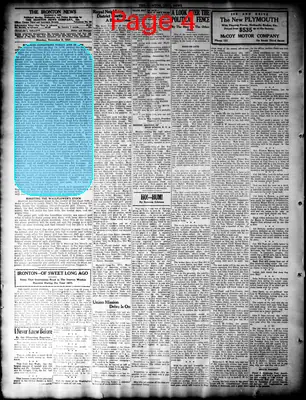
Story
November 9, 1931
The Ironton News
Ironton, Lawrence County, Ohio
What is this article about?
The Ironton Register reprints a 1876 Ohio State Journal editorial attributing post-Civil War business depression to excessive debt from war stimulus and expanded currency. It criticizes demagogues for blaming currency scarcity, praises self-reliant debt liquidation, and urges honest production for recovery, deeming the advice still relevant today.
Clipping
OCR Quality
98%
Excellent
Full Text
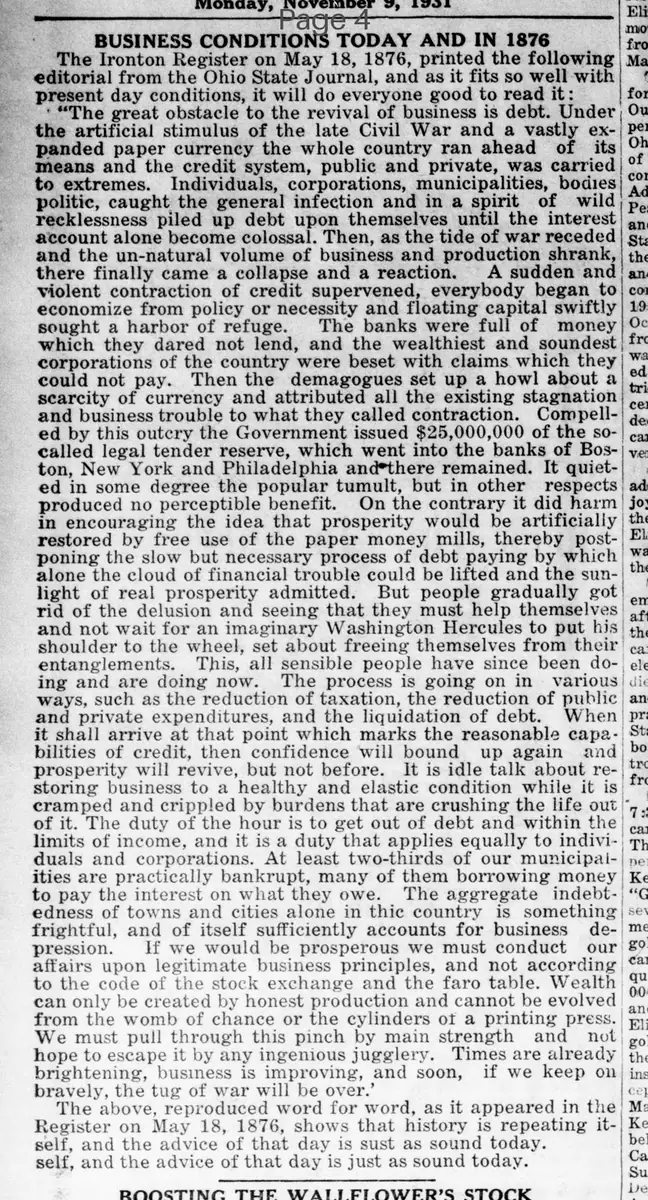
BUSINESS CONDITIONS TODAY AND IN 1876
The Ironton Register on May 18, 1876, printed the following editorial from the Ohio State Journal, and as it fits so well with present day conditions, it will do everyone good to read it:
"The great obstacle to the revival of business is debt. Under the artificial stimulus of the late Civil War and a vastly expanded paper currency the whole country ran ahead of its means and the credit system, public and private, was carried to extremes. Individuals, corporations, municipalities, bodies politic, caught the general infection and in a spirit of wild recklessness piled up debt upon themselves until the interest account alone become colossal. Then, as the tide of war receded and the un-natural volume of business and production shrank, there finally came a collapse and a reaction. A sudden and violent contraction of credit supervened, everybody began to economize from policy or necessity and floating capital swiftly sought a harbor of refuge.
The banks were full of money which they dared not lend, and the wealthiest and soundest corporations of the country were beset with claims which they could not pay. Then the demagogues set up a howl about a scarcity of currency and attributed all the existing stagnation and business trouble to what they called contraction. Compelled by this outcry the Government issued $25,000,000 of the so-called legal tender reserve, which went into the banks of Boston, New York and Philadelphia and there remained. It quieted in some degree the popular tumult, but in other respects produced no perceptible benefit. On the contrary it did harm in encouraging the idea that prosperity would be artificially restored by free use of the paper money mills, thereby postponing the slow but necessary process of debt paying by which alone the cloud of financial trouble could be lifted and the sunlight of real prosperity admitted. But people gradually got rid of the delusion and seeing that they must help themselves and not wait for an imaginary Washington Hercules to put his shoulder to the wheel, set about freeing themselves from their entanglements. This, all sensible people have since been doing and are doing now. The process is going on in various ways, such as the reduction of taxation, the reduction of public and private expenditures, and the liquidation of debt. When it shall arrive at that point which marks the reasonable capabilities of credit, then confidence will bound up again and prosperity will revive, but not before. It is idle talk about restoring business to a healthy and elastic condition while it is cramped and crippled by burdens that are crushing the life out of it. The duty of the hour is to get out of debt and within the limits of income, and it is a duty that applies equally to individuals and corporations. At least two-thirds of our municipalities are practically bankrupt, many of them borrowing money to pay the interest on what they owe. The aggregate indebtedness of towns and cities alone in this country is something frightful, and of itself sufficiently accounts for business depression.
If we would be prosperous we must conduct our affairs upon legitimate business principles, and not according to the code of the stock exchange and the faro table. Wealth can only be created by honest production and cannot be evolved from the womb of chance or the cylinders of a printing press. We must pull through this pinch by main strength and not hope to escape it by any ingenious jugglery. Times are already brightening, business is improving, and soon, if we keep on bravely, the tug of war will be over."
The above, reproduced word for word, as it appeared in the Register on May 18, 1876, shows that history is repeating itself, and the advice of that day is just as sound today.
The Ironton Register on May 18, 1876, printed the following editorial from the Ohio State Journal, and as it fits so well with present day conditions, it will do everyone good to read it:
"The great obstacle to the revival of business is debt. Under the artificial stimulus of the late Civil War and a vastly expanded paper currency the whole country ran ahead of its means and the credit system, public and private, was carried to extremes. Individuals, corporations, municipalities, bodies politic, caught the general infection and in a spirit of wild recklessness piled up debt upon themselves until the interest account alone become colossal. Then, as the tide of war receded and the un-natural volume of business and production shrank, there finally came a collapse and a reaction. A sudden and violent contraction of credit supervened, everybody began to economize from policy or necessity and floating capital swiftly sought a harbor of refuge.
The banks were full of money which they dared not lend, and the wealthiest and soundest corporations of the country were beset with claims which they could not pay. Then the demagogues set up a howl about a scarcity of currency and attributed all the existing stagnation and business trouble to what they called contraction. Compelled by this outcry the Government issued $25,000,000 of the so-called legal tender reserve, which went into the banks of Boston, New York and Philadelphia and there remained. It quieted in some degree the popular tumult, but in other respects produced no perceptible benefit. On the contrary it did harm in encouraging the idea that prosperity would be artificially restored by free use of the paper money mills, thereby postponing the slow but necessary process of debt paying by which alone the cloud of financial trouble could be lifted and the sunlight of real prosperity admitted. But people gradually got rid of the delusion and seeing that they must help themselves and not wait for an imaginary Washington Hercules to put his shoulder to the wheel, set about freeing themselves from their entanglements. This, all sensible people have since been doing and are doing now. The process is going on in various ways, such as the reduction of taxation, the reduction of public and private expenditures, and the liquidation of debt. When it shall arrive at that point which marks the reasonable capabilities of credit, then confidence will bound up again and prosperity will revive, but not before. It is idle talk about restoring business to a healthy and elastic condition while it is cramped and crippled by burdens that are crushing the life out of it. The duty of the hour is to get out of debt and within the limits of income, and it is a duty that applies equally to individuals and corporations. At least two-thirds of our municipalities are practically bankrupt, many of them borrowing money to pay the interest on what they owe. The aggregate indebtedness of towns and cities alone in this country is something frightful, and of itself sufficiently accounts for business depression.
If we would be prosperous we must conduct our affairs upon legitimate business principles, and not according to the code of the stock exchange and the faro table. Wealth can only be created by honest production and cannot be evolved from the womb of chance or the cylinders of a printing press. We must pull through this pinch by main strength and not hope to escape it by any ingenious jugglery. Times are already brightening, business is improving, and soon, if we keep on bravely, the tug of war will be over."
The above, reproduced word for word, as it appeared in the Register on May 18, 1876, shows that history is repeating itself, and the advice of that day is just as sound today.
What sub-type of article is it?
Historical Event
Curiosity
What themes does it cover?
Misfortune
Moral Virtue
Triumph
What keywords are associated?
Business Depression
Debt Crisis
Civil War Economy
Currency Contraction
Economic Recovery
Municipal Bankruptcy
Honest Production
Where did it happen?
United States
Story Details
Location
United States
Event Date
1876 05 18
Story Details
Post-Civil War debt accumulation leads to business collapse; government currency issuance fails to help; recovery requires debt liquidation, reduced spending, and honest production principles.