Thank you for visiting SNEWPapers!
Sign up free
Washington Standard
Olympia, Thurston County, Washington
What is this article about?
In South Carolina, three full-blooded negroes and one mulatto were elected to Congress, with negroes dominating politics and sidelining carpet-baggers. A legislative session featured bribery and corruption during a judge's election, involving figures like R. B. Elliott and De Large. The legislature increased state debt, sold privileges, and enforced equality measures.
Clipping
OCR Quality
Full Text
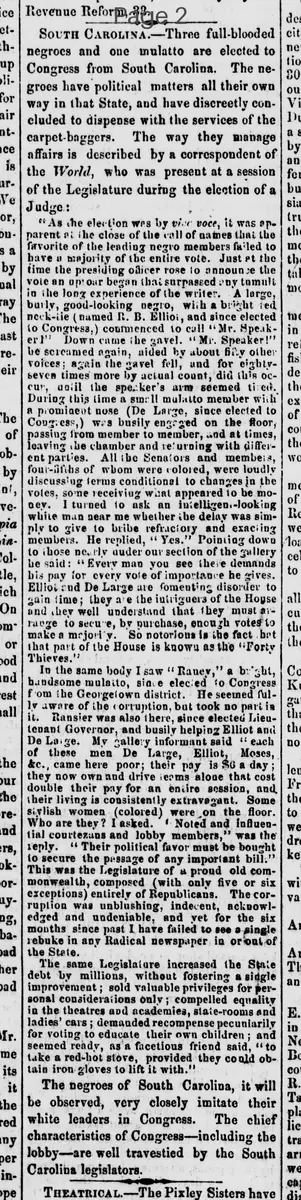
As the election was by viva voce, it was apparent at the close of the call of names that the favorite of the leading negro members failed to have a majority of the entire vote. Just at the time the presiding officer rose to announce the vote an uproar began that surpassed any tumult in the long experience of the writer. A large, burly, good-looking negro, with a bright red neck-tie (named R. B. Elliott, and since elected to Congress,) commenced to call "Mr. Speaker!" Down came the gavel. "Mr. Speaker!" he screamed again, aided by about five other voices; again the gavel fell, and for eighty-seven times more by actual count, did this occur, until the speaker's arm seemed tired. During this time a small mulatto member with a prominent nose (De Large, since elected to Congress,) was busily engaged on the floor, passing from member to member, and at times, leaving the chamber and returning with different parties. All the Senators and members four-fifths of whom were colored, were loudly discussing terms conditional to changes in the votes, some receiving what appeared to be money. I turned to ask an intelligent-looking white man near me whether the delay was simply to give time to bribe refractory and exacting members. He replied, "Yes." Pointing down to those nearly under our section of the gallery he said: "Every man you see there demands his pay for every vote of importance he gives. Elliot and De Large are fomenting disorder to gain time; they are the intriguers of the House and they well understand that they must arrange to secure, by purchase, enough votes to make a majority. So notorious is the fact, that part of the House is known as the "Forty Thieves."
In the same body I saw "Raney," a bright, handsome mulatto, since elected to Congress from the Georgetown district. He seemed fully aware of the corruption, but took no part in it. Ransier was also there, since elected Lieutenant Governor, and busily helping Elliot and De Large. My gallery informant said "each of these men De Large, Elliot, Moses, &c., came here poor; their pay is $6 a day; they now own and drive teams alone that cost double their pay for an entire session, and their living is consistently extravagant. Some stylish women (colored) were on the floor. Who are they? I asked. 'Noted and influential courtezans and lobby members,' was the reply. 'Their political favor must be bought to secure the passage of any important bill.' This was the Legislature of a proud old commonwealth, composed (with only five or six exceptions) entirely of Republicans. The corruption was unblushing, indecent, acknowledged and undeniable, and yet for the six months since past I have failed to see a single rebuke in any Radical newspaper in or out of the State.
The same Legislature increased the State debt by millions, without fostering a single improvement; sold valuable privileges for personal considerations only; compelled equality in the theatres and academies, state-rooms and ladies' cars; demanded recompense pecuniarily for voting to educate their own children; and seemed ready, as a facetious friend said, "to take a red-hot stove, provided they could obtain iron gloves to lift it with."
The negroes of South Carolina, it will be observed, very closely imitate their white leaders in Congress. The chief characteristics of Congress—including the lobby—are well travestied by the South Carolina legislators.
What sub-type of article is it?
What keywords are associated?
What entities or persons were involved?
Where did it happen?
Domestic News Details
Primary Location
South Carolina
Key Persons
Outcome
three full-blooded negroes and one mulatto elected to congress; increased state debt by millions; sold privileges for personal gain; enforced equality in public facilities; widespread bribery and corruption in legislature.
Event Details
Negroes dominate South Carolina politics, electing three full-blooded negroes and one mulatto to Congress, dispensing with carpet-baggers. During a legislative session for electing a judge, uproar and bribery occurred, with R. B. Elliott and De Large fomenting disorder to buy votes. The legislature, mostly colored Republicans, engaged in unblushing corruption, imitating Congress.