Thank you for visiting SNEWPapers!
Sign up free
Editorial
November 15, 1832
Martinsburg Gazette And Public Advertiser
Martinsburg, Berkeley County, West Virginia
What is this article about?
An editorial advocating habits of economy among laborers, quoting Mr. Colchough and Mr. William Hall on how saving money improves fortunes, work ethic, morals, and societal stake, preventing reliance on parish aid. From Wilderspin's Early Discipline.
Clipping
OCR Quality
95%
Excellent
Full Text
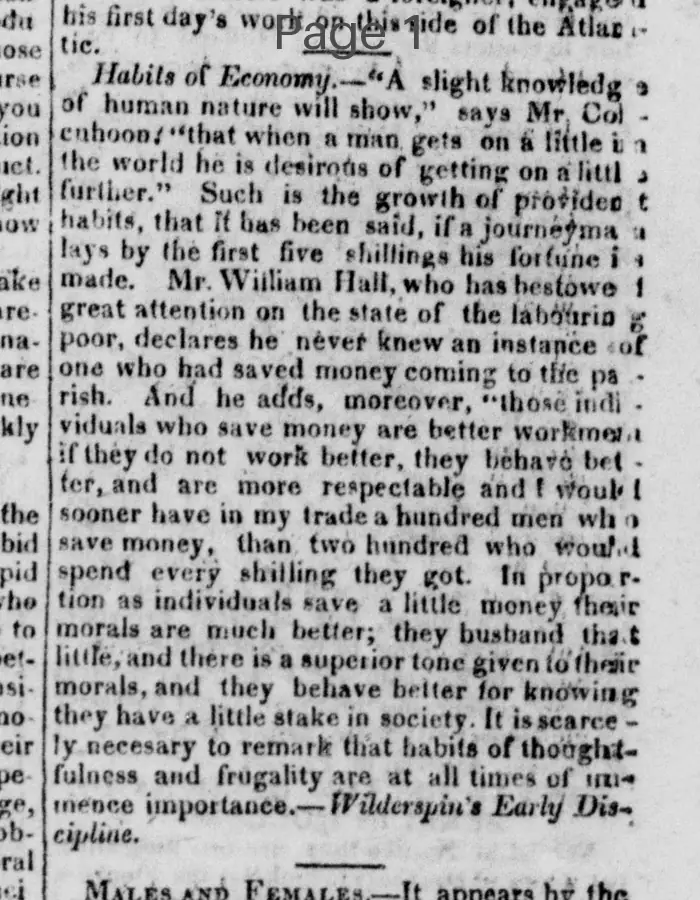
Habits of Economy.—"A slight knowledge
of human nature will show," says Mr. Colchough, "that when a man gets on a little in the world he is desirous of getting on a little
further." Such is the growth of provident
habits, that it has been said, if a journeyman
lays by the first five shillings his fortune is
made. Mr. William Hall, who has bestowed
great attention on the state of the laboring
poor, declares he never knew an instance of
one who had saved money coming to the parish. And he adds, moreover, those individuals who save money are better workmen.
If they do not work better, they behave better, and are more respectable and I would
sooner have in my trade a hundred men who
save money, than two hundred who would
spend every shilling they got. In proportion as individuals save a little money their
morals are much better; they husband that
little, and there is a superior tone given to their morals, and they behave better for knowing they have a little stake in society. It is scarcely necessary to remark that habits of thoughtfulness and frugality are at all times of immense importance.—Wilderspin's Early Discipline.
of human nature will show," says Mr. Colchough, "that when a man gets on a little in the world he is desirous of getting on a little
further." Such is the growth of provident
habits, that it has been said, if a journeyman
lays by the first five shillings his fortune is
made. Mr. William Hall, who has bestowed
great attention on the state of the laboring
poor, declares he never knew an instance of
one who had saved money coming to the parish. And he adds, moreover, those individuals who save money are better workmen.
If they do not work better, they behave better, and are more respectable and I would
sooner have in my trade a hundred men who
save money, than two hundred who would
spend every shilling they got. In proportion as individuals save a little money their
morals are much better; they husband that
little, and there is a superior tone given to their morals, and they behave better for knowing they have a little stake in society. It is scarcely necessary to remark that habits of thoughtfulness and frugality are at all times of immense importance.—Wilderspin's Early Discipline.
What sub-type of article is it?
Social Reform
Labor
Moral Or Religious
What keywords are associated?
Habits Of Economy
Saving Money
Laboring Poor
Frugality
Morals
Provident Habits
Work Ethic
What entities or persons were involved?
Mr. Colchough
Mr. William Hall
Wilderspin's Early Discipline
Editorial Details
Primary Topic
Habits Of Economy For Laborers
Stance / Tone
Advocacy For Frugality And Saving
Key Figures
Mr. Colchough
Mr. William Hall
Wilderspin's Early Discipline
Key Arguments
Desire To Advance Leads To Provident Habits
Saving First Five Shillings Makes A Journeyman's Fortune
Savers Never Become Parish Burdens
Savers Are Better Workmen Or Behave Better
Prefer 100 Savers Over 200 Spenders In Trade
Saving Improves Morals And Gives Stake In Society
Habits Of Thoughtfulness And Frugality Are Immensely Important