Thank you for visiting SNEWPapers!
Sign up free
Story
August 8, 1861
The Plymouth Weekly Democrat
Plymouth, Marshall County, Indiana
What is this article about?
Detailed account of the Union defeat at the Battle of Bull's Run on July 21, 1861, including prelude, engagements, retreat, and aftermath, criticizing Union planning and praising Confederate strategy.
Clipping
OCR Quality
95%
Excellent
Full Text
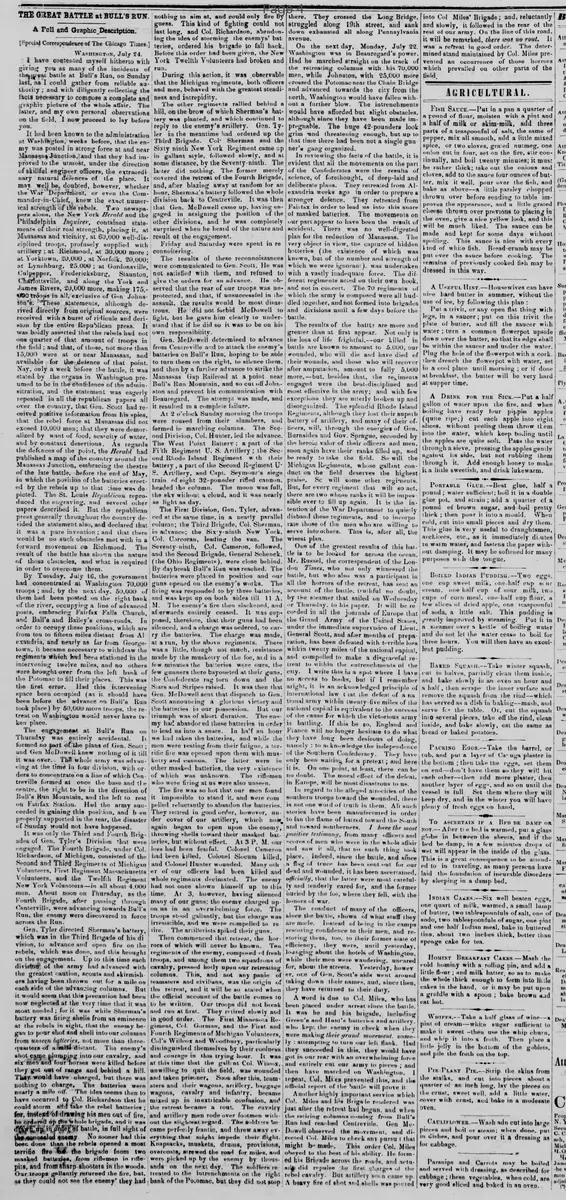
A Full and Graphic Description.
[Special Correspondence of The Chicago Times.]
WASHINGTON, July 24.
I have contented myself hitherto with giving you as many of the incidents of the great battle at Bull's Run, on Sunday last, as I could gather from reliable authority; and with diligently collecting the facts necessary to compose a complete and graphic picture of the whole affair. The latter, and my own personal observations on the field, I now proceed to lay before you.
It had been known to the administration at Washington, weeks before, that the enemy was posted in strong force at and near Manassas Junction, and that they had improved to the utmost, under the direction of skillful engineer officers, the extraordinary natural defences of the place. It may well be doubted, however, whether the War Department, or even the Commander-in-Chief, knew the exact numerical strength of the rebels. Two newspapers alone, the New York Herald and the Philadelphia Inquirer, contained statements of their real strength, placing it, at Manassas and vicinity, at 60,000 well-disciplined troops, profusely supplied with artillery; at Richmond, at 30,000 more; at Yorktown, 20,000, at Norfolk, 20,000; at Lynchburg, 25,000; at Gordonsville, Culpepper, Fredericksburg, Staunton, Charlottsville, and along the York and James Rivers, 20,000 more, making 175,000 troops in all, exclusive of Gen. Johnston's. These statements, although derived directly from original sources, were received with a burst of ridicule and derision by the entire Republican press. It was boldly asserted that the rebels had not one quarter of that amount of troops in the field; and that, of those, not more than 15,000 were at or near Manassas, and available for the defence of that point. Nay, only a week before the battle, it was stated by the organs in Washington presumed to be in the confidence of the administration, and the statement was eagerly repeated in all the republican papers all over the country, that Gen. Scott had received positive information from his spies, that the rebel force at Manassas did not exceed 10,000 men; that they were demoralized by want of food, scarcity of water, and by constant desertions. As regards the defences of the point, the Herald had published a map of the country around the Manassas Junction, embracing the theatre of the late battle, before the end of May, in which the position of the batteries erected by the rebels up to that time was depicted. The St. Louis Republican reproduced the engraving, and several other papers described it. But the republican press generally throughout the country derided the statement also, and declared that it was a pure invention; and that there would be no such obstacles met with in a forward movement on Richmond. The result of the battle has shown the nature of those obstacles, and what is required in order to overcome them.
By Tuesday, July 16, the government had concentrated at Washington 70,000 troops; and, by the next day, 50,000 of them had been posted on the right bank of the river, occupying a line of advanced posts, embracing Fairfax, Falls Church, and Ball's and Bailey's cross-roads. In order to occupy these positions, which are from ten to fifteen miles distant from Alexandria, and nearly as far from Georgetown, it became necessary to withdraw the regiments which had been stationed in the intervening twelve miles, and no others were brought over from the left bank of the Potomac to fill their places. This was the first error. Had this intervening space been occupied (as it should have been before the advance on Bull's Run took place) by 50,000 more troops, the retreat on Washington would never have taken place.
The engagement at Bull's Run on Thursday was entirely accidental. It formed no part of the plans of Gen. Scott; and Gen. McDowell knew nothing of it till it was over. The whole army was advancing at the time in four divisions, with orders to concentrate on a line of which Centreville formed at once the base and the centre, the right to be in the direction of Bull's Run Mountain, and the left to rest on Fairfax Station. Had the army succeeded in gaining this position, and been properly supported in the rear, the disaster of Sunday would not have happened.
It was only the Third and Fourth Brigades of Gen. Tyler's Division that were engaged. The Fourth Brigade, under Col. Richardson, of Michigan, consisted of the Second and Third Regiments of Michigan Volunteers, First Regiment Massachusetts Volunteers, and the Twelfth Regiment New York Volunteers—in all about 4,000 men. About noon on Thursday, as the Fourth Brigade, after passing through Centerville, were advancing towards Bull's Run, the enemy were discovered in force across the Run.
Gen. Tyler directed Sherman's battery, which was in the Third Brigade of his division, to advance and open fire on the rebels, which was done, and this brought on the engagement. Up to this time each division of the army had advanced with the greatest caution, scouts and skirmishers having been thrown out for a mile on each side of the advancing columns. But it would seem that this precaution had been now neglected at the very time that it was most needed; for it was while Sherman's battery was firing shells from an eminence at the rebels in sight, that the enemy began to pour shot and shell into our columns from unseen batteries, not more than three-quarters of a mile distant. The enemy's shot came plumping into our cavalry, and six men and four horses were killed before they got out of range and behind a hill. They would have charged, but there was nothing to charge. The batteries were nearly a mile off. The idea seems then to have occurred to Col. Richardson that he could storm and take the rebel batteries; for, instead of drawing his men out of fire, he ordered up the whole brigade, and it was drawn up in order of battle, in full sight of the concealed enemy. No sooner had this been done than the rebels opened a most terrific fire on the brigade from two masked batteries, from riflemen in rifle-pits, and from sharp-shooters in the woods. Our troops gallantly returned the fire, but, nothing to aim at, and could only fire by guess. This kind of fighting could not last long, and Col. Richardson, abandoning the idea of storming the enemy's batteries, ordered his brigade to fall back. Before this order had been given, the New York Twelfth Volunteers had broken and run.
During this action, it was observable that the Michigan regiments, both officers and men, behaved with the greatest steadiness and intrepidity. The other regiments rallied behind a hill, on the brow of which Sherman's battery was planted, and which continued to reply to the enemy's artillery. Gen. Tyler in the meantime had ordered up the Third Brigade. Col. Sherman and the Sixty-ninth New York Regiment came up in gallant style, followed slowly, and at some distance, by the Seventy-ninth. The latter did nothing. The former merely covered the retreat of the Fourth Brigade, and, after blazing away at random for an hour, Sherman's battery followed the whole division back to Centreville. It was then that Gen. McDowell came up, having engaged in assigning the position of the other divisions, and he was completely surprised when he heard of the nature and result of the engagement.
Friday and Saturday were spent in reconnoitering. The results of these reconnoissances were communicated to Gen. Scott. He was not satisfied with them, and refused to give the orders for an advance. He observed that the rear of our troops was unprotected, and that, if unsuccessful in the assault, the results would be most disastrous. He did not forbid McDowell to fight, but he gave him clearly to understand that if he did so it was to be on his own responsibility.
Gen. McDowell determined to advance from Centreville and to attack the enemy's batteries on Bull's Run, hoping to be able to turn them on the right, to silence them, and then by a further advance to strike the Manassas Gap Railroad at a point near Bull's Run Mountain, and so cut off Johnston and prevent his communication with Beauregard. The attempt was made, and it resulted in a complete failure.
At 2 o'clock Sunday morning the troops were roused from their slumbers, and formed in marching columns. The Second Division, Col. Hunter, led the advance. The West Point Battery, a part of the Fifth Regiment U. S. Artillery; the Second Rhode Island Regiment with their battery, a part of the Second Regiment U. S. Artillery, and Capt. Seymour's siege train of eight 32-pounder rifled cannon, headed the column. The moon was full, the sky without a cloud, and it was nearly as light as day.
The First Division, Gen. Tyler, advanced at the same time, in a nearly parallel column; the Third Brigade, Col. Sherman, in advance; the Sixty-ninth New York, Col. Corcoran, leading the van. The Seventy-ninth, Col. Cameron, followed, and the Second Brigade, General Schenck (the Ohio Regiments), were close behind. By daybreak Bull's Run was reached. The batteries were placed in position and our guns opened on the enemy's works. The firing was responded to by three batteries, and was kept up on both sides till 11 A. M. The enemy's fire then slackened, and afterwards entirely ceased. It was supposed, therefore, that their guns had been silenced, and a charge was ordered, to carry the batteries. The charge was made, at a run, by the above regiments. There was a little, though not much, resistance made by the musketry of the foe, and in a few minutes the batteries were ours, the few gunners there bayoneted at their guns, the Confederate rag torn down and the Stars and Stripes raised. It was then that Gen. McDowell sent that dispatch to Gen. Scott announcing a glorious victory and the batteries in our possession. But our triumph was of short duration. The enemy had abandoned these batteries in order to lead us into a snare. In half an hour we had taken the batteries, and while the men were resting from their fatigue, a terrific fire was opened upon them with musketry and cannon. The latter were in other masked batteries, the very existence of which was unknown. The riflemen who were firing at us were also unseen. The fire was so hot that our men found it impossible to stand it, and were compelled reluctantly to abandon the batteries. They retired in good order, however, under cover of our artillery, which now again began to open upon the enemy, terribly, but without effect. At 3 P. M. our loss had been fearful. Colonel Cameron had been killed, Colonel Slocum killed, and Colonel Hunter wounded. Many others of our officers had been killed and whole regiments decimated. The enemy had not once shown himself up to this time. At 3, however, having silenced many of our guns, the enemy charged upon us in an overwhelming force. The troops stood gallantly, but the charge was irresistible, and we were compelled to retire. The artillerists spiked their guns. Then commenced that retreat, the horrors of which will never be known. Ten regiments of the enemy, composed of fresh troops, and among them two squadrons of cavalry, pressed hotly upon our retreating columns. This, and not any panic of teamsters and civilians, was the origin of the retreat, and it will be so stated when the official account of the battle comes to be written. Our troops did not break and run at first. They retired slowly and in good order. The First Minnesota Regiment, Col. Gorman, and the First and Fourth Regiments of Michigan Volunteers, Col's Wilcox and Woodbury, particularly distinguished themselves by their coolness and courage in this trying hour. It was at this time that the gallant Col. Wilcox, unwilling to quit the field, was wounded and taken prisoner. Soon after this, teamsters and their wagons, artillery, baggage wagons, cavalry and infantry, became mixed up in inextricable confusion, and the retreat became a rout. The cavalry and artillery men rode over footmen without the slightest regard. The soldiers became perfectly frantic, and threw away everything that might impede their flight. Knapsacks, muskets, drums, provisions, overcoats, strewed the road for miles, and were picked up by the enemy by thousands on the next day. The soldiers retreated to the intrenchments on the right bank of the Potomac, but they did not stop there. They crossed the Long Bridge, struggled along 19th street, and sank down exhausted all along Pennsylvania avenue.
On the next day, Monday, July 22, Washington was in Beauregard's power. Had he marched straight on the track of the retreating columns with his 70,000 men, while Johnston, with 25,000 more, crossed the Potomac near the Chain Bridge and advanced towards the city from the north, Washington would have fallen without a further blow. The intrenchments would have afforded but slight obstacles, although since they have been made impregnable. The huge 42-pounders look grim and threatening enough, but up to that time there had been not a single gunner organized.
In reviewing the facts of the battle, it is evident that all the movements on the part of the Confederates were the results of science, of forethought, of deep-laid and deliberate plans. They retreated from Alexandria weeks ago in order to prepare a stronger defence. They retreated from Fairfax in order to lead us into this snare of masked batteries. The movements on our part appear to have been the result of accident. There was no well-digested plan for the reduction of Manassas. The very object in view, the capture of hidden batteries (the existence of which was known, but of the number and strength of which we were ignorant), was undertaken with a vastly inadequate force. The different regiments acted on their own hook, and not in concert. The 70 regiments of which the army is composed were all huddled together, and not formed into brigades and divisions until a few days before the battle.
The results of the battle are more and greater than at first appear. Not only is the loss of life frightful,—our killed in battle are known to amount to 5,000; our wounded, who will die and have died of their wounds, and those who will recover after amputation, amount to fully 5,000 more,—but, besides that, the regiments engaged were the best-disciplined and most effective in the army; and with few exceptions they are utterly broken up and disorganized. The splendid Rhode Island Regiments, although they lost their superb battery of artillery, and many of their officers, will, through the energies of Gen. Burnside and Gov. Sprague, seconded by the heroic valor of their officers and men, soon again have their ranks filled up, and be ready to take the field. So will the Michigan Regiments, whose gallant conduct on the field deserves the highest praise. So will some other regiments. But, for every regiment that will so act, there are two whose ranks it will be impossible ever to fill up again. It is the intention of the War Department to quietly disband these regiments, and to incorporate those of the men who are willing to serve into others. This is, after all, the wisest plan.
One of the greatest results of this battle is to be looked for across the ocean. Mr. Russell, the correspondent of the London Times, who not only witnessed the battle, but who also was a participant in all the horrors of the retreat, has sent an account of the battle, truthful no doubt, by the steamer that sailed on Wednesday or Thursday, to his paper. It will be recorded in all the journals of Europe that the Grand Army of the United States, under the immediate supervision of Lieut. General Scott, and after months of preparation, has been defeated with terrible loss within twenty miles of the national capital, and compelled to make a disgraceful retreat to within the entrenchments of the city. I write thus in a spot where I have no access to books, but if I remember aright, it is an acknowledged principle of international law that the defeat of a national army within twenty-five miles of the national capital is equivalent to the success of the cause for which the victorious army is battling. If this be so, England and France will no longer hesitate to do what they have long been desirous of doing, namely: to acknowledge the independence of the Southern Confederacy. They have only been waiting for a pretext; and here it is. On one point, at least, there can be no doubt. The moral effect of the defeat, in Europe, will be most disastrous to us.
In regard to the alleged atrocities of the southern troops toward the wounded, there is not one word of truth in them. All such stories have been manufactured in order to fan the flame of hatred toward the South and toward southerners. I have the most positive testimony, from many officers and scores of men who were in the whole affair and saw it all, that no such thing took place. Indeed, since the battle, and since a flag of truce has been sent out for our dead and wounded, it has been ascertained, officially, that the latter were most carefully and tenderly cared for, and the former buried by the foe, where they fell, with the honors of war.
The conduct of many of the officers, since the battle, shows of what stuff they are made. Instead of being in the camps restoring confidence to their men, and restoring them, too, to their former state of efficiency, they were, until yesterday, lounging about the hotels of Washington, while their men were wandering, uncared for, about the streets. Yesterday, however, one of Gen. Scott's aids went around taking down their names, and, since then, they have returned to their duty.
A word is due to Col. Miles, who has been placed under arrest since the battle. It was he and his brigade, including Green's and Hunt's batteries and artillery, who kept the enemy in check when they were making their grand movement, namely: attempting to turn our left flank. Had they succeeded in this, they would have got in our rear with an overwhelming force and entirely cut our army to pieces; and then have marched on Washington. I repeat, Col. Miles prevented this, and the official report of the battle will prove it.
Another highly important service which Col. Miles and his Brigade rendered was just after the retreat had begun, and when the retiring columns coming from Bull's Run had reached Centreville. Gen. McDowell observed the movement, and directed Col. Miles to check any pursuit that might be made. This order Col. Miles obeyed to the best of his ability. He formed his Brigade across the roads, and actually did repulse the first charges of the rebel cavalry. But artillery soon came up. A heavy fire of shot and shells was poured into Col. Miles' Brigade; and, reluctantly and slowly, it followed in the rear of the rest of our army. On the line of this road, it will be remarked, there was no rout. It was a retreat in good order. The determined stand maintained by Col. Miles prevented an occurrence of those horrors which prevailed on other parts of the field.
[Special Correspondence of The Chicago Times.]
WASHINGTON, July 24.
I have contented myself hitherto with giving you as many of the incidents of the great battle at Bull's Run, on Sunday last, as I could gather from reliable authority; and with diligently collecting the facts necessary to compose a complete and graphic picture of the whole affair. The latter, and my own personal observations on the field, I now proceed to lay before you.
It had been known to the administration at Washington, weeks before, that the enemy was posted in strong force at and near Manassas Junction, and that they had improved to the utmost, under the direction of skillful engineer officers, the extraordinary natural defences of the place. It may well be doubted, however, whether the War Department, or even the Commander-in-Chief, knew the exact numerical strength of the rebels. Two newspapers alone, the New York Herald and the Philadelphia Inquirer, contained statements of their real strength, placing it, at Manassas and vicinity, at 60,000 well-disciplined troops, profusely supplied with artillery; at Richmond, at 30,000 more; at Yorktown, 20,000, at Norfolk, 20,000; at Lynchburg, 25,000; at Gordonsville, Culpepper, Fredericksburg, Staunton, Charlottsville, and along the York and James Rivers, 20,000 more, making 175,000 troops in all, exclusive of Gen. Johnston's. These statements, although derived directly from original sources, were received with a burst of ridicule and derision by the entire Republican press. It was boldly asserted that the rebels had not one quarter of that amount of troops in the field; and that, of those, not more than 15,000 were at or near Manassas, and available for the defence of that point. Nay, only a week before the battle, it was stated by the organs in Washington presumed to be in the confidence of the administration, and the statement was eagerly repeated in all the republican papers all over the country, that Gen. Scott had received positive information from his spies, that the rebel force at Manassas did not exceed 10,000 men; that they were demoralized by want of food, scarcity of water, and by constant desertions. As regards the defences of the point, the Herald had published a map of the country around the Manassas Junction, embracing the theatre of the late battle, before the end of May, in which the position of the batteries erected by the rebels up to that time was depicted. The St. Louis Republican reproduced the engraving, and several other papers described it. But the republican press generally throughout the country derided the statement also, and declared that it was a pure invention; and that there would be no such obstacles met with in a forward movement on Richmond. The result of the battle has shown the nature of those obstacles, and what is required in order to overcome them.
By Tuesday, July 16, the government had concentrated at Washington 70,000 troops; and, by the next day, 50,000 of them had been posted on the right bank of the river, occupying a line of advanced posts, embracing Fairfax, Falls Church, and Ball's and Bailey's cross-roads. In order to occupy these positions, which are from ten to fifteen miles distant from Alexandria, and nearly as far from Georgetown, it became necessary to withdraw the regiments which had been stationed in the intervening twelve miles, and no others were brought over from the left bank of the Potomac to fill their places. This was the first error. Had this intervening space been occupied (as it should have been before the advance on Bull's Run took place) by 50,000 more troops, the retreat on Washington would never have taken place.
The engagement at Bull's Run on Thursday was entirely accidental. It formed no part of the plans of Gen. Scott; and Gen. McDowell knew nothing of it till it was over. The whole army was advancing at the time in four divisions, with orders to concentrate on a line of which Centreville formed at once the base and the centre, the right to be in the direction of Bull's Run Mountain, and the left to rest on Fairfax Station. Had the army succeeded in gaining this position, and been properly supported in the rear, the disaster of Sunday would not have happened.
It was only the Third and Fourth Brigades of Gen. Tyler's Division that were engaged. The Fourth Brigade, under Col. Richardson, of Michigan, consisted of the Second and Third Regiments of Michigan Volunteers, First Regiment Massachusetts Volunteers, and the Twelfth Regiment New York Volunteers—in all about 4,000 men. About noon on Thursday, as the Fourth Brigade, after passing through Centerville, were advancing towards Bull's Run, the enemy were discovered in force across the Run.
Gen. Tyler directed Sherman's battery, which was in the Third Brigade of his division, to advance and open fire on the rebels, which was done, and this brought on the engagement. Up to this time each division of the army had advanced with the greatest caution, scouts and skirmishers having been thrown out for a mile on each side of the advancing columns. But it would seem that this precaution had been now neglected at the very time that it was most needed; for it was while Sherman's battery was firing shells from an eminence at the rebels in sight, that the enemy began to pour shot and shell into our columns from unseen batteries, not more than three-quarters of a mile distant. The enemy's shot came plumping into our cavalry, and six men and four horses were killed before they got out of range and behind a hill. They would have charged, but there was nothing to charge. The batteries were nearly a mile off. The idea seems then to have occurred to Col. Richardson that he could storm and take the rebel batteries; for, instead of drawing his men out of fire, he ordered up the whole brigade, and it was drawn up in order of battle, in full sight of the concealed enemy. No sooner had this been done than the rebels opened a most terrific fire on the brigade from two masked batteries, from riflemen in rifle-pits, and from sharp-shooters in the woods. Our troops gallantly returned the fire, but, nothing to aim at, and could only fire by guess. This kind of fighting could not last long, and Col. Richardson, abandoning the idea of storming the enemy's batteries, ordered his brigade to fall back. Before this order had been given, the New York Twelfth Volunteers had broken and run.
During this action, it was observable that the Michigan regiments, both officers and men, behaved with the greatest steadiness and intrepidity. The other regiments rallied behind a hill, on the brow of which Sherman's battery was planted, and which continued to reply to the enemy's artillery. Gen. Tyler in the meantime had ordered up the Third Brigade. Col. Sherman and the Sixty-ninth New York Regiment came up in gallant style, followed slowly, and at some distance, by the Seventy-ninth. The latter did nothing. The former merely covered the retreat of the Fourth Brigade, and, after blazing away at random for an hour, Sherman's battery followed the whole division back to Centreville. It was then that Gen. McDowell came up, having engaged in assigning the position of the other divisions, and he was completely surprised when he heard of the nature and result of the engagement.
Friday and Saturday were spent in reconnoitering. The results of these reconnoissances were communicated to Gen. Scott. He was not satisfied with them, and refused to give the orders for an advance. He observed that the rear of our troops was unprotected, and that, if unsuccessful in the assault, the results would be most disastrous. He did not forbid McDowell to fight, but he gave him clearly to understand that if he did so it was to be on his own responsibility.
Gen. McDowell determined to advance from Centreville and to attack the enemy's batteries on Bull's Run, hoping to be able to turn them on the right, to silence them, and then by a further advance to strike the Manassas Gap Railroad at a point near Bull's Run Mountain, and so cut off Johnston and prevent his communication with Beauregard. The attempt was made, and it resulted in a complete failure.
At 2 o'clock Sunday morning the troops were roused from their slumbers, and formed in marching columns. The Second Division, Col. Hunter, led the advance. The West Point Battery, a part of the Fifth Regiment U. S. Artillery; the Second Rhode Island Regiment with their battery, a part of the Second Regiment U. S. Artillery, and Capt. Seymour's siege train of eight 32-pounder rifled cannon, headed the column. The moon was full, the sky without a cloud, and it was nearly as light as day.
The First Division, Gen. Tyler, advanced at the same time, in a nearly parallel column; the Third Brigade, Col. Sherman, in advance; the Sixty-ninth New York, Col. Corcoran, leading the van. The Seventy-ninth, Col. Cameron, followed, and the Second Brigade, General Schenck (the Ohio Regiments), were close behind. By daybreak Bull's Run was reached. The batteries were placed in position and our guns opened on the enemy's works. The firing was responded to by three batteries, and was kept up on both sides till 11 A. M. The enemy's fire then slackened, and afterwards entirely ceased. It was supposed, therefore, that their guns had been silenced, and a charge was ordered, to carry the batteries. The charge was made, at a run, by the above regiments. There was a little, though not much, resistance made by the musketry of the foe, and in a few minutes the batteries were ours, the few gunners there bayoneted at their guns, the Confederate rag torn down and the Stars and Stripes raised. It was then that Gen. McDowell sent that dispatch to Gen. Scott announcing a glorious victory and the batteries in our possession. But our triumph was of short duration. The enemy had abandoned these batteries in order to lead us into a snare. In half an hour we had taken the batteries, and while the men were resting from their fatigue, a terrific fire was opened upon them with musketry and cannon. The latter were in other masked batteries, the very existence of which was unknown. The riflemen who were firing at us were also unseen. The fire was so hot that our men found it impossible to stand it, and were compelled reluctantly to abandon the batteries. They retired in good order, however, under cover of our artillery, which now again began to open upon the enemy, terribly, but without effect. At 3 P. M. our loss had been fearful. Colonel Cameron had been killed, Colonel Slocum killed, and Colonel Hunter wounded. Many others of our officers had been killed and whole regiments decimated. The enemy had not once shown himself up to this time. At 3, however, having silenced many of our guns, the enemy charged upon us in an overwhelming force. The troops stood gallantly, but the charge was irresistible, and we were compelled to retire. The artillerists spiked their guns. Then commenced that retreat, the horrors of which will never be known. Ten regiments of the enemy, composed of fresh troops, and among them two squadrons of cavalry, pressed hotly upon our retreating columns. This, and not any panic of teamsters and civilians, was the origin of the retreat, and it will be so stated when the official account of the battle comes to be written. Our troops did not break and run at first. They retired slowly and in good order. The First Minnesota Regiment, Col. Gorman, and the First and Fourth Regiments of Michigan Volunteers, Col's Wilcox and Woodbury, particularly distinguished themselves by their coolness and courage in this trying hour. It was at this time that the gallant Col. Wilcox, unwilling to quit the field, was wounded and taken prisoner. Soon after this, teamsters and their wagons, artillery, baggage wagons, cavalry and infantry, became mixed up in inextricable confusion, and the retreat became a rout. The cavalry and artillery men rode over footmen without the slightest regard. The soldiers became perfectly frantic, and threw away everything that might impede their flight. Knapsacks, muskets, drums, provisions, overcoats, strewed the road for miles, and were picked up by the enemy by thousands on the next day. The soldiers retreated to the intrenchments on the right bank of the Potomac, but they did not stop there. They crossed the Long Bridge, struggled along 19th street, and sank down exhausted all along Pennsylvania avenue.
On the next day, Monday, July 22, Washington was in Beauregard's power. Had he marched straight on the track of the retreating columns with his 70,000 men, while Johnston, with 25,000 more, crossed the Potomac near the Chain Bridge and advanced towards the city from the north, Washington would have fallen without a further blow. The intrenchments would have afforded but slight obstacles, although since they have been made impregnable. The huge 42-pounders look grim and threatening enough, but up to that time there had been not a single gunner organized.
In reviewing the facts of the battle, it is evident that all the movements on the part of the Confederates were the results of science, of forethought, of deep-laid and deliberate plans. They retreated from Alexandria weeks ago in order to prepare a stronger defence. They retreated from Fairfax in order to lead us into this snare of masked batteries. The movements on our part appear to have been the result of accident. There was no well-digested plan for the reduction of Manassas. The very object in view, the capture of hidden batteries (the existence of which was known, but of the number and strength of which we were ignorant), was undertaken with a vastly inadequate force. The different regiments acted on their own hook, and not in concert. The 70 regiments of which the army is composed were all huddled together, and not formed into brigades and divisions until a few days before the battle.
The results of the battle are more and greater than at first appear. Not only is the loss of life frightful,—our killed in battle are known to amount to 5,000; our wounded, who will die and have died of their wounds, and those who will recover after amputation, amount to fully 5,000 more,—but, besides that, the regiments engaged were the best-disciplined and most effective in the army; and with few exceptions they are utterly broken up and disorganized. The splendid Rhode Island Regiments, although they lost their superb battery of artillery, and many of their officers, will, through the energies of Gen. Burnside and Gov. Sprague, seconded by the heroic valor of their officers and men, soon again have their ranks filled up, and be ready to take the field. So will the Michigan Regiments, whose gallant conduct on the field deserves the highest praise. So will some other regiments. But, for every regiment that will so act, there are two whose ranks it will be impossible ever to fill up again. It is the intention of the War Department to quietly disband these regiments, and to incorporate those of the men who are willing to serve into others. This is, after all, the wisest plan.
One of the greatest results of this battle is to be looked for across the ocean. Mr. Russell, the correspondent of the London Times, who not only witnessed the battle, but who also was a participant in all the horrors of the retreat, has sent an account of the battle, truthful no doubt, by the steamer that sailed on Wednesday or Thursday, to his paper. It will be recorded in all the journals of Europe that the Grand Army of the United States, under the immediate supervision of Lieut. General Scott, and after months of preparation, has been defeated with terrible loss within twenty miles of the national capital, and compelled to make a disgraceful retreat to within the entrenchments of the city. I write thus in a spot where I have no access to books, but if I remember aright, it is an acknowledged principle of international law that the defeat of a national army within twenty-five miles of the national capital is equivalent to the success of the cause for which the victorious army is battling. If this be so, England and France will no longer hesitate to do what they have long been desirous of doing, namely: to acknowledge the independence of the Southern Confederacy. They have only been waiting for a pretext; and here it is. On one point, at least, there can be no doubt. The moral effect of the defeat, in Europe, will be most disastrous to us.
In regard to the alleged atrocities of the southern troops toward the wounded, there is not one word of truth in them. All such stories have been manufactured in order to fan the flame of hatred toward the South and toward southerners. I have the most positive testimony, from many officers and scores of men who were in the whole affair and saw it all, that no such thing took place. Indeed, since the battle, and since a flag of truce has been sent out for our dead and wounded, it has been ascertained, officially, that the latter were most carefully and tenderly cared for, and the former buried by the foe, where they fell, with the honors of war.
The conduct of many of the officers, since the battle, shows of what stuff they are made. Instead of being in the camps restoring confidence to their men, and restoring them, too, to their former state of efficiency, they were, until yesterday, lounging about the hotels of Washington, while their men were wandering, uncared for, about the streets. Yesterday, however, one of Gen. Scott's aids went around taking down their names, and, since then, they have returned to their duty.
A word is due to Col. Miles, who has been placed under arrest since the battle. It was he and his brigade, including Green's and Hunt's batteries and artillery, who kept the enemy in check when they were making their grand movement, namely: attempting to turn our left flank. Had they succeeded in this, they would have got in our rear with an overwhelming force and entirely cut our army to pieces; and then have marched on Washington. I repeat, Col. Miles prevented this, and the official report of the battle will prove it.
Another highly important service which Col. Miles and his Brigade rendered was just after the retreat had begun, and when the retiring columns coming from Bull's Run had reached Centreville. Gen. McDowell observed the movement, and directed Col. Miles to check any pursuit that might be made. This order Col. Miles obeyed to the best of his ability. He formed his Brigade across the roads, and actually did repulse the first charges of the rebel cavalry. But artillery soon came up. A heavy fire of shot and shells was poured into Col. Miles' Brigade; and, reluctantly and slowly, it followed in the rear of the rest of our army. On the line of this road, it will be remarked, there was no rout. It was a retreat in good order. The determined stand maintained by Col. Miles prevented an occurrence of those horrors which prevailed on other parts of the field.
What sub-type of article is it?
Historical Event
Military Action
Disaster
What themes does it cover?
Catastrophe
Misfortune
Bravery Heroism
What keywords are associated?
Bull's Run Battle
Union Defeat
Masked Batteries
Civil War
Manassas Junction
Confederate Strategy
Union Retreat
Military Disaster
What entities or persons were involved?
Gen. Mcdowell
Gen. Tyler
Gen. Scott
Col. Richardson
Col. Sherman
Col. Hunter
Beauregard
Johnston
Col. Miles
Col. Wilcox
Where did it happen?
Bull's Run, Near Manassas Junction, Virginia
Story Details
Key Persons
Gen. Mcdowell
Gen. Tyler
Gen. Scott
Col. Richardson
Col. Sherman
Col. Hunter
Beauregard
Johnston
Col. Miles
Col. Wilcox
Location
Bull's Run, Near Manassas Junction, Virginia
Event Date
July 21, 1861
Story Details
Union forces under Gen. McDowell advance on Confederate positions at Bull's Run, initially capture batteries but fall into a trap of masked artillery, leading to heavy losses, retreat, and rout back to Washington; praises Michigan regiments and Col. Miles' stand.