Thank you for visiting SNEWPapers!
Sign up free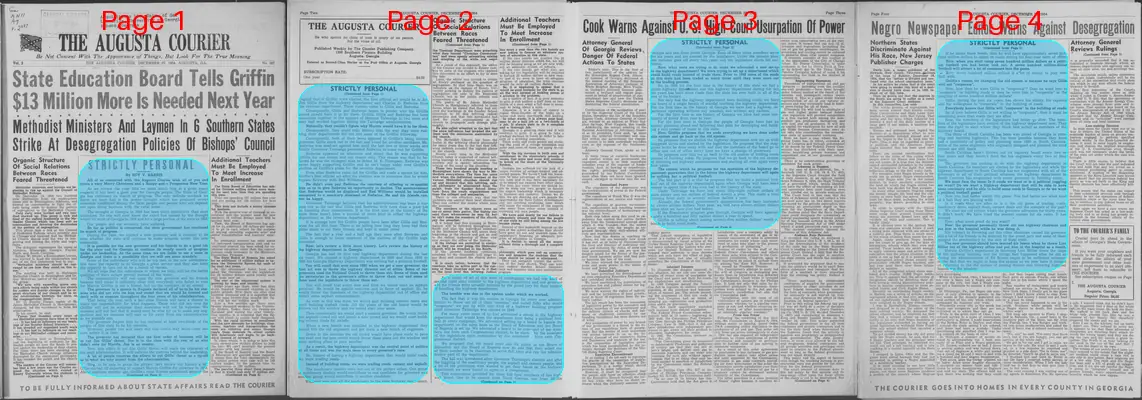
The Augusta Courier
Augusta, Richmond County, Georgia
What is this article about?
In this 1954 editorial, Roy V. Harris reviews Georgia's year, noting progress despite drought impacts on agriculture. He expresses cautious optimism for new Governor Marvin Griffin's administration but warns of potential scandals, particularly Griffin's plans to overhaul the stable Highway Department, criticizing political interference and advocating continuity for effective road building.
Merged-components note: Merged multi-page continuation of the 'STRICTLY PERSONAL' editorial column across pages 1-4.
Clippings
1 of 4
OCR Quality
Full Text
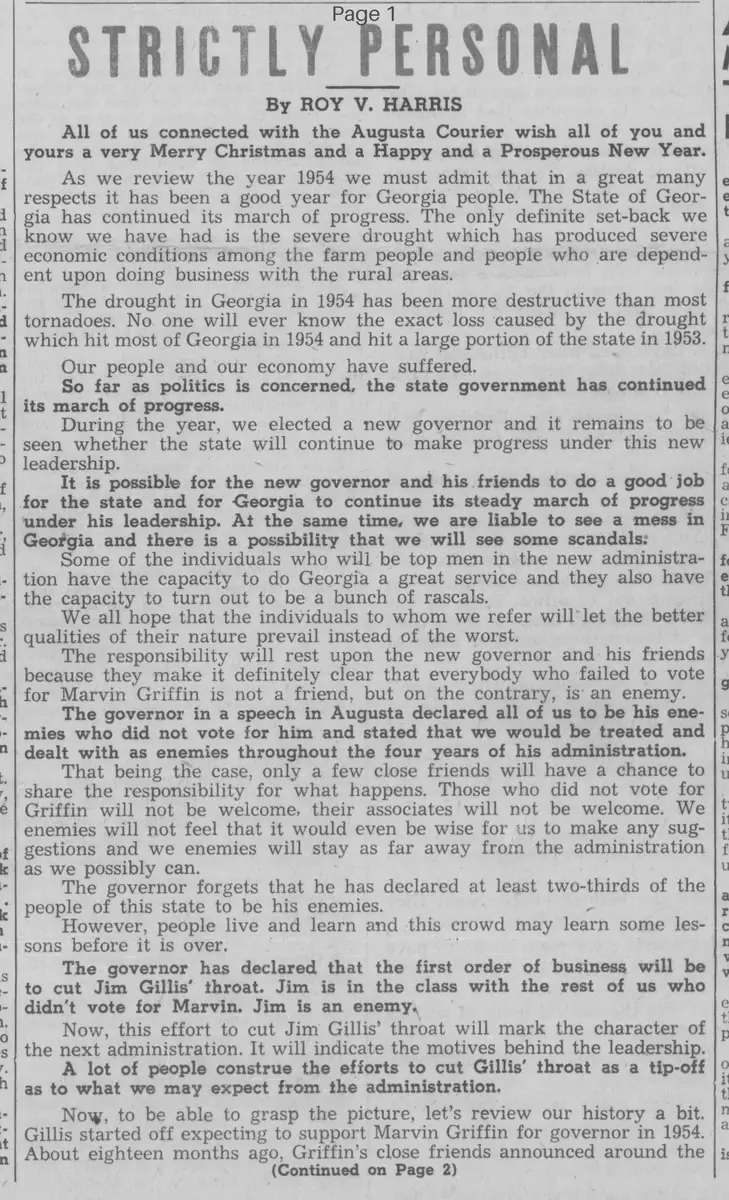
By ROY V. HARRIS
All of us connected with the Augusta Courier wish all of you and yours a very Merry Christmas and a Happy and a Prosperous New Year.
As we review the year 1954 we must admit that in a great many respects it has been a good year for Georgia people. The State of Georgia has continued its march of progress. The only definite set-back we know we have had is the severe drought which has produced severe economic conditions among the farm people and people who are dependent upon doing business with the rural areas.
The drought in Georgia in 1954 has been more destructive than most tornadoes. No one will ever know the exact loss caused by the drought which hit most of Georgia in 1954 and hit a large portion of the state in 1953.
Our people and our economy have suffered.
So far as politics is concerned, the state government has continued its march of progress.
During the year, we elected a new governor and it remains to be seen whether the state will continue to make progress under this new leadership.
It is possible for the new governor and his friends to do a good job for the state and for Georgia to continue its steady march of progress under his leadership. At the same time, we are liable to see a mess in Georgia and there is a possibility that we will see some scandals:
Some of the individuals who will be top men in the new administration have the capacity to do Georgia a great service and they also have the capacity to turn out to be a bunch of rascals.
We all hope that the individuals to whom we refer will let the better qualities of their nature prevail instead of the worst.
The responsibility will rest upon the new governor and his friends because they make it definitely clear that everybody who failed to vote for Marvin Griffin is not a friend, but on the contrary, is an enemy.
The governor in a speech in Augusta declared all of us to be his enemies who did not vote for him and stated that we would be treated and dealt with as enemies throughout the four years of his administration.
That being the case, only a few close friends will have a chance to share the responsibility for what happens. Those who did not vote for Griffin will not be welcome, their associates will not be welcome. We enemies will not feel that it would even be wise for us to make any suggestions and we enemies will stay as far away from the administration as we possibly can.
The governor forgets that he has declared at least two-thirds of the people of this state to be his enemies.
However, people live and learn and this crowd may learn some lessons before it is over.
The governor has declared that the first order of business will be to cut Jim Gillis' throat. Jim is in the class with the rest of us who didn't vote for Marvin. Jim is an enemy.
Now, this effort to cut Jim Gillis' throat will mark the character of the next administration. It will indicate the motives behind the leadership.
A lot of people construe the efforts to cut Gillis' throat as a tip-off as to what we may expect from the administration.
Now, to be able to grasp the picture, let's review our history a bit.
Gillis started off expecting to support Marvin Griffin for governor in 1954.
About eighteen months ago, Griffin's close friends announced around the Capitol that if Griffin were elected, the first official act would be to fire Jim Gillis from the highway department and Charles D. Redwine from the revenue department. These rumors came to Gillis and Redwine.
Consequently, Gillis and Redwine began to ponder why the Griffin crowd should have it in for them. Griffin, Gillis and Redwine had been associated together in the support of Herman Talmadge in two races and they had worked together during the Talmadge administration.
Naturally, they couldn't figure why Marvin would have it in for them.
Consequently, they could only believe that the way they were running their departments did not suit some of the Griffin following.
Consequently, both of them were opposed to Griffin's being elected governor. Gillis stuck out to the last and voted for another candidate. Mr. Redwine was dead-set against him until the last two or three weeks and finally Governor Talmadge persuaded Redwine to come out for Griffin.
Redwine appeared on television and stated that he was supporting Griffin for one reason and one reason only. This reason was that he believed he was the strongest man to defeat M. E. Thompson. Redwine was never happy supporting Griffin and he isn't happy today over Griffin's election or Griffin's plans for the revenue department.
Even after Redwine came out for Griffin and made a speech for him, Griffin's first official act after the election was to announce that he would replace Redwine with Red Williams.
He didn't even pay Redwine the courtesy of offering to re-appoint him so as to give Redwine an opportunity to decline. The announcement that Redwine would be displaced and Red Williams would be installed amounted to a summary dismissal of Redwine. He and his friends cannot be happy.
Governor Talmadge believes that his administration has been a success due to the fact that Gillis and Redwine both have done a good job in handling their departments. It is the first time in the history of the state there hasn't been a scandal of some kind in either the highway department or the revenue department.
It is strange how the Griffin people have been after Gillis and Redwine for all this time. There is no telling how long they have had their plans made to cut their throats and kept it under cover.
The fact that a year and a half ago they were after Redwine and Gillis is enough to cause suspicion of the motives of the Griffin high command.
Now, let's review a little more history. Let's review the history of the highway department in Georgia.
Georgia has had its first real highway department during the last six years. We created a highway department in 1920 and from 1920 to 1948 the Georgia Highway Department was nothing but a political football.
You will recall that ever since 1920 when we got a new governor, the first act was to throw the highway director out of office. Some of our governors used the National Guard to throw them out. Some of them used the secretaries in the governor's office to throw them out and some of them used the legislature to throw them out.
You will recall that every now and then we would elect an asphalt governor. He would be against concrete and in favor of asphalt. So, he would throw the members of the highway department out of office and install some asphalt commissioners.
As soon as this was done, we would quit building cement roads and start building asphalt roads. All the plans of the old board would be thrown out the window and we would start over anew.
Then occasionally we would elect a cement governor. He would throw the asphalt crowd out and install a new crowd and we would start building cement roads for awhile.
When a new bunch was installed in the highway department they would fire the old engineers and get them a new bunch of engineers.
Down in the counties the old crowd would have plans made to pave one road and the new crowd would throw these plans out the window and start making plans to pave another.
As a result, the highway department was the central point of politics at all times and was the main issue in every governor's race.
So, instead of having a highway department that would build roads, we were trading roads.
Instead of building roads, we were trading roads, cement and asphalt.
The machinery dealers were not out of the picture either. One group of machinery dealers would contribute to one candidate for governor and another group would contribute to another candidate.
Whoever won sold all the machinery to the state highway department.
As a result of all of this kind of sculduggery we had one kind of scandal right after another in the highway department and one governor and his friends were actually indicted by the grand jury for their method of handling the highway department.
The trouble was due to the system under which we worked.
The fact that it was the custom in Georgia for every new administration to throw out all of their "enemies" and install folks who would "cooperate" we put up with that kind of a highway building program until Governor Talmadge was elected in 1948.
For many years some of us had advocated a set-up in the highway department that would keep the department from being a political football in every campaign.
We advocated setting up a board to handle the department on the same basis as the Board of Education and the Board of Regents is set up. We advocated a board to be composed of ten members, one from each Congressional district, to be elected by the members of the legislature upon nomination by the members from each Congressional district.
We proposed that the board meet and fix policy as the Board of Education and the Board of Regents now do and that they select one of their number to be chairman to serve full time and run the administrative part of the department.
The bill was introduced after Governor Talmadge's election and after the juggling of the machinery people, the asphalt and cement people, and a lot of the politicians who wanted to get their hands on the highway department we were forced to agree to a compromise.
This compromise provided for three full time members of the highway board.
One to be from Middle Georgia and one from South Georgia.
Each of these three members serve for six years and are elected by the legislature.
Under the present plan, one member goes off every two years and the legislature elects his successor.
Now, what were we trying to do when we advocated a new set-up in the highway department? We were trying to set up a department which could build roads instead of trade them. Prior to 1948 some of the roads in this state had been traded so many times until they were worn out in the trading process.
So, in 1948 for the first time in the history of this state we had a stable highway department and this highway department during the last six years has built more roads than the state has ever built in all of the rest of its history.
Not only has the highway department been building roads, we have not heard of a single breath of scandal touching the highway department.
For the first time in the history of Georgia we have had a highway department operating without any scandals and without any rackets.
For the first time in the history of Georgia we have had some continuity of policy from year to year.
For the first time in Georgia the people of Georgia have had an agency planning ahead and following that plan for developing and building a real system of roads in this state.
Now, Griffin proposes that we undo everything we have done under this system and go back to the old system.
He proposes that we abolish the highway department now set up with staggered terms and elected by the legislature. He proposes that the staggered terms be done away with and that the members of the board go in office and out of office every time we have a change of governors.
He proposes now that we go back to the old system of trading roads instead of building roads. He proposes that we go back to the old system of throwing out highway commissioners and starting all over again every four years.
The system which he proposes for the operation of the highway department guarantees that in the future the highway department will again be nothing but a political football.
The bad part of it is that he proposes that we make a political football out of the highway department again when Georgia will have more money to spend than it has ever had in the history of the state.
Under Talmadge we have had about fifty-eight million dollars of state money and ten million of federal money a year. This made a total running from sixty to seventy million dollars a year.
Already, the federal government's appropriation has been increased by eleven million dollars. Next year, we will have eleven million dollars more than we have ever had before.
If the Eisenhower program goes through, Georgia will have approximately a hundred and fifty million dollars a year to spend.
Griffin is talking about issuing seventy-five million dollars' worth of bonds to build rural roads.
If he issues these bonds, then he will have approximately seven hundred million dollars to spend on roads during his four-year term of office.
Now, when you start using seven hundred million dollars as a political football you had better look out. A seven hundred million-dollar football will attract a lot of customers into the game.
Now, seven hundred million dollars is a lot of money to play football with.
Griffin's reason for changing the old system is because he says Gillis will not "cooperate".
Now, how does he want Gillis to "cooperate"? Does he want him to cooperate in building roads or does he want him to "cooperate" in the juggling of seven hundred million dollars?
Gillis, during the past six years, has shown his ability, his capacity and his willingness to "cooperate" in the building of roads.
Everybody knows that Gillis will "cooperate" in the building of roads.
So, if they believe Gillis is not willing to "cooperate", then it must be something more than roads they are after.
Now, the members of the legislature had better go slow. The members of the legislature have control of the highway department now. They have the right to elect whom they think best suited as members of the highway board.
The State of South Carolina has been way ahead of Georgia in planning and building highways. This has been possible because they have had a continuity of policy and planning since 1920 in South Carolina.
Some of the same engineers who originally designed and planned the road system are still there.
South Carolina hasn't thrown out its highway board every two or four years and they haven't fired the top engineers every two or four years.
The governor has nothing to do with the highway department in South Carolina. Its members are elected by the legislature and while the highway department in South Carolina has not cooperated with all of the governors in all of their political schemes, the highway department in South Carolina has cooperated with every governor in building roads.
We must face the issue: Is it roads we want or is it political juggling we want? Do we want a highway department that will be able to have some continuity and be able to build some roads in Georgia or do we want a political football game?
Now you had better watch this game. You had better see what kind of a ball they are playing with.
Is it roads they are after or is it the old game of trading roads, machinery deals, asphalt deals, cement deals and the scandals of the past?
We tried the old system which the governor advocates for thirty years. It didn't work. We have tried the present system for six years. It has worked.
Now, what more proof do you want?
Now, the governor personally threw out one highway chairman and put him in the hospital while he was doing it.
His conduct in throwing out this other chairman caused his governor and a lot of his friends to be indicted by the grand jury and some of them escaped the penitentiary by the skin of their teeth.
The new governor should have learned his lesson when he threw Lint Miller out of the highway office and put him in the hospital as a result.
Marvin Griffin's experience in throwing Lint Miller down the steps of the highway building and the things that happened after he did so during the administration of Ed Rivers ought to be sufficient evidence of the fact that we ought to keep the system as we now have it instead of returning to the old system of cutting throats and throwing highway boards out the window.
What sub-type of article is it?
What keywords are associated?
What entities or persons were involved?
Editorial Details
Primary Topic
Critique Of Governor Elect Marvin Griffin's Plans To Restructure The Georgia Highway Department
Stance / Tone
Critical Of Political Interference And Supportive Of Stable, Scandal Free Administration
Key Figures
Key Arguments