Thank you for visiting SNEWPapers!
Sign up free
Editorial
January 7, 1862
Newbern Weekly Progress
New Bern, Craven County, North Carolina
What is this article about?
Confederate-leaning editorial mocks the US government's surrender of seized Confederate commissioners from the British ship Trent, attributing it to cowardly fear of British retaliation rather than justice, amid strong anti-Yankee sentiment and quotes from excited British public reactions in London.
Merged-components note: Merged continuation of the editorial quoting the London Post speech on the Trent affair.
Clipping
OCR Quality
98%
Excellent
Full Text
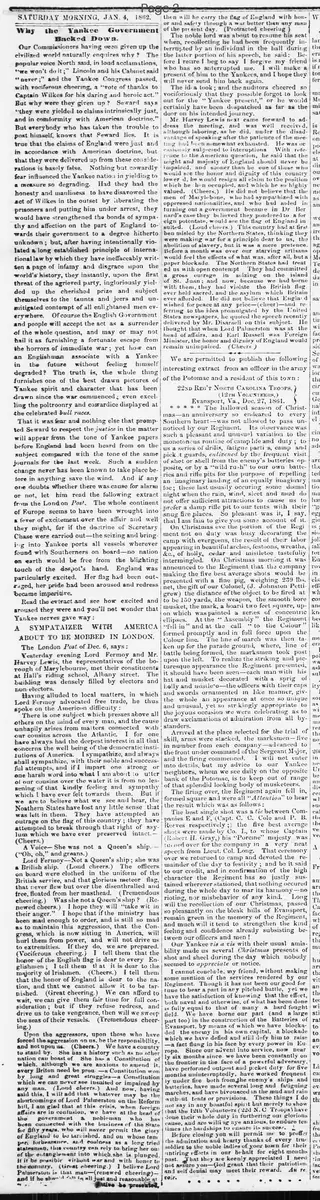
SATURDAY MORNING, JAN. 4, 1862.
Why the Yankee Government Backed Down.
Our Commissioners having been given up the civilized world naturally enquires why? The popular voice North said, in loud acclamations, "we won't do it;" Lincoln and his Cabinet said "never;" and the Yankee Congress passed, with vociferous cheering, a "vote of thanks to Captain Wilkes for his daring and heroic act."
But why were they given up? Seward says "they were yielded to claims intrinsically just, and in conformity with American doctrine."
But everybody who has taken the trouble to post himself, knows that Seward lies. It is true that the claims of England were just and in accordance with American doctrine, but that they were delivered up from these considerations is basely false. Nothing but cowardly fear influenced the Yankee nation in yielding to a measure so degrading. Had they had the honesty and manliness to have disavowed the act of Wilkes in the outset by liberating the prisoners and putting him under arrest, they would have strengthened the bonds of sympathy and affection on the part of England towards their government to a degree hitherto unknown; but, after having intentionally violated a long established principle of international law by which they have ineffaceably written a page of infamy and disgrace upon the world's history, they instantly, upon the first threat of the aggrieved party, ingloriously yielded up the cherished prize and subjected themselves to the taunts and jeers and unmitigated contempt of all enlightened men everywhere. Of course the English Government and people will accept the act as a surrender of the whole question, and may or may not hail it as furnishing a fortunate escape from the horrors of immediate war; yet how can an Englishman associate with a Yankee in the future without feeling himself degraded? The truth is, the whole thing furnishes one of the best drawn pictures of Yankee spirit and character that has been drawn since the war commenced; even excelling the poltroonery and cowardice displayed at the celebrated bull races.
That it was fear and nothing else that prompted Seward to respect the justice in the matter will appear from the tone of Yankee papers before England had been heard from on the subject compared with the tone of the same journals for the last week. Such a sudden change never has been known to take place before in anything save the wind. And if anyone doubts whether there was cause for alarm or not, let him read the following extract from the London Post. The whole continent of Europe seems to have been wrought into a fever of excitement over the affair and well they might, for if the doctrine of Secretary Chase were carried out—the seizing and bringing into Yankee ports all vessels wherever found with Southerners on board—no nation on earth would be free from the blighting touch of the despot's hand. England was particularly excited. Her flag had been outraged, her pride had been aroused and redress became imperative.
Read the extracts and see how excited and aroused they were and you'll not wonder that Yankee nerves gave way:
A SYMPATHIZER WITH AMERICA ABOUT TO BE MOBBED IN LONDON
The London Post of Dec. 6, says:
Yesterday evening Lord Fermoy and Mr. Harvey Lewis, the representatives of the borough of Marylebone, met their constituents at Hall's riding school, Albany street. The building was densely filled by electors and non-electors.
Having alluded to local matters, in which Lord Fermoy advocated free trade, he thus spoke on the American difficulty:
There is one subject which presses above all others on the mind of every man, and the cause unhappily arises from matters connected with our cousins across the Atlantic. I for one have always had the deepest interest in all that concerns the well being of the democratic institutions of America. I sympathize, and always shall sympathize, with their noble and successful attempts, and if I impart one strong or one harsh word into what I am about to utter of our cousins over the water it is from no lessening of that kindly feeling and sympathy which I have ever felt towards them. But if we are to believe what we see and hear, the Northern States have lost any little sense that was left in them. They have attempted an outrage on the flag of this country; they have attempted to break through that right of asylum which we have ever preserved intact.—(Cheers.)
A Voice—She was not a Queen's ship.—("Oh, oh," and groans.)
Lord Fermoy—Not a Queen's ship; she was a British ship. (Loud cheers.) The officers on board were clothed in the uniform of the British service, and that glorious meteor flag, that never flew but over the disenthralled and free, floated from her masthead. (Tremendous cheering.) Was she not a Queen's ship? (Renewed cheers.) I hope they will "take wit in their anger." I hope that if the ministry has been mad enough to order, and is still so mad as to maintain this aggression, that the Congress, which is now sitting in America, will hurl them from power, and will not drive us to extremities. If they do, we are prepared. (Vociferous cheering.) I tell them that the honor of the English flag is dear to every Englishman; I tell them that it is dear to the majority of Irishmen. (Cheers.) I tell them that the honor of England is dear to the nation, and that we cannot allow it to be tarnished. (Great cheering.) We can afford to wait, we can give them time for full consideration; but if they refuse redress, and drive us to take vengeance, then will we sweep the seas of their vessels. (Tremendous cheering.)
Upon the aggressors, upon those who have forced the aggression on us, be the responsibility, and not upon us. (Cheers.) We have a country to stand by. She has a history such as no other nation can boast of. She has a Constitution of which, although we are anxious to amend it, every Briton need be proud—a Constitution won by long and great struggles—a Constitution which we can never see insulted or impaired by any man. (Loud cheers.) And now, having said this, I will add that whatever may be the shortcomings of Lord Palmerston on the Reform bill, I am glad that at this crisis, when foreign affairs are in confusion, we have at the head of the government a nobleman who has been connected with the business of the State for fifty years, who will never permit the glory of England to be tarnished, and on whose temper, forbearance, and coolness as a long tried statesman, this country can rely to bring her out of the entanglement into which she is plunged if it be possible without war and with honor to the country. (Great cheering.) I believe Lord Palmerston is that man—(renewed cheering)—and if he should "stand in all just and reasonable attitude be presented
then will he carry the flag of England with honor and safety through a war better than any man of the present day. (Protracted cheering.)
The noble lord was about to resume his seat when, recollecting he had been frequently interrupted by an individual in the hall during the latter portion of his speech, he said: Before I retire I beg to say I forgive my friend who has so interrupted me. I will make a present of him to the Yankees, and I hope they will never send him back again.
The idea took; and the audience cheered so vociferously that they possibly forgot to look out for the "Yankee present," or he would certainly have been despatched as far as the door on his intended journey.
Mr. Harvey Lewis next came forward to address the meeting, and was well received, although laboring, as he did, under the disadvantage of speaking after the patience of the meeting had been somewhat exhausted. He was occasionally subjected to interruptions.
With reference to the American question, he said that the might and majesty of England should never be impaired, and sooner than be one of those who would see the honor and dignity of this country lowered, he would resign all claim to the position which he then occupied, and which he so highly valued. (Cheers.) He did not believe that the men of Marylebone, who had sympathized with oppressed nationalities, and who had aided in turning out a government because in Dr. Bernard's case they believed they pandered to a foreign potentate, would see the flag of England insulted. (Loud cheers.) This country had at first been misled by the Northern States, thinking they were making war for a principle dear to us, the abolition of slavery, but it was a mere pretence. Before a month was over our starving artisans would feel the effects of what was, after all, but a paper blockade. The Northern States had treated us with open contempt. They had committed a gross outrage in seizing on the island of St. Juan; and now, because we had borne with them, they had violated the British flag ever held sacred, and the asylum which Britain ever afforded. He did not believe that England wished for peace at any price—(cheer)—and referring to the idea promulgated by the United States newspapers, he quoted the speech recently delivered by Mr. Disraeli on this subject. He thought that when Lord Palmerston was at the head of affairs, and Earl Russell was Foreign Minister, the honor and dignity of England would remain unimpaired. (Cheers.)
Why the Yankee Government Backed Down.
Our Commissioners having been given up the civilized world naturally enquires why? The popular voice North said, in loud acclamations, "we won't do it;" Lincoln and his Cabinet said "never;" and the Yankee Congress passed, with vociferous cheering, a "vote of thanks to Captain Wilkes for his daring and heroic act."
But why were they given up? Seward says "they were yielded to claims intrinsically just, and in conformity with American doctrine."
But everybody who has taken the trouble to post himself, knows that Seward lies. It is true that the claims of England were just and in accordance with American doctrine, but that they were delivered up from these considerations is basely false. Nothing but cowardly fear influenced the Yankee nation in yielding to a measure so degrading. Had they had the honesty and manliness to have disavowed the act of Wilkes in the outset by liberating the prisoners and putting him under arrest, they would have strengthened the bonds of sympathy and affection on the part of England towards their government to a degree hitherto unknown; but, after having intentionally violated a long established principle of international law by which they have ineffaceably written a page of infamy and disgrace upon the world's history, they instantly, upon the first threat of the aggrieved party, ingloriously yielded up the cherished prize and subjected themselves to the taunts and jeers and unmitigated contempt of all enlightened men everywhere. Of course the English Government and people will accept the act as a surrender of the whole question, and may or may not hail it as furnishing a fortunate escape from the horrors of immediate war; yet how can an Englishman associate with a Yankee in the future without feeling himself degraded? The truth is, the whole thing furnishes one of the best drawn pictures of Yankee spirit and character that has been drawn since the war commenced; even excelling the poltroonery and cowardice displayed at the celebrated bull races.
That it was fear and nothing else that prompted Seward to respect the justice in the matter will appear from the tone of Yankee papers before England had been heard from on the subject compared with the tone of the same journals for the last week. Such a sudden change never has been known to take place before in anything save the wind. And if anyone doubts whether there was cause for alarm or not, let him read the following extract from the London Post. The whole continent of Europe seems to have been wrought into a fever of excitement over the affair and well they might, for if the doctrine of Secretary Chase were carried out—the seizing and bringing into Yankee ports all vessels wherever found with Southerners on board—no nation on earth would be free from the blighting touch of the despot's hand. England was particularly excited. Her flag had been outraged, her pride had been aroused and redress became imperative.
Read the extracts and see how excited and aroused they were and you'll not wonder that Yankee nerves gave way:
A SYMPATHIZER WITH AMERICA ABOUT TO BE MOBBED IN LONDON
The London Post of Dec. 6, says:
Yesterday evening Lord Fermoy and Mr. Harvey Lewis, the representatives of the borough of Marylebone, met their constituents at Hall's riding school, Albany street. The building was densely filled by electors and non-electors.
Having alluded to local matters, in which Lord Fermoy advocated free trade, he thus spoke on the American difficulty:
There is one subject which presses above all others on the mind of every man, and the cause unhappily arises from matters connected with our cousins across the Atlantic. I for one have always had the deepest interest in all that concerns the well being of the democratic institutions of America. I sympathize, and always shall sympathize, with their noble and successful attempts, and if I impart one strong or one harsh word into what I am about to utter of our cousins over the water it is from no lessening of that kindly feeling and sympathy which I have ever felt towards them. But if we are to believe what we see and hear, the Northern States have lost any little sense that was left in them. They have attempted an outrage on the flag of this country; they have attempted to break through that right of asylum which we have ever preserved intact.—(Cheers.)
A Voice—She was not a Queen's ship.—("Oh, oh," and groans.)
Lord Fermoy—Not a Queen's ship; she was a British ship. (Loud cheers.) The officers on board were clothed in the uniform of the British service, and that glorious meteor flag, that never flew but over the disenthralled and free, floated from her masthead. (Tremendous cheering.) Was she not a Queen's ship? (Renewed cheers.) I hope they will "take wit in their anger." I hope that if the ministry has been mad enough to order, and is still so mad as to maintain this aggression, that the Congress, which is now sitting in America, will hurl them from power, and will not drive us to extremities. If they do, we are prepared. (Vociferous cheering.) I tell them that the honor of the English flag is dear to every Englishman; I tell them that it is dear to the majority of Irishmen. (Cheers.) I tell them that the honor of England is dear to the nation, and that we cannot allow it to be tarnished. (Great cheering.) We can afford to wait, we can give them time for full consideration; but if they refuse redress, and drive us to take vengeance, then will we sweep the seas of their vessels. (Tremendous cheering.)
Upon the aggressors, upon those who have forced the aggression on us, be the responsibility, and not upon us. (Cheers.) We have a country to stand by. She has a history such as no other nation can boast of. She has a Constitution of which, although we are anxious to amend it, every Briton need be proud—a Constitution won by long and great struggles—a Constitution which we can never see insulted or impaired by any man. (Loud cheers.) And now, having said this, I will add that whatever may be the shortcomings of Lord Palmerston on the Reform bill, I am glad that at this crisis, when foreign affairs are in confusion, we have at the head of the government a nobleman who has been connected with the business of the State for fifty years, who will never permit the glory of England to be tarnished, and on whose temper, forbearance, and coolness as a long tried statesman, this country can rely to bring her out of the entanglement into which she is plunged if it be possible without war and with honor to the country. (Great cheering.) I believe Lord Palmerston is that man—(renewed cheering)—and if he should "stand in all just and reasonable attitude be presented
then will he carry the flag of England with honor and safety through a war better than any man of the present day. (Protracted cheering.)
The noble lord was about to resume his seat when, recollecting he had been frequently interrupted by an individual in the hall during the latter portion of his speech, he said: Before I retire I beg to say I forgive my friend who has so interrupted me. I will make a present of him to the Yankees, and I hope they will never send him back again.
The idea took; and the audience cheered so vociferously that they possibly forgot to look out for the "Yankee present," or he would certainly have been despatched as far as the door on his intended journey.
Mr. Harvey Lewis next came forward to address the meeting, and was well received, although laboring, as he did, under the disadvantage of speaking after the patience of the meeting had been somewhat exhausted. He was occasionally subjected to interruptions.
With reference to the American question, he said that the might and majesty of England should never be impaired, and sooner than be one of those who would see the honor and dignity of this country lowered, he would resign all claim to the position which he then occupied, and which he so highly valued. (Cheers.) He did not believe that the men of Marylebone, who had sympathized with oppressed nationalities, and who had aided in turning out a government because in Dr. Bernard's case they believed they pandered to a foreign potentate, would see the flag of England insulted. (Loud cheers.) This country had at first been misled by the Northern States, thinking they were making war for a principle dear to us, the abolition of slavery, but it was a mere pretence. Before a month was over our starving artisans would feel the effects of what was, after all, but a paper blockade. The Northern States had treated us with open contempt. They had committed a gross outrage in seizing on the island of St. Juan; and now, because we had borne with them, they had violated the British flag ever held sacred, and the asylum which Britain ever afforded. He did not believe that England wished for peace at any price—(cheer)—and referring to the idea promulgated by the United States newspapers, he quoted the speech recently delivered by Mr. Disraeli on this subject. He thought that when Lord Palmerston was at the head of affairs, and Earl Russell was Foreign Minister, the honor and dignity of England would remain unimpaired. (Cheers.)
What sub-type of article is it?
Foreign Affairs
War Or Peace
What keywords are associated?
Trent Affair
Us Britain Relations
Confederate Commissioners
Yankee Cowardice
International Law Violation
British Outrage
What entities or persons were involved?
Lincoln
Seward
Captain Wilkes
Lord Palmerston
Lord Fermoy
Mr. Harvey Lewis
British Government
Confederate Commissioners
Editorial Details
Primary Topic
Us Backing Down In The Trent Affair Due To Fear Of Britain
Stance / Tone
Strongly Anti Union, Pro Confederate Mockery Of Yankee Cowardice
Key Figures
Lincoln
Seward
Captain Wilkes
Lord Palmerston
Lord Fermoy
Mr. Harvey Lewis
British Government
Confederate Commissioners
Key Arguments
Us Yielded The Commissioners Out Of Cowardly Fear, Not Justice
Violation Of International Law By Seizing British Ship Tarnishes Us Reputation
Initial Us Defiance Turned To Quick Surrender Upon British Threats
British Public Outrage Demands Redress And Potential War
Us Actions Reveal Yankee Poltroonery And Character Flaws