Thank you for visiting SNEWPapers!
Sign up free
The Morning Star And Catholic Messenger
New Orleans, Orleans County, Louisiana
What is this article about?
During the Civil War's Wilderness campaign, General Meade punishes Philadelphia Inquirer reporter Crapsey for leaking army plans, prompting correspondents to credit all successes to General Grant, damaging Meade's reputation and aiding Grant's presidency.
Clipping
OCR Quality
Full Text
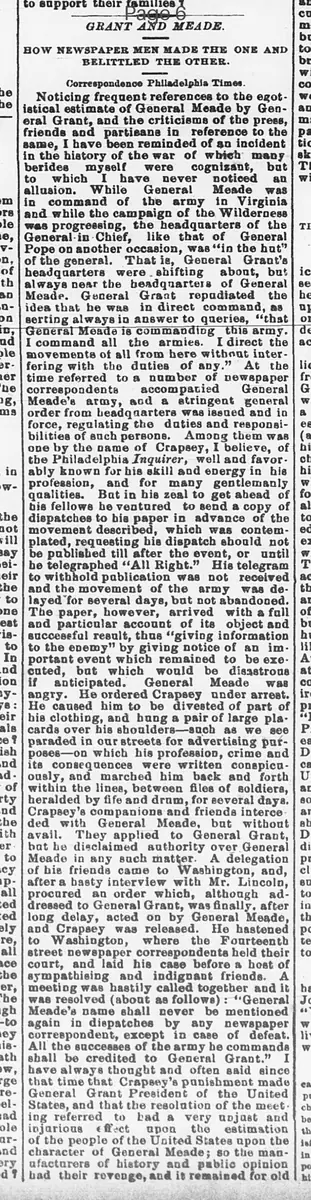
HOW NEWSPAPER MEN MADE THE ONE AND BELITTLED THE OTHER.
Correspondence Philadelphia Times.
Noticing frequent references to the egotistical estimate of General Meade by General Grant, and the criticisms of the press, friends and partisans in reference to the same, I have been reminded of an incident in the history of the war of which many besides myself were cognizant. but to which I have never noticed an allusion. While General Meade was in command of the army in Virginia and while the campaign of the Wilderness was progressing, the headquarters of the General-in-Chief, like that of General Pope on another occasion, was "in the hut" of the general. That is, General Grant's headquarters were shifting about, but always near the headquarters of General Meade. General Grant repudiated the idea that he was in direct command, asserting always in answer to queries, "that General Meade is commanding this army. I command all the armies. I direct the movements of all from here without interfering with the duties of any." At the time referred to a number of newspaper correspondents accompanied General Meade's army, and a stringent general order from headquarters was issued and in force, regulating the duties and responsibilities of such persons. Among them was one by the name of Crapsey, I believe, of the Philadelphia Inquirer, well and favorably known for his skill and energy in his profession, and for many gentlemanly qualities. But in his zeal to get ahead of his fellows he ventured to send a copy of dispatches to his paper in advance of the movement described, which was contemplated, requesting his dispatch should not be published till after the event, or until he telegraphed "All Right." His telegram to withhold publication was not received and the movement of the army was delayed for several days, but not abandoned. The paper, however, arrived with a full and particular account of its object and successful result, thus "giving information to the enemy" by giving notice of an important event which remained to be executed, but which would be disastrous if anticipated. General Meade was angry. He ordered Crapsey under arrest. He caused him to be divested of part of his clothing, and hung a pair of large placards over his shoulders—such as we see paraded in our streets for advertising purposes—on which his profession, crime and its consequences were written conspicuously, and marched him back and forth within the lines, between files of soldiers, heralded by fife and drum, for several days. Crapsey's companions and friends interceded with General Meade, but without avail. They applied to General Grant, but he disclaimed authority over General Meade in any such matter. A delegation of his friends came to Washington, and, after a hasty interview with Mr. Lincoln, procured an order which, although addressed to General Grant, was finally, after long delay, acted on by General Meade, and Crapsey was released. He hastened to Washington, where the Fourteenth street newspaper correspondents held their court, and laid his case before a host of sympathizing and indignant friends. A meeting was hastily called together and it was resolved (about as follows): "General Meade's name shall never be mentioned again in dispatches by any newspaper correspondent, except in case of defeat. All the successes of the army he commands shall be credited to General Grant." I have always thought and often said since that time that Crapsey's punishment made General Grant President of the United States, and that the resolution of the meeting referred to had a very unjust and injurious effect upon the estimation of the people of the United States upon the character of General Meade: so the manufacturers of history and public opinion had their revenge, and it remained for old Father Time to set all things right before.
What sub-type of article is it?
What themes does it cover?
What keywords are associated?
What entities or persons were involved?
Where did it happen?
Story Details
Key Persons
Location
Virginia, Headquarters Of The Army; Washington
Event Date
During The Campaign Of The Wilderness
Story Details
Reporter Crapsey leaks planned army movement to Philadelphia Inquirer; publication alerts enemy, delaying operation. Meade arrests and publicly humiliates Crapsey. After failed intercessions with Meade and Grant, Lincoln's order secures release. Correspondents resolve to credit successes to Grant, ignoring Meade except in defeats, boosting Grant's reputation and presidency while harming Meade's.