Thank you for visiting SNEWPapers!
Sign up free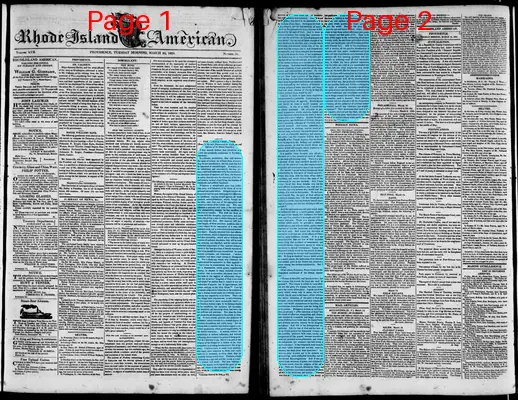
Literary
March 22, 1825
Rhode Island American
Providence, Providence County, Rhode Island
What is this article about?
Excerpt from Dr. Spring's discourse praising neatness, taste, and personal piety as essential virtues in the female character, emphasizing their role in enhancing domestic happiness, social influence, and Christian modesty without excess or singularity in dress.
Merged-components note: Continuation of the literary piece 'THE FEMALE CHARACTER' from Dr. Spring's Discourse, split across pages.
Clippings
1 of 2
OCR Quality
98%
Excellent
Full Text
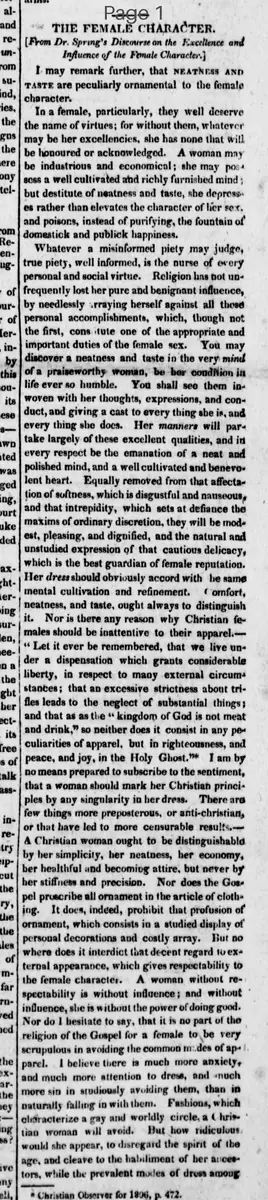
THE FEMALE CHARACTER.
[From Dr. Spring's Discourse on the Excellence and Influence of the Female Character.]
I may remark further, that NEATNESS AND TASTE are peculiarly ornamental to the female character.
In a female, particularly, they well deserve the name of virtues; for without them, whatever may be her excellencies, she has none that will be honoured or acknowledged. A woman may be industrious and economical; she may possess a well cultivated and richly furnished mind; but destitute of neatness and taste, she depresses rather than elevates the character of her sex, and poisons, instead of purifying, the fountain of domestick and publick happiness.
Whatever a misinformed piety may judge, true piety, well informed, is the nurse of every personal and social virtue. Religion has not unfrequently lost her pure and benignant influence, by needlessly arraying herself against all those personal accomplishments, which, though not the first, constitute one of the appropriate and important duties of the female sex. You may discover a neatness and taste in the very mind of a praiseworthy woman, be her condition in life ever so humble. You shall see them interwoven with her thoughts, expressions, and conduct, and giving a cast to every thing she is, and every thing she does. Her manners will partake largely of these excellent qualities, and in every respect be the emanation of a neat and polished mind, and a well cultivated and benevolent heart. Equally removed from that affectation of softness, which is disgustful and nauseous, and that intrepidity, which sets at defiance the maxims of ordinary discretion, they will be modest, pleasing, and dignified, and the natural and unstudied expression of that cautious delicacy, which is the best guardian of female reputation.
Her dress should obviously accord with the same mental cultivation and refinement. Comfort, neatness, and taste, ought always to distinguish it. Nor is there any reason why Christian females should be inattentive to their apparel.--"Let it ever be remembered, that we live under a dispensation which grants considerable liberty, in respect to many external circumstances; that an excessive strictness about trifles leads to the neglect of substantial things; and that as the "kingdom of God is not meat and drink," so neither does it consist in any peculiarities of apparel, but in righteousness, and peace, and joy, in the Holy Ghost."* I am by no means prepared to subscribe to the sentiment, that a woman should mark her Christian principles by any singularity in her dress. There are few things more preposterous, or anti-christian, or that have led to more censurable results.--A Christian woman ought to be distinguishable by her simplicity, her neatness, her economy, her healthful and becoming attire, but never by her stiffness and precision. Nor does the Gospel proscribe all ornament in the article of clothing. It does, indeed, prohibit that profusion of ornament, which consists in a studied display of personal decorations and costly array. But nowhere does it interdict that decent regard to external appearance, which gives respectability to the female character. A woman without respectability is without influence; and without influence, she is without the power of doing good.
Nor do I hesitate to say, that it is no part of the religion of the Gospel for a female to be very scrupulous in avoiding the common modes of apparel. I believe there is much more anxiety, and much more attention to dress, and much more sin in studiously avoiding them, than in naturally falling in with them. Fashions, which characterize a gay and worldly circle, a Christian woman will avoid. But how ridiculous would she appear, to disregard the spirit of the age, and cleave to the habiliment of her ancestors, while the prevalent modes of dress among
Persons of her own class, are not inconsistent with modesty and decorum. And let it not be forgotten, that there is no intrinsick evil in mere dress of any kind. So long as the heart is not corrupted, nor the best interests of men injured by the garments we wear, they are of little account in the sight of God. And is there no reason to believe that vanity may insinuate itself into the mind from the love of plainness and singularity? Do we not all know enough of human nature to be satisfied, that a woman who is habitually well dressed, thinks less of her apparel than the woman who is well dressed only occasionally, and whose thoughts are incessantly occupied about the dress of her neighbours? An Indian may be as vain of her blanket, and a Quaker of her bonnet and cap, as a coxcomb is of the newest fashion, or a courtier of his splendid retinue. And what would become of the interests of society, if you proscribe all the ornaments and conveniences of dress? To what untold multitudes do these give useful employment? How large a portion of the Church of God do they elevate above want and suffering? How many benevolent institutions are maintained in existence by the industry of females, in forming articles of mere ornament and fancy? And how many streams of charity do they fill, which, without them, would be dry?
I should be loath to have these suggestions misunderstood or perverted. I plead not for excess and profusion in apparel. Extravagance and finery in dress I would censure and condemn. A fop, or a belle, I would hold in steady contempt. All attention to personal appearance which excludes higher and more important objects from the mind, is inconsistent with a pure religion. Against the splendour, gaiety, and fickleness of fashions, the pure and unassuming influence of Christian piety is natively arrayed. And vanity, splendour, and extravagance in clothing, are the result of a vitiated taste, and never become the person half so well as a beautiful simplicity and neatness. But while I say this, I cannot believe that the Religion of the Gospel requires that we should have no regard to the feelings and opinions of human society, or that we should divest ourselves of that self-respect, which renders us respected and useful in the world.
It is possible these thoughts may offend.—But sure am I, they present no cause of offence to the most self-denying mind. There is a spirit in some of our most excellent females in relation to the article of dress, that requires a more prayerful self-examination than it has received. For myself, I do not believe there is any thing praiseworthy in that spirit of female curiosity, which interferes with the dress of her fellow christians, and would reduce the taste of the community to any one standard. And I have always found that those females who are the most officious in these matters, are, with few exceptions, the very persons who would lead the fashion, if it were in their power. To such persons I would say, the spirit of God affirms of a virtuous woman, that all her household are clothed in scarlet: that she maketh herself coverings of tapestry, and that her clothing is silk and purple.
And the same neatness and taste which ought to be discoverable in a lady's person, ought to be seen in her family, her residence, her furniture, and that, whether it be ample and rich, or scanty and poor. There is a degree of these virtues which ought to pervade a woman's entire sphere, and without which, society would degenerate into the barbarism and violence of the dark ages. And hence this elevation of character is always one of the effects of Christianity upon barbarous nations. It is a sad misconception that the law of God excludes every thing that is refined or ornamental, and restricts human enjoyments merely to what is necessary to human subsistence. Coarse and depraved indeed, would be that society in which there is nothing for the ease and convenience of life. So long as mankind have a social as well as a moral nature, the cultivation of an elevated and refined spirit in the female sex, deserves a place among her obvious excellencies. But I will add,
Of all others, Personal Piety forms the distinguished excellence of the female character. 'Favour is deceitful, and beauty is vain; but the woman that feareth the Lord, she shall be praised.' The virtues to which we have alluded, are the glory of a woman, but piety constitutes the crown of her glory. I speak not of that piety which exists only in name, but of that which has its seat in the heart; which subdues the native alienation of the mind to God and holiness; which transforms and new creates the soul; and which concentrates its faculties, and concentrates them forever upon the living God as its portion. Religion in woman, as well as in man, is not only 'of the operation of God,' but the result of reflection, comparison, and choice, and consists in a cheerful and happy renunciation of all the heart holds dear, for Jesus Christ, and of every opposing interest for his kingdom and glory. And this is her distinguished excellence. Let the fear of God and the love of Jesus Christ control her domestick virtues; let the humility, patience, faith, hope, charity and resignation of the gospel, become interwoven with her personal accomplishments, and sweeten and govern her conduct; and how lovely is such a woman! It has frequently been remarked, that 'pious women are not only more numerous, but more pious than pious men.' In a woman, piety is more apt to be uniform and persevering, amid multiplied obstacles, and accumulated discouragements. And if she possesses large measures of grace, her religion will be more ardent, than the religion of the other sex. Such was Hannah, Elizabeth, Mary, and Anna; and such have been a multitude of others, of whom the world was not worthy. If woman was first in transgression, she is most lovely in her penitence. If she was first in her infidelity, she is most faithful in her attachment—'last at his cross, and earliest at his grave.' Hers is the piety which purifies the heart and overcomes the world. Hers is the piety which raises the eye and heart to God; which consecrates to him those ardent affections, that youth, that beauty, and that pride of life. Hers is the piety which urges to the unbending attachment to every truth, the assiduous cultivation of every grace, and the diligent and self-denying performance of every duty. Add to the excellence of such a woman, all the peculiar excellencies of her sex—all that native tenderness and kindness—all that cheerfulness and sweetness of disposition—all that untiring patience and submission to suffering—and all that immutable love, in which she has a glorious superiority over the other sex; and as you contemplate her virtues, tell me, what empire has true excellence on the earth like the bosom of such a woman. Or if you will contemplate her character in a more advantageous light still, behold religion not only combined with all the peculiar excellencies of her sex, but gradually exterminating all her peculiar faults and foibles—subjugating her spirit of unworthy curiosity—eradicating her spirit of envy and detraction—softening her spirit of fretfulness and complaint—and elevating to things unseen her worldly mind; and how inestimable such a woman! How infinitely superiour are her charms to all the fascinations of beauty, all the splendour of external accomplishment, and all the 'delirious joys of giddy dissipation!' How invaluable does such a woman appear, adorned and dignified, not only by all that earth can give, but decked in the robes of that piety and loveliness which earth can neither give nor take away.
[From Dr. Spring's Discourse on the Excellence and Influence of the Female Character.]
I may remark further, that NEATNESS AND TASTE are peculiarly ornamental to the female character.
In a female, particularly, they well deserve the name of virtues; for without them, whatever may be her excellencies, she has none that will be honoured or acknowledged. A woman may be industrious and economical; she may possess a well cultivated and richly furnished mind; but destitute of neatness and taste, she depresses rather than elevates the character of her sex, and poisons, instead of purifying, the fountain of domestick and publick happiness.
Whatever a misinformed piety may judge, true piety, well informed, is the nurse of every personal and social virtue. Religion has not unfrequently lost her pure and benignant influence, by needlessly arraying herself against all those personal accomplishments, which, though not the first, constitute one of the appropriate and important duties of the female sex. You may discover a neatness and taste in the very mind of a praiseworthy woman, be her condition in life ever so humble. You shall see them interwoven with her thoughts, expressions, and conduct, and giving a cast to every thing she is, and every thing she does. Her manners will partake largely of these excellent qualities, and in every respect be the emanation of a neat and polished mind, and a well cultivated and benevolent heart. Equally removed from that affectation of softness, which is disgustful and nauseous, and that intrepidity, which sets at defiance the maxims of ordinary discretion, they will be modest, pleasing, and dignified, and the natural and unstudied expression of that cautious delicacy, which is the best guardian of female reputation.
Her dress should obviously accord with the same mental cultivation and refinement. Comfort, neatness, and taste, ought always to distinguish it. Nor is there any reason why Christian females should be inattentive to their apparel.--"Let it ever be remembered, that we live under a dispensation which grants considerable liberty, in respect to many external circumstances; that an excessive strictness about trifles leads to the neglect of substantial things; and that as the "kingdom of God is not meat and drink," so neither does it consist in any peculiarities of apparel, but in righteousness, and peace, and joy, in the Holy Ghost."* I am by no means prepared to subscribe to the sentiment, that a woman should mark her Christian principles by any singularity in her dress. There are few things more preposterous, or anti-christian, or that have led to more censurable results.--A Christian woman ought to be distinguishable by her simplicity, her neatness, her economy, her healthful and becoming attire, but never by her stiffness and precision. Nor does the Gospel proscribe all ornament in the article of clothing. It does, indeed, prohibit that profusion of ornament, which consists in a studied display of personal decorations and costly array. But nowhere does it interdict that decent regard to external appearance, which gives respectability to the female character. A woman without respectability is without influence; and without influence, she is without the power of doing good.
Nor do I hesitate to say, that it is no part of the religion of the Gospel for a female to be very scrupulous in avoiding the common modes of apparel. I believe there is much more anxiety, and much more attention to dress, and much more sin in studiously avoiding them, than in naturally falling in with them. Fashions, which characterize a gay and worldly circle, a Christian woman will avoid. But how ridiculous would she appear, to disregard the spirit of the age, and cleave to the habiliment of her ancestors, while the prevalent modes of dress among
Persons of her own class, are not inconsistent with modesty and decorum. And let it not be forgotten, that there is no intrinsick evil in mere dress of any kind. So long as the heart is not corrupted, nor the best interests of men injured by the garments we wear, they are of little account in the sight of God. And is there no reason to believe that vanity may insinuate itself into the mind from the love of plainness and singularity? Do we not all know enough of human nature to be satisfied, that a woman who is habitually well dressed, thinks less of her apparel than the woman who is well dressed only occasionally, and whose thoughts are incessantly occupied about the dress of her neighbours? An Indian may be as vain of her blanket, and a Quaker of her bonnet and cap, as a coxcomb is of the newest fashion, or a courtier of his splendid retinue. And what would become of the interests of society, if you proscribe all the ornaments and conveniences of dress? To what untold multitudes do these give useful employment? How large a portion of the Church of God do they elevate above want and suffering? How many benevolent institutions are maintained in existence by the industry of females, in forming articles of mere ornament and fancy? And how many streams of charity do they fill, which, without them, would be dry?
I should be loath to have these suggestions misunderstood or perverted. I plead not for excess and profusion in apparel. Extravagance and finery in dress I would censure and condemn. A fop, or a belle, I would hold in steady contempt. All attention to personal appearance which excludes higher and more important objects from the mind, is inconsistent with a pure religion. Against the splendour, gaiety, and fickleness of fashions, the pure and unassuming influence of Christian piety is natively arrayed. And vanity, splendour, and extravagance in clothing, are the result of a vitiated taste, and never become the person half so well as a beautiful simplicity and neatness. But while I say this, I cannot believe that the Religion of the Gospel requires that we should have no regard to the feelings and opinions of human society, or that we should divest ourselves of that self-respect, which renders us respected and useful in the world.
It is possible these thoughts may offend.—But sure am I, they present no cause of offence to the most self-denying mind. There is a spirit in some of our most excellent females in relation to the article of dress, that requires a more prayerful self-examination than it has received. For myself, I do not believe there is any thing praiseworthy in that spirit of female curiosity, which interferes with the dress of her fellow christians, and would reduce the taste of the community to any one standard. And I have always found that those females who are the most officious in these matters, are, with few exceptions, the very persons who would lead the fashion, if it were in their power. To such persons I would say, the spirit of God affirms of a virtuous woman, that all her household are clothed in scarlet: that she maketh herself coverings of tapestry, and that her clothing is silk and purple.
And the same neatness and taste which ought to be discoverable in a lady's person, ought to be seen in her family, her residence, her furniture, and that, whether it be ample and rich, or scanty and poor. There is a degree of these virtues which ought to pervade a woman's entire sphere, and without which, society would degenerate into the barbarism and violence of the dark ages. And hence this elevation of character is always one of the effects of Christianity upon barbarous nations. It is a sad misconception that the law of God excludes every thing that is refined or ornamental, and restricts human enjoyments merely to what is necessary to human subsistence. Coarse and depraved indeed, would be that society in which there is nothing for the ease and convenience of life. So long as mankind have a social as well as a moral nature, the cultivation of an elevated and refined spirit in the female sex, deserves a place among her obvious excellencies. But I will add,
Of all others, Personal Piety forms the distinguished excellence of the female character. 'Favour is deceitful, and beauty is vain; but the woman that feareth the Lord, she shall be praised.' The virtues to which we have alluded, are the glory of a woman, but piety constitutes the crown of her glory. I speak not of that piety which exists only in name, but of that which has its seat in the heart; which subdues the native alienation of the mind to God and holiness; which transforms and new creates the soul; and which concentrates its faculties, and concentrates them forever upon the living God as its portion. Religion in woman, as well as in man, is not only 'of the operation of God,' but the result of reflection, comparison, and choice, and consists in a cheerful and happy renunciation of all the heart holds dear, for Jesus Christ, and of every opposing interest for his kingdom and glory. And this is her distinguished excellence. Let the fear of God and the love of Jesus Christ control her domestick virtues; let the humility, patience, faith, hope, charity and resignation of the gospel, become interwoven with her personal accomplishments, and sweeten and govern her conduct; and how lovely is such a woman! It has frequently been remarked, that 'pious women are not only more numerous, but more pious than pious men.' In a woman, piety is more apt to be uniform and persevering, amid multiplied obstacles, and accumulated discouragements. And if she possesses large measures of grace, her religion will be more ardent, than the religion of the other sex. Such was Hannah, Elizabeth, Mary, and Anna; and such have been a multitude of others, of whom the world was not worthy. If woman was first in transgression, she is most lovely in her penitence. If she was first in her infidelity, she is most faithful in her attachment—'last at his cross, and earliest at his grave.' Hers is the piety which purifies the heart and overcomes the world. Hers is the piety which raises the eye and heart to God; which consecrates to him those ardent affections, that youth, that beauty, and that pride of life. Hers is the piety which urges to the unbending attachment to every truth, the assiduous cultivation of every grace, and the diligent and self-denying performance of every duty. Add to the excellence of such a woman, all the peculiar excellencies of her sex—all that native tenderness and kindness—all that cheerfulness and sweetness of disposition—all that untiring patience and submission to suffering—and all that immutable love, in which she has a glorious superiority over the other sex; and as you contemplate her virtues, tell me, what empire has true excellence on the earth like the bosom of such a woman. Or if you will contemplate her character in a more advantageous light still, behold religion not only combined with all the peculiar excellencies of her sex, but gradually exterminating all her peculiar faults and foibles—subjugating her spirit of unworthy curiosity—eradicating her spirit of envy and detraction—softening her spirit of fretfulness and complaint—and elevating to things unseen her worldly mind; and how inestimable such a woman! How infinitely superiour are her charms to all the fascinations of beauty, all the splendour of external accomplishment, and all the 'delirious joys of giddy dissipation!' How invaluable does such a woman appear, adorned and dignified, not only by all that earth can give, but decked in the robes of that piety and loveliness which earth can neither give nor take away.
What sub-type of article is it?
Essay
What themes does it cover?
Moral Virtue
Religious
Social Manners
What keywords are associated?
Female Character
Neatness
Taste
Personal Piety
Christian Women
Modesty
Dress
Virtue
Religion
Social Influence
What entities or persons were involved?
Dr. Spring
Literary Details
Title
The Female Character.
Author
Dr. Spring
Subject
Discourse On The Excellence And Influence Of The Female Character
Key Lines
Neatness And Taste Are Peculiarly Ornamental To The Female Character.
True Piety, Well Informed, Is The Nurse Of Every Personal And Social Virtue.
Personal Piety Forms The Distinguished Excellence Of The Female Character. 'Favour Is Deceitful, And Beauty Is Vain; But The Woman That Feareth The Lord, She Shall Be Praised.'
A Christian Woman Ought To Be Distinguishable By Her Simplicity, Her Neatness, Her Economy, Her Healthful And Becoming Attire, But Never By Her Stiffness And Precision.
Hers Is The Piety Which Purifies The Heart And Overcomes The World.