Thank you for visiting SNEWPapers!
Sign up free
The Charlotte Journal
Charlotte, Mecklenburg County, North Carolina
What is this article about?
An anonymous letter to the Charleston Mercury editor expresses disappointment in the paper's reluctance to support John C. Calhoun for president and urges backing Henry Clay instead. The writer defends Clay's positions on a national bank and protective tariff, arguing they benefit the South economically, and predicts Calhoun's defeat.
Clipping
OCR Quality
Full Text
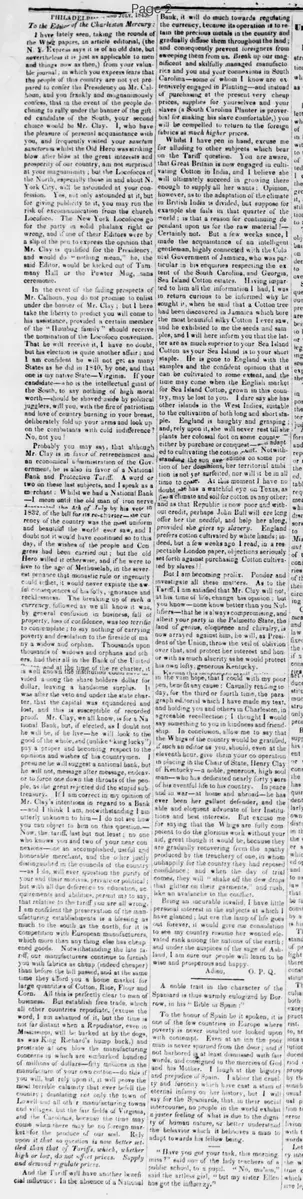
I have lately seen, taking the rounds of the whig papers, an article editorial, (the N. Y. Express says it is of an old date, but nevertheless it is just as applicable to men and things now as then,) from your valuable journal; in which you express fears that the people of this country are not yet prepared to confer the Presidency on Mr. Calhoun, and you frankly and magnanimously confess, that in the event of the people declining to rally under the banner of the gifted candidate of the South, your second choice would be Mr. Clay. I, who have the pleasure of personal acquaintance with you, and frequently visited your sanctum sanctorum whilst the Old Hero was striking blow after blow at the great interests and prosperity of our country, am not surprised at your magnanimity; but the Locofocos of the North, especially those in and about New York City, will be astounded at your confession. Yes, not only astounded at it, but for giving publicity to it, you may run the risk of excommunication from the church Locofoco. The New York Locofocos go for the party in solid phalanx right or wrong, and if one of their Editors were by a slip of the pen to express the opinion that Mr. Clay is qualified for the Presidency, and would do "nothing mean," he, the said Editor, would be kicked out of Tammany Hall or the Pewter Mug, sans ceremonie.
In the event of the fading prospects of Mr. Calhoun, you do not promise to enlist under the banner of Mr. Clay; but I here take the liberty to predict you will come to his assistance, provided a certain member of the "humbug family" should receive the nomination of the Locofoco convention. That he will receive it, I have no doubt, but his election is quite another affair; and I am confident he will not get as many States as he did in 1840, by one, and that one is my native State—Virginia. If your candidate—who is the intellectual giant of the South, to say nothing of high moral worth—should be shoved aside by political jugglers, will you, with the fire of patriotism and love of country burning in your breast, deliberately fold up your arms and look on the combatants with cold indifference? No, not you!
Probably you may say, that although Mr. Clay is in favor of retrenchment and an economical administration of the Government, he is also in favor of a National Bank and Protective Tariff. A word or two on these last subjects, and I speak as a merchant: Whilst we had a National Bank—I mean until the old man of iron nerve consummated the 4th of July by his veto in 1832, of the bill for its re-charter—we currency of the country was the most uniform and beautiful the world ever saw, and I doubt not it would have continued so to this day, if the wishes of the people and Congress had been carried out; but the old Hero willed it otherwise, and if he were to live to the age of Methuselah, in the severest penance that monastic rule or ingenuity could inflict, it would never expiate the awful consequences of his folly, ignorance and recklessness. The breaking up of such a currency, followed as we all know it was, by general confusion in business, fall of property, loss of confidence, was too terrific to contemplate; to say nothing of carrying poverty and desolation to the fireside of many a widow and orphan. Thousands upon thousands of widows and orphans and others, had their all in the Bank of the United States, which is well known, and at the end the effects were divided among the shareholders dollar for dollar, leaving a handsome surplus. It was after the veto and under the state charter, that the capital was squandered and lost, and this is susceptible of recorded proof. Mr. Clay, we all know, is for a National Bank, but, if elected, as I doubt not he will be, if he live—he will look to the good of the whole, and (unlike "king lucky") pay a proper and becoming respect to the opinions and wishes of his countrymen. I presume he will suggest a national bank, but he will not, message after message, endeavor to force one down the throats of the people, as the great rejected did the stupid sub-treasury. If I am correct in my opinion of Mr. Clay's intentions in regard to a Bank—and I think I am, notwithstanding I am utterly unknown to him—I do not see how you can object to him on this question.
Now, the tariff, last but not least: no one who knows you and two of your near connexions—one an accomplished, useful and honorable merchant, and the other justly distinguished in the councils of the country—as I do, will ever question the purity of your and their motives, private or political; but with all due deference to education, acquirements and abilities, permit me to say, that relative to the tariff you are all wrong: I am confident the preservation of the manufacturing establishments is a blessing as much to the south as the north, for it is competition with European manufacturers, which more than anything else has cheapened goods. Notwithstanding the late tariff, our manufacturers continue to furnish you with fabrics as cheap (indeed cheaper) than before the bill passed, and at the same time they afford you a home market for large quantities of Cotton, Rice, Flour and Corn. All this is perfectly clear to men of business. But establish free trade, which all other countries repudiate, (excuse the word. I am ashamed of it, but the time is not far distant when a Repudiator, even in Mississippi, will be barked at by the dogs as was King Richard's humpback,) and prostrate at one blow the manufacturing concerns in which are embarked hundreds of millions of dollars—fifty millions in the manufacture of your own cotton—do this if you will, but rely upon it, it will prove the most terrible calamity that ever befell the country; desolating not only the town of Lowell and all other manufacturing towns and villages, but the fair fields of Virginia, and the Carolinas, because the time may come when there may be no foreign market for the produce of our soil. Rely upon it that no question is more better settled than that of Tariffs, which, whether high or low, do not affect prices. Supply and demand regulate prices. And the Tariff will have another beneficial influence: In the absence of a National Bank, it will do much towards regulating the currency, because its operation is to retain the precious metals in the country and gradually diffuse them throughout the land; and consequently prevent foreigners from sweeping them from us. Break up our magnificent and skilfully managed manufactories and you and your connexions in South Carolina—some of whom I know are extensively engaged in Planting—and instead of purchasing at the present very cheap prices, supplies for yourselves and your slaves (a South Carolina Planter is proverbially for making his slave comfortable,) you will be compelled to return to the foreign fabrics at much higher prices.
Whilst I have pen in hand, excuse me for alluding to other subjects which bear on the Tariff question. You are aware, that Great Britain is now engaged in cultivating Cotton in India, and I believe she will ultimately succeed in growing there enough to supply all her wants: Opinion, however, as to the adaptation of the climate in British India is divided, but suppose for example she fails in that quarter of the world; is that a reason for continuing dependent upon us for the raw material?—Certainly not. But a few weeks since, I made the acquaintance of an intelligent gentleman, highly connected with the Colonial Government of Jamaica, who was particular in his enquiries respecting the extent of the South Carolina, and Georgia, Sea Island Cotton estates. Having imparted to him all the information I had, I was in return curious to be informed why he sought it, when he said that a Cotton tree had been discovered in Jamaica which bore the most beautiful silk Cotton I ever saw, and he exhibited to me the seeds and samples, and I will here inform you that the latter are as much superior to your Sea Island Cotton as your Sea Island is to your short staple. He is gone to England with the samples and the confident opinion that it can be cultivated to some extent, and the time may come when the English market for Sea Island Cotton, grown in this country, may be lost to you. I dare say she has other islands in the West Indies, suitable to the cultivation of both long and short staple. England is haughty and grasping; and, rely upon it, she will never rest till she plants her colossal foot on some country either by purchase or conquest—e.g. adapted to cultivating the cotton plant. Notwithstanding the sun ever shines on some portion of her dominions, her territorial ambition is not yet surfeited, nor will it be at all time to cease. At this moment I have no doubt she has a watchful eye on Texas, as fine a climate and soil for cotton as any other; and as that Republic is now poor and without credit, perhaps John Bull will ere long offer her the needful, and help her along, provided she gives up slavery. England prefers cotton cultivated by white hands; indeed, but a few weeks ago I read, in a respectable London paper, objections seriously set forth against purchasing Cotton cultivated by slaves!!
But I am becoming prolix. Ponder and investigate all these matters. As to the Tariff, I am satisfied that Mr. Clay will not, at his time of life, change his opinion; but you know—none know better than you Nullifiers—that he is always compromising, and albeit your party in the Palmetto State, the land of genius, eloquence and chivalry, is now arrayed against him, he will, as President of the Union, throw the veil of oblivion over that, and protect her interest and honor with as much alacrity as he would protect his own lofty, generous Kentucky.
Excuse the sympathy in the vain hope, that I could with my poor pen, benefit any cause: Casually reading to-day, for the third or fourth time, the paragraph editorial which I have made my text, and holding you and others in Charleston, in agreeable recollection; I thought I would say something to you in kindness and friendship. In conclusion, allow me to say that the Whigs of the country would be gratified, if such an editor as you, should, even at the eleventh hour, give them your co-operation in placing in the Chair of State, Henry Clay of Kentucky—a noble, generous, high souled man—who has dedicated nearly forty years of his eventful life to his country. In peace and in war—at home and abroad—he has ever been her gallant defender, and the able and eloquent advocate of her Institutions and best interests. But excuse me for saying that the Whigs are fully competent to do the glorious work without your aid, great though it would be, because they are gradually recovering from the apathy produced by the treachery of one, in whom unhappily for the country they had reposed confidence; and when the day of trial comes, they will "shake off the dew drops that glitter on their garments," and rush, like an avalanche to the conflict.
Being an incurable invalid, I have little personal interest in the subjects at which I have glanced; but ere the lamp of life goes out forever, it would give me consolation to see my country resume her wonted elevated rank among the nations of the earth; and under the auspices of the sage of Ashland, I am sure our people will learn to be wise and prosperous and happy.
Adieu,
O. P. Q.
What sub-type of article is it?
What themes does it cover?
What keywords are associated?
What entities or persons were involved?
Letter to Editor Details
Author
O. P. Q.
Recipient
To The Editor Of The Charleston Mercury
Main Argument
the writer urges the editor to support henry clay for president if john c. calhoun fails, defending clay's stances on a national bank and protective tariff as beneficial to the south and the nation, while criticizing jackson's policies and predicting economic disaster from free trade.
Notable Details