Thank you for visiting SNEWPapers!
Sign up free
Editorial
June 5, 1818
Richmond Enquirer
Richmond, Richmond County, Virginia
What is this article about?
Editorial from Richmond defends President Monroe's administration against the Kentucky Lexington Reporter's criticism of his conciliatory policies toward Federalists and constitutional objections to federal internal improvements, asserting alignment with core Republican principles and predicting continued party support.
Clipping
OCR Quality
95%
Excellent
Full Text
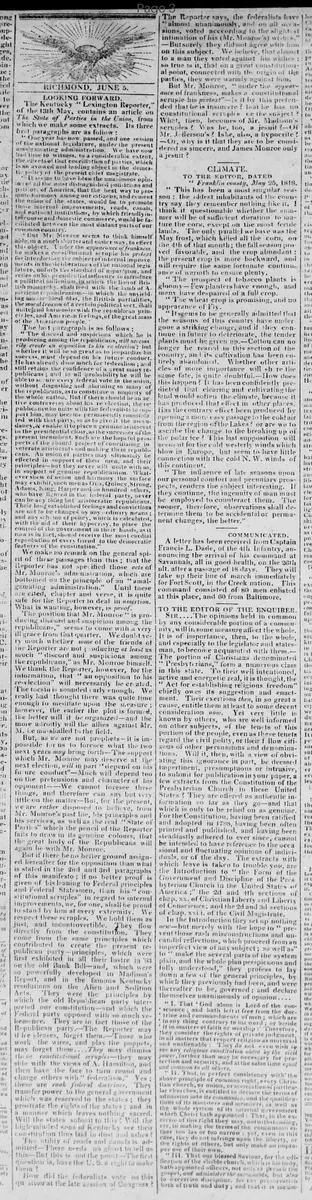
RICHMOND, JUNE 5.
LOOKING FORWARD.
The Kentucky 'Lexington Reporter,' of the 13th May, contains an article on The State of Parties in the Union, from which we make some extracts. Its three first paragraphs are as follow:
"One year has now passed, and one session of the national legislature, under the present amalgamating administration. We have now had time to witness, to a considerable extent, the effects of that conciliation of parties, which is an avowed and leading object in the domestic policy of the present chief magistrate. It seems to have been the unanimous opinion of all the most distinguished politicians and patriots of America, that the best way to promote harmony among our citizens, and cement the union of the states, would be to promote those internal improvements, roads, canals, and national institutions, by which friendly intercourse and domestic commerce, would be facilitated between the most distant parts of our common country. But Mr. Monroe seems to think himself able, in a much shorter and easier way, to effect this object. Under the appearance of frankness, he makes a constitutional scruple his pretext for interdicting the subject of internal improvements in the deliberations of the national legislature, unfurls the standard of nepartysm, and relies on his presidential influence to introduce a political millennium, in which the lion of British monarchy, shall feed with the lamb of American republicanism—in which the unsheilding monarchical bias, the British partialities, the moral treason of a certain political sect, shall unite and harmonize with the republican principles, and American feelings, of the great mass of the American people."
The last paragraph is as follows:
"The discord and suspicions which he is producing among the republicans, will necessarily create an opposition to his re-election: but whether it will be so great as to jeopardize his success, must depend on his future conduct. He has already done much for federalism: and still retains the confidence of a great many republicans; and in all probability he will be able to secure every federal vote in the union, without disgusting and alarming so many of the republicans, as to constitute a majority of the whole nation. But if there should be an active controversy about his re-election, the republicans who unite with the federalists to support him, may become permanently consolidated with that party, so as to give it the ascendancy, and enable it to place a genuine aristocrat in the presidential chair, as the successor of the present incumbent. Such are the hopeful prospects of the absurd project of conciliating inveterate aristocrats and making them republicans. An union of parties may ultimately be effected in support of their men, and their principles—but they never will unite with us, in support of genuine republicanism, whatever show of union and harmony the surface may exhibit, such men as Otis, Quincy, Strong, Adams, King, Harper and an hundred others, who have figured in the federal party, never can be any thing but aristocratic republicans. Their long established feelings and convictions are not to be changed by any ordinary means; and any scheme of policy, which is calculated, with the aid of their hypocrisy, to place the control of the government in their hands, as it now is in fact, should receive the most cordial reprobation of every friend to the democratic features of the constitution."
We make no remark on the general spirit of these passages than this: that the Reporter has not specified those acts of Mr. Monroe’s administration, which are bottomed on the principle of an "amalgamating administration." Until these are cited, chapter and verse, it is quite safe for the Reporter to deal in assertion. What is wanting, however, is proof.
The position that Mr. Monroe "is producing discord and suspicion among the republicans," seems to come with a very ill grace from that quarter. We doubt very much whether some of the friends of the Reporter are not producing at least as much "discord and suspicions among the republicans," as Mr. Monroe himself.
We thank the Reporter, however, for the information, that "an opposition to his re-election" will necessarily be created. The tocsin is sounded early enough. We really had thought there was quite time enough to meditate upon the measure; however, the earlier the plot is formed, the better will it be organized—and the more adroitly will the allies against Mr. M. be marshalled to the field.
But, as we are not prophets—it is impossible for us to foresee what the two next years may bring forth—The support which Mr. Monroe may deserve at the next election, will in part "depend on his future conduct"—Much will depend too on the pretensions and character of his opponent—We cannot foresee these things, and therefore can say but very little on the matter—But, for the present, we are rather disposed to believe, from Mr. Monroe’s past life, his principles and his services, as well as the real "State of Parties" which the pencil of the Reporter fails to draw in its genuine colours, that the great body of the Republicans will again be with Mr. Monroe.
But if there be no better ground assigned hereafter for the opposition than what is stated in the 2nd and 3rd paragraphs of this manifesto; if no better proof is given of his leaning to Federal principles and Federal Statesmen, than his "constitutional scruples" in regard to internal improvements, we, for one, shall be proud to stand by him at every extremity. We respect these scruples. We hold them as just, and incontrovertible. They flow directly from the constitution. They come from the same principles which contributed to create the present republican party—principles, which were first exhibited in all their lustre in '93 on the old Bank Bill—and, which were so powerfully developed in Madison’s Report, and in the famous Kentucky resolutions on the Alien and Sedition Acts. They were the principles by which the old Republican party interpreted our constitution—and which the Federal party opposed with so much vehemence. They are in fact those of the Republican party.—The Reporter may if he pleases, forget them.—Those who work the wires, and play the puppets, may forget them....They may dismiss these constitutional scruples—they may side with the views of A. Hamilton, and then have the face to turn round and charge others with "federalism." Yes: these are rank federal doctrines. They transfer power to the general government which was reserved to the states; they prostrate the rights of the states; and in a manner which leaves nothing sacred. Will the states submit to this? Will the high-minded sons of Kentucky see their constitution thus laid in dust and ashes?
The utility of roads and canals is admitted—There needs no ghost to tell us this—But this is not the point—The first question is, have the U. S. a right to make them?
How did the federalists vote on this question at the late session of Congress?
The Reporter says, the federalists have "almost unanimously, and on all occasions, voted according to the slightest intimation of his (Mr. Monroe’s) wishes."—But surely they did not agree with him on this subject. We believe, that almost to a man they voted against his wishes so true is it, that on a great constitutional point, connected with the origin of the parties, they were warmly against him.
But Mr. Monroe, "under the appearance of frankness, makes a constitutional scruple his pretext"—Is it by this pretended that he is insincere? that he has no constitutional scruples on the subject? What, then, becomes of Mr. Madison’s scruples? Was he, too, a jesuit?—Or Mr. Jefferson’s? Is he, also, a hypocrite? —Or, why is it that they are to be considered as sincere, and James Monroe only a jesuit?
LOOKING FORWARD.
The Kentucky 'Lexington Reporter,' of the 13th May, contains an article on The State of Parties in the Union, from which we make some extracts. Its three first paragraphs are as follow:
"One year has now passed, and one session of the national legislature, under the present amalgamating administration. We have now had time to witness, to a considerable extent, the effects of that conciliation of parties, which is an avowed and leading object in the domestic policy of the present chief magistrate. It seems to have been the unanimous opinion of all the most distinguished politicians and patriots of America, that the best way to promote harmony among our citizens, and cement the union of the states, would be to promote those internal improvements, roads, canals, and national institutions, by which friendly intercourse and domestic commerce, would be facilitated between the most distant parts of our common country. But Mr. Monroe seems to think himself able, in a much shorter and easier way, to effect this object. Under the appearance of frankness, he makes a constitutional scruple his pretext for interdicting the subject of internal improvements in the deliberations of the national legislature, unfurls the standard of nepartysm, and relies on his presidential influence to introduce a political millennium, in which the lion of British monarchy, shall feed with the lamb of American republicanism—in which the unsheilding monarchical bias, the British partialities, the moral treason of a certain political sect, shall unite and harmonize with the republican principles, and American feelings, of the great mass of the American people."
The last paragraph is as follows:
"The discord and suspicions which he is producing among the republicans, will necessarily create an opposition to his re-election: but whether it will be so great as to jeopardize his success, must depend on his future conduct. He has already done much for federalism: and still retains the confidence of a great many republicans; and in all probability he will be able to secure every federal vote in the union, without disgusting and alarming so many of the republicans, as to constitute a majority of the whole nation. But if there should be an active controversy about his re-election, the republicans who unite with the federalists to support him, may become permanently consolidated with that party, so as to give it the ascendancy, and enable it to place a genuine aristocrat in the presidential chair, as the successor of the present incumbent. Such are the hopeful prospects of the absurd project of conciliating inveterate aristocrats and making them republicans. An union of parties may ultimately be effected in support of their men, and their principles—but they never will unite with us, in support of genuine republicanism, whatever show of union and harmony the surface may exhibit, such men as Otis, Quincy, Strong, Adams, King, Harper and an hundred others, who have figured in the federal party, never can be any thing but aristocratic republicans. Their long established feelings and convictions are not to be changed by any ordinary means; and any scheme of policy, which is calculated, with the aid of their hypocrisy, to place the control of the government in their hands, as it now is in fact, should receive the most cordial reprobation of every friend to the democratic features of the constitution."
We make no remark on the general spirit of these passages than this: that the Reporter has not specified those acts of Mr. Monroe’s administration, which are bottomed on the principle of an "amalgamating administration." Until these are cited, chapter and verse, it is quite safe for the Reporter to deal in assertion. What is wanting, however, is proof.
The position that Mr. Monroe "is producing discord and suspicion among the republicans," seems to come with a very ill grace from that quarter. We doubt very much whether some of the friends of the Reporter are not producing at least as much "discord and suspicions among the republicans," as Mr. Monroe himself.
We thank the Reporter, however, for the information, that "an opposition to his re-election" will necessarily be created. The tocsin is sounded early enough. We really had thought there was quite time enough to meditate upon the measure; however, the earlier the plot is formed, the better will it be organized—and the more adroitly will the allies against Mr. M. be marshalled to the field.
But, as we are not prophets—it is impossible for us to foresee what the two next years may bring forth—The support which Mr. Monroe may deserve at the next election, will in part "depend on his future conduct"—Much will depend too on the pretensions and character of his opponent—We cannot foresee these things, and therefore can say but very little on the matter—But, for the present, we are rather disposed to believe, from Mr. Monroe’s past life, his principles and his services, as well as the real "State of Parties" which the pencil of the Reporter fails to draw in its genuine colours, that the great body of the Republicans will again be with Mr. Monroe.
But if there be no better ground assigned hereafter for the opposition than what is stated in the 2nd and 3rd paragraphs of this manifesto; if no better proof is given of his leaning to Federal principles and Federal Statesmen, than his "constitutional scruples" in regard to internal improvements, we, for one, shall be proud to stand by him at every extremity. We respect these scruples. We hold them as just, and incontrovertible. They flow directly from the constitution. They come from the same principles which contributed to create the present republican party—principles, which were first exhibited in all their lustre in '93 on the old Bank Bill—and, which were so powerfully developed in Madison’s Report, and in the famous Kentucky resolutions on the Alien and Sedition Acts. They were the principles by which the old Republican party interpreted our constitution—and which the Federal party opposed with so much vehemence. They are in fact those of the Republican party.—The Reporter may if he pleases, forget them.—Those who work the wires, and play the puppets, may forget them....They may dismiss these constitutional scruples—they may side with the views of A. Hamilton, and then have the face to turn round and charge others with "federalism." Yes: these are rank federal doctrines. They transfer power to the general government which was reserved to the states; they prostrate the rights of the states; and in a manner which leaves nothing sacred. Will the states submit to this? Will the high-minded sons of Kentucky see their constitution thus laid in dust and ashes?
The utility of roads and canals is admitted—There needs no ghost to tell us this—But this is not the point—The first question is, have the U. S. a right to make them?
How did the federalists vote on this question at the late session of Congress?
The Reporter says, the federalists have "almost unanimously, and on all occasions, voted according to the slightest intimation of his (Mr. Monroe’s) wishes."—But surely they did not agree with him on this subject. We believe, that almost to a man they voted against his wishes so true is it, that on a great constitutional point, connected with the origin of the parties, they were warmly against him.
But Mr. Monroe, "under the appearance of frankness, makes a constitutional scruple his pretext"—Is it by this pretended that he is insincere? that he has no constitutional scruples on the subject? What, then, becomes of Mr. Madison’s scruples? Was he, too, a jesuit?—Or Mr. Jefferson’s? Is he, also, a hypocrite? —Or, why is it that they are to be considered as sincere, and James Monroe only a jesuit?
What sub-type of article is it?
Partisan Politics
Constitutional
Infrastructure
What keywords are associated?
Monroe Administration
Internal Improvements
Constitutional Scruples
Republican Party
Federalism
Party Union
Re Election Opposition
What entities or persons were involved?
Mr. Monroe
Kentucky Lexington Reporter
Federalists
Otis
Quincy
Strong
Adams
King
Harper
Madison
Jefferson
A. Hamilton
Editorial Details
Primary Topic
Defense Of Monroe's Constitutional Stance On Internal Improvements And Non Partisan Policy
Stance / Tone
Supportive Of Monroe, Critical Of Republican Opposition
Key Figures
Mr. Monroe
Kentucky Lexington Reporter
Federalists
Otis
Quincy
Strong
Adams
King
Harper
Madison
Jefferson
A. Hamilton
Key Arguments
Monroe's Conciliatory Policy Lacks Specified Acts Of Amalgamation
Constitutional Scruples On Internal Improvements Align With Republican Principles From 1793 Bank Bill And Kentucky Resolutions
Reporter's Opposition Creates Discord Among Republicans
Federalists Opposed Monroe On Internal Improvements Vote
Monroe's Stance Is Sincere, Not Pretext, Unlike Accusations