Thank you for visiting SNEWPapers!
Sign up free
Editorial
May 7, 1838
Lynchburg Virginian
Lynchburg, Virginia
What is this article about?
This editorial critiques the Washington Chronicle's inconsistent positions on abolitionism, accusing it of shifting to alarm the South about Whig leaders like Clay while previously supporting Van Buren despite similar charges. It defends Clay as no true abolitionist and argues Southern leaders historically favored gradual emancipation without Northern interference.
Clipping
OCR Quality
95%
Excellent
Full Text
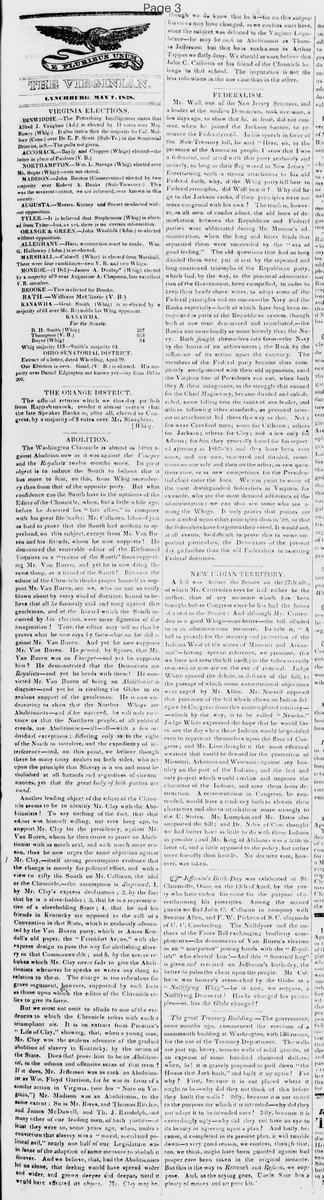
ABOLITION.
The Washington Chronicle is almost as bitter against Abolition now as it was against the Usurper and the Royalists twelve months since. Its great object is to induce the South to believe that it has more to fear, on this, from Whig ascendency than from that of the opposite party. But what confidence can the South have in the opinions of the Editor of the Chronicle, when, but a little while ago before he deserted his "late allies," in company with his great fleader, Mr. Calhoun, labored just as hard to prove that the South had nothing to apprehend, on this subject, except from Mr. Van Buren and his friends, whom he now supports! He denounced the venerable editor of the Richmond Enquirer as a "traitor of the South" from supporting Mr. Van Buren, and yet he is now doing the same thing, as a friend of the South! Because the editor of the Chronicle thinks proper himself to support Mr. Van Buren, are we, who are not so easily blown about by every wind of doctrine, bound to believe that all he formerly said and sung against that gentleman, and of the hazard which the South incurred by his election, were mere figments of the imagination! True, the editor may tell us that he proves what he now says by facts—but so he did against Mr. Van Buren. And yet he now supports Mr. Van Buren. He proved, by figures, that Mr. Van Buren was an Usurper—and yet he supports him? He demonstrated that the Democrats are Royalists—and yet he herds with them! He convicted Mr. Van Buren of being an Abolitionist in disguise—and yet he is rivalling the Globe in its zealous support of the gentleman. He is now endeavoring to show that the Norther Whigs are Abolitionists—and if he succeed, he will only convince us that the Northern people, of all political creeds, are Abolitionists—all—all—with a few individual exceptions; differing only as to the right of the North to interfere, and the expediency of interference—and, on this point, we believe though there be many noisy zealots on both sides, who act upon the principle that Slavery is a sin and must be abolished at all hazards and regardless of circumstances, yet that the great body of both parties are sound.
Another leading object of the editor of the Chronicle seems to be to identify Mr. Clay with the Abolitionists! To say nothing of the fact, that that editor was himself willing, not very long ago, to support Mr. Clay for the presidency, against Mr. Van Buren, whom he then strove to prove an Abolitionist with as much zeal, and with much more reason, than he now urges the same objection against Mr. Clay,—itself strong presumptive evidence that the change is merely for political effect, and with a view to rally the South on Mr. Calhoun, the idol of the Chronicle,—the assumption is disproved, 1, by Mr. Clay's express declaration; 2, by the fact that he is a slave-holder; 3, that he is a representative of a slaveholding State; 4, that he and his friends in Kentucky are opposed to the call of a Convention in that State, which is zealously advocated by the Van Buren party, which is Amos Kendall's old paper, the "Frankfort Argus," with the express design to pave the way for abolishing slavery in that Commonwealth; and 5, by the severe rebukes which Mr. Clay never fails to give the Abolitionists whenever he speaks or writes any thing in relation to them. The charge is too ridiculous for grave argument, however, supported by such facts as those upon which the editor of the Chronicle relies to give it force.
But we must not omit to allude to one of the evidences to which the Chronicle refers with such a triumphant air. It is an extract from Prentice's "Life of Clay," showing, that, when a young man, Mr. Clay was the zealous advocate of the gradual abolition of slavery in Kentucky, by the action of the State. Does that prove him to be an Abolitionist, in the odious and offensive sense of that term? If it does, Mr. Jefferson was as rank an Abolitionist as Wm. Lloyd Garrison, for he was in favor of a similar action in Virginia, (see his "Notes on Virginia,") Mr. Madison was an Abolitionist, to the same extent: So is Mr. Rives, and Thomas Ritchie, and James McDowell, and Th. J. Randolph, and many other of our leading men, of both parties—at least they were so, some years ago, when, under a conviction that slavery was a "moral, social and political evil," nearly one half of our Legislature was in favor of the adoption of some measure to abolish it forever. And we believe, that, had the Abolitionists let us alone, that feeling would have spread wider and wider, and grown deeper and deeper, until it would have effected its object. Mr. Clay may be, though we do know that he is—for on this subject his views may have changed, as we confess ours have, since the subject was debated in the Virginia Legislature—he may be such an Abolitionist as Thomas Jefferson: but that he is such a one as Arthur Tappan we flatly deny. We should as soon believe that John C. Calhoun or his friend of the Chronicle belongs to that school. The imputation is not the less ridiculous in the one case than in the other.
The Washington Chronicle is almost as bitter against Abolition now as it was against the Usurper and the Royalists twelve months since. Its great object is to induce the South to believe that it has more to fear, on this, from Whig ascendency than from that of the opposite party. But what confidence can the South have in the opinions of the Editor of the Chronicle, when, but a little while ago before he deserted his "late allies," in company with his great fleader, Mr. Calhoun, labored just as hard to prove that the South had nothing to apprehend, on this subject, except from Mr. Van Buren and his friends, whom he now supports! He denounced the venerable editor of the Richmond Enquirer as a "traitor of the South" from supporting Mr. Van Buren, and yet he is now doing the same thing, as a friend of the South! Because the editor of the Chronicle thinks proper himself to support Mr. Van Buren, are we, who are not so easily blown about by every wind of doctrine, bound to believe that all he formerly said and sung against that gentleman, and of the hazard which the South incurred by his election, were mere figments of the imagination! True, the editor may tell us that he proves what he now says by facts—but so he did against Mr. Van Buren. And yet he now supports Mr. Van Buren. He proved, by figures, that Mr. Van Buren was an Usurper—and yet he supports him? He demonstrated that the Democrats are Royalists—and yet he herds with them! He convicted Mr. Van Buren of being an Abolitionist in disguise—and yet he is rivalling the Globe in its zealous support of the gentleman. He is now endeavoring to show that the Norther Whigs are Abolitionists—and if he succeed, he will only convince us that the Northern people, of all political creeds, are Abolitionists—all—all—with a few individual exceptions; differing only as to the right of the North to interfere, and the expediency of interference—and, on this point, we believe though there be many noisy zealots on both sides, who act upon the principle that Slavery is a sin and must be abolished at all hazards and regardless of circumstances, yet that the great body of both parties are sound.
Another leading object of the editor of the Chronicle seems to be to identify Mr. Clay with the Abolitionists! To say nothing of the fact, that that editor was himself willing, not very long ago, to support Mr. Clay for the presidency, against Mr. Van Buren, whom he then strove to prove an Abolitionist with as much zeal, and with much more reason, than he now urges the same objection against Mr. Clay,—itself strong presumptive evidence that the change is merely for political effect, and with a view to rally the South on Mr. Calhoun, the idol of the Chronicle,—the assumption is disproved, 1, by Mr. Clay's express declaration; 2, by the fact that he is a slave-holder; 3, that he is a representative of a slaveholding State; 4, that he and his friends in Kentucky are opposed to the call of a Convention in that State, which is zealously advocated by the Van Buren party, which is Amos Kendall's old paper, the "Frankfort Argus," with the express design to pave the way for abolishing slavery in that Commonwealth; and 5, by the severe rebukes which Mr. Clay never fails to give the Abolitionists whenever he speaks or writes any thing in relation to them. The charge is too ridiculous for grave argument, however, supported by such facts as those upon which the editor of the Chronicle relies to give it force.
But we must not omit to allude to one of the evidences to which the Chronicle refers with such a triumphant air. It is an extract from Prentice's "Life of Clay," showing, that, when a young man, Mr. Clay was the zealous advocate of the gradual abolition of slavery in Kentucky, by the action of the State. Does that prove him to be an Abolitionist, in the odious and offensive sense of that term? If it does, Mr. Jefferson was as rank an Abolitionist as Wm. Lloyd Garrison, for he was in favor of a similar action in Virginia, (see his "Notes on Virginia,") Mr. Madison was an Abolitionist, to the same extent: So is Mr. Rives, and Thomas Ritchie, and James McDowell, and Th. J. Randolph, and many other of our leading men, of both parties—at least they were so, some years ago, when, under a conviction that slavery was a "moral, social and political evil," nearly one half of our Legislature was in favor of the adoption of some measure to abolish it forever. And we believe, that, had the Abolitionists let us alone, that feeling would have spread wider and wider, and grown deeper and deeper, until it would have effected its object. Mr. Clay may be, though we do know that he is—for on this subject his views may have changed, as we confess ours have, since the subject was debated in the Virginia Legislature—he may be such an Abolitionist as Thomas Jefferson: but that he is such a one as Arthur Tappan we flatly deny. We should as soon believe that John C. Calhoun or his friend of the Chronicle belongs to that school. The imputation is not the less ridiculous in the one case than in the other.
What sub-type of article is it?
Slavery Abolition
Partisan Politics
What keywords are associated?
Abolition
Van Buren
Clay
Calhoun
Southern Fears
Political Inconsistency
Gradual Emancipation
Kentucky Convention
What entities or persons were involved?
Washington Chronicle
Mr. Calhoun
Mr. Van Buren
Mr. Clay
Richmond Enquirer
Amos Kendall
Thomas Jefferson
James Madison
John C. Calhoun
Editorial Details
Primary Topic
Critique Of Political Manipulation Of Abolition Fears
Stance / Tone
Skeptical And Defensive Of Southern Interests Against Opportunistic Charges
Key Figures
Washington Chronicle
Mr. Calhoun
Mr. Van Buren
Mr. Clay
Richmond Enquirer
Amos Kendall
Thomas Jefferson
James Madison
John C. Calhoun
Key Arguments
Chronicle's Editor Inconsistent In Abolition Accusations Against Van Buren And Now Clay For Political Gain
South Should Distrust Chronicle Due To Past Support For Calhoun And Shifts
Clay Not An Abolitionist: Slaveholder, Opposes Kentucky Convention, Rebukes Abolitionists
Early Advocacy For Gradual State Led Abolition Common Among Southern Leaders Like Jefferson, Not Equivalent To Radical Abolitionism
Northern Interference Hinders Southern Gradual Emancipation Efforts