Thank you for visiting SNEWPapers!
Sign up free
The Virginia Gazette
Richmond, Williamsburg, Richmond County, Virginia
What is this article about?
Massachusetts Council committee report from June 1773 authenticates letters by Gov. Thomas Hutchinson and Lt. Gov. Andrew Oliver (1767-1769), critiques their misrepresentations of colonial events, Council actions, and advocacy for troops/revenue acts, blaming them for escalating British-colonial tensions and recommending their removal.
Merged-components note: This is a continuous narrative report of the Committee on the Governor's and Lieutenant Governor's letters, spanning pages 2 and 3 in sequential reading order. Merging into a single story component; relabeling the second part from domestic_news to story for consistency with the dominant narrative content.
Clippings
1 of 2
OCR Quality
Full Text
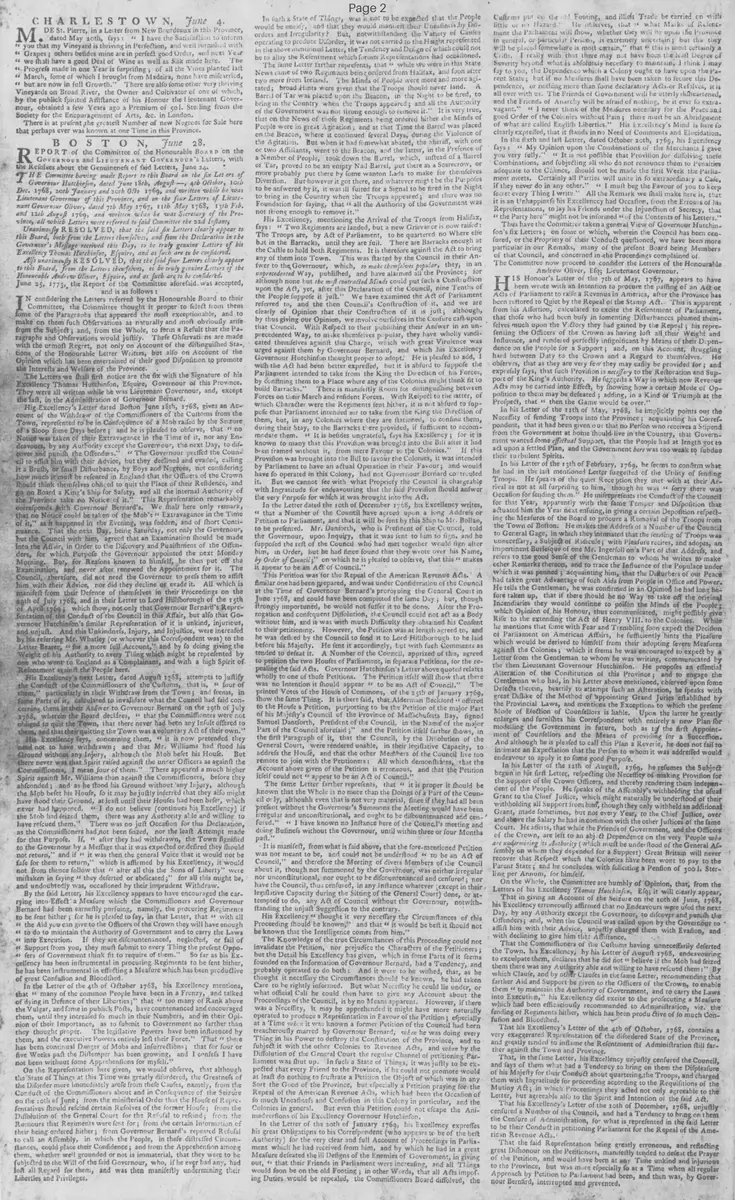
REPORT of the Committee of the Honourable Board on the Governour and Lieutenant Governour's Letters, with the Resolves about the Genuineness of said Letters, June 24.
THE Committee having made Report to this Board on the six Letters of Governour Hutchinson, dated June 18th, August -, 4th October, 10th Dec. 1768, 20th January and 20th Oct. 1769, and written while he was Lieutenant Governour of this Province, and on the four Letters of Lieutenant Governour Oliver, dated 7th May 1767, 11th May 1768, 13th Feb. and 12th August 1769, and written when he was Secretary of the Province, all which Letters were referred to said Committee the 22d Instant,
Unanimously RESOLVED, that the said six Letters clearly appear to this Board, both from the Letters themselves, and from the Declaration in the Governour's Message received this Day, to be truly genuine Letters of his Excellency Thomas Hutchinson, Esquire, and as such are to be considered.
Also unanimously RESOLVED, that the said four Letters clearly appear, to this Board, from the Letters themselves, to be truly genuine Letters of the Honourable Andrew Oliver, Esquire, and as such are to be considered.
June 25, 1773, the Report of the Committee aforesaid, was accepted, and is as follows:
In considering the Letters referred by the Honourable Board to their Committee, the Committee thought it proper to select from them some of the Paragraphs that appeared the most exceptionable, and to make on them such Observations as naturally and most obviously arise from the Subject; and, from the Whole, to form a Result that the Paragraphs and Observations would justify. These Observations are made with the utmost Regret, not only on Account of the distinguished Stations of the Honourable Letter Writers, but also on Account of the Opinion which has been entertained of their good Disposition to promote the Interests and Welfare of the Province.
The Letters we shall first notice are the six with the Signature of his Excellency Thomas Hutchinson, Esquire, Governour of this Province. They were all written while he was Lieutenant Governour, and, except the last, in the Administration of Governour Bernard.
His Excellency's Letter dated Boston June 18th, 1768, gives an Account of the Withdraw of the Commissioners of the Customs from the Town, represented to be in Consequence of a Mob raised by the Seizure of a Sloop some Days before; and he is pleased to observe, that "no Notice was taken of their Extravagance in the Time of it, nor any Endeavours, by any Authority except the Governour, the next Day, to discover and punish the Offenders." "The Governour pressed the Council to assist him with their Advice, but they declined and evaded, calling it a Brush, or small Disturbance, by Boys and Negroes, not considering how much it must be resented in England that the Officers of the Crown should think themselves obliged to quit the Place of their Residence, and go on Board a King's Ship for Safety, and all the internal Authority of the Province take no Notice of it." This Representation remarkably corresponds with Governour Bernard's. We shall here only remark, that no Notice could be taken of the Mob's "Extravagance in the Time of it," as it happened in the Evening, was sudden, and of short Continuance. That the next Day, being Saturday, not only the Governour, but the Council with him, agreed that an Examination should be made into the Affair, in Order to the Discovery and Punishment of the Offenders, for which Purpose the Governour appointed the next Monday Morning. But, for Reasons known to himself, he then put off the Examination, and never after renewed the Appointment for it. The Council, therefore, did not need the Governour to press them to assist him with their Advice, nor did they decline or evade it. All which is manifest from their Defence of themselves in their Proceedings on the 29th of July 1768, and in their Letter to Lord Hillsborough of the 15th of April 1769; which show, not only that Governour Bernard's Representation of the Conduct of the Council in this Affair, but also that Governour Hutchinson's similar Representation of it is unkind, injurious, and unjust. And this Unkindness, Injury, and Injustice, were increased by his referring Mr. Whatley (or whoever this Correspondent was) to the Letter Bearer, "for a more full Account," and by so doing giving the Weight of his Authority to every Thing which might be represented by one who went to England as a Complainant, and with a high Spirit of Resentment against the People here.
His Excellency's next Letter, dated August 1768, attempts to justify the Conduct of the Commissioners of the Customs, that is, "four of them," particularly in their Withdraw from the Town; and seems, in some Parts of it, calculated to invalidate what the Council had said concerning them in their Answer to Governour Bernard on the 29th of July 1768, wherein the Board declares, "that the Commissioners were not obliged to quit the Town, that there never had been any Insult offered to them, and that their quitting the Town was a voluntary Act of their own."
His Excellency says, concerning them, "it is now pretended they need not to have withdrawn; and that Mr. Williams had stood his Ground without any Injury, although the Mob beset his House. But there never was that Spirit raised against the under Officers as against the Commissioners, I mean four of them." There appeared a much higher Spirit against Mr. Williams than against the Commissioners, before they absconded; and as he stood his Ground without any Injury, although the Mob beset his House, so it may be justly inferred that they also might have stood their Ground, at least until their Houses had been beset, which never had happened. "I do not believe (continues his Excellency) if the Mob had seized them, there was any Authority able and willing to have rescued them." There was no just Occasion for this Declaration, as the Commissioners had not been seized, nor the least Attempt made for that Purpose. If, "after they had withdrawn, the Town signified to the Governour by a Message that it was expected or desired they should not return," and if "it was then the general Voice that it would not be safe for them to return," which is affirmed by his Excellency, it would not from thence follow that "after all this the Sons of Liberty" were mistaken in saying "they deserted or abdicated;" for all this might be, and undoubtedly was, occasioned by their imprudent Withdraw.
By the said Letter, his Excellency appears to have encouraged the carrying into Effect a Measure which the Commissioners and Governour Bernard had been earnestly pursuing, namely, the procuring Regiments to be sent hither; for he is pleased to say, in that Letter, that "with all the Aid you can give to the Officers of the Crown they will have enough to do to maintain the Authority of Government and to carry the Laws into Execution. If they are discountenanced, neglected, or fail of Support from you, they must submit to every Thing the present Opposers of Government think fit to require of them." So far as his Excellency has been instrumental in procuring Regiments to be sent hither, he has been instrumental in effecting a Measure which has been productive of great Confusion and Bloodshed.
In the Letter of the 4th of October 1768, his Excellency mentions, that "many of the common People have been in a Frenzy, and talked of dying in Defence of their Liberties;" that "too many of Rank above the Vulgar, and some in public Posts, have countenanced and encouraged them, until they increased so much in their Numbers, and in their Opinion of their Importance, as to submit to Government no farther than they thought proper. The legislative Powers have been influenced by them, and the executive Powers entirely lost their Force." That "there has been continual Danger of Mobs and Insurrections; that for four or five Weeks past the Distemper has been growing, and I confess I have not been without some Apprehensions for myself."
On the Representation here given, we would observe, that although the State of Things at this Time was greatly disordered, the Greatness of the Disorder more immediately arose from these Causes, namely, from the Conduct of the Commissioners about and in Consequence of the Seizure on the 10th of June; from the ministerial Order that the House of Representatives should rescind certain Resolves of the former House; from the Dissolution of the General Court for the Refusal to rescind; from the Rumours that Regiments were sent for; from the certain Information of their being ordered hither; from Governour Bernard's repeated Refusal to call an Assembly, in which the People, in these distressed Circumstances, could place their Confidence; and from the Apprehension among them, whether well grounded or not is immaterial, that they were to be subjected to the Will of the said Governour, who, if he ever had any, had lost all Regard for them, and was then manifestly undermining their Liberties and Privileges.
In such a State of Things, was it not to be expected that the People would be uneasy, and that they would manifest their Uneasiness, by Disorders and Irregularity? But, notwithstanding the Variety of Causes operating to produce Disorder, it was not carried to the Height represented in the above mentioned Letter, the Tendency and Design of which could not be to allay the Resentment which former Representations had occasioned.
The same Letter farther represents, that "while we were in this State News came of two Regiments being ordered from Halifax, and soon after two more from Ireland. The Minds of People were more and more agitated; broad Hints were given that the Troops should never land. A Barrel of Tar was placed upon the Beacon, in the Night to be fired, to bring in the Country when the Troops appeared; and all the Authority of the Government was not strong enough to remove it." It is very true, that on the News of those Regiments being ordered hither the Minds of People were in great Agitation; and at that Time the Barrel was placed on the Beacon, where it continued several Days, during the Violence of the Agitation. But when it had somewhat abated, the Sheriff, with one or two Assistants, went to the Beacon, and the latter, in the Presence of a Number of People, took down the Barrel, which, instead of a Barrel of Tar, proved to be an empty Nail Barrel, put there as a Scarecrow, or more probably put there by some wanton Lads to make for themselves Diversion. But however it got there, and whatever might be the Purposes to be answered by it, it was ill suited for a Signal to be fired in the Night to bring in the Country when the Troops appeared; and there was no Foundation for saying, that "all the Authority of the Government was not strong enough to remove it."
His Excellency, mentioning the Arrival of the Troops from Halifax, says: "Two Regiments are landed, but a new Grievance is now raised: The Troops are, by Act of Parliament, to be quartered no Where else but in the Barracks, until they are full. There are Barracks enough at the Castle to hold both Regiments. It is therefore against the Act to bring any of them into Town. This was started by the Council in their Answer to the Governour, which, to make themselves popular, they, in an unprecedented Way, published, and have alarmed all the Province; for although none but the most contracted Minds could put such a Construction upon the Act, yet, after this Declaration of the Council, nine Tenths of the People suppose it just." We have examined the Act of Parliament referred to, and the then Council's Construction of it, and we are clearly of Opinion that their Construction of it is just; although, by thus giving our Opinion, we involve ourselves in the Censure cast upon that Council. With Respect to their publishing their Answer in an unprecedented Way, to make themselves popular, they have wholly vindicated themselves against this Charge, which with great Virulence was urged against them by Governour Bernard, and which his Excellency Governour Hutchinson thought proper to adopt. He is pleased to add, "I wish the Act had been better expressed, but it is absurd to suppose the Parliament intended to take from the King the Direction of his Forces, by confining them to a Place where any of the Colonies might think fit to build Barracks." There is manifestly Room for distinguishing between Forces on their March and resident Forces. With Respect to the latter, of which Character were the Regiments sent hither, it is not absurd to suppose that Parliament intended not to take from the King the Direction of them, but, in any Colonies where they are stationed, to confine them, during their Stay, to the Barracks there provided, if sufficient to accommodate them. "It is besides ungrateful, says his Excellency; for it is known to many that this Provision was brought into the Bill after it had been framed without it, from mere Favour to the Colonies." If this Provision was brought into the Bill to favour the Colonies, it was intended by Parliament to have an actual Operation in their Favour; and would have so operated in this Colony, had not Governour Bernard controverted it. But we cannot see with what Propriety the Council is chargeable with Ingratitude for endeavouring that the said Provision should answer the very Purpose for which it was brought into the Act.
In the Letter dated the 10th of December 1768, his Excellency writes, "that a Number of the Council have agreed upon a long Address or Petition to Parliament, and that it will be sent by this Ship to Mr. Bollan, to be presented. Mr. Danforth, who is President of the Council, told the Governour, upon Inquiry, that it was sent to him to sign, and he supposed the rest of the Council who had met together would sign after him, in Order, but he had since found that they wrote over his Name, by Order of Council;" on which he is pleased to observe, that this "makes it appear to be an Act of Council."
This Petition was for the Repeal of the American Revenue Acts. A similar one had been prepared, and was under Consideration of the Council at the Time of Governour Bernard's proroguing the General Court in June 1768, and could have been completed the same Day; but, though strongly importuned, he would not suffer it to be done. After the Prorogation and consequent Dissolution, the Council could not act as a Body without him, and it was with much Difficulty they obtained his Consent to their petitioning. However, the Petition was at length agreed to, and he was desired by the Council to send it to Lord Hillsborough to be laid before his Majesty. He sent it accordingly, but with such Comments as tended to defeat it. A Number of the Council, apprized of this, agreed to petition the two Houses of Parliament, in separate Petitions, for the repealing the said Acts. Governour Hutchinson's Letter above quoted relates wholly to one of those Petitions. The Petition itself will show that there was no Intention it should appear "to be an Act of Council." The printed Votes of the House of Commons, of the 25th of January 1769, show the same Thing. It is there said, that Alderman Beckford "offered to the House a Petition, purporting to be the Petition of the major Part of his Majesty's Council of the Province of Massachusetts Bay, signed Samuel Danforth, President of the Council, in the Name of the major Part of the Council aforesaid;" and the Petition itself farther shows, in the first Paragraph of it, that the Council, by the Dissolution of the General Court, were rendered unable, in their legislative Capacity, to address the House, and that the other Members of the Council live too remote to join with the Petitioners: All which demonstrates, that the Account above given of the Petition is erroneous, and that the Petition itself could not "appear to be an Act of Council."
The same Letter farther represents, that "it is proper it should be known that the Whole is no more than the Doings of a Part of the Council only, although even that is not very material, since if they had all been present without the Governour's Summons the Meeting would have been irregular and unconstitutional, and ought to be discountenanced and censured." "I have known no Instance here of the Council's meeting and doing Business without the Governour, until within three or four Months past."
It is manifest, from what is said above, that the fore-mentioned Petition was not meant to be, and could not be understood "to be an Act of Council," and therefore the Meeting of divers Members of the Council about it, though not summoned by the Governour, was neither irregular nor unconstitutional, nor ought to be discountenanced and censured; nor have the Council, thus censured, in any Instance whatever (except in their legislative Capacity during the Sitting of the General Court) done, or attempted to do, any Act of Council without the Governour, notwithstanding the unjust Suggestion to the contrary.
His Excellency "thought it very necessary the Circumstances of this Proceeding should be known," and that "it would be best it should not be known that the Intelligence comes from him."
The Knowledge of the true Circumstances of this Proceeding could not invalidate the Petition, nor prejudice the Characters of the Petitioners; but the Detail his Excellency has given, which in some Parts of it seems founded on the Information of Governour Bernard, had a Tendency, and probably operated to do both: And it were to be wished, that, as he thought it necessary the Circumstances should be known, he had taken Care to be rightly informed. But what Necessity he could lie under, or what official Call he could then have to give any Account about the Proceedings of the Council, is by no Means apparent. However, if there was a Necessity, it may be apprehended it might have more naturally operated to produce a Representation in Favour of the Petition; especially at a Time when it was known a former Petition of the Council had been treacherously marred by Governour Bernard, when he was doing every Thing in his Power to destroy the Constitution of the Province, and to subject it with the other Colonies to Revenue Acts, and when by the Dissolution of the General Court the regular Channel of petitioning Parliament was shut up. In such a State of Things, it was justly to be expected that every Friend to the Province, if he could not promote would at least do nothing to frustrate a Petition the Object of which was in any Sort the Good of the Province, but especially a Petition praying for the Repeal of the American Revenue Acts, which had been the Occasion of so much Uneasiness and Confusion in this Colony in particular, and the Colonies in general. But even this Petition could not escape the Animadversions of his Excellency Governour Hutchinson.
In the Letter of the 20th of January 1769, his Excellency expresses his great Obligations to his Correspondent (who appears to be of the best Authority) for the very clear and full Account of Proceedings in Parliament which he had received from him, and by which he had in a great Measure defeated the ill Designs of the Enemies of Government, in giving out, "that their Friends in Parliament were increasing, and all Things would soon be on the old Footing; in other Words, that all Acts imposing Duties would be repealed, the Commissioners Board dissolved, the Customs put on the old Footing, and illicit Trade be carried on with little or no Hazard." He observes, that what Marks of Resentment the Parliament will show, whether they will fall upon the Province in general, or particular Persons, is extremely uncertain; but that they will be placed somewhere is most certain," that "this is most certainly a Crisis. I really wish that there may not have been the least Degree of Severity beyond what is absolutely necessary to maintain, I think I may say to you, the Dependence which a Colony ought to have upon the Parent State; but if no Measures shall have been taken to secure this Dependence, or nothing more than some declaratory Acts or Resolves, it is all over with us. The Friends of Government will be utterly disheartened, and the Friends of Anarchy will be afraid of nothing, be it ever so extravagant." "I never think of the Measures necessary for the Peace and good Order of the Colonies without Pain; there must be an Abridgment of what are called English Liberties." His Excellency's Mind is here so clearly expressed, that it stands in no Need of Comments and Elucidation.
In the sixth and last Letter, dated October 20th, 1769, his Excellency says: "My Opinion upon the Combinations of the Merchants I gave you very fully." "It is not possible that Provision for dissolving these Combinations, and subjecting all who do not renounce them to Penalties adequate to the Crime, should not be made the first Week the Parliament meets. Certainly all Parties will unite in so extraordinary a Case, if they never do in any other." "I must beg the Favour of you to keep secret every Thing I write." All the Remark we shall make here is, that it is an Unhappiness his Excellency had Occasion, from the Errors of his Representations, to lay his Friends under the Injunction of Secrecy, that "the Party here" might not be informed "of the Contents of his Letters."
Thus have the Committee taken a general View of Governour Hutchinson's six Letters; on some of which, wherein the Council has been censured, or the Propriety of their Conduct questioned, we have been more particular in our Remarks, many of the present Board being Members of that Council, and concerned in the Proceedings complained of.
The Committee now proceed to consider the Letters of the Honourable Andrew Oliver, Esq; Lieutenant Governour.
His Honour's Letter of the 7th of May, 1767, appears to have been wrote with an Intention to procure the passing of an Act or Acts of Parliament to raise a Revenue in America, after the Province has been restored to Quiet by the Repeal of the Stamp Act. This is apparent from his Assertion, calculated to excite the Resentment of Parliament, that those who had been busy in fomenting Disturbances plumed themselves much upon the Victory they had gained by the Repeal; his representing the Officers of the Crown as having lost all their Weight and Influence, and rendered perfectly insignificant by Means of their Dependence on the People for a Support; and, on this Account, struggling hard between Duty to the Crown and a Regard to themselves. He observes, that as they are very few they may easily be provided for; and expressly says, that such Provision is necessary to the Restoration and Support of the King's Authority. He suggests a Way in which new Revenue Acts may be carried into Effect, by showing how a certain Mode of Opposition to them may be defeated; adding, in a Kind of Triumph at the Prospect, that "then the Game would be over."
In his Letter of the 11th of May, 1768, he implicitly points out the Necessity of sending Troops into the Province; acquainting his Correspondent, that it had been given out that no Person who receives a Stipend from the Government at home should live in the Country, that Government wanted some effectual Support, that the People had at length got to act upon a settled Plan, and the Government here was too weak to subdue their turbulent Spirits.
In his Letter of the 13th of February, 1769, he seems to confirm what he had in the last mentioned Letter suggested of the Utility of sending Troops. He speaks of the quiet Reception they met with at their Arrival as not at all surprising to him, though he was "sorry there was Occasion for sending them." He misrepresents the Conduct of the Council for that Year, apparently with the same Temper and Disposition that actuated him the Year next ensuing, in giving a certain Deposition respecting the Measures of the Board to procure a Removal of the Troops from the Town of Boston. He makes the Address of a Number of the Council to General Gage, in which they intimated that the sending of Troops was unnecessary, a Subject of Ridicule; with Pleasure recites, and adopts, an impertinent Burlesque of one Mr. Ingersoll on a Part of that Address, and refers to the good Sense of the Gentleman to whom he writes to make other Remarks thereon, and to trace the Influence of the Populace under which it was penned; acquainting him, that the Disturbers of our Peace had taken great Advantage of Such Aids from People in Office and Power. He tells the Gentleman, he was confirmed in an Opinion he had long before taken up, that if there should be no Way to take off the original Incendiaries they would continue to poison the Minds of the People; which Opinion of his Honour, thus communicated, might possibly give Rise to the extending the Act of Henry VIII. to the Colonies. While he mentions that some with Fear and Trembling soon expect the Decision of Parliament on American Affairs, he sufficiently hints the Pleasure which would be derived to himself from their adopting severe Measures against the Colonies; which it seems he was encouraged to expect by a Letter from the Gentleman to whom he was writing, communicated by the then Lieutenant Governour Hutchinson. He proposes an essential Alteration of the Constitution of this Province; and to engage the Gentleman who had, in his Letter above mentioned, observed upon some Defects therein, heartily to attempt such an Alteration, he speaks with great Dislike of the Method of appointing Grand Juries established by the Provincial Laws, and mentions the Exceptions to which the present Mode of Election of Counsellors is liable. Upon the latter he greatly enlarges and furnishes his Correspondent with entirely a new Plan for modelling the Government in future, both as to the first Appointment of Counsellors and the Means of providing for a Succession. And although he is pleased to call this Plan a Reverie, he does not fail to intimate an Expectation that the Person to whom it was addressed would endeavour to apply it to some good Purpose.
In his Letter of the 12th of August, 1769, he resumes the Subject begun in his first Letter, respecting the Necessity of making Provision for the Support of the Crown Officers, and thereby rendering them independent of the People. He speaks of the Assembly's withholding the usual Grant to the Chief Justice, which might naturally be understood of their withholding all Support from him, though they only withheld an additional Grant, made sometimes, but not every Year, to the Chief Justice, over and above the Salary he had in common with the other Justices of the same Court. He asserts, that while the Friends of Government, and the Officers of the Crown, are left to an abject Dependence on the very People who are undermining its Authority (which must be understood of the General Assembly on whom they depended for a Support) Great Britain will never recover that Respect which the Colonies have been wont to pay to the Parent State; and he concludes with soliciting a Pension of 300 l. Sterling per Annum, for himself.
On the Whole, the Committee are humbly of Opinion, that, from the Letters of his Excellency Thomas Hutchinson, Esq; it will clearly appear,
That in giving an Account of the Seizure on the 10th of June, 1768, his Excellency erroneously affirmed that no Endeavours were used the next Day, by any Authority except the Governour, to discover and punish the Offenders; and, when the Council was called upon by the Governour to assist him with their Advice, unjustly charged them with Evasion, and with declining to give him that Assistance.
That the Commissioners of the Customs having unnecessarily deserted the Town, his Excellency, by his Letter of August 1768, endeavouring to exculpate them, declares that he did not "believe if the Mob had seized them there was any Authority able and willing to have rescued them:" By which Clause, and by other Clauses in the same Letter, recommending that farther Aid and Support be given to the Officers of the Crown, to enable them "to maintain the Authority of Government, and to carry the Laws into Execution," his Excellency did excite to the prosecuting a Measure which had been efficaciously recommended to Administration, viz. the sending of Regiments hither, which has been productive of so much Confusion and Bloodshed.
That his Excellency's Letter of the 4th of October, 1768, contains a very exaggerated Representation of the disordered State of the Province, and greatly tended to inflame the Resentment of Administration still farther against the Town and Province.
That, in the same Letter, his Excellency unjustly censured the Council, and says of them what had a Tendency to bring on them the Displeasure of his Majesty for their Conduct about quartering the Troops, and charged them with Ingratitude for proceeding according to the Requisitions of the Mutiny Act; in which Proceedings they acted not only agreeable to the Letter, but agreeable also to the Spirit and Intention of the said Act.
That his Excellency's Letter of the 10th of December, 1768, unjustly censured a Number of the Council, and had a Tendency to bring on them the Censure of Administration, for what is represented in the said Letter to be their Conduct in petitioning Parliament for the Repeal of the American Revenue Acts.
That the said Representation being greatly erroneous, and reflecting great Dishonour on the Petitioners, manifestly tended to defeat the Prayer of the Petition, and would have been at any Time unkind and injurious to the Province, but was more especially so at a Time when all regular Approach by Petition to Parliament had been, and then was, by Governour Bernard, interrupted and prevented.
That his Excellency, who does not appear to have thought the sending of Troops hither indicated a sufficient Sentiment, did, by his Letter of the 20th of January 1769, manifestly approve, and therein intimated the Propriety, of farther Marks of Resentment to be shown by Parliament, either on the Province in general, or on particular Persons.
That, by the same Letter, it appears it was his Excellency's Opinion that other Measures than declaratory Acts and Resolves were necessary to secure the Dependence of the Colonies, and strongly recommended such Measures; and declares, that there must be an Abridgment of what are called English Liberties.
And from the Letters of the Honourable Andrew Oliver, Esq; it will clearly appear,
That he had it in Design to promote the passing of Acts of Parliament for the Purpose of raising a Revenue in America, with a View to his own personal Emolument, and rendering the Officers of the Crown independent of the People.
That by the Representation contained in his Letter dated May 11th, 1768, of the Temper of the People, and the Want of some effectual Support to Government, which he speaks of as too weak to subdue their turbulent Spirits, he not only had it in his Intention, but probably became instrumental, to introduce a military Force into the Province.
And that by representing the Council as wholly under the Influence of the Populace, in his Letter of the 13th of February 1768, he intended to prepare the Way for the Adoption of his Plan, proposed in the same Letter, for subverting the Constitution, and in a great Measure destroying the Liberties of this People.
And it further appears,
That the Exaggerations and Misrepresentations contained in the said Letters of Governour Hutchinson and Lieutenant Governour Oliver, collectively considered, have had an unhappy Tendency, and have probably operated, to bring upon this Province the Displeasure of our gracious Sovereign, to procure the Armaments which have been sent hither and are expressive of it, to prevent a Redress of our Grievances, and to alienate the mutual Affection, and dissolve the Union, which ought always to subsist between Great Britain and her Colonies.
Wherefore, as Duty and Loyalty to the King, Affection to the Mother Country, and Regard for this Province, must influence the Friends of them to desire the Removal of Causes productive of such Effects, they must influence them to desire the Removal of his Excellency Thomas Hutchinson, Esq; and of the Honourable Andrew Oliver, Esq; from the Offices of Governour and Lieutenant Governour of this Province.
And it is the humble Opinion of the Committee that Resolves be passed by the Honourable Board conformable to this Report. [They were passed accordingly, June 25th.]
What sub-type of article is it?
What themes does it cover?
What keywords are associated?
What entities or persons were involved?
Where did it happen?
Story Details
Key Persons
Location
Boston, Province Of Massachusetts Bay
Event Date
June 24 25, 1773
Story Details
Committee report authenticates and analyzes letters from Gov. Hutchinson and Lt. Gov. Oliver, highlighting misrepresentations of colonial unrest, Council actions, and advocacy for troops and revenue measures; concludes they inflamed British resentment, recommends their removal from office.