Thank you for visiting SNEWPapers!
Sign up free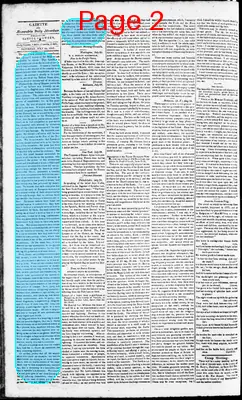
Editorial
July 24, 1819
Alexandria Gazette & Daily Advertiser
Alexandria, Virginia
What is this article about?
The editorial celebrates the success of steam navigation on the Missouri River as a milestone in internal improvements, enabling westward expansion. It praises American ingenuity in harnessing steam power, contrasts it with European envy and skepticism about the longevity of the U.S. republic, and argues that free principles are spreading globally.
Clipping
OCR Quality
95%
Excellent
Full Text
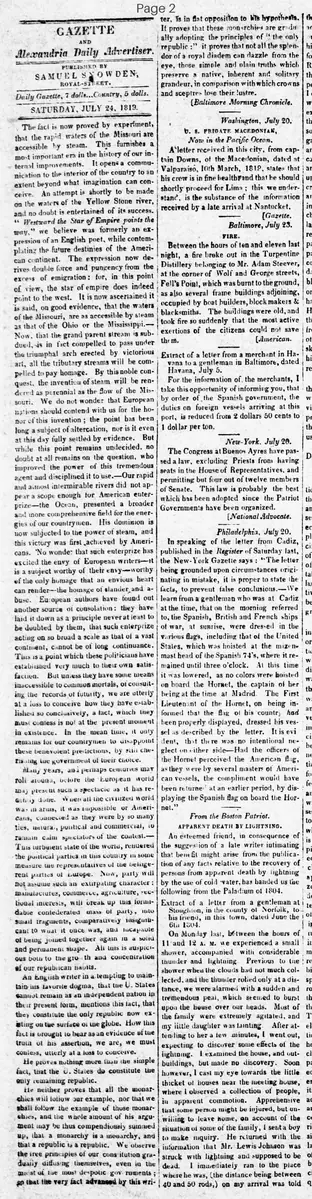
The fact is now proved by experiment, that the rapid waters of the Missouri are accessible by steam. This furnishes a most important era in the history of our internal improvements. It opens a communication to the interior of the country to an extent beyond what imagination can conceive.
An attempt is shortly to be made on the waters of the Yellow Stone river, and no doubt is entertained of its success. "Westward the Star of Empire points the way," we believe was formerly an expression of an English poet, while contemplating the future destinies of the American continent. The expression now derives double force and pungency from the excess of emigration: for, in this point of view, the star of empire does indeed point to the west.
It is now ascertained it is said, on good evidence, that the waters of the Missouri, are as accessible by steam as that of the Ohio or the Mississippi. Now, that the grand parent stream is subdued, is in fact compelled to pass under the triumphant arch erected by victorious art, all the tributary streams will be compelled to pay homage. By this noble conquest, the invention of steam will be rendered as perennial as the flow of the Missouri.
We do not wonder that European nations should contend with us for the honor of this invention; the point has been long a subject of altercation, nor is it even at this day fully settled by evidence. But while this point remains undecided, no doubt at all remains on the question, who improved the power of this tremendous agent and disciplined it to use. Our rapid and almost interminable rivers did not appear a scope enough for American enterprise—the Ocean, presented a broader and more comprehensive field for the energies of our countrymen. His dominion is now subjected to the power of steam, and this victory was first achieved by Americans.
No wonder that such enterprise has excited the envy of European writers—it is a subject worthy of their envy—worthy of the only homage that an envious heart can render—the homage of slander and abuse. European authors have found out another source of consolation: they have laid it down as a principle never at least to be doubted by them, that such enterprise acting on so broad a scale as that of a vast continent, cannot be of long continuance. This is a point which these politicians have established very much to their own satisfaction. But unless they have some means inaccessible to common mortals, of consulting the records of futurity, we are utterly at a loss to conceive how they have established so conclusively, a fact, which they must confess is not at the present moment in existence.
In the mean time, it only remains for our countrymen to disappoint these benevolent predictions, by still cherishing the government of their choice. Many years, and perhaps centuries may roll around, before the European world may present such a spectacle as it has recently done. When all the civilized world was in arms, it was impossible for Americans, connected as they were by so many ties, natural, political and commercial, to remain calm spectators of the contest. This turbulent state of the world, rendered the political parties in this country in some measure the representatives of the belligerent parties of Europe.
Now, party will not assume such an exterminating character: manufactures, commerce, agriculture, sectional interests, will break up this formidable confederated mass of party, into small fragments, comparatively insignificant to what it once was, and incapable of being joined together again in a solid and permanent shape. All this is auspicious both to the growth and concentration of our republican habits.
An English writer in attempting to maintain his favorite dogma, that the U. States cannot remain as an independent nation in their present form, mentions this fact, that they constitute the only republic now existing on the surface of the whole globe. How this fact is brought to bear as an evidence of the truth of his assertion, we are, we must confess, utterly at a loss to conceive. He proves nothing more than the simple fact, that the U. States do constitute the only remaining republic. He neither proves that all the monarchies will follow our example, nor that we shall follow the example of those monarchies, and the whole amount of his argument may be thus compendiously summed up, that a monarchy is a monarchy, and that a republic is a republic.
We observe the free principles of our constitution gradually diffusing themselves, even in the midst of the most despotic governments; so that the very fact advanced by this writer, is in flat opposition to his hypothesis.
An attempt is shortly to be made on the waters of the Yellow Stone river, and no doubt is entertained of its success. "Westward the Star of Empire points the way," we believe was formerly an expression of an English poet, while contemplating the future destinies of the American continent. The expression now derives double force and pungency from the excess of emigration: for, in this point of view, the star of empire does indeed point to the west.
It is now ascertained it is said, on good evidence, that the waters of the Missouri, are as accessible by steam as that of the Ohio or the Mississippi. Now, that the grand parent stream is subdued, is in fact compelled to pass under the triumphant arch erected by victorious art, all the tributary streams will be compelled to pay homage. By this noble conquest, the invention of steam will be rendered as perennial as the flow of the Missouri.
We do not wonder that European nations should contend with us for the honor of this invention; the point has been long a subject of altercation, nor is it even at this day fully settled by evidence. But while this point remains undecided, no doubt at all remains on the question, who improved the power of this tremendous agent and disciplined it to use. Our rapid and almost interminable rivers did not appear a scope enough for American enterprise—the Ocean, presented a broader and more comprehensive field for the energies of our countrymen. His dominion is now subjected to the power of steam, and this victory was first achieved by Americans.
No wonder that such enterprise has excited the envy of European writers—it is a subject worthy of their envy—worthy of the only homage that an envious heart can render—the homage of slander and abuse. European authors have found out another source of consolation: they have laid it down as a principle never at least to be doubted by them, that such enterprise acting on so broad a scale as that of a vast continent, cannot be of long continuance. This is a point which these politicians have established very much to their own satisfaction. But unless they have some means inaccessible to common mortals, of consulting the records of futurity, we are utterly at a loss to conceive how they have established so conclusively, a fact, which they must confess is not at the present moment in existence.
In the mean time, it only remains for our countrymen to disappoint these benevolent predictions, by still cherishing the government of their choice. Many years, and perhaps centuries may roll around, before the European world may present such a spectacle as it has recently done. When all the civilized world was in arms, it was impossible for Americans, connected as they were by so many ties, natural, political and commercial, to remain calm spectators of the contest. This turbulent state of the world, rendered the political parties in this country in some measure the representatives of the belligerent parties of Europe.
Now, party will not assume such an exterminating character: manufactures, commerce, agriculture, sectional interests, will break up this formidable confederated mass of party, into small fragments, comparatively insignificant to what it once was, and incapable of being joined together again in a solid and permanent shape. All this is auspicious both to the growth and concentration of our republican habits.
An English writer in attempting to maintain his favorite dogma, that the U. States cannot remain as an independent nation in their present form, mentions this fact, that they constitute the only republic now existing on the surface of the whole globe. How this fact is brought to bear as an evidence of the truth of his assertion, we are, we must confess, utterly at a loss to conceive. He proves nothing more than the simple fact, that the U. States do constitute the only remaining republic. He neither proves that all the monarchies will follow our example, nor that we shall follow the example of those monarchies, and the whole amount of his argument may be thus compendiously summed up, that a monarchy is a monarchy, and that a republic is a republic.
We observe the free principles of our constitution gradually diffusing themselves, even in the midst of the most despotic governments; so that the very fact advanced by this writer, is in flat opposition to his hypothesis.
What sub-type of article is it?
Infrastructure
Foreign Affairs
Constitutional
What keywords are associated?
Steam Navigation
Missouri River
Internal Improvements
Westward Expansion
American Enterprise
European Envy
Republican Government
Constitutional Principles
What entities or persons were involved?
European Nations
European Writers
English Poet
Americans
U. States
Editorial Details
Primary Topic
Steam Navigation On The Missouri River And Endurance Of The American Republic
Stance / Tone
Celebratory Of American Enterprise And Optimistic Defense Against European Skepticism
Key Figures
European Nations
European Writers
English Poet
Americans
U. States
Key Arguments
Steam Navigation Has Succeeded On The Missouri River, Marking A Key Era In Internal Improvements.
This Opens Vast Communication To The Country's Interior And Supports Westward Emigration.
Americans Have Mastered And Improved Steam Power, Subduing Rivers And Oceans.
European Envy Leads To Slander, But American Achievements Are Undeniable.
European Predictions Of The Republic's Short Lifespan Are Unfounded And Presumptuous.
Cherishing The Republican Government Will Disprove These Predictions.
Past Global Wars Influenced U.S. Parties, But Now Domestic Interests Will Fragment Parties Beneficially.
The U.S. As The Only Republic Demonstrates Its Uniqueness, Not Fragility.
Free Constitutional Principles Are Spreading Even To Despotic Governments.