Thank you for visiting SNEWPapers!
Sign up free
Trainman News
Indianapolis, Marion County, Indiana
What is this article about?
Article from Trainman News, Nov. 21, 1955, by W.J. Weil explaining 1954 Railroad Unemployment Act amendments: benefit rates ($3.50-$8.50) based on base-year earnings or half last daily wage (max $8.50). Includes Q&A on scenarios like illness, layoff, low earnings.
Merged-components note: Table is integral to the explanatory article on railroad retirement benefits
Clipping
OCR Quality
Full Text
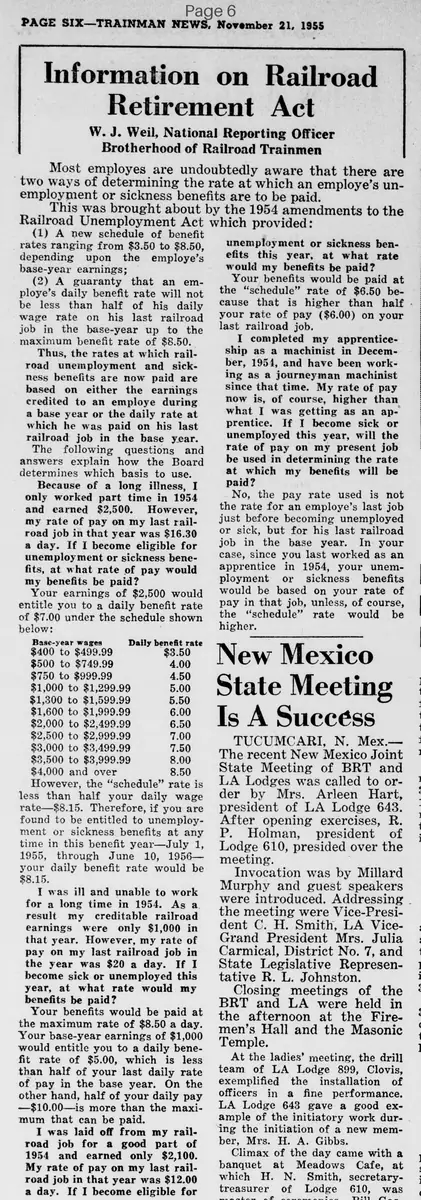
Information on Railroad Retirement Act
W. J. Weil, National Reporting Officer
Brotherhood of Railroad Trainmen
Most employes are undoubtedly aware that there are two ways of determining the rate at which an employe's unemployment or sickness benefits are to be paid.
This was brought about by the 1954 amendments to the Railroad Unemployment Act which provided:
(1) A new schedule of benefit rates ranging from $3.50 to $8.50, depending upon the employe's base-year earnings;
(2) A guaranty that an employe's daily benefit rate will not be less than half of his daily wage rate on his last railroad job in the base-year up to the maximum benefit rate of $8.50.
Thus, the rates at which railroad unemployment and sickness benefits are now paid are based on either the earnings credited to an employe during a base year or the daily rate at which he was paid on his last railroad job in the base year.
The following questions and answers explain how the Board determines which basis to use.
Because of a long illness, I only worked part time in 1954 and earned $2,500. However, my rate of pay on my last railroad job in that year was $16.30 a day. If I become eligible for unemployment or sickness benefits, at what rate of pay would my benefits be paid?
Your earnings of $2,500 would entitle you to a daily benefit rate of $7.00 under the schedule shown below:
However, the "schedule" rate is less than half your daily wage rate -$8.15. Therefore, if you are found to be entitled to unemployment or sickness benefits at any time in this benefit year-July 1, 1955, through June 30, 1956-your daily benefit rate would be $8.15.
I was ill and unable to work for a long time in 1954. As a result my creditable railroad earnings were only $1,000 in that year. However, my rate of pay on my last railroad job in the year was $20 a day. If I become sick or unemployed this year, at what rate would my benefits be paid?
Your benefits would be paid at the maximum rate of $8.50 a day.
Your base-year earnings of $1,000 would entitle you to a daily benefit rate of $5.00, which is less than half of your last daily rate of pay in the base year. On the other hand, half of your daily pay -$10.00 is more than the maximum that can be paid.
I was laid off from my railroad job for a good part of 1954 and earned only $2,100. My rate of pay on my last railroad job in that year was $12.00 a day. If I become eligible for unemployment or sickness benefits this year, at what rate would my benefits be paid?
Your benefits would be paid at the "schedule" rate of $6.50 because that is higher than half your rate of pay ($6.00) on your last railroad job.
I completed my apprenticeship as a machinist in December, 1954, and have been working as a journeyman machinist since that time. My rate of pay now is, of course, higher than what I was getting as an apprentice. If I become sick or unemployed this year, will the rate of pay on my present job be used in determining the rate at which my benefits will be paid?
No, the pay rate used is not the rate for an employe's last job just before becoming unemployed or sick, but for his last railroad job in the base year. In your case, since you last worked as an apprentice in 1954, your unemployment or sickness benefits would be based on your rate of pay in that job, unless, of course, the "schedule" rate would be higher.
| Base-year wages | Daily benefit rate |
| $400 to $499.99 | $3.50 |
| $500 to $749.99 | 4.00 |
| $750 to $999.99 | 4.50 |
| $1,000 to $1,299.99 | 5.00 |
| $1,300 to $1,599.99 | 5.50 |
| $1,600 to $1,999.99 | 6.00 |
| $2,000 to $2,499.99 | 6.50 |
| $2,500 to $2,999.99 | 7.00 |
| $3,000 to $3,499.99 | 7.50 |
| $3,500 to $3,999.99 | 8.00 |
| $4,000 and over | 8.50 |
What sub-type of article is it?
What keywords are associated?
What entities or persons were involved?
Story Details
Key Persons
Event Date
1954
Story Details
Explanation of 1954 amendments to Railroad Unemployment Act providing benefit rates from $3.50 to $8.50 based on base-year earnings or half of last daily wage up to $8.50 maximum, with Q&A examples for different scenarios including part-time work, illness, layoff, and apprenticeship completion.