Thank you for visiting SNEWPapers!
Sign up free
Richmond Enquirer
Richmond, Richmond County, Virginia
What is this article about?
In the British House of Commons, Dr. Lushington moves for papers on French negotiations to establish a Bourbon monarchy in South America, arguing for recognition of independent states to protect British trade interests. Opponents like Lord Castlereagh and Mr. Canning cite incomplete information and caution against straining alliances. The motion is withdrawn after debate highlighting diplomatic and commercial implications.
Clipping
OCR Quality
Full Text
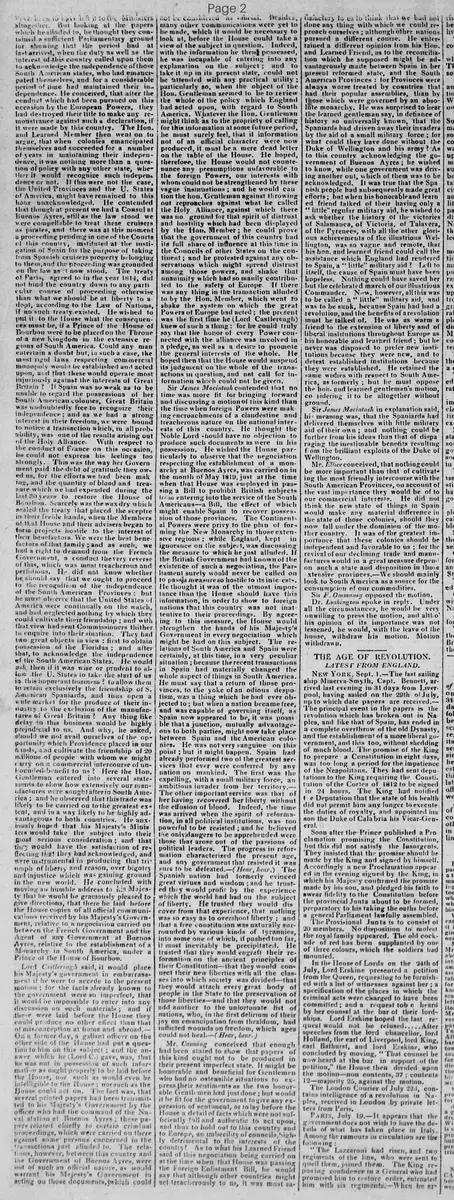
With respect to the conduct of France on this occasion, he could not express his feelings too strongly. This was the way her Government paid the debt of gratitude they owed us, for the efforts we had been making, and the quantity of blood and treasure which we had expended during the last 30 years to restore the House of Bourbon. Scarcely was the wax dry which sealed the treaty that placed the sceptre in their feeble hands, when the Members of that House and their advisers began to form projects hostile to the interest of their benefactors. We were the best benefactors of that family: and as such, we had a right to demand from the French Government, a conduct the very reverse of this, which was most treacherous and perfidious. He did not know whether he should say that we ought to proceed to the recognition of the independence of the South American Provinces: but he must observe that the United States of America were continually on the watch, and had neglected nothing by which they could cultivate their friendship: and with that view had sent Commissioners thither to enquire into their situation. They had two great objects in view: first to obtain possession of the Floridas; and after that, to acknowledge the independence of the South American States. He would ask then if it was wise or prudent to allow the U. States to take the start of us in this important business? to allow them to retain exclusively the friendship of S. American Spaniards, and thus open a wide market for the produce of their industry to the exclusion of the manufactures of Great Britain? Any thing like delay in this business would be highly prejudicial to us. And why, he asked, should we not avail ourselves of the opportunity which Providence placed in our hands, and cultivate the friendship of 20 millions of people with whom we might carry on a commercial intercourse of untold benefit to us? Here the Hon. Gentleman entered into several statements to show how extensively our manufactures were sought after in South America; and he observed that this trade was likely to be carried on to the greatest extent, and in a way likely to be highly advantageous to both countries. He anxiously hoped that his Majesty's Ministers would take the subject into their most serious consideration; and that they would have the satisfaction of reflecting that they had acknowledged, and were instrumental in producing that triumph of liberty and reason, over bigotry and injustice which was gaining ground in the new world. He concluded with moving an humble address to his Majesty that he would be graciously pleased to give directions, that there be laid before the House copies of all official communications received by his Majesty's Government, relative to a negotiation carried on between the French Government and the Agent of any Government at Buenos Ayres, relative to the establishment of a Monarchy in South America, under a Prince of the House of Bourbon.
Lord Castlereagh said, it would place his Majesty's government in embarrassment if he were to accede to the present motion; for the facts already known to the government were so imperfect, that it would be impossible to enter into any discussion on such materials: and if these were laid before the House they could produce no other effect than that of misconception at home and abroad. On a former day, a gallant officer on the other side of the House had put a question to him on this subject; and the answer which he (Lord C.) gave, was, that he was not in possession of such information as ought properly to be laid before the House, nor such as would even be intelligible to the House: nor such as the House could act on. The fact was, that several printed papers had been transmitted to his Majesty's Government by the officer who had the command of the Naval station at Buenos Ayres: these papers related chiefly to certain criminal proceedings, which were carried on there against some persons concerned in the transactions just alluded to. The relations, however, between this country and The Government of Buenos Ayres, were not of such an official nature, as would warrant his Majesty's Government in acting on those documents, which could not be considered as official. Besides, many other communications were yet to be made, which it would be necessary to look at, before the House could take a view of the subject in question. Indeed, with the information he then possessed, he was incapable of entering into any explanation on the subject; and to take it up in its present state, could not be attended with any practical utility; particularly so, when the object of the Hon. Gentleman seemed to be to review the whole of the policy which England had acted upon, with regard to South America. Whatever the Hon. Gentleman might think as to the propriety of calling for this information at some future period, he must surely feel, that if information not of an official character were now produced, it must be a mere dead letter on the table of the House. He hoped, therefore, the House would not countenance any presumptions unfavorable to the foreign Powers, our interests with whom could not be strengthened by these vague insinuations: and he would caution the Hon. Gentleman against throwing out reproaches against what he called the Holy Alliance, against which there was no ground for that spirit of distrust and hostility which had been displayed by the Hon. Member: he could prove that the government of this country had its full share of influence at this time in the Councils of other States on the continent: and he protested against any observations which might spread distrust among those powers, and shake that unanimity which had so mainly contributed to the safety of Europe. If there was any thing in the transaction alluded to by the Hon. Member, which went to shake the system on which the great Powers of Europe had acted: the present was the first time he (Lord Castlereagh) knew of such a thing: for he could truly say that the honor of every Power connected with the alliance was involved in a pledge, as well as a desire to promote the general interests of the whole. He hoped then that the House would suspend its judgment on the whole of the transactions in question, and not call for information which could not be given.
Sir James Macintosh contended that no time was more fit for bringing forward and discussing a motion of this kind than the time when foreign Powers were making encroachments of a clandestine and treacherous nature on the national interests of this country. He thought the Noble Lord should have no objection to produce such documents as were in his possession. He wished the House particularly to observe that the negotiation respecting the establishment of a monarchy at Buenos Ayres, was carried on in the month of May 1819, just at the time when that House was employed in passing a Bill to prohibit British subjects from entering into the service of the South Americans—a Bill, the effect of which might enable Spain to recover possession of those provinces. The Continental Powers were privy to the plan of forming the New Monarchy in those extensive regions: while England, kept in ignorance on the subject, was discussing the measure to which he just alluded. If the British Government had known of the existence of such a negotiation, the Parliament surely would never be called on to pass a measure so hostile to its interests. He thought it was of the utmost importance that the House should have this information, in order to show to foreign nations that this country was not inattentive to their proceedings. By agreeing to this measure, the House would strengthen the hands of his Majesty's Government in every negotiation which might be had on this subject. The relations of South America and Spain were certainly, at this time, in a very peculiar situation: because the recent transactions in Spain had materially changed the whole aspect of things in South America. He must say that a return of those provinces, to the yoke of an odious despotism, was a thing which he had ever objected to; but when a nation became free, and was capable of governing itself, as Spain now appeared to be, it was possible that a junction, mutually advantageous to both parties, might now take place between Spain and the American colonies. He was not very sanguine on this point; but it might happen. Spain had already performed two of the greatest services that ever were conferred by any nation on mankind. The first was the expelling, with a small military force, an ambitious invader from her territory. The other important service was that of her having recovered her liberty without the effusion of blood. Indeed, the time was arrived when the spirit of reformation, in all political institutions, was too powerful to be resisted: and he believed the only dangers to be apprehended were those that arose out of the passions of political leaders. The progress in reformation characterized the present age, and any government that resisted it was sure to be defeated.—(Hear, hear.) The Spanish nation had formerly evinced great virtues and wisdom: and he trusted they would profit by the experience which the world had had on the subject of liberty. He trusted they would discover from that experience, that nothing was so easy as to overshoot liberty: and that a free constitution was naturally surrounded by various kinds of tyrannies, into some one of which, if pushed too far, it must inevitably be precipitated. He trusted that they would engraft their reformation on the ancient principles of their Constitution—that they would connect their new liberties with all the classes into which society was divided—that they would attach every great body of people in the State to the preservation of those liberties—and that they would not add another to the unfortunate list of nations, who, in the first delirium of their joy on emancipation from thraldom, had inflicted wounds on freedom, which ages could not heal.—(Hear, hear.)
Mr. Canning conceived that enough had been said to show that papers of this kind ought not to be produced in their present imperfect state. It might be honorable and beneficial for Gentlemen who had no ostensible situations to express their sentiments as the two honorable Gentlemen had just done: but would it be fit for the government to give any expression of sentiment, or to lay before the House a detail of facts which were not sufficiently full and authentic to act upon, and thus to hold out to this country and to Europe, an imbecility of councils, highly detrimental to the interests of the country? As to what his Learned Friend said of this negotiation being carried on at the time when that House was passing the Foreign Enlistment Bill, he would say that although other countries might act treacherously to us, it was most satisfactory to us to think that we had not done any thing with which we could reproach ourselves: although other nations pursued a different course. He entertained a different opinion from his Hon. and Learned Friend, as to the reconciliation which he supposed might be advantageously made between Spain in her present reformed state, and the South American Provinces: for Provinces were always worse treated by countries that had their popular assemblies, than by those which were governed by an absolute monarchy. He was surprised to hear the learned gentleman say, in defiance of history so universally known, that the Spaniards had driven away their invaders by the aid of a small military force; for what could they have done without the Duke of Wellington and his army? As to this country acknowledging the government of Buenos Ayres: he wished to know, while one government was driving another out, which of them was to be acknowledged. It was true that the Spanish people had subsequently made great efforts: but when his honorable and learned friend talked of their having only a "little" regular military aid, he wished to ask whether the history of the victories of Salamanca, of Vittoria, of Talavera, of the Pyrenees, with all the other glorious achievements of the illustrious Wellington, was so vague and remote, that his hon. and learned friend could call the assistance which England had rendered to Spain, a "little" military aid? Left to itself, the cause of Spain must have been hopeless. Nothing could have saved her but the celebrated march of our illustrious Commander. Now, however, all this was to be called a "little" military aid, and was to be sunk, because Spain had had a revolution, and the benefits of a revolution must be talked of. He was as warm a friend to the extension of liberty and of liberal institutions throughout Europe as his honorable and learned friend: but he never was disposed to prefer new institutions because they were new, and to detest established institutions because they were established. He retained the same wishes with respect to South America, as formerly: but he must oppose the hon. and learned gentleman's motion, considering it to be altogether without ground.
Sir James Macintosh in explanation said, his meaning was, that the Spaniards had delivered themselves with little military aid of their own: and nothing could be further from his ideas than that of disparaging the inestimable benefits resulting from the brilliant exploits of the Duke of Wellington.
Mr. Ellice conceived that nothing could be more important than that of cultivating the most friendly intercourse with the South American Provinces, on account of the vast importance they would be of to our commercial interests. He did not think the new state of things in Spain would make any material difference in the state of those colonies, should they now fall under the dominion of the mother country. It was of the greatest importance that these colonies should be independent and favorable to us: for the revival of our declining trade and manufactures would in a great measure depend on such a state and disposition in those extensive provinces.—We should mainly look to South America as a source for the consumption of our commodities.
Sir F. Ommaney opposed the motion.
Dr. Lushington spoke in reply. Under all the circumstances, he would be very unwilling to press the motion, and although his opinion of its importance was not lessened, he would, with the leave of the house, withdraw his motion. Motion withdrawn.
What sub-type of article is it?
What keywords are associated?
What entities or persons were involved?
Where did it happen?
Foreign News Details
Primary Location
South America
Event Date
Month Of May 1819
Key Persons
Outcome
motion withdrawn
Event Details
British parliamentary debate on recognizing independence of South American states emancipated from Spain, amid reports of French negotiations in May 1819 to establish a Bourbon monarchy in Buenos Ayres. Speakers argue for recognition to protect British commercial interests and counter European powers' actions, while government opposes due to incomplete information. Debate touches on Holy Alliance, US intentions, Spanish reforms, and historical British aid to Spain.