Thank you for visiting SNEWPapers!
Sign up free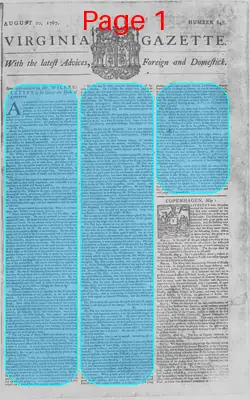
Editorial
August 20, 1767
The Virginia Gazette
Richmond, Williamsburg, Richmond County, Virginia
What is this article about?
An editorial defends William Pitt (Lord Chatham) against John Wilkes's recent critical letter to the Duke of Grafton by quoting Wilkes's earlier praises of Pitt from 1762-1763, highlighting Wilkes's inconsistency and refuting specific charges like blasphemy support and liberty advocacy.
Clipping
OCR Quality
98%
Excellent
Full Text
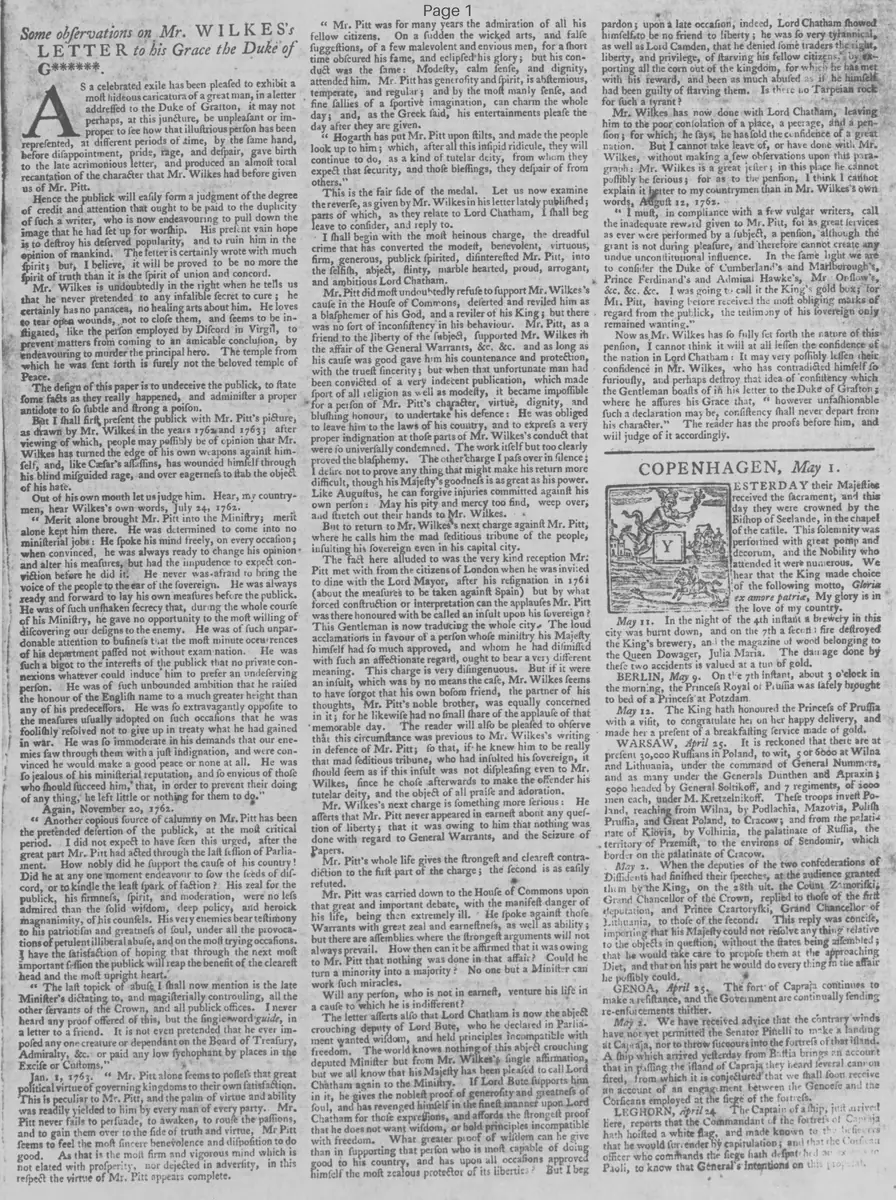
Some observations on Mr. Wilkes's LETTER to his Grace the Duke of G******.
A celebrated exile has been pleased to exhibit a most hideous caricatura of a great man, in a letter addressed to the Duke of Grafton, it may not perhaps, at this juncture, be unpleasant or improper to see how that illustrious person has been represented, at different periods of time, by the same hand, before disappointment, pride, rage, and despair, gave birth to the late acrimonious letter, and produced an almost total recantation of the character that Mr. Wilkes had before given us of Mr. Pitt.
Hence the publick will easily form a judgment of the degree of credit and attention that ought to be paid to the duplicity of such a writer, who is now endeavouring to pull down the image that he had set up for worship. His present vain hope is to destroy his deserved popularity, and to ruin him in the opinion of mankind. The letter is certainly wrote with much spirit but, I believe, it will be proved to be no more the spirit of truth than it is the spirit of union and concord.
Mr. Wilkes is undoubtedly in the right when he tells us that he never pretended to any infallible secret to cure; he certainly has no panacea, no healing arts about him. He loves to tear open wounds, not to close them, and seems to be instigated, like the person employed by Discord in Virgil, to prevent matters from coming to an amicable conclusion, by endeavouring to murder the principal hero. The temple from which he was sent forth is surely not the beloved temple of Peace.
The design of this paper is to undeceive the publick, to state some facts as they really happened, and administer a proper antidote to so subtle and strong a poison. But I shall first present the publick with Mr. Pitt's picture; as drawn by Mr. Wilkes in the years 1762 and 1763; after viewing of which, people may possibly be of opinion that Mr. Wilkes has turned the edge of his own weapons against himself, and, like Caesar's assassins, has wounded himself through his blind misguided rage, and over eagerness to stab the object of his hate.
Out of his own mouth let us judge him. Hear, my countrymen, hear Wilkes's own words, July 24, 1762.
"Merit alone brought Mr. Pitt into the Ministry; merit alone kept him there. He was determined to come into no ministerial jobs: He spoke his mind freely, on every occasion; when convinced, he was always ready to change his opinion and alter his measures, but had the impudence to expect conviction before he did it. He never was afraid to bring the voice of the people to the ear of the sovereign. He was always ready and forward to lay his own measures before the publick. He was of such unshaken secrecy that, during the whole course of his Ministry, he gave no opportunity to the most willing of discovering our designs to the enemy. He was of such unpardonable attention to business that the most minute occurrences of his department passed not without examination. He was such a bigot to the interests of the publick that no private connexions whatever could induce him to prefer an undeserving person. He was of such unbounded ambition that he raised the honour of the English name to a much greater height than any of his predecessors. He was so extravagantly opposite to the measures usually adopted on such occasions that he was foolishly resolved not to give up in treaty what he had gained in war. He was so immoderate in his demands that our enemies saw through them with a just indignation, and were convinced he would make a good peace or none at all. He was so jealous of his ministerial reputation, and so envious of those who should succeed him, that, in order to prevent their doing of any thing, he left little or nothing for them to do."
Again, November 20, 1762.
"Another copious source of calumny on Mr. Pitt has been the pretended desertion of the publick, at the most critical period. I did not expect to have seen this urged, after the great part Mr. Pitt had acted through the last session of Parliament. How nobly did he support the cause of his country! Did he at any one moment endeavour to sow the seeds of discord, or to kindle the least spark of faction? His zeal for the publick, his firmness, spirit, and moderation, were no less admired than the solid wisdom, deep policy, and heroick magnanimity, of his counsels. His very enemies bear testimony to his patriotism and greatness of soul, under all the provocations of petulant illiberal abuse, and on the most trying occasions. I have the satisfaction of hoping that through the next most important session the publick will reap the benefit of the clearest head and the most upright heart."
"The last topick of abuse I shall now mention is the late Minister's dictating to, and magisterially controuling, all the other servants of the Crown, and all publick offices. I never heard any proof offered of this, but the single word guide, in a letter to a friend. It is not even pretended that he ever imposed any one creature or dependant on the Board of Treasury, Admiralty, &c. or paid any low sychophant by places in the Excise or Customs."
Jan. 1, 1763. "Mr. Pitt alone seems to possess that great political virtue of governing kingdoms to their own satisfaction. This is peculiar to Mr. Pitt, and the palm of virtue and ability was readily yielded to him by every man of every party. Mr. Pitt never fails to persuade, to awaken, to rouze the passions, and to gain them over to the side of truth and virtue, Mr Pitt seems to feel the most sincere benevolence and disposition to do good. As that is the most firm and vigorous mind which is not elated with prosperity, nor dejected in adversity, in this respect the virtue of Mr. Pitt appears complete."
"Mr. Pitt was for many years the admiration of all his fellow citizens. On a sudden the wicked arts, and false suggestions, of a few malevolent and envious men, for a short time obscured his fame, and eclipsed his glory; but his conduct was the same: Modesty, calm sense, and dignity attended him. Mr. Pitt has generosity and spirit, is abstemious, temperate, and regular; and by the most manly sense, and fine sallies of a sportive imagination, can charm the whole day; and, as the Greek said, his entertainments please the day after they are given."
"Hogarth has put Mr. Pitt upon stilts, and made the people look up to him; which, after all this insipid ridicule, they will continue to do, as a kind of tutelar deity, from whom they expect that security, and those blessings, they despair of from others."
This is the fair side of the medal. Let us now examine the reverse, as given by Mr. Wilkes in his letter lately published; parts of which, as they relate to Lord Chatham, I shall beg leave to consider, and reply to.
I shall begin with the most heinous charge, the dreadful crime that has converted the modest, benevolent, virtuous, firm, generous, publick spirited, disinterested Mr. Pitt, into the selfish, abject, flinty, marble hearted, proud, arrogant, and ambitious Lord Chatham.
Mr. Pitt did most undoubtedly refuse to support Mr. Wilkes's cause in the House of Commons, deserted and reviled him as a blasphemer of his God, and a reviler of his King; but there was no sort of inconsistency in his behaviour. Mr. Pitt, as a friend to the liberty of the subject, supported Mr. Wilkes in the affair of the General Warrants, &c. &c. and as long as his cause was good gave him his countenance and protection, with the truest sincerity; but when that unfortunate man had been convicted of a very indecent publication, which made sport of all religion as well as modesty, it became impossible for a person of Mr. Pitt's character, virtue, dignity, and blushing honour, to undertake his defence: He was obliged to leave him to the laws of his country, and to express a very proper indignation at those parts of Mr. Wilkes's conduct that were so universally condemned. The work itself but too clearly proved the blasphemy. The other charge I pass over in silence; I desire not to prove any thing that might make his return more difficult, though his Majesty's goodness is as great as his power. Like Augustus, he can forgive injuries committed against his own person: May his pity and mercy too find, weep over; and stretch out their hands to Mr. Wilkes.
But to return to Mr. Wilkes's next charge against Mr. Pitt, where he calls him the mad seditious tribune of the people, insulting his sovereign even in his capital city.
The fact here alluded to was the very kind reception Mr. Pitt met with from the citizens of London when he was invited to dine with the Lord Mayor, after his resignation in 1761 (about the measures to be taken against Spain) but by what forced construction or interpretation can the applauses Mr. Pitt was there honoured with be called an insult upon his sovereign? This Gentleman is now traducing the whole city. The loud acclamations in favour of a person whose ministry his Majesty himself had so much approved, and whom he had dismissed with such an affectionate regard, ought to bear a very different meaning. This charge is very disingenuous. But if it were an insult, which was by no means the case, Mr. Wilkes seems to have forgot that his own bosom friend, the partner of his thoughts, Mr. Pitt's noble brother, was equally concerned in it; for he likewise had no small share of the applause of that memorable day. The reader will also be pleased to observe that this circumstance was previous to Mr. Wilkes's writing in defence of Mr. Pitt; so that, if he knew him to be really that mad seditious tribune, who had insulted his sovereign, it should seem as if this insult was not displeasing even to Mr. Wilkes, since he chose afterwards to make the offender his tutelar deity, and the object of all praise and adoration.
Mr. Wilkes's next charge is something more serious: He asserts that Mr. Pitt never appeared in earnest about any question of liberty; that it was owing to him that nothing was done with regard to General Warrants, and the Seizure of Papers.
Mr. Pitt's whole life gives the strongest and clearest contradiction to the first part of the charge; the second is as easily refuted.
Mr. Pitt was carried down to the House of Commons upon that great and important debate, with the manifest danger of his life, being then extremely ill. He spoke against those Warrants with great zeal and earnestness, as well as ability; but there are assemblies where the strongest arguments will not always prevail. How then can it be affirmed that it was owing to Mr. Pitt that nothing was done in that affair? Could he turn a minority into a majority? No one but a Minister can work such miracles.
Will any person, who is not in earnest, venture his life in a cause to which he is indifferent?
The letter asserts also that Lord Chatham is now the abject crouching deputy of Lord Bute, who he declared in Parliament wanted wisdom, and held principles incompatible with freedom. The world knows nothing of this abject crouching deputed Minister but from Mr. Wilkes's single affirmation, but we all know that his Majesty has been pleased to call Lord Chatham again to the Ministry. If Lord Bute supports him in it, he gives the noblest proof of generosity and greatness of soul, and has revenged himself in the finest manner upon Lord Chatham for those expressions, and affords the strongest proof that he does not want wisdom, or hold principles incompatible with freedom. What greater proof of wisdom can he give than in supporting that person who is not capable of doing good to his country, and has upon all occasions approved himself the most zealous protector of its liberties?
But I beg pardon; upon a late occasion, indeed, Lord Chatham showed himself to be no friend to liberty; he was so very tyrannical, as well as Lord Camden, that he denied some traders the right, liberty, and privilege, of starving his fellow citizens, by exporting all the corn out of the kingdom, for which he has met with his reward, and been as much abused as if he himself had been guilty of starving them. Is there no Tarpeian rock for such a tyrant?
Mr. Wilkes has now done with Lord Chatham, leaving him to the poor consolation of a place, a peerage, and a pension; for which, he says, he has sold the confidence of a great nation. But I cannot take leave of, or have done with Mr. Wilkes, without making a few observations upon this paragraph: Mr. Wilkes is a great jester; in this place he cannot possibly be serious; for as to the pension, I think I cannot explain it better to my countrymen than in Mr. Wilkes's own words, August 12, 1762.
"I must, in compliance with a few vulgar writers, call the inadequate reward given to Mr. Pitt, for as great services as ever were performed by a subject, a pension, although the grant is not during pleasure, and therefore cannot create any undue unconstitutional influence. In the same light we are to consider the Duke of Cumberland's and Marlborough's, Prince Ferdinand's and Admiral Hawke's, Mr. Orflaw's, &c. &c. &c. I was going to call it the King's gold box; for Mr. Pitt, having before received the most obliging marks of regard from the publick, the testimony of his sovereign only remained wanting."
Now as Mr. Wilkes has so fully set forth the nature of this pension, I cannot think it will at all lessen the confidence of the nation in Lord Chatham: It may very possibly lessen their confidence in Mr. Wilkes, who has contradicted himself so furiously, and perhaps destroy that idea of consistency which the Gentleman boasts of in his letter to the Duke of Grafton where he assures his Grace that, "however unfashionable such a declaration may be, consistency shall never depart from his character." The reader has the proofs before him, and will judge of it accordingly.
A celebrated exile has been pleased to exhibit a most hideous caricatura of a great man, in a letter addressed to the Duke of Grafton, it may not perhaps, at this juncture, be unpleasant or improper to see how that illustrious person has been represented, at different periods of time, by the same hand, before disappointment, pride, rage, and despair, gave birth to the late acrimonious letter, and produced an almost total recantation of the character that Mr. Wilkes had before given us of Mr. Pitt.
Hence the publick will easily form a judgment of the degree of credit and attention that ought to be paid to the duplicity of such a writer, who is now endeavouring to pull down the image that he had set up for worship. His present vain hope is to destroy his deserved popularity, and to ruin him in the opinion of mankind. The letter is certainly wrote with much spirit but, I believe, it will be proved to be no more the spirit of truth than it is the spirit of union and concord.
Mr. Wilkes is undoubtedly in the right when he tells us that he never pretended to any infallible secret to cure; he certainly has no panacea, no healing arts about him. He loves to tear open wounds, not to close them, and seems to be instigated, like the person employed by Discord in Virgil, to prevent matters from coming to an amicable conclusion, by endeavouring to murder the principal hero. The temple from which he was sent forth is surely not the beloved temple of Peace.
The design of this paper is to undeceive the publick, to state some facts as they really happened, and administer a proper antidote to so subtle and strong a poison. But I shall first present the publick with Mr. Pitt's picture; as drawn by Mr. Wilkes in the years 1762 and 1763; after viewing of which, people may possibly be of opinion that Mr. Wilkes has turned the edge of his own weapons against himself, and, like Caesar's assassins, has wounded himself through his blind misguided rage, and over eagerness to stab the object of his hate.
Out of his own mouth let us judge him. Hear, my countrymen, hear Wilkes's own words, July 24, 1762.
"Merit alone brought Mr. Pitt into the Ministry; merit alone kept him there. He was determined to come into no ministerial jobs: He spoke his mind freely, on every occasion; when convinced, he was always ready to change his opinion and alter his measures, but had the impudence to expect conviction before he did it. He never was afraid to bring the voice of the people to the ear of the sovereign. He was always ready and forward to lay his own measures before the publick. He was of such unshaken secrecy that, during the whole course of his Ministry, he gave no opportunity to the most willing of discovering our designs to the enemy. He was of such unpardonable attention to business that the most minute occurrences of his department passed not without examination. He was such a bigot to the interests of the publick that no private connexions whatever could induce him to prefer an undeserving person. He was of such unbounded ambition that he raised the honour of the English name to a much greater height than any of his predecessors. He was so extravagantly opposite to the measures usually adopted on such occasions that he was foolishly resolved not to give up in treaty what he had gained in war. He was so immoderate in his demands that our enemies saw through them with a just indignation, and were convinced he would make a good peace or none at all. He was so jealous of his ministerial reputation, and so envious of those who should succeed him, that, in order to prevent their doing of any thing, he left little or nothing for them to do."
Again, November 20, 1762.
"Another copious source of calumny on Mr. Pitt has been the pretended desertion of the publick, at the most critical period. I did not expect to have seen this urged, after the great part Mr. Pitt had acted through the last session of Parliament. How nobly did he support the cause of his country! Did he at any one moment endeavour to sow the seeds of discord, or to kindle the least spark of faction? His zeal for the publick, his firmness, spirit, and moderation, were no less admired than the solid wisdom, deep policy, and heroick magnanimity, of his counsels. His very enemies bear testimony to his patriotism and greatness of soul, under all the provocations of petulant illiberal abuse, and on the most trying occasions. I have the satisfaction of hoping that through the next most important session the publick will reap the benefit of the clearest head and the most upright heart."
"The last topick of abuse I shall now mention is the late Minister's dictating to, and magisterially controuling, all the other servants of the Crown, and all publick offices. I never heard any proof offered of this, but the single word guide, in a letter to a friend. It is not even pretended that he ever imposed any one creature or dependant on the Board of Treasury, Admiralty, &c. or paid any low sychophant by places in the Excise or Customs."
Jan. 1, 1763. "Mr. Pitt alone seems to possess that great political virtue of governing kingdoms to their own satisfaction. This is peculiar to Mr. Pitt, and the palm of virtue and ability was readily yielded to him by every man of every party. Mr. Pitt never fails to persuade, to awaken, to rouze the passions, and to gain them over to the side of truth and virtue, Mr Pitt seems to feel the most sincere benevolence and disposition to do good. As that is the most firm and vigorous mind which is not elated with prosperity, nor dejected in adversity, in this respect the virtue of Mr. Pitt appears complete."
"Mr. Pitt was for many years the admiration of all his fellow citizens. On a sudden the wicked arts, and false suggestions, of a few malevolent and envious men, for a short time obscured his fame, and eclipsed his glory; but his conduct was the same: Modesty, calm sense, and dignity attended him. Mr. Pitt has generosity and spirit, is abstemious, temperate, and regular; and by the most manly sense, and fine sallies of a sportive imagination, can charm the whole day; and, as the Greek said, his entertainments please the day after they are given."
"Hogarth has put Mr. Pitt upon stilts, and made the people look up to him; which, after all this insipid ridicule, they will continue to do, as a kind of tutelar deity, from whom they expect that security, and those blessings, they despair of from others."
This is the fair side of the medal. Let us now examine the reverse, as given by Mr. Wilkes in his letter lately published; parts of which, as they relate to Lord Chatham, I shall beg leave to consider, and reply to.
I shall begin with the most heinous charge, the dreadful crime that has converted the modest, benevolent, virtuous, firm, generous, publick spirited, disinterested Mr. Pitt, into the selfish, abject, flinty, marble hearted, proud, arrogant, and ambitious Lord Chatham.
Mr. Pitt did most undoubtedly refuse to support Mr. Wilkes's cause in the House of Commons, deserted and reviled him as a blasphemer of his God, and a reviler of his King; but there was no sort of inconsistency in his behaviour. Mr. Pitt, as a friend to the liberty of the subject, supported Mr. Wilkes in the affair of the General Warrants, &c. &c. and as long as his cause was good gave him his countenance and protection, with the truest sincerity; but when that unfortunate man had been convicted of a very indecent publication, which made sport of all religion as well as modesty, it became impossible for a person of Mr. Pitt's character, virtue, dignity, and blushing honour, to undertake his defence: He was obliged to leave him to the laws of his country, and to express a very proper indignation at those parts of Mr. Wilkes's conduct that were so universally condemned. The work itself but too clearly proved the blasphemy. The other charge I pass over in silence; I desire not to prove any thing that might make his return more difficult, though his Majesty's goodness is as great as his power. Like Augustus, he can forgive injuries committed against his own person: May his pity and mercy too find, weep over; and stretch out their hands to Mr. Wilkes.
But to return to Mr. Wilkes's next charge against Mr. Pitt, where he calls him the mad seditious tribune of the people, insulting his sovereign even in his capital city.
The fact here alluded to was the very kind reception Mr. Pitt met with from the citizens of London when he was invited to dine with the Lord Mayor, after his resignation in 1761 (about the measures to be taken against Spain) but by what forced construction or interpretation can the applauses Mr. Pitt was there honoured with be called an insult upon his sovereign? This Gentleman is now traducing the whole city. The loud acclamations in favour of a person whose ministry his Majesty himself had so much approved, and whom he had dismissed with such an affectionate regard, ought to bear a very different meaning. This charge is very disingenuous. But if it were an insult, which was by no means the case, Mr. Wilkes seems to have forgot that his own bosom friend, the partner of his thoughts, Mr. Pitt's noble brother, was equally concerned in it; for he likewise had no small share of the applause of that memorable day. The reader will also be pleased to observe that this circumstance was previous to Mr. Wilkes's writing in defence of Mr. Pitt; so that, if he knew him to be really that mad seditious tribune, who had insulted his sovereign, it should seem as if this insult was not displeasing even to Mr. Wilkes, since he chose afterwards to make the offender his tutelar deity, and the object of all praise and adoration.
Mr. Wilkes's next charge is something more serious: He asserts that Mr. Pitt never appeared in earnest about any question of liberty; that it was owing to him that nothing was done with regard to General Warrants, and the Seizure of Papers.
Mr. Pitt's whole life gives the strongest and clearest contradiction to the first part of the charge; the second is as easily refuted.
Mr. Pitt was carried down to the House of Commons upon that great and important debate, with the manifest danger of his life, being then extremely ill. He spoke against those Warrants with great zeal and earnestness, as well as ability; but there are assemblies where the strongest arguments will not always prevail. How then can it be affirmed that it was owing to Mr. Pitt that nothing was done in that affair? Could he turn a minority into a majority? No one but a Minister can work such miracles.
Will any person, who is not in earnest, venture his life in a cause to which he is indifferent?
The letter asserts also that Lord Chatham is now the abject crouching deputy of Lord Bute, who he declared in Parliament wanted wisdom, and held principles incompatible with freedom. The world knows nothing of this abject crouching deputed Minister but from Mr. Wilkes's single affirmation, but we all know that his Majesty has been pleased to call Lord Chatham again to the Ministry. If Lord Bute supports him in it, he gives the noblest proof of generosity and greatness of soul, and has revenged himself in the finest manner upon Lord Chatham for those expressions, and affords the strongest proof that he does not want wisdom, or hold principles incompatible with freedom. What greater proof of wisdom can he give than in supporting that person who is not capable of doing good to his country, and has upon all occasions approved himself the most zealous protector of its liberties?
But I beg pardon; upon a late occasion, indeed, Lord Chatham showed himself to be no friend to liberty; he was so very tyrannical, as well as Lord Camden, that he denied some traders the right, liberty, and privilege, of starving his fellow citizens, by exporting all the corn out of the kingdom, for which he has met with his reward, and been as much abused as if he himself had been guilty of starving them. Is there no Tarpeian rock for such a tyrant?
Mr. Wilkes has now done with Lord Chatham, leaving him to the poor consolation of a place, a peerage, and a pension; for which, he says, he has sold the confidence of a great nation. But I cannot take leave of, or have done with Mr. Wilkes, without making a few observations upon this paragraph: Mr. Wilkes is a great jester; in this place he cannot possibly be serious; for as to the pension, I think I cannot explain it better to my countrymen than in Mr. Wilkes's own words, August 12, 1762.
"I must, in compliance with a few vulgar writers, call the inadequate reward given to Mr. Pitt, for as great services as ever were performed by a subject, a pension, although the grant is not during pleasure, and therefore cannot create any undue unconstitutional influence. In the same light we are to consider the Duke of Cumberland's and Marlborough's, Prince Ferdinand's and Admiral Hawke's, Mr. Orflaw's, &c. &c. &c. I was going to call it the King's gold box; for Mr. Pitt, having before received the most obliging marks of regard from the publick, the testimony of his sovereign only remained wanting."
Now as Mr. Wilkes has so fully set forth the nature of this pension, I cannot think it will at all lessen the confidence of the nation in Lord Chatham: It may very possibly lessen their confidence in Mr. Wilkes, who has contradicted himself so furiously, and perhaps destroy that idea of consistency which the Gentleman boasts of in his letter to the Duke of Grafton where he assures his Grace that, "however unfashionable such a declaration may be, consistency shall never depart from his character." The reader has the proofs before him, and will judge of it accordingly.
What sub-type of article is it?
Partisan Politics
Press Freedom
What keywords are associated?
Wilkes
Pitt
Chatham
Grafton
Inconsistency
General Warrants
Pension
Blasphemy
Liberty
What entities or persons were involved?
Mr. Wilkes
Mr. Pitt
Lord Chatham
Duke Of Grafton
Lord Bute
Lord Camden
Editorial Details
Primary Topic
Defense Of William Pitt Against John Wilkes's Criticisms
Stance / Tone
Defensive Of Pitt, Critical Of Wilkes's Inconsistency
Key Figures
Mr. Wilkes
Mr. Pitt
Lord Chatham
Duke Of Grafton
Lord Bute
Lord Camden
Key Arguments
Wilkes Previously Praised Pitt Highly In 1762 1763 Writings
Wilkes's Recent Letter Contradicts His Past Admiration
Pitt Supported Wilkes On General Warrants But Not On Blasphemy Charges
Pitt's Reception In London Was Not An Insult To The Sovereign
Pitt Spoke Earnestly Against General Warrants Despite Illness
Pitt Is Not A Deputy Of Lord Bute
Pitt's Pension Is A Deserved Reward, As Wilkes Once Stated
Wilkes Lacks Consistency In His Character