Thank you for visiting SNEWPapers!
Sign up free
Vermont Watchman And State Journal
Montpelier, Washington County, Vermont
What is this article about?
In the U.S. House of Representatives on April 13, Mr. Slade of Vermont delivered a speech opposing the appointment of Mr. Thompson as Minister to Mexico, citing his pro-Texas annexation views amid concerns over slavery extension and potential war. The debate arose from Mr. Linn's motion to strike the appropriation, highlighting tensions over U.S.-Mexico relations and Texas independence.
Clipping
OCR Quality
Full Text
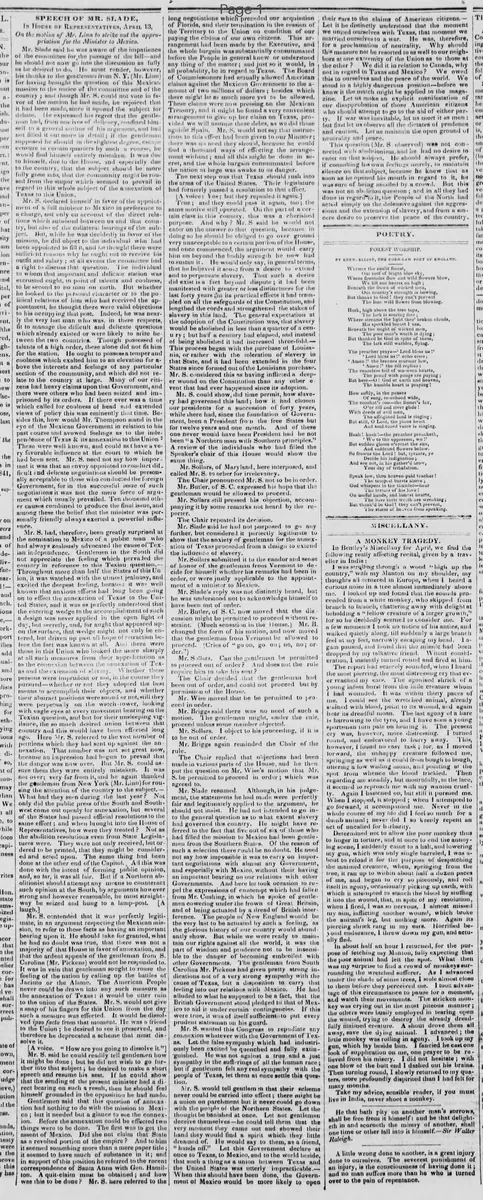
In House of Representatives, April 13.
On the motion of Mr. Linn to strike out the appropriation for the Minister to Mexico.
Mr. Slade said he was aware of the impatience of the committee for the passage of the bill—and he should not now go into the discussion as fully as he desired to do. He must render, however, his thanks to the gentleman from N. Y. (Mr. Linn) for having brought the question of this Mexican mission to the notice of the committee and of the country: and though Mr. S. could not vote in favor of the motion he had made, he rejoiced that it had been made, since it opened the subject for debate. He expressed his regret that the gentleman had, from motives of delicacy, confined himself to a general outline of his argument, and had not filled it out more in detail: if the gentleman supposed he should in the slightest degree, escape censure in certain quarters by such a course, he would find himself entirely mistaken. It was due to himself, due to the House, and especially due to the country, that the subject should be more fully gone into, that the community might be roused from the stupor which seemed to prevail in regard to this whole subject of the annexation of Texas to this Union.
Mr. S. declared himself in favor of the appointment of a full minister to Mexico in preference to a charge, not only on account of the direct relations which subsisted between us and that country, but also of the collateral bearings of the subject. But, while he was decidedly in favor of the mission, he did object to the individual who had been appointed to fill it, and he thought there were sufficient reasons why he ought not to receive his outfit and salary; at all events the committee had a right to discuss that question. The individual to whom that important and delicate station was entrusted ought, in point of talents and coolness, to be second to no man on earth. But whether he looked to the personal character or to the political relations of him who had received the appointment, he thought there were valid objections to his occupying that post. Indeed, he was nearly the very last man who was, in these respects, fit to manage the difficult and delicate questions which already existed or were likely to arise between the two countries. Though possessed of talents of a high order, these alone did not fit him for the station. He ought to possess a temper and coolness which exalted him to an elevation far above the interests and feelings of any particular section of the community, and which did not relate to the country at large. Many of our citizens had heavy claims upon that Government, and there were others who had been seized and imprisoned by its orders. If there ever was a time which called for coolness of head and extended views of policy this was eminently that time. Besides this, how would Mr. Thompson stand in the eye of the Mexican Government in relation to his past course and avowed feelings as to the independence of Texas & its annexation to this Union? These were well known, and could not have a very favorable influence at the court to which he had been sent. Mr. S. need not say how important it was that an envoy appointed to conduct difficult and delicate negotiations should be personally acceptable to those who conducted the foreign Government, for in the successful issue of such negotiations it was not the mere force of argument which usually prevailed. Ten thousand other causes combined to produce the final issue, and among these the belief that the minister was personally friendly always exerted a powerful influence.
Mr. S. had, therefore, been greatly surprised at the nomination to Mexico of a public man who had always zealously advocated the cause of Texian independence. Gentlemen in the South did not appreciate the feeling which pervaded the country in reference to this Texian question.—Throughout more than half the States of this Union, it was watched with the utmost jealousy, and excited the deepest feeling, because it was well known that anxious efforts had long been going on to effect the annexation of Texas to the United States, and it was as perfectly understood that the entering wedge to the accomplishment of such a design was never applied in the open light of day, but secretly, and, for aught that appeared upon the surface, that wedge might not only be entered, but driven home past all hope of retraction before the fact was known at all. "And there were those in this Union who looked the more sharply at all such measures from their apprehension as to the connexion between the annexation of Texas and the extension of slavery. Whether these persons were imprudent or not, in the course they pursued—whether or not they adopted the best means to accomplish their objects, and whether their abstract positions were sound or not, still they were perpetually on the watch-tower, looking with eagle eyes at every movement bearing on the Texian question, and but for their unsleeping vigilance, the so much desired union between that country and this would have been effected long ago. Here Mr. S. referred to the vast number of petitions which they had sent up against the annexation. That number was not so great now, because an impression had begun to prevail that the danger was now over. But Mr. S. could assure them they were entirely mistaken. It was not over; very far from it, and he again thanked the gentleman from New York (Mr. Linn) for rousing the attention of the country to the subject.—What had they seen during the last year? Not only did the public press of the South and South-west come out openly for annexation, but several of the States had passed official resolutions to the same effect; and when brought into the House of Representatives, how were they treated? Not as the abolition resolutions even from State Legislatures were. They were not only received, but ordered to be printed, that they might be considered and acted upon. The same thing had been done at the other end of the Capitol. All this was done with the intent of forcing public opinion, and, so far, it was all fair. But if a Northern abolitionist should attempt any means to counteract such opinion at the South, by arguments however strong and however reasonable, he must straightway be seized and hung to a lamp-post. [A laugh.]
Mr. S. contended that it was perfectly legitimate, in an argument respecting the Mexican mission, to refer to these facts as having an important bearing upon it. He should take for granted, what he had no doubt was true, that there was not a majority of that House in favor of annexation, and that the ardent appeals of the gentleman from S. Carolina (Mr. Pickens) would not be responded to. It was in vain that gentleman sought to rouse the feeling of the nation by calling up the battles of Jacinto or the Alamo. The American People never could be drawn into any such measure as the annexation of Texas: it would be utter ruin to the union of the States. Mr. S. would not give a snap of his fingers for this Union from the day such a measure was effected. It would be dissolved ipso facto from that moment. He was a friend to the Union; he desired to see it preserved, and therefore he deprecated a scheme that must dissolve it.
[A voice. "How are you going to dissolve it."]
Mr. S. said he could readily tell gentlemen how it might be done; but he did not wish to go further into that subject; he desired to make a short speech and resume his seat. If he could show that the sending of the present minister had a direct bearing on such a result, then he should feel himself justified in the opposition he had made. Gentlemen said that this question of annexation had nothing to do with the mission to Mexico; but it needed but a glance to see the connexion. Before the annexation could be effected two things were to be done. The first was to get the assent of Mexico. Did she not claim that State as a revolted portion of the empire? And to him it seemed something more than a mere paper title: it seemed to have much of substance in it; and in support of this position he referred to the recent correspondence of Santa Anna with Gen. Hamilton. A quit-claim must be obtained; and how was this to be done? Mr. S. here referred to the long negotiations which preceded our acquisition of Florida, and their termination in the cession of the Territory to the Union on condition of our paying the claims of our own citizens. This arrangement had been made by the Executive, and the whole bargain was substantially consummated before the People in general knew or understood any thing of the matter; and just so it would, in all probability, be in regard to Texas. The Board of Commissioners had actually allowed American claims against the Mexican Government to the amount of two millions of dollars; besides which there might be as much more yet to be allowed. These claims were now pressing on the Mexican Treasury, and it might be found a very convenient arrangement to give up her claim on Texas, provided we will assume these debts, as we did those against Spain. Mr. S. would not say that instructions to this effect had been given to our Ministers; there was no need they should, because he could find a thousand ways of effecting the arrangement without; and all this might be done in secret, and the whole bargain consummated before the nation at large was awake to its danger.
The next step was that Texas should rush into the arms of the United States. Their legislature had formerly passed a resolution to that effect.
[A voice: Yes; but they repealed it again.]
True; and they could pass it again, too; the same motive still operated. On the part of a certain class in this country, this was a cherished purpose. And why? Mr. S said he would not enter on the answer to that question, because in doing so he should be obliged to go over ground very unacceptable to a certain portion of the House and once commenced, the argument would carry him on beyond the bodily strength he now had to sustain it. He would only say, in general terms, that he believed it arose from a desire to extend and to perpetuate slavery. That such a desire did exist is a fact beyond dispute: it had been manifested with greater or less distinctness for the last forty years; in its practical effects it had trampled on all the safeguards of the Constitution, and lengthened the cords and strengthened the stakes of slavery in this land. The general expectation at the adoption of the Constitution was, that slavery would be abolished in less than a quarter of a century; but half a century had elapsed, and instead of being abolished it had increased three-fold.—This process began with the purchase of Louisiana, or rather with the toleration of slavery in that State, and it had been extended in the four States since formed out of the Louisiana purchase. Mr. S. considered this as having inflicted a deeper wound on the Constitution than any other event that had ever happened since its adoption.
Mr. S. could show, did time permit, how slavery had governed this land; how it had chosen our presidents for a succession of forty years, while there had, since the foundation of Government, been a President from the free States but for twelve years and one month. And of these one never would have been President had he not been "a Northern man with Southern principles." A review of the individuals who had filled the Speaker's chair of this House would show the same thing.
Mr. Sollars, of Maryland, here interposed, and called Mr. S. to order for irrelevancy.
The Chair pronounced Mr. S. not to be in order.
Mr. Butler, of S. C. expressed his hope that the gentleman would be allowed to proceed.
Mr. Sollars still pressed his objection, accompanying it by some remarks not heard by the reporter.
The Chair repeated its decision.
Mr. Slade said he had not purposed to go any further, but considered it perfectly legitimate to show that the anxiety of gentlemen for the annexation of Texas proceeded from a design to extend the influence of slavery.
Mr. Sollars submitted it to the candor and sense of honor of the gentleman from Vermont to decide for himself whether his remarks had been in order, or were justly applicable to the appointment of a minister to Mexico.
Mr. Slade's reply was not distinctly heard, but he was understood not to acknowledge himself to have been out of order.
Mr. Butler, of S. C. now moved that the discussion might be permitted to proceed without restraint. (Much sensation in the House.) Mr. B. changed the form of his motion, and now moved that the gentleman from Vermont be allowed to proceed. (Cries of "go on, go on; no, no; order.")
Mr. Sollars. Can the gentleman be permitted to proceed out of order? And does not the rule require him to take his seat?
The Chair decided that the gentleman had been out of order, and could not proceed but by permission of the House.
Mr. Wise moved that he be permitted to proceed in order.
Mr. Briggs said there was no need of such a motion. The gentleman might, under the rule, proceed unless some member objected.
Mr. Sollars. I object to his proceeding, if it is to be out of order.
Mr. Briggs again reminded the Chair of the rule.
The Chair replied that objections had been made in various parts of the House, and he then put the question on Mr. Wise's motion that Mr. S. be permitted to proceed in order; which was agreed to.
Mr. Slade resumed. Although, in his judgment, the statements he had made were perfectly fair and legitimately applied to the argument, he should not insist. He had not intended to go into the general question as to what extent slavery had governed this country. He might have referred to the fact that five out of six of those who had filled the mission to Mexico had been gentlemen from the Southern States. Of the reason of such a selection there could be no doubt. He need not say how impossible it was to carry on important negotiations with almost any Government, and especially with Mexico, without their having an important bearing on our relations with other Governments. And here he took occasion to repel the expressions of contempt which had fallen from Mr. Cushing, in which he spoke of gentlemen cowering under the frown of Great Britain, and of being actuated by a dread of British interference. The people of New England would be the very last to be actuated by such a feeling, as the glorious history of our country would abundantly show. But while we were ready to maintain our rights against all the world, it was the part of wisdom and prudence not to be insensible to the danger of becoming embroiled with other Governments. The gentleman from South Carolina Mr. Pickens had given pretty strong indications not of a very strong sympathy with the cause of Texas, but a disposition to carry that feeling into our relations with Mexico. He had alluded to what he supposed to be a fact, that the British Government stood pledged to that of Mexico to aid it under certain contingencies. If this were true, it was of itself sufficient to put every prudent statesman on his guard.
Mr. S. wanted this Congress to repudiate any connexion whatever with the Government of Texas. Let the false sympathy which had industriously been excited be quenched and fully extinguished. He was not against a true and a just sympathy in the sufferings of all the human race; but if gentlemen felt any real sympathy with the people of Texas, let them at once settle this question. Mr. S. would tell gentlemen that their scheme never could be carried into effect; there might be a union on parchment but it never could go down with the people of the Northern States. Let the thought be banished at once. Let not gentlemen deceive themselves—he could tell them that the very moment they came out and showed their hand they would find a spirit which they little dreamed of. He would say to them, as a friend, "hands off." Let this Government declare at once to Texas, to Mexico, and to the world beside, that such a thing as a union between Texas and the United States was utterly impracticable.—When this should have been done, the Government of Mexico would be more likely to open their ears to the claims of American citizens.—Let it be distinctly understood that the moment we united ourselves with Texas, that moment we married ourselves to a war. He was, therefore, for a proclamation of neutrality. Why should this measure not be resorted to as well to our neighbors at one extremity of the Union as to those at the other? We did it in relation to Canada, why not in regard to Texas and Mexico? We owed this to ourselves and the peace of the world. We stood in a highly dangerous position—before we knew it the match might be applied to the magazine. Let us make an explicit manifestation of our disapprobation of those American citizens who should attempt to go to the aid of either party. If war was inevitable, let us meet it as men: but first let us observe all the dictates of prudence and caution. Let us maintain the open ground of neutrality and peace.
This question (Mr. S observed) was not connected with abolitionism, and he had no desire to enter on that subject. He should always prefer, if consulting his own feelings merely, to maintain silence on that subject, because he knew that as soon as he opened his mouth in regard to it, he was sure of being assailed by a crowd. But this was not an abolition question; and in all they had done in regard to it, the People of the North had acted simply on the defensive against the aggressions and the extension of slavery, and from a sincere desire to preserve the peace of the country.
What sub-type of article is it?
What keywords are associated?
What entities or persons were involved?
Where did it happen?
Domestic News Details
Primary Location
House Of Representatives
Event Date
April 13
Key Persons
Event Details
Mr. Slade spoke against funding Mr. Thompson's appointment as Minister to Mexico due to his pro-Texas annexation stance, warning of slavery extension, union dissolution, and war risks. Debate included interruptions and a vote to allow continuation; Slade advocated neutrality toward Texas-Mexico conflict.