Thank you for visiting SNEWPapers!
Sign up free
Domestic News
November 24, 1809
Virginia Argus
Richmond, Virginia
What is this article about?
An opinion piece in the Aurora urges the Virginia legislature to require physicians to undergo qualification examinations before practicing, to curb the influence of empirics and quacks, arguing for the protection of public health and the promotion of skilled medical professionals.
Clipping
OCR Quality
95%
Excellent
Full Text
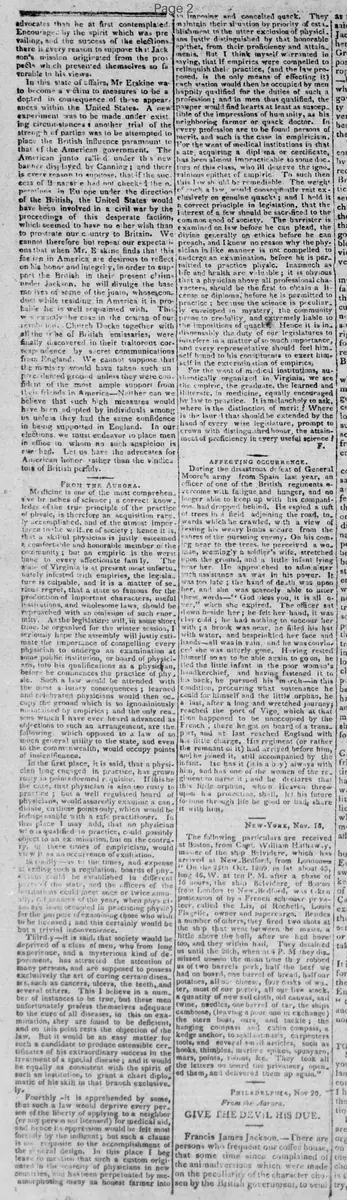
FROM THE AURORA.
Medicine is one of the most comprehensive branches of science: a correct knowledge of the true principles of the practice of physic, is therefore an acquisition rarely accomplished, and of the utmost importance to the welfare of society; hence it is, that a skillful physician is justly esteemed a comfortable and honorable member of the community; but an empiric is the worst bane to every affectionate family. The state of Virginia is at present most unfortunately infested with empirics, the legislature is culpable, and it is a matter of serious regret, that a state so famous for the production of important characters, useful institutions, and wholesome laws, should be reproached with an omission of such enactments. As the legislature will, in some short time, be organized for the winter session, I seriously hope the assembly will justly estimate the importance of compelling every physician to undergo an examination at some public institution, or board of physicians, into his qualifications as a physician, before he commences the practice of physic. Such a law would be attended with the most salutary consequences; learned and celebrated physicians would then occupy the ground which is so ignominiously maintained by empirics; and the only reasons which I have ever heard advanced as objections to such an arrangement, are the following, which opposed to a law of so much general utility to the state, and even to the commonwealth, would occupy points of insignificance.
In the first place, it is said, that a physician long engaged in practice, has grown rusty in points deemed requisite. If this be the case, that physician is also too rusty to practice; but a well regulated board of physicians, would assuredly examine a candidate, on those points only, which would be indispensable with a safe practitioner. In this place I may add, that no physician who is qualified to practice, could possibly object to an examination, but on the contrary, in these times of empiricism, would view it as an occurrence of exultation.
Secondly—as to the times, and expense attending such a regulation, boards of physicians could be established in different parts of the state, and the officers of the institutions could meet once or twice annually, (at seasons of the year, when physicians are least occupied in practicing physic) for the purpose of examining those who wish to be licensed; and this certainly would be but a trivial inconvenience.
Thirdly—it is said, that society would be deprived of a class of men, who from long experience, and a mysterious kind of experiment, has attracted the attention of many persons, and are supposed to possess exclusively the art of curing certain diseases, such as cancers, ulcers, the teeth, and several others. This I believe in a number of instances to be true, but these men unfortunately profess themselves adequate to the cure of all diseases, in this on examination, they are found to be deficient, and on this point rests the objection of the law. But it would be an easy matter for such a candidate to produce ostensible certificates of his extraordinary success in the treatment of a special disease; and it would be equally as consistent with the spirit of such an institution, to grant a charter diplomatic of his skill in that branch exclusively.
Fourthly—it is apprehended by some, that such a law would deprive every person of the liberty of applying to a neighbor (or any person not licensed) for medical aid, and hence its oppression would be felt most forcibly by the indigent; but such a clause is requisite to the accomplishment of the general design. In this place I beg leave to mention that such a custom originated in the scarcity of physicians in new countries, and has been perpetuated by metamorphosing many an honest farmer into an imposing and conceited quack. They maintain their situation by priority of establishment to the utter exclusion of physicians justly distinguished by that honorable epithet, from their proficiency and attainments. But I think myself warranted in saying, that if empirics were compelled to relinquish their practice, (and the law proposed, is the only means of effecting it) each station would then be occupied by men happily qualified for the duties of such a profession; and in men thus qualified, the pauper would find hearts at least as susceptible of the impressions of humanity, as his neighboring farmer or quack doctor. In every profession are to be found persons of merit, and such is the case in empiricism. For the want of medical institutions in that state, acquiring a diploma or certificate, has been almost impracticable to some doctors of this class, who ill deserve the ignominious epithet of empiric. To such then this law should be remediable. The weight or pinch of such a law, would consequently rest exclusively on genuine quacks; and I hold it a correct principle in legislation, that the interest of a few should be sacrificed to the common good of society. The barrister is examined on law before he can plead, the divine generally on ethics before he can preach, and I know no reason why the physician in like manner is not compelled to undergo an examination, before he is permitted to practice physic. Inasmuch as life and health are valuable: it is obvious that a physician above all professional characters, should be the first to obtain a license or diploma, before he is permitted to practice: because the science is peculiarly enveloped in mystery, the community prone to credulity, and extremely liable to the impositions of quacks. Hence it is indispensably the duty of our legislatures to interfere in a matter of so much importance, and every representative should feel himself bound to his constituents to exert himself in the extermination of empirics.
For the want of medical institutions, authentically organized in Virginia, we see the empiric, the graduate, the learned and illiterate, in medicine, equally encouraged by law to practice. It is melancholy to ask, where is the distinction of merit? Where is the laurel that should be extended by the hand of every wise legislature, prompt to crown with distinguished honor, the attainment of proficiency in every useful science.
F.
Medicine is one of the most comprehensive branches of science: a correct knowledge of the true principles of the practice of physic, is therefore an acquisition rarely accomplished, and of the utmost importance to the welfare of society; hence it is, that a skillful physician is justly esteemed a comfortable and honorable member of the community; but an empiric is the worst bane to every affectionate family. The state of Virginia is at present most unfortunately infested with empirics, the legislature is culpable, and it is a matter of serious regret, that a state so famous for the production of important characters, useful institutions, and wholesome laws, should be reproached with an omission of such enactments. As the legislature will, in some short time, be organized for the winter session, I seriously hope the assembly will justly estimate the importance of compelling every physician to undergo an examination at some public institution, or board of physicians, into his qualifications as a physician, before he commences the practice of physic. Such a law would be attended with the most salutary consequences; learned and celebrated physicians would then occupy the ground which is so ignominiously maintained by empirics; and the only reasons which I have ever heard advanced as objections to such an arrangement, are the following, which opposed to a law of so much general utility to the state, and even to the commonwealth, would occupy points of insignificance.
In the first place, it is said, that a physician long engaged in practice, has grown rusty in points deemed requisite. If this be the case, that physician is also too rusty to practice; but a well regulated board of physicians, would assuredly examine a candidate, on those points only, which would be indispensable with a safe practitioner. In this place I may add, that no physician who is qualified to practice, could possibly object to an examination, but on the contrary, in these times of empiricism, would view it as an occurrence of exultation.
Secondly—as to the times, and expense attending such a regulation, boards of physicians could be established in different parts of the state, and the officers of the institutions could meet once or twice annually, (at seasons of the year, when physicians are least occupied in practicing physic) for the purpose of examining those who wish to be licensed; and this certainly would be but a trivial inconvenience.
Thirdly—it is said, that society would be deprived of a class of men, who from long experience, and a mysterious kind of experiment, has attracted the attention of many persons, and are supposed to possess exclusively the art of curing certain diseases, such as cancers, ulcers, the teeth, and several others. This I believe in a number of instances to be true, but these men unfortunately profess themselves adequate to the cure of all diseases, in this on examination, they are found to be deficient, and on this point rests the objection of the law. But it would be an easy matter for such a candidate to produce ostensible certificates of his extraordinary success in the treatment of a special disease; and it would be equally as consistent with the spirit of such an institution, to grant a charter diplomatic of his skill in that branch exclusively.
Fourthly—it is apprehended by some, that such a law would deprive every person of the liberty of applying to a neighbor (or any person not licensed) for medical aid, and hence its oppression would be felt most forcibly by the indigent; but such a clause is requisite to the accomplishment of the general design. In this place I beg leave to mention that such a custom originated in the scarcity of physicians in new countries, and has been perpetuated by metamorphosing many an honest farmer into an imposing and conceited quack. They maintain their situation by priority of establishment to the utter exclusion of physicians justly distinguished by that honorable epithet, from their proficiency and attainments. But I think myself warranted in saying, that if empirics were compelled to relinquish their practice, (and the law proposed, is the only means of effecting it) each station would then be occupied by men happily qualified for the duties of such a profession; and in men thus qualified, the pauper would find hearts at least as susceptible of the impressions of humanity, as his neighboring farmer or quack doctor. In every profession are to be found persons of merit, and such is the case in empiricism. For the want of medical institutions in that state, acquiring a diploma or certificate, has been almost impracticable to some doctors of this class, who ill deserve the ignominious epithet of empiric. To such then this law should be remediable. The weight or pinch of such a law, would consequently rest exclusively on genuine quacks; and I hold it a correct principle in legislation, that the interest of a few should be sacrificed to the common good of society. The barrister is examined on law before he can plead, the divine generally on ethics before he can preach, and I know no reason why the physician in like manner is not compelled to undergo an examination, before he is permitted to practice physic. Inasmuch as life and health are valuable: it is obvious that a physician above all professional characters, should be the first to obtain a license or diploma, before he is permitted to practice: because the science is peculiarly enveloped in mystery, the community prone to credulity, and extremely liable to the impositions of quacks. Hence it is indispensably the duty of our legislatures to interfere in a matter of so much importance, and every representative should feel himself bound to his constituents to exert himself in the extermination of empirics.
For the want of medical institutions, authentically organized in Virginia, we see the empiric, the graduate, the learned and illiterate, in medicine, equally encouraged by law to practice. It is melancholy to ask, where is the distinction of merit? Where is the laurel that should be extended by the hand of every wise legislature, prompt to crown with distinguished honor, the attainment of proficiency in every useful science.
F.
What sub-type of article is it?
Politics
What keywords are associated?
Virginia Legislature
Physician Licensing
Empirics
Medical Examination
Quacks
Public Health
What entities or persons were involved?
F.
Where did it happen?
Virginia
Domestic News Details
Primary Location
Virginia
Key Persons
F.
Event Details
A letter argues for Virginia legislature to require physician examinations to eliminate empirics, addressing objections on experience, expense, special skills, and liberty, emphasizing public welfare and comparison to other professions.