Thank you for visiting SNEWPapers!
Sign up free
Literary
July 2, 1818
Daily National Intelligencer
Washington, District Of Columbia
What is this article about?
Extract from Henry Sass's 1817 travel book describing a visit to the ancient ruins of Pompeii after descending Vesuvius. The author explores the remarkably preserved city, including theaters, temples, forum, houses like Sallust's, streets, shops, and amphitheater, marveling at the architecture, paintings, and sudden burial in AD 79.
Clipping
OCR Quality
95%
Excellent
Full Text
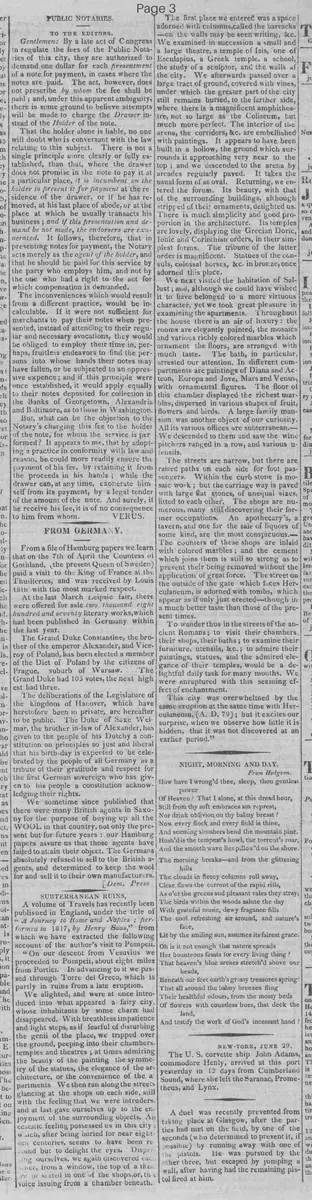
SUBTERRANEAN RUINS,
A volume of Travels has recently been published in England, under the title of "A Journey to Rome and Naples; performed in 1817, by Henry Sass," from which we have extracted the following account of the author's visit to Pompeii.
"On our descent from Vesuvius we proceeded to Pompeii, about eight miles from Portici. In advancing to it we passed through Torre del Greco, which is partly in ruins from a late eruption. We alighted, and were at once introduced into what appeared a fairy city, whose inhabitants by some charm had disappeared. With breathless impatience and light steps, as if fearful of disturbing the genii of the place, we tripped over the ground, peeping into their chambers, temples and theatres; at times admiring the beauty of the painting the symmetry of the statues, the elegance of the architecture, or the convenience of the apartments We then ran along the streets glancing at the shops on each side, still with the feeling that we were intruders. and at last gave ourselves up to the enjoyment of the surrounding objects. An ecstatic feeling possessed us in this city which, after being buried for near eighteen centuries, seems to have been found but to delight the eyes. Dispersing ourselves, we again discovered each other, from a window, the top of a theatre or seated in one of the shops,or, the voice issuing from a chamber beneath.
The first place we entered was a space adorned with columns,called the barracks—on the walls may be seen writing, &c. We examined in succession a small and a large theatre, a temple of Isis, one of Esculapius, a Greek temple, a school, the study of a sculptor, and the walls of the city. We afterwards passed over a large tract of ground, covered with vines, under which the greater part of the city still remains buried, to the farther side, where there is a magnificent amphitheatre, not so large as the Coliseum, but much more perfect. The interior of the arena, the corridors, &c. are embellished with paintings. It appears to have been built in a hollow, the ground which surrounds it approaching very near to the top ; and we descended to the arena by arcades regularly paved. It takes the usual form of an oval. Returning, we entered the forum. Its beauty, with that of the surrounding buildings, although stripped of their ornaments, delighted us. There is much simplicity and good proportion in the architecture. Its temples are lovely, displaying the Grecian Doric, Ionic and Corinthian orders, in their simplest forms. The tribune of the latter order is magnificent. Statues of the consuls, colossal horses, &c. in bronze, once adorned this place.
We next visited the habitation of Sallust; and, although we could have wished it to have belonged to a more virtuous character, yet we took great pleasure in examining the apartments. Throughout the house there is an air of luxury: the rooms are elegantly painted, the mosaics and various richly colored marbles which ornament the floors, are arranged with much taste. The bath, in particular, arrested our attention. In different compartments are paintings of Diana and Acteon, Europa and Jove, Mars and Venus, with ornamental figures. The floor of this chamber displayed the richest marbles, dispersed in various shapes of fruit flowers and birds. A large family mansion was another object of our curiosity. All its various offices are subterranean.—We descended to them and saw the wine pitchers ranged in a row, and various utensils.
The streets are narrow, but there are raised paths on each side for foot passengers. Within the curb stone is mosaic work; but the carriage way is paved with large flat stones, of unequal sizes, fitted to each other. The shops are numerous, many still discovering their former occupations. An apothecary's, a tavern, and one for the sale of liquors of some kind, are the most conspicuous.—The counters of these shops are inlaid with colored marbles; and the cement which joins them is still so strong as to prevent their being removed without the application of great force. The street on the outside of the gate which faces Herculaneum, is adorned with tombs, which appear as if only just erected—though in a much better taste than those of the present times.
To wander thus in the streets of the ancient Romans: to visit their chambers, their shops. their baths: to examine their furniture, utensils. &c.: to admire their paintings, statues, and the admired elegance of their temples, would be a delightful daily task for many months. We were enraptured with this seeming effect of enchantment.
This city was overwhelmed by the same eruption at the same time with Herculaneum, (A. D. 79); but it excites our surprise, when we observe how little it is hidden, that it was not discovered at an earlier period."
A volume of Travels has recently been published in England, under the title of "A Journey to Rome and Naples; performed in 1817, by Henry Sass," from which we have extracted the following account of the author's visit to Pompeii.
"On our descent from Vesuvius we proceeded to Pompeii, about eight miles from Portici. In advancing to it we passed through Torre del Greco, which is partly in ruins from a late eruption. We alighted, and were at once introduced into what appeared a fairy city, whose inhabitants by some charm had disappeared. With breathless impatience and light steps, as if fearful of disturbing the genii of the place, we tripped over the ground, peeping into their chambers, temples and theatres; at times admiring the beauty of the painting the symmetry of the statues, the elegance of the architecture, or the convenience of the apartments We then ran along the streets glancing at the shops on each side, still with the feeling that we were intruders. and at last gave ourselves up to the enjoyment of the surrounding objects. An ecstatic feeling possessed us in this city which, after being buried for near eighteen centuries, seems to have been found but to delight the eyes. Dispersing ourselves, we again discovered each other, from a window, the top of a theatre or seated in one of the shops,or, the voice issuing from a chamber beneath.
The first place we entered was a space adorned with columns,called the barracks—on the walls may be seen writing, &c. We examined in succession a small and a large theatre, a temple of Isis, one of Esculapius, a Greek temple, a school, the study of a sculptor, and the walls of the city. We afterwards passed over a large tract of ground, covered with vines, under which the greater part of the city still remains buried, to the farther side, where there is a magnificent amphitheatre, not so large as the Coliseum, but much more perfect. The interior of the arena, the corridors, &c. are embellished with paintings. It appears to have been built in a hollow, the ground which surrounds it approaching very near to the top ; and we descended to the arena by arcades regularly paved. It takes the usual form of an oval. Returning, we entered the forum. Its beauty, with that of the surrounding buildings, although stripped of their ornaments, delighted us. There is much simplicity and good proportion in the architecture. Its temples are lovely, displaying the Grecian Doric, Ionic and Corinthian orders, in their simplest forms. The tribune of the latter order is magnificent. Statues of the consuls, colossal horses, &c. in bronze, once adorned this place.
We next visited the habitation of Sallust; and, although we could have wished it to have belonged to a more virtuous character, yet we took great pleasure in examining the apartments. Throughout the house there is an air of luxury: the rooms are elegantly painted, the mosaics and various richly colored marbles which ornament the floors, are arranged with much taste. The bath, in particular, arrested our attention. In different compartments are paintings of Diana and Acteon, Europa and Jove, Mars and Venus, with ornamental figures. The floor of this chamber displayed the richest marbles, dispersed in various shapes of fruit flowers and birds. A large family mansion was another object of our curiosity. All its various offices are subterranean.—We descended to them and saw the wine pitchers ranged in a row, and various utensils.
The streets are narrow, but there are raised paths on each side for foot passengers. Within the curb stone is mosaic work; but the carriage way is paved with large flat stones, of unequal sizes, fitted to each other. The shops are numerous, many still discovering their former occupations. An apothecary's, a tavern, and one for the sale of liquors of some kind, are the most conspicuous.—The counters of these shops are inlaid with colored marbles; and the cement which joins them is still so strong as to prevent their being removed without the application of great force. The street on the outside of the gate which faces Herculaneum, is adorned with tombs, which appear as if only just erected—though in a much better taste than those of the present times.
To wander thus in the streets of the ancient Romans: to visit their chambers, their shops. their baths: to examine their furniture, utensils. &c.: to admire their paintings, statues, and the admired elegance of their temples, would be a delightful daily task for many months. We were enraptured with this seeming effect of enchantment.
This city was overwhelmed by the same eruption at the same time with Herculaneum, (A. D. 79); but it excites our surprise, when we observe how little it is hidden, that it was not discovered at an earlier period."
What sub-type of article is it?
Journey Narrative
Essay
What themes does it cover?
Social Manners
Commerce Trade
Death Mortality
What keywords are associated?
Pompeii
Roman Ruins
Vesuvius
Travel Account
Ancient Architecture
Sallust House
Amphitheatre
Forum
What entities or persons were involved?
Henry Sass
Literary Details
Title
Subterranean Ruins
Author
Henry Sass
Subject
Visit To Pompeii In 1817
Key Lines
We Alighted, And Were At Once Introduced Into What Appeared A Fairy City, Whose Inhabitants By Some Charm Had Disappeared.
An Ecstatic Feeling Possessed Us In This City Which, After Being Buried For Near Eighteen Centuries, Seems To Have Been Found But To Delight The Eyes.
Its Temples Are Lovely, Displaying The Grecian Doric, Ionic And Corinthian Orders, In Their Simplest Forms.
Throughout The House There Is An Air Of Luxury: The Rooms Are Elegantly Painted, The Mosaics And Various Richly Colored Marbles Which Ornament The Floors, Are Arranged With Much Taste.
To Wander Thus In The Streets Of The Ancient Romans: To Visit Their Chambers, Their Shops. Their Baths: To Examine Their Furniture, Utensils. &C.: To Admire Their Paintings, Statues, And The Admired Elegance Of Their Temples, Would Be A Delightful Daily Task For Many Months.