Thank you for visiting SNEWPapers!
Sign up free
Editorial
August 8, 1910
The Richmond Palladium And Sun Telegram
Richmond, Wayne County, Indiana
What is this article about?
Judge John Gibbons of Cook County, Illinois, criticizes the doctrine of assumed risk in labor injury cases, arguing it encourages employer negligence. He proposes abrogating it and implementing a fixed compensation schedule for injuries and deaths to ensure prompt payments and reduce court burdens.
Clipping
OCR Quality
95%
Excellent
Full Text
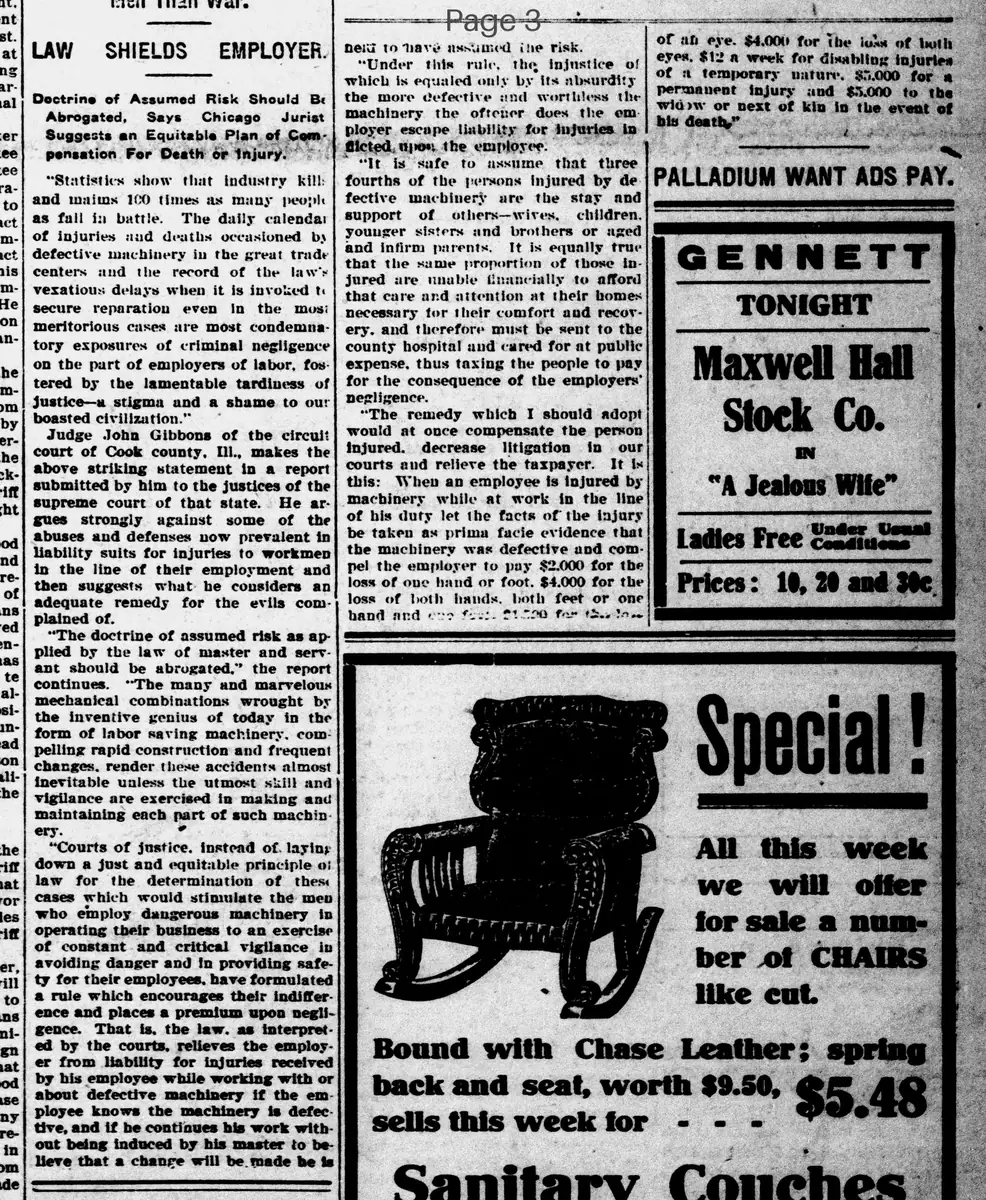
Doctrine of Assumed Risk Should Be Abrogated,
Says Chicago Jurist Suggests an Equitable Plan of Compensation. For Death or injury.
"Statistics show that industry kills and maims ten times as many people as fall in battle. The daily calendar of injuries and deaths occasioned by defective machinery in the great trade centers and the record of the law's vexatious delays when it is invoked to secure reparation even in the most meritorious cases are most condemnatory exposures of criminal negligence on the part of employers of labor, fostered by the lamentable tardiness of justice--a stigma and a shame to our boasted civilization."
Judge John Gibbons of the circuit court of Cook county, Ill., makes the above striking statement in a report submitted by him to the justices of the supreme court of that state. He argues strongly against some of the abuses and defenses now prevalent in liability suits for injuries to workmen in the line of their employment and then suggests what he considers an adequate remedy for the evils complained of.
"The doctrine of assumed risk as applied by the law of master and servant should be abrogated," the report continues.
The many and marvelous mechanical combinations wrought by the inventive genius of today in the form of labor saving machinery, compelling rapid construction and frequent changes, render these accidents almost inevitable unless the utmost skill and vigilance are exercised in making and maintaining each part of such machinery.
"Courts of justice, instead of laying down a just and equitable principle of law for the determination of these cases which would stimulate the men who employ dangerous machinery in operating their business to an exercise of constant and critical vigilance in avoiding danger and in providing safety for their employees, have formulated a rule which encourages their indifference and places a premium upon negligence. That is, the law, as interpreted by the courts, relieves the employer from liability for injuries received by his employee while working with or about defective machinery if the employee knows the machinery is defective, and if he continues his work without being induced by his master to believe that a change will be made he is under this rule, the injustice of which is equaled only by its absurdity the more defective and worthless the machinery the oftener does the employer escape liability for injuries inflicted upon the employee.
"It is safe to assume that three fourths of the persons injured by defective machinery are the stay and support of others--wives, children, younger sisters and brothers or aged and infirm parents. It is equally true that the same proportion of those injured are unable financially to afford that care and attention at their homes necessary for their comfort and recovery, and therefore must be sent to the county hospital and cared for at public expense, thus taxing the people to pay for the consequence of the employers negligence.
"The remedy which I should adopt would at once compensate the person injured, decrease litigation in our courts and relieve the taxpayer. It is this: When an employee is injured by machinery while at work in the line of his duty let the facts of the injury be taken as prima facie evidence that the machinery was defective and compel the employer to pay $2,000 for the loss of one hand or foot, $4,000 for the loss of both hands, both feet or one hand and one foot, $100 for the loss of an eye, $4,000 for the loss of both eyes, $12 a week for disabling injuries of a temporary nature, $1,000 for a permanent injury and $5,000 to the widow or next of kin in the event of his death."
Says Chicago Jurist Suggests an Equitable Plan of Compensation. For Death or injury.
"Statistics show that industry kills and maims ten times as many people as fall in battle. The daily calendar of injuries and deaths occasioned by defective machinery in the great trade centers and the record of the law's vexatious delays when it is invoked to secure reparation even in the most meritorious cases are most condemnatory exposures of criminal negligence on the part of employers of labor, fostered by the lamentable tardiness of justice--a stigma and a shame to our boasted civilization."
Judge John Gibbons of the circuit court of Cook county, Ill., makes the above striking statement in a report submitted by him to the justices of the supreme court of that state. He argues strongly against some of the abuses and defenses now prevalent in liability suits for injuries to workmen in the line of their employment and then suggests what he considers an adequate remedy for the evils complained of.
"The doctrine of assumed risk as applied by the law of master and servant should be abrogated," the report continues.
The many and marvelous mechanical combinations wrought by the inventive genius of today in the form of labor saving machinery, compelling rapid construction and frequent changes, render these accidents almost inevitable unless the utmost skill and vigilance are exercised in making and maintaining each part of such machinery.
"Courts of justice, instead of laying down a just and equitable principle of law for the determination of these cases which would stimulate the men who employ dangerous machinery in operating their business to an exercise of constant and critical vigilance in avoiding danger and in providing safety for their employees, have formulated a rule which encourages their indifference and places a premium upon negligence. That is, the law, as interpreted by the courts, relieves the employer from liability for injuries received by his employee while working with or about defective machinery if the employee knows the machinery is defective, and if he continues his work without being induced by his master to believe that a change will be made he is under this rule, the injustice of which is equaled only by its absurdity the more defective and worthless the machinery the oftener does the employer escape liability for injuries inflicted upon the employee.
"It is safe to assume that three fourths of the persons injured by defective machinery are the stay and support of others--wives, children, younger sisters and brothers or aged and infirm parents. It is equally true that the same proportion of those injured are unable financially to afford that care and attention at their homes necessary for their comfort and recovery, and therefore must be sent to the county hospital and cared for at public expense, thus taxing the people to pay for the consequence of the employers negligence.
"The remedy which I should adopt would at once compensate the person injured, decrease litigation in our courts and relieve the taxpayer. It is this: When an employee is injured by machinery while at work in the line of his duty let the facts of the injury be taken as prima facie evidence that the machinery was defective and compel the employer to pay $2,000 for the loss of one hand or foot, $4,000 for the loss of both hands, both feet or one hand and one foot, $100 for the loss of an eye, $4,000 for the loss of both eyes, $12 a week for disabling injuries of a temporary nature, $1,000 for a permanent injury and $5,000 to the widow or next of kin in the event of his death."
What sub-type of article is it?
Legal Reform
Labor
What keywords are associated?
Assumed Risk
Labor Injuries
Employer Liability
Defective Machinery
Compensation Plan
Judicial Reform
Worker Safety
What entities or persons were involved?
Judge John Gibbons
Circuit Court Of Cook County, Ill.
Supreme Court Of Illinois
Editorial Details
Primary Topic
Abrogation Of Assumed Risk Doctrine And Fixed Compensation For Labor Injuries
Stance / Tone
Strong Advocacy For Legal Reform Against Employer Negligence
Key Figures
Judge John Gibbons
Circuit Court Of Cook County, Ill.
Supreme Court Of Illinois
Key Arguments
Industry Causes More Deaths And Injuries Than Battles
Current Law's Delays Expose Employer Negligence
Doctrine Of Assumed Risk Should Be Abrogated
It Encourages Employer Indifference And Premiums Negligence
Injured Workers Often Support Dependents And Burden Public Hospitals
Propose Prima Facie Evidence Of Defect And Fixed Compensation Amounts For Specific Injuries