Thank you for visiting SNEWPapers!
Sign up free
Alabama State Intelligencer
Tuscaloosa, Tuscaloosa County, Alabama
What is this article about?
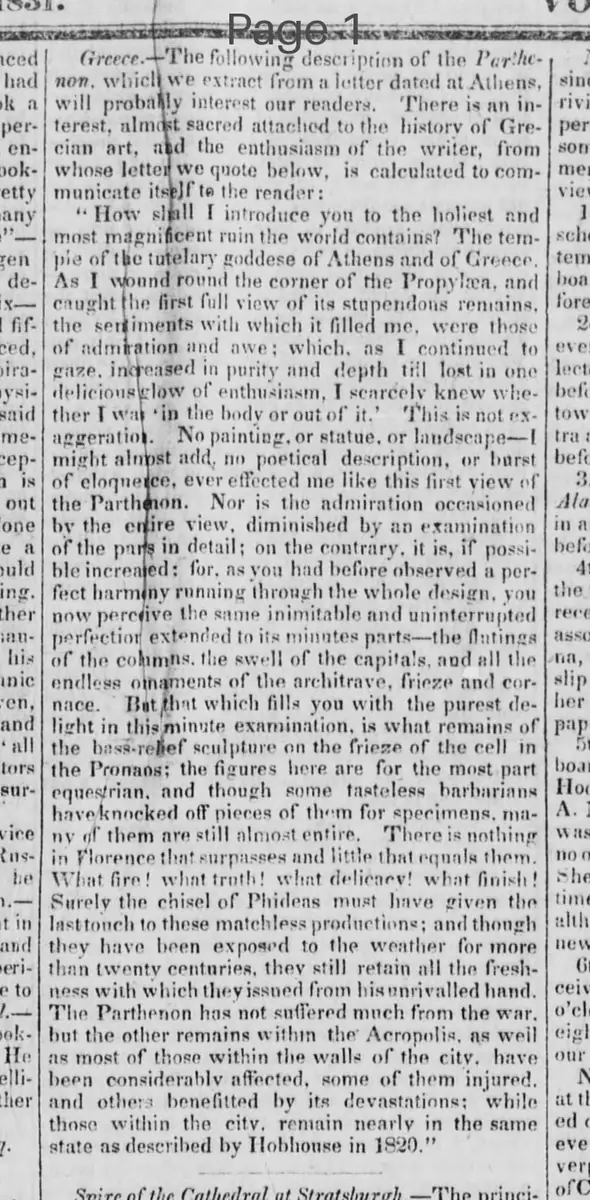
Extract from a letter in Athens praising the Parthenon's ruins for their awe-inspiring architecture and enduring sculptures by Phidias, with minimal war damage compared to other sites. (168 characters)
Clipping
OCR Quality
Full Text
which we extract from a letter dated at Athens,
will probably interest our readers. 'There is an interest
almost sacred attached to the history of Grecian
art, and the enthusiasm of the writer, from
whose letter we quote below, is calculated to communicate
itself to the reader:
"How shall I introduce you to the holiest and
most magnificent ruin the world contains? The temple
of the tutelary goddess of Athens and of Greece.
As I wound round the corner of the Propylaea, and
caught the first full view of its stupendous remains,
the sentiments with which it filled me were those
of admiration and awe: which, as I continued to
gaze, increased in purity and depth till lost in one
delicious glow of enthusiasm. I scarcely knew whether
I was in the body or out of it.' This is not exaggeration.
No painting, or statue, or landscape—I
might almost add, no poetical description, or burst
of eloquence, ever affected me like this first view of
the Parthenon. Nor is the admiration occasioned
by the entire view diminished by an examination
of the parts in detail; on the contrary, it is, if possible,
increased: for, as you had before observed a perfect
harmony running through the whole design, you
now perceive the same inimitable and uninterrupted
perfection extended to its minutest parts—the flutings
of the columns, the swell of the capitals, and all the
endless ornaments of the architrave, frieze and cornice.
But that which fills you with the purest delight
in this minute examination, is what remains of
the bass-relief sculpture on the frieze of the cell in
the Pronaos; the figures here are for the most part
equestrian, and though some tasteless barbarians
have knocked off pieces of them for specimens, many
of them are still almost entire. There is nothing
in Florence that surpasses and little that equals them.
What fire! what truth! what delicacy! what finish!
Surely the chisel of Phidias must have given the
last touch to these matchless productions; and though
they have been exposed to the weather for more
than twenty centuries, they still retain all the freshness
with which they issued from his unrivalled hand.
The Parthenon has not suffered much from the war,
but the other remains within the Acropolis, as well
as most of those within the walls of the city, have
been considerably affected, some of them injured,
and others benefitted by its devastations; while
those within the city remain nearly in the same
state as described by Hobhouse in 1820."
What sub-type of article is it?
What themes does it cover?
What keywords are associated?
What entities or persons were involved?
Where did it happen?
Story Details
Key Persons
Location
Athens, Greece; Parthenon, Acropolis
Story Details
A letter from Athens describes the sacred history and magnificent ruins of the Parthenon, evoking admiration and awe upon first view. The architecture shows perfect harmony in details like columns and ornaments. The frieze sculptures, mostly equestrian, display fire, truth, delicacy, and finish, likely touched by Phidias, retaining freshness after centuries. The Parthenon suffered little from war, unlike other Acropolis and city remains, similar to Hobhouse's 1820 description.