Thank you for visiting SNEWPapers!
Sign up free
Story
March 20, 1846
The Charlotte Journal
Charlotte, Mecklenburg County, North Carolina
What is this article about?
The Magnetic Telegraph could provide advance warnings of storms progressing from leeward to windward, preventing shipwrecks on the coast. Example: February 14-15 snow storm hit Toledo at 4 PM Saturday, Buffalo at 8 PM, Boston at 5 AM Sunday, allowing 15-16 hours notice from Toledo.
Clipping
OCR Quality
95%
Excellent
Full Text
ANTICIPATING A STORM BY THE MAGNETIC TELEGRAPH
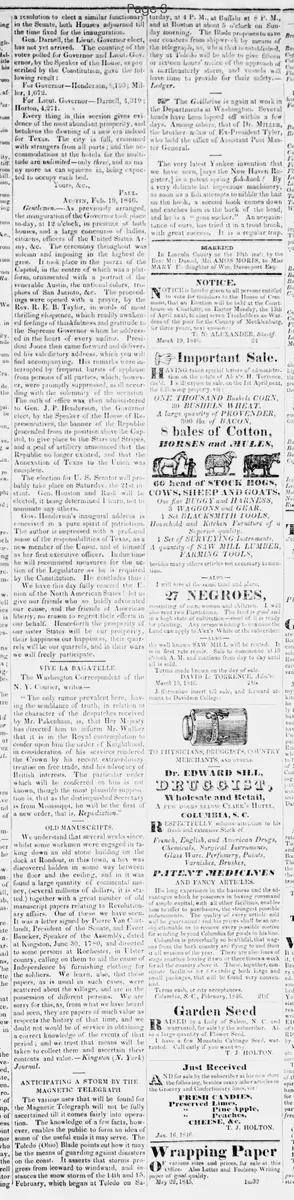
The various uses that will be found for the Magnetic Telegraph will not be fully ascertained till it comes fairly into operation. The knowledge of a few facts, however, enables the public to form an idea of some of the useful ends it may serve. The Toledo (Ohio) Blade points out how it may be the means of guarding against disasters on the coast. It asserts that storms progress from leeward to windward, and instances the snow storm of the 14th and 15 February, which began at Toledo on Saturday, at 4 P. M., at Buffalo at 8 P. M. and at Boston at about 5 o'clock on Sunday morning. The Blade proposes to save our coasters from shipwreck by means of the telegraph, as, when it is established, they at Toledo will be able to give fifteen or sixteen hours' notice of the approach of a northeasterly storm, and vessels will have time to provide for their safety.— Ledger.
The various uses that will be found for the Magnetic Telegraph will not be fully ascertained till it comes fairly into operation. The knowledge of a few facts, however, enables the public to form an idea of some of the useful ends it may serve. The Toledo (Ohio) Blade points out how it may be the means of guarding against disasters on the coast. It asserts that storms progress from leeward to windward, and instances the snow storm of the 14th and 15 February, which began at Toledo on Saturday, at 4 P. M., at Buffalo at 8 P. M. and at Boston at about 5 o'clock on Sunday morning. The Blade proposes to save our coasters from shipwreck by means of the telegraph, as, when it is established, they at Toledo will be able to give fifteen or sixteen hours' notice of the approach of a northeasterly storm, and vessels will have time to provide for their safety.— Ledger.
What sub-type of article is it?
Curiosity
What themes does it cover?
Catastrophe
Survival
What keywords are associated?
Magnetic Telegraph
Storm Warning
Shipwreck Prevention
Weather Progression
Coastal Disasters
Where did it happen?
Toledo (Ohio), Buffalo, Boston, Coast
Story Details
Location
Toledo (Ohio), Buffalo, Boston, Coast
Event Date
14th And 15 February
Story Details
Storms progress from leeward to windward; telegraph from Toledo can warn coastal vessels 15-16 hours ahead of northeasterly storms, preventing shipwrecks, as shown by February snow storm timeline.