Thank you for visiting SNEWPapers!
Sign up free
Literary
August 19, 1790
The New Hampshire Gazette And General Advertiser
Portsmouth, Rockingham County, New Hampshire
What is this article about?
An essay advocating harmonious family government to instill virtue in children, emphasizing parental unity and discretion. It recounts the late marriage of Philanthropus and Serinia, their happiness, and includes a sonnet on discovering love in maturity, promoting marital bliss.
Clipping
OCR Quality
98%
Excellent
Full Text
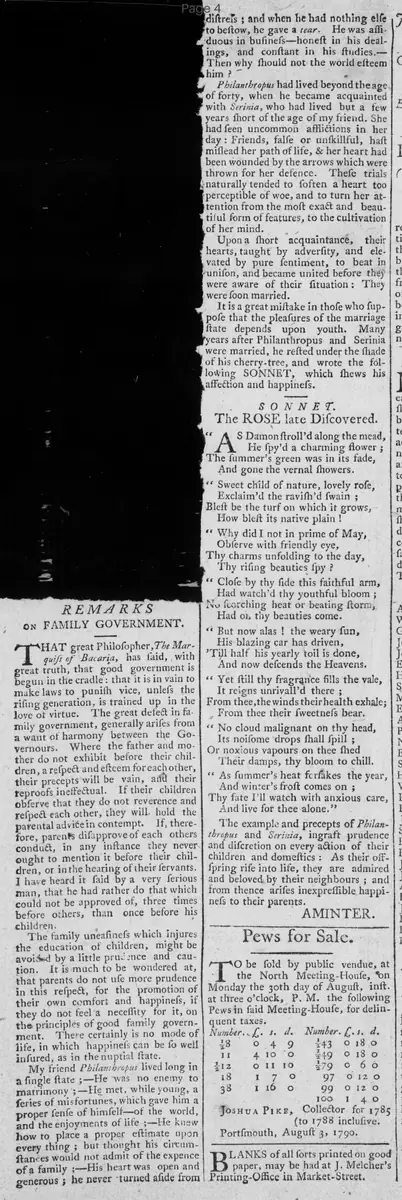
REMARKS
ON FAMILY GOVERNMENT.
That great Philosopher, The Marquis of Beccaria, has said, with great truth, that good government is begun in the cradle: that it is in vain to make laws to punish vice, unless the rising generation, is trained up in the love of virtue. The great defect in family government, generally arises from a want of harmony between the Governors. Where the father and mother do not exhibit before their children, a respect and esteem for each other, their precepts will be vain, and their reproofs ineffectual. If their children observe that they do not reverence and respect each other, they will hold the parental advice in contempt.
If, therefore, parents disapprove of each others conduct, in any instance they never ought to mention it before their children, or in the hearing of their servants. I have heard it said by a very serious man, that he had rather do that which could not be approved of, three times before others, than once before his children.
The family uneasiness which injures the education of children, might be avoided by a little prudence and caution. It is much to be wondered at, that parents do not use more prudence in this respect, for the promotion of their own comfort and happiness, if they do not feel a necessity for it, on the principles of good family government. There certainly is no mode of life, in which happiness can be so well insured, as in the nuptial state.
My friend Philanthropus lived long in a single state; He was no enemy to matrimony; He met, while young, a series of misfortunes, which gave him a proper sense of himself-of the world, and the enjoyments of life; He knew how to place a proper estimate upon every thing; but thought his circumstances would not admit of the expense of a family; His heart was open and generous; he never turned aside from distresses: and when he had nothing else to bestow, he gave a tear. He was assiduous in business--honest in his dealings, and constant in his studies.-- Then why should not the world esteem him?
Philanthropus had lived beyond the age of forty, when he became acquainted with Serinia, who had lived but a few years short of the age of my friend. She had seen uncommon afflictions in her day: Friends, false or unskillful, had mislead her path of life, & her heart had been wounded by the arrows which were thrown for her defence. These trials naturally tended to soften a heart too perceptible of woe, and to turn her attention from the most exact and beautiful form of features, to the cultivation of her mind.
Upon a short acquaintance, their hearts, taught by adversity, and elevated by pure sentiment, to beat in unison, and became united before they were aware of their situation: They were soon married.
It is a great mistake in those who suppose that the pleasures of the marriage state depends upon youth. Many years after Philanthropus and Serinia were married. he rested under the shade of his cherry-tree, and wrote the following SONNET, which shows his affection and happiness.
SONNET.
The ROSE late Discovered.
As Damon stroll'd along the mead,
He spied a charming flower;
The summer's green was in its shade,
And gone the vernal showers.
"Sweet child of nature, lovely rose.
Exclaim'd the ravish'd swain;
Blest be the turf on which it grows,
How blest its native plain!
"Why did I not in prime of May,
Observe with friendly eye,
Thy charms unfolding to the day,
Thy rising beauties spy?
"Cloe by thy side this faithful arm,
Had watch'd thy youthful bloom;
No scorching heat or beating storm,
Had on thy beauties come.
"But now alas! the weary sun,
His blazing car has driven,
'Till half his yearly toil is done,
And now descends the Heavens.
"Yet till thy fragrance fills the vale,
It reigns unrival'd there;
From thee,the winds their health exhale;
From thee their sweetness bear.
"No cloud malignant on thy head,
Its noisome drops shall spill;
Or noxious vapours on thee shed
Their damps, thy bloom to chill.
"As summer's heat forsakes the year,
And winter's frost comes on;
Thy fate I'll watch with anxious care,
And live for thee alone."
The example and precepts of Philanthropus and Serinia, ingraft prudence and discretion on every action of their children and domestics: As their offspring rise into life, they are admired and beloved by their neighbours; and from thence arises inexpressible happiness to their parents.
ON FAMILY GOVERNMENT.
That great Philosopher, The Marquis of Beccaria, has said, with great truth, that good government is begun in the cradle: that it is in vain to make laws to punish vice, unless the rising generation, is trained up in the love of virtue. The great defect in family government, generally arises from a want of harmony between the Governors. Where the father and mother do not exhibit before their children, a respect and esteem for each other, their precepts will be vain, and their reproofs ineffectual. If their children observe that they do not reverence and respect each other, they will hold the parental advice in contempt.
If, therefore, parents disapprove of each others conduct, in any instance they never ought to mention it before their children, or in the hearing of their servants. I have heard it said by a very serious man, that he had rather do that which could not be approved of, three times before others, than once before his children.
The family uneasiness which injures the education of children, might be avoided by a little prudence and caution. It is much to be wondered at, that parents do not use more prudence in this respect, for the promotion of their own comfort and happiness, if they do not feel a necessity for it, on the principles of good family government. There certainly is no mode of life, in which happiness can be so well insured, as in the nuptial state.
My friend Philanthropus lived long in a single state; He was no enemy to matrimony; He met, while young, a series of misfortunes, which gave him a proper sense of himself-of the world, and the enjoyments of life; He knew how to place a proper estimate upon every thing; but thought his circumstances would not admit of the expense of a family; His heart was open and generous; he never turned aside from distresses: and when he had nothing else to bestow, he gave a tear. He was assiduous in business--honest in his dealings, and constant in his studies.-- Then why should not the world esteem him?
Philanthropus had lived beyond the age of forty, when he became acquainted with Serinia, who had lived but a few years short of the age of my friend. She had seen uncommon afflictions in her day: Friends, false or unskillful, had mislead her path of life, & her heart had been wounded by the arrows which were thrown for her defence. These trials naturally tended to soften a heart too perceptible of woe, and to turn her attention from the most exact and beautiful form of features, to the cultivation of her mind.
Upon a short acquaintance, their hearts, taught by adversity, and elevated by pure sentiment, to beat in unison, and became united before they were aware of their situation: They were soon married.
It is a great mistake in those who suppose that the pleasures of the marriage state depends upon youth. Many years after Philanthropus and Serinia were married. he rested under the shade of his cherry-tree, and wrote the following SONNET, which shows his affection and happiness.
SONNET.
The ROSE late Discovered.
As Damon stroll'd along the mead,
He spied a charming flower;
The summer's green was in its shade,
And gone the vernal showers.
"Sweet child of nature, lovely rose.
Exclaim'd the ravish'd swain;
Blest be the turf on which it grows,
How blest its native plain!
"Why did I not in prime of May,
Observe with friendly eye,
Thy charms unfolding to the day,
Thy rising beauties spy?
"Cloe by thy side this faithful arm,
Had watch'd thy youthful bloom;
No scorching heat or beating storm,
Had on thy beauties come.
"But now alas! the weary sun,
His blazing car has driven,
'Till half his yearly toil is done,
And now descends the Heavens.
"Yet till thy fragrance fills the vale,
It reigns unrival'd there;
From thee,the winds their health exhale;
From thee their sweetness bear.
"No cloud malignant on thy head,
Its noisome drops shall spill;
Or noxious vapours on thee shed
Their damps, thy bloom to chill.
"As summer's heat forsakes the year,
And winter's frost comes on;
Thy fate I'll watch with anxious care,
And live for thee alone."
The example and precepts of Philanthropus and Serinia, ingraft prudence and discretion on every action of their children and domestics: As their offspring rise into life, they are admired and beloved by their neighbours; and from thence arises inexpressible happiness to their parents.
What sub-type of article is it?
Essay
Poem
What themes does it cover?
Moral Virtue
Social Manners
Love Romance
What keywords are associated?
Family Government
Parental Harmony
Marital Happiness
Virtue Education
Late Marriage
Sonnet Rose
Literary Details
Title
Remarks On Family Government.
Subject
On Family Government And Marital Harmony
Form / Style
Prose Essay With Embedded Sonnet
Key Lines
That Great Philosopher, The Marquis Of Beccaria, Has Said, With Great Truth, That Good Government Is Begun In The Cradle: That It Is In Vain To Make Laws To Punish Vice, Unless The Rising Generation, Is Trained Up In The Love Of Virtue.
There Certainly Is No Mode Of Life, In Which Happiness Can Be So Well Insured, As In The Nuptial State.
As Damon Stroll'd Along The Mead, He Spied A Charming Flower; The Summer's Green Was In Its Shade, And Gone The Vernal Showers.
Yet Till Thy Fragrance Fills The Vale, It Reigns Unrival'd There; From Thee,The Winds Their Health Exhale; From Thee Their Sweetness Bear.
Thy Fate I'll Watch With Anxious Care, And Live For Thee Alone.