Thank you for visiting SNEWPapers!
Sign up free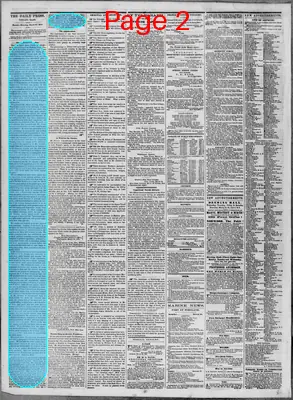
Editorial
March 28, 1864
The Portland Daily Press
Portland, Cumberland County, Maine
What is this article about?
Editorial opposes postponing the National Union Convention in Baltimore from early June, arguing it would aid Lincoln's opponents like Fremont amid strong public support for his renomination during the Civil War, allowing time to unify Union forces before fall elections.
Clipping
OCR Quality
95%
Excellent
Full Text
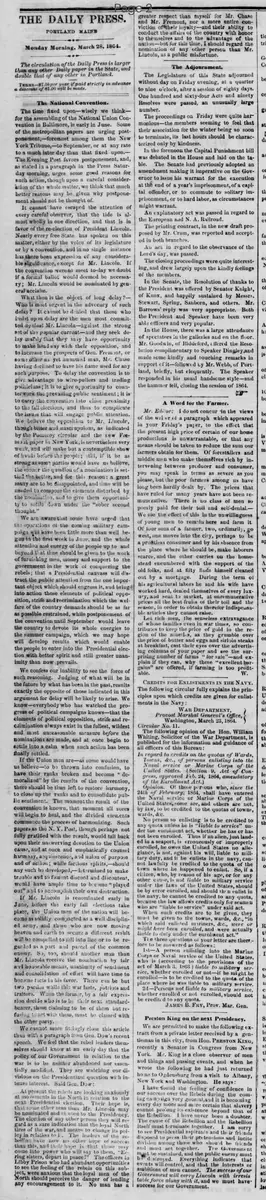
The National Convention.
The time fixed upon—wisely we think—for the assembling of the National Union Convention in Baltimore, is early in June. Some of the metropolitan papers are urging postponement,—foremost among them the New York Tribune, to September, or at any rate to a much later day than that fixed upon. The Evening Post favors postponement, and, as stated in a paragraph in the Press Saturday morning, urges some good reasons for such action, though upon a careful consideration of the whole matter, we think that much better reasons may be given why postponement should not be thought of.
It cannot have escaped the attention of every careful observer, that the tide is almost wholly in one direction, and that is in favor of the re-election of President Lincoln. Nearly every free State has spoken on this matter, either by the voice of its legislature or by a convention, and in no single instance has there been expression of any considerable significance, except for Mr. Lincoln. If the convention were to meet to-day we doubt if a formal ballot would be deemed necessary; Mr. Lincoln would be nominated by general acclaim.
What then is the object of long delay?—Who is most urgent in the advocacy of such delay? It cannot be denied that those who insist upon delay are the men most committed against Mr. Lincoln—against the strong set of the popular current—and they seek delay warily that they may have opportunity to make headway with their opposition, and to increase the prospects of Gen. Fremont, or some other as yet unnamed man, Mr. Chase having declined to have his name used for any such purpose. To delay the convention is to give advantage to wire-pullers and trading politicians; it is to give opportunity to counterwork the prevailing public sentiment; it is to carry the convention into close proximity to the fall elections, and thus to complicate the issues that will engage public attention.
We believe the opposition to Mr. Lincoln, though bitter and unscrupulous, as indicated by the Pomeroy circular and the new Fremont paper in New York, is nevertheless very weak, and will make but a contemptible show of hands before the people; still, if it be as strong as some parties would have us believe, the sooner the question of a nomination is settled the better, and for this reason: a great many are to be disappointed, and time will be needed to compose the elements disturbed by the nomination, and to give them opportunity to settle down under the "sober second thought."
We are aware that some have urged that the operations of the coming military campaign will have been little more than well begun in the first week in June, and the whole attention and energy of the people up to and beyond that time should be given to the work of furnishing men, money and support to the government in the work of conquering the rebels; that a Presidential canvass will distract the public attention from the one important object which should engross it, and bring into action those elements of political opposition, strife and recrimination which the welfare of the country demands should be as far as possible restrained, while postponement of the convention until September would leave the country to devote its whole energies to the summer campaign, which we may hope will develop results which would enable the people to enter into the Presidential election with better spirit and still greater unanimity than now prevails.
We confess our inability to see the force of such reasoning. Judging of what will be in the future by what has been in the past, results exactly the opposite of those indicated in this argument for delay will be likely to arise. We know—everybody who has watched the progress of political campaigns knows—that the elements of political opposition, strife and recrimination always exist in the fullest, wildest and most unreasonable measure before the nominations are made, and at once begin to settle into a calm when such action has been finally settled.
If the Union men are—as some would have us believe—to be thrown into confusion, to have their ranks broken and become "demoralized" by the results of the convention, there should be time left to restore harmony, to close up the ranks and to consolidate public sentiment. The moment the result of the convention is known, that moment all sores will begin to heal, and the divided elements commence the process of harmonizing. Such papers as the N. Y. Post, though perhaps not fully gratified with the result, would fall back upon their unswerving devotion to the Union cause, and at once and emphatically counsel harmony, acquiescence, and union of purpose and of action; while factious spirits,—should any such be developed,—determined to make trouble and to foment discord and discontent, would have ample time to become "played out" and to accomplish their own destruction.
If Mr. Lincoln is renominated early in June, before the early fall elections take place, the Union men of the nation will become as solidly compacted as a well disciplined army, and those who are now moving heaven and earth to secure a different result will be compelled to fall into line or to be regarded as a part and parcel of the common enemy. So, too, should another man than Mr. Lincoln receive the nomination by fair and honorable means, unanimity of sentiment and consolidation of effort will have time to become facts in his favor. There can be but two parties while this war lasts, patriots and traitors. When the former, by a fair expression decide who is to be their next standard-bearer, those claiming to be of them but refusing to act with them, must be classed with the other party.
We cannot more fittingly close this article than with a paragraph from Gen. Dow's recent speech. We feel that the rebel leaders themselves should know at an early day that the policy of our Government in relation to the war is to be neither abandoned nor essentially modified. They are watching our divisions on the Presidential question with intense interest. Said Gen. Dow:
"At present the rebels are looking anxiously at movements in the North in relation to the next Presidential election. Their hope is, that some other man than Mr. Lincoln may be nominated and elected to the Presidency. The election of any other person they will regard as a sure indication that the loyal North tires of the war, and means to change its policy in relation to it. The leaders of the rebellion have now no other hope of success than this, and their hope is that those may come into power who will say to them, 'Erring sisters, depart in peace!' The officers in Libby Prison who had abundant opportunities to see the feeling of the rebels on this subject, were anxious that the loyal men of the North should perceive the danger of lending any encouragement to it. No man has a
greater respect than myself for Mr. Chase and Mr. Fremont, nor a more entire conviction of their loyalty—and their ability to conduct the affairs of the country with honor to themselves and to the advantage of the nation—but at this time, I should regard the nomination of any other person than Mr. Lincoln, as a public misfortune."
The time fixed upon—wisely we think—for the assembling of the National Union Convention in Baltimore, is early in June. Some of the metropolitan papers are urging postponement,—foremost among them the New York Tribune, to September, or at any rate to a much later day than that fixed upon. The Evening Post favors postponement, and, as stated in a paragraph in the Press Saturday morning, urges some good reasons for such action, though upon a careful consideration of the whole matter, we think that much better reasons may be given why postponement should not be thought of.
It cannot have escaped the attention of every careful observer, that the tide is almost wholly in one direction, and that is in favor of the re-election of President Lincoln. Nearly every free State has spoken on this matter, either by the voice of its legislature or by a convention, and in no single instance has there been expression of any considerable significance, except for Mr. Lincoln. If the convention were to meet to-day we doubt if a formal ballot would be deemed necessary; Mr. Lincoln would be nominated by general acclaim.
What then is the object of long delay?—Who is most urgent in the advocacy of such delay? It cannot be denied that those who insist upon delay are the men most committed against Mr. Lincoln—against the strong set of the popular current—and they seek delay warily that they may have opportunity to make headway with their opposition, and to increase the prospects of Gen. Fremont, or some other as yet unnamed man, Mr. Chase having declined to have his name used for any such purpose. To delay the convention is to give advantage to wire-pullers and trading politicians; it is to give opportunity to counterwork the prevailing public sentiment; it is to carry the convention into close proximity to the fall elections, and thus to complicate the issues that will engage public attention.
We believe the opposition to Mr. Lincoln, though bitter and unscrupulous, as indicated by the Pomeroy circular and the new Fremont paper in New York, is nevertheless very weak, and will make but a contemptible show of hands before the people; still, if it be as strong as some parties would have us believe, the sooner the question of a nomination is settled the better, and for this reason: a great many are to be disappointed, and time will be needed to compose the elements disturbed by the nomination, and to give them opportunity to settle down under the "sober second thought."
We are aware that some have urged that the operations of the coming military campaign will have been little more than well begun in the first week in June, and the whole attention and energy of the people up to and beyond that time should be given to the work of furnishing men, money and support to the government in the work of conquering the rebels; that a Presidential canvass will distract the public attention from the one important object which should engross it, and bring into action those elements of political opposition, strife and recrimination which the welfare of the country demands should be as far as possible restrained, while postponement of the convention until September would leave the country to devote its whole energies to the summer campaign, which we may hope will develop results which would enable the people to enter into the Presidential election with better spirit and still greater unanimity than now prevails.
We confess our inability to see the force of such reasoning. Judging of what will be in the future by what has been in the past, results exactly the opposite of those indicated in this argument for delay will be likely to arise. We know—everybody who has watched the progress of political campaigns knows—that the elements of political opposition, strife and recrimination always exist in the fullest, wildest and most unreasonable measure before the nominations are made, and at once begin to settle into a calm when such action has been finally settled.
If the Union men are—as some would have us believe—to be thrown into confusion, to have their ranks broken and become "demoralized" by the results of the convention, there should be time left to restore harmony, to close up the ranks and to consolidate public sentiment. The moment the result of the convention is known, that moment all sores will begin to heal, and the divided elements commence the process of harmonizing. Such papers as the N. Y. Post, though perhaps not fully gratified with the result, would fall back upon their unswerving devotion to the Union cause, and at once and emphatically counsel harmony, acquiescence, and union of purpose and of action; while factious spirits,—should any such be developed,—determined to make trouble and to foment discord and discontent, would have ample time to become "played out" and to accomplish their own destruction.
If Mr. Lincoln is renominated early in June, before the early fall elections take place, the Union men of the nation will become as solidly compacted as a well disciplined army, and those who are now moving heaven and earth to secure a different result will be compelled to fall into line or to be regarded as a part and parcel of the common enemy. So, too, should another man than Mr. Lincoln receive the nomination by fair and honorable means, unanimity of sentiment and consolidation of effort will have time to become facts in his favor. There can be but two parties while this war lasts, patriots and traitors. When the former, by a fair expression decide who is to be their next standard-bearer, those claiming to be of them but refusing to act with them, must be classed with the other party.
We cannot more fittingly close this article than with a paragraph from Gen. Dow's recent speech. We feel that the rebel leaders themselves should know at an early day that the policy of our Government in relation to the war is to be neither abandoned nor essentially modified. They are watching our divisions on the Presidential question with intense interest. Said Gen. Dow:
"At present the rebels are looking anxiously at movements in the North in relation to the next Presidential election. Their hope is, that some other man than Mr. Lincoln may be nominated and elected to the Presidency. The election of any other person they will regard as a sure indication that the loyal North tires of the war, and means to change its policy in relation to it. The leaders of the rebellion have now no other hope of success than this, and their hope is that those may come into power who will say to them, 'Erring sisters, depart in peace!' The officers in Libby Prison who had abundant opportunities to see the feeling of the rebels on this subject, were anxious that the loyal men of the North should perceive the danger of lending any encouragement to it. No man has a
greater respect than myself for Mr. Chase and Mr. Fremont, nor a more entire conviction of their loyalty—and their ability to conduct the affairs of the country with honor to themselves and to the advantage of the nation—but at this time, I should regard the nomination of any other person than Mr. Lincoln, as a public misfortune."
What sub-type of article is it?
Partisan Politics
What keywords are associated?
National Convention
Lincoln Renomination
Baltimore Convention
Civil War Politics
Fremont Opposition
Union Unity
Presidential Election
What entities or persons were involved?
President Lincoln
Gen. Fremont
Mr. Chase
New York Tribune
Evening Post
Gen. Dow
Pomeroy Circular
Editorial Details
Primary Topic
Opposition To Postponing National Union Convention For Lincoln Renomination
Stance / Tone
Advocacy For Early June Convention To Support Lincoln And Unify Union
Key Figures
President Lincoln
Gen. Fremont
Mr. Chase
New York Tribune
Evening Post
Gen. Dow
Pomeroy Circular
Key Arguments
Public Sentiment Strongly Favors Lincoln's Re Election
Delay Aids Opponents And Wire Pullers Against Prevailing Sentiment
Early Nomination Allows Time To Heal Divisions And Consolidate Support
Political Strife Peaks Before Nominations And Calms After
Rebels Hope For Non Lincoln Nomination As Sign Of Northern War Fatigue
Early Decision Signals Unchanged War Policy To Rebels