Thank you for visiting SNEWPapers!
Sign up free
Letter to Editor
March 31, 1807
The Enquirer
Richmond, Henrico County, Virginia
What is this article about?
A Citizen argues that state laws prohibiting public gaming infringe on natural liberties without benefit, increasing secret gambling, fraud, and social discord. He advocates regulating gaming to minimize harm rather than futile suppression, citing historical and philosophical precedents.
Clipping
OCR Quality
95%
Excellent
Full Text
FOR THE ENQUIRER.
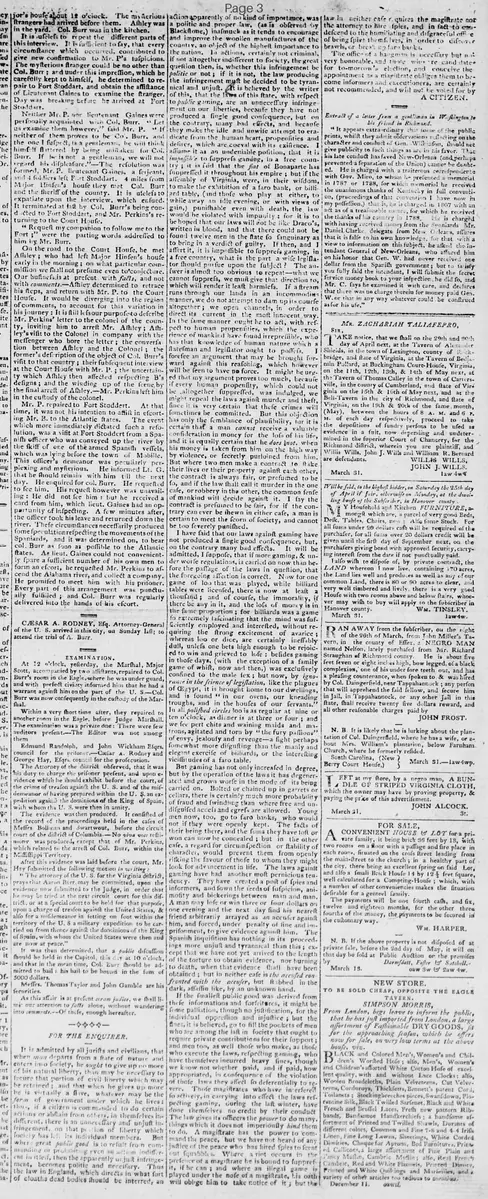
It is admitted by all jurists and civilians, that when man departs from a state of nature and enters into society, he ought to give up no more of his natural liberty, than may be necessary to secure that portion of civil liberty which may be retained; and that when he gives up more he is virtually a slave, whatever may be the form of government under which he lives:
thus, if a citizen is commanded to do certain actions or abstain from others. in themselves indifferent. there is an unnecessary and unjust infringement. on that portion of liberty which society has left to its individual members. But where great public good is to result from commanding or prohibiting even an action indifferent in itself, then the apparently unjust infringement, becomes politic and necessary. Thus the law in England, which directs in what sort of clothes dead bodies should be interred, an action apparently of no kind of importance, was politic and proper law, (as is observed by Blackstone,) inasmuch as it tends to encourage and improve the woollen manufactures of the country. an object of the highest importance to the nation. In actions, certainly not criminal, if not altogether indifferent to society. the great question then, is, whether this infringement be politic or not; if it is not, the law producing the infringement must be decided to be tyrannical and unjust. It is believed by the writer of this. that the laws of this state, with respect to public gaming, are an unnecessary infringement on our liberties, because they have not produced a single good consequence, but on the contrary, many bad effects. and because they make the idle and unwise attempt to eradicate from the human heart, propensities and desires. which are coeval with its existence. I assume it as an undeniable position, that it is impossible to suppress gaming, in a free country ; it is said that the fiat of Bonaparte has suppressed it throughout his empire : but if the assembly of Virginia, were, in their wisdom, to make the exhibition of a faro bank, or billiard table, (and those who play at either, to while away an idle evening, or with views of gain,) punishable even with death, the law would be violated with impunity: for it is to be hoped that our laws will not be like Draco's, written in blood, and that there could not be found twelve men in the state so sanguinary as to bring in a verdict of guilty. If then, and I assert it, it is impossible to suppress gaming, in a free country, what is the part a wise legislator should pursue upon the subject? The answer is almost too obvious to repeat—what we cannot suppress, we must give that direction to, which will render it least harmful. If a stream runs through our lands in an incommodious manner, we do not attempt to dam up its course altogether; we open channels, in order to direct its current in the most innocent way.
In the same manner ought he to act, with respect to human propensities, which the experience of mankind have found irrepressible, who has that knowledge of human nature which a statesman and legislator ought to possess.
I foresee an argument that may be brought forward against this reasoning, which however will be seen to have no force. It might be urged that my argument proves too much, because if every human propensity, which could not be altogether suppressed, was indulged, we might repeal the laws against murder and theft, since it is very certain that these crimes will sometimes be committed. But this objection has only the semblance of plausibility, for it is certain that a man cannot receive a valuable consideration in money for the loss of his life, and it is equally certain that he does not. when his money is taken from him on the high way by violence, or secretly purloined from him.
But where two men make a contract to take their lives or their property against each other, the contract is always fair, or presumed to be so, and if the law shall call it murder in the one case, or robbery in the other, the common sense of mankind will decide against it. I say the contract is presumed to be fair, for if the contrary can ever be shown in either case, a man is certain to meet the scorn of society, and cannot be too severely punished.
I have said that our laws against gaming have not produced a single good consequence, but, on the contrary many bad effects. " It will be admitted, I suppose, that if more gaming, & under worse regulations, is carried on now than before the passage of the laws in question, that the foregoing assertion is correct. Now for one game of loo that was played, while billiard tables were licensed, there is now at least a thousand; and of course, the immorality, if there be any in it, and the loss of money is in the same proportion; for billiards was a game so extremely fascinating that the mind was sufficiently employed and interested, without requiring the strong excitement of avarice; whereas loo or dice, are certainly ineffably dull, unless one bets high enough to be rejoiced to win and grieved to lose : besides gaming in those days, (with the exception of a family game of whist, now and then,) was exclusively confined to the male sex; but now, by ignorance in the science of legislation, like the plagues of Egypt, it is brought home to our dwellings, and is found "in our ovens, our kneading troughs, and in the houses of our servants."
In all polished circles loo is as regular at nine or ten o'clock, as dinner is at three or four : and we see pert chits and waiting maids and matrons, agitated and torn by "the fury passions" of envy, jealousy and revenge—a sight perhaps somewhat more disgusting than the manly and elegant exercise of billiards, or the interesting vicissitudes of a faro table.
But gaming has not only increased in degree, but by the operation of the laws it has degenerated and grown worse in the mode of its being carried on. Bolted or chained up in garrets or cellars, there is certainly much more probability of fraud and swindling than where free and undisguised access and egress are allowed. Young men now, too, go to faro banks, who would not if they were openly kept. The facts of their being there, and the sums they have lost or won can now be concealed ; but in the other case, a regard for circumscription or stability of character, would prevent them from openly risking the favour of those to whom they might look for advancement in life. The laws against gaming have had another most pernicious tendency: They have created a post of spies and informers, and sown the seeds of suspicion, animosity and bickerings between man and man.
A man may lose or win three or four dollars on one evening and the next day find his nearest friend arbitrarily arrayed as an accuser against him, and forced, under penalty of fine and imprisonment, to give evidence against him. The Spanish inquisition has nothing in its proceedings more unjust and tyrannical than this; except that we have not yet arrived to the length of the torture to obtain evidence, nor burning to death, when that evidence shall have been obtained : but in neither case is the accused confronted with the accuser, but stabbed in the dark, assassin like, by an unknown hand.
If the smallest public good was derived from these informations and forfeitures, it might be some palliation, though no justification, for the individual oppression and injustice; but the fines, it is believed, go to fill the pockets of men who are among the last in society that ought to require private contributions for their support; and men too, as well those who make, as those who execute the laws, respecting gaming, who have themselves incurred heavy fines, though we know not whether paid, and if paid, how appropriated, in consequence of the violation of those laws they affect so deferentially to revere. Those magistrates who have interfered so actively, in carrying into effect the laws respecting gaming, during the last winter, have done themselves no credit by their conduct
The law gives its officers the power to do many. things which it does not imperiously bind them to do. A magistrate has the power to command the peace, but we have not heard of any justice of the peace who has hired spies to scent out squabbles. Where a riot occurs in the presence of a magistrate he is bound to suppress it, if he can : and where an illegal game is played under the nose of a magistrate, his oath will oblige him to take notice of it ; but the law in neither case requires the magistrate nor the attorney to hire spies, and in fact—to condescend to the humiliating and disgraceful office of being spies themselves, in order to discover brawls, or break up faro banks.
The office of a hangman is necessary but not very honorable. and those who are candidates for to-morrow's election, and conceive the appointment as a magistrate obliges them to become informers and executioners, are certainly not recommended, and will not be voted for by
A CITIZEN.
It is admitted by all jurists and civilians, that when man departs from a state of nature and enters into society, he ought to give up no more of his natural liberty, than may be necessary to secure that portion of civil liberty which may be retained; and that when he gives up more he is virtually a slave, whatever may be the form of government under which he lives:
thus, if a citizen is commanded to do certain actions or abstain from others. in themselves indifferent. there is an unnecessary and unjust infringement. on that portion of liberty which society has left to its individual members. But where great public good is to result from commanding or prohibiting even an action indifferent in itself, then the apparently unjust infringement, becomes politic and necessary. Thus the law in England, which directs in what sort of clothes dead bodies should be interred, an action apparently of no kind of importance, was politic and proper law, (as is observed by Blackstone,) inasmuch as it tends to encourage and improve the woollen manufactures of the country. an object of the highest importance to the nation. In actions, certainly not criminal, if not altogether indifferent to society. the great question then, is, whether this infringement be politic or not; if it is not, the law producing the infringement must be decided to be tyrannical and unjust. It is believed by the writer of this. that the laws of this state, with respect to public gaming, are an unnecessary infringement on our liberties, because they have not produced a single good consequence, but on the contrary, many bad effects. and because they make the idle and unwise attempt to eradicate from the human heart, propensities and desires. which are coeval with its existence. I assume it as an undeniable position, that it is impossible to suppress gaming, in a free country ; it is said that the fiat of Bonaparte has suppressed it throughout his empire : but if the assembly of Virginia, were, in their wisdom, to make the exhibition of a faro bank, or billiard table, (and those who play at either, to while away an idle evening, or with views of gain,) punishable even with death, the law would be violated with impunity: for it is to be hoped that our laws will not be like Draco's, written in blood, and that there could not be found twelve men in the state so sanguinary as to bring in a verdict of guilty. If then, and I assert it, it is impossible to suppress gaming, in a free country, what is the part a wise legislator should pursue upon the subject? The answer is almost too obvious to repeat—what we cannot suppress, we must give that direction to, which will render it least harmful. If a stream runs through our lands in an incommodious manner, we do not attempt to dam up its course altogether; we open channels, in order to direct its current in the most innocent way.
In the same manner ought he to act, with respect to human propensities, which the experience of mankind have found irrepressible, who has that knowledge of human nature which a statesman and legislator ought to possess.
I foresee an argument that may be brought forward against this reasoning, which however will be seen to have no force. It might be urged that my argument proves too much, because if every human propensity, which could not be altogether suppressed, was indulged, we might repeal the laws against murder and theft, since it is very certain that these crimes will sometimes be committed. But this objection has only the semblance of plausibility, for it is certain that a man cannot receive a valuable consideration in money for the loss of his life, and it is equally certain that he does not. when his money is taken from him on the high way by violence, or secretly purloined from him.
But where two men make a contract to take their lives or their property against each other, the contract is always fair, or presumed to be so, and if the law shall call it murder in the one case, or robbery in the other, the common sense of mankind will decide against it. I say the contract is presumed to be fair, for if the contrary can ever be shown in either case, a man is certain to meet the scorn of society, and cannot be too severely punished.
I have said that our laws against gaming have not produced a single good consequence, but, on the contrary many bad effects. " It will be admitted, I suppose, that if more gaming, & under worse regulations, is carried on now than before the passage of the laws in question, that the foregoing assertion is correct. Now for one game of loo that was played, while billiard tables were licensed, there is now at least a thousand; and of course, the immorality, if there be any in it, and the loss of money is in the same proportion; for billiards was a game so extremely fascinating that the mind was sufficiently employed and interested, without requiring the strong excitement of avarice; whereas loo or dice, are certainly ineffably dull, unless one bets high enough to be rejoiced to win and grieved to lose : besides gaming in those days, (with the exception of a family game of whist, now and then,) was exclusively confined to the male sex; but now, by ignorance in the science of legislation, like the plagues of Egypt, it is brought home to our dwellings, and is found "in our ovens, our kneading troughs, and in the houses of our servants."
In all polished circles loo is as regular at nine or ten o'clock, as dinner is at three or four : and we see pert chits and waiting maids and matrons, agitated and torn by "the fury passions" of envy, jealousy and revenge—a sight perhaps somewhat more disgusting than the manly and elegant exercise of billiards, or the interesting vicissitudes of a faro table.
But gaming has not only increased in degree, but by the operation of the laws it has degenerated and grown worse in the mode of its being carried on. Bolted or chained up in garrets or cellars, there is certainly much more probability of fraud and swindling than where free and undisguised access and egress are allowed. Young men now, too, go to faro banks, who would not if they were openly kept. The facts of their being there, and the sums they have lost or won can now be concealed ; but in the other case, a regard for circumscription or stability of character, would prevent them from openly risking the favour of those to whom they might look for advancement in life. The laws against gaming have had another most pernicious tendency: They have created a post of spies and informers, and sown the seeds of suspicion, animosity and bickerings between man and man.
A man may lose or win three or four dollars on one evening and the next day find his nearest friend arbitrarily arrayed as an accuser against him, and forced, under penalty of fine and imprisonment, to give evidence against him. The Spanish inquisition has nothing in its proceedings more unjust and tyrannical than this; except that we have not yet arrived to the length of the torture to obtain evidence, nor burning to death, when that evidence shall have been obtained : but in neither case is the accused confronted with the accuser, but stabbed in the dark, assassin like, by an unknown hand.
If the smallest public good was derived from these informations and forfeitures, it might be some palliation, though no justification, for the individual oppression and injustice; but the fines, it is believed, go to fill the pockets of men who are among the last in society that ought to require private contributions for their support; and men too, as well those who make, as those who execute the laws, respecting gaming, who have themselves incurred heavy fines, though we know not whether paid, and if paid, how appropriated, in consequence of the violation of those laws they affect so deferentially to revere. Those magistrates who have interfered so actively, in carrying into effect the laws respecting gaming, during the last winter, have done themselves no credit by their conduct
The law gives its officers the power to do many. things which it does not imperiously bind them to do. A magistrate has the power to command the peace, but we have not heard of any justice of the peace who has hired spies to scent out squabbles. Where a riot occurs in the presence of a magistrate he is bound to suppress it, if he can : and where an illegal game is played under the nose of a magistrate, his oath will oblige him to take notice of it ; but the law in neither case requires the magistrate nor the attorney to hire spies, and in fact—to condescend to the humiliating and disgraceful office of being spies themselves, in order to discover brawls, or break up faro banks.
The office of a hangman is necessary but not very honorable. and those who are candidates for to-morrow's election, and conceive the appointment as a magistrate obliges them to become informers and executioners, are certainly not recommended, and will not be voted for by
A CITIZEN.
What sub-type of article is it?
Persuasive
Philosophical
Ethical Moral
What themes does it cover?
Morality
Politics
Constitutional Rights
What keywords are associated?
Gaming Laws
Civil Liberty
Virginia Assembly
Billiards
Faro Bank
Regulation
Informers
Magistrates
What entities or persons were involved?
A Citizen
For The Enquirer
Letter to Editor Details
Author
A Citizen
Recipient
For The Enquirer
Main Argument
state laws against public gaming are unnecessary infringements on civil liberties that fail to suppress the practice, produce harmful effects like increased secret gambling and social discord, and should be replaced with regulation to direct it harmlessly.
Notable Details
References Blackstone On English Burial Laws
Cites Impossibility Of Suppression Like Bonaparte's Fiat Or Draco's Bloody Laws
Alludes To Plagues Of Egypt For Gaming's Spread
Compares Enforcement To Spanish Inquisition
Criticizes Magistrates As Informers