Thank you for visiting SNEWPapers!
Sign up free
The Virginia Gazette
Richmond, Williamsburg, Richmond County, Virginia
What is this article about?
Detailed instructions for extracting Epsom and Glauber's salts from schlot at French salt-works using water dissolution, ashes, evaporation, and crystallization, followed by purification. Includes notes on maximizing yield with soda and a method to produce magnesia from sea water using alkaline salts.
Merged-components note: These sequential components continue the description of chemical processes for making salts and should be merged into a single literary essay.
Clipping
OCR Quality
Full Text
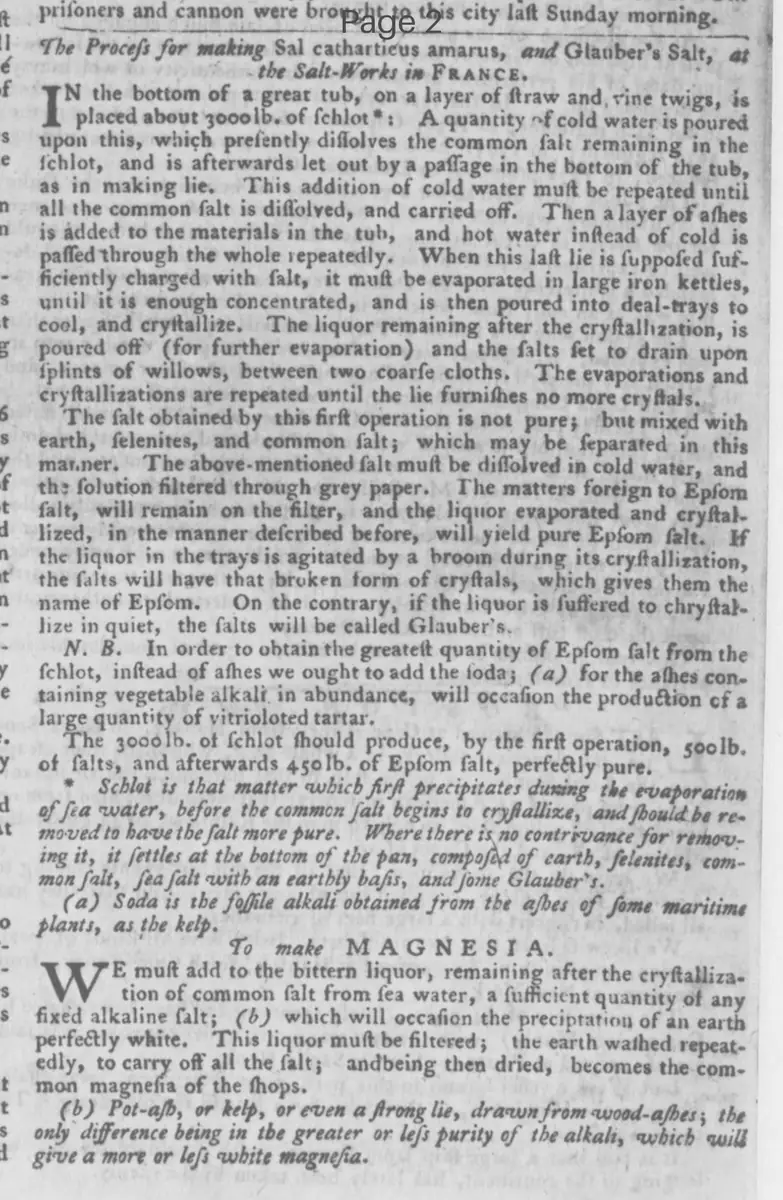
In the bottom of a great tub, on a layer of straw and vine twigs, is placed about 3000 lb. of schlot: A quantity of cold water is poured upon this, which presently dissolves the common salt remaining in the schlot, and is afterwards let out by a passage in the bottom of the tub, as in making lye. This addition of cold water must be repeated until all the common salt is dissolved, and carried off. Then a layer of ashes is added to the materials in the tub, and hot water instead of cold is passed through the whole repeatedly. When this last lye is supposed sufficiently charged with salt, it must be evaporated in large iron kettles, until it is enough concentrated, and is then poured into deal-trays to cool, and crystallize. The liquor remaining after the crystallization, is poured off (for further evaporation) and the salts set to drain upon plats of willows, between two coarse cloths. The evaporations and crystallizations are repeated until the lye furnishes no more crystals.
The salt obtained by this first operation is not pure; but mixed with earth, selenites, and common salt; which may be separated in this manner. The above-mentioned salt must be dissolved in cold water, and the solution filtered through grey paper. The matters foreign to Epsom salt, will remain on the filter, and the liquor evaporated and crystallized, in the manner described before, will yield pure Epsom salt. If the liquor in the trays is agitated by a broom during its crystallization, the salts will have that broken form of crystals, which gives them the name of Epsom. On the contrary, if the liquor is suffered to crystallize in quiet, the salts will be called Glauber's.
N. B. In order to obtain the greatest quantity of Epsom salt from the schlot, instead of ashes we ought to add the soda; (a) for the ashes containing vegetable alkali in abundance, will occasion the production of a large quantity of vitriolated tartar.
The 3000 lb. of schlot should produce, by the first operation, 500 lb. of salts, and afterwards 450 lb. of Epsom salt, perfectly pure.
Schlot is that matter which first precipitates during the evaporation of sea water, before the common salt begins to crystallize, and should be removed to have the salt more pure. Where there is no contrivance for removing it, it settles at the bottom of the pan, composed of earth, selenites, common salt, sea salt with an earthy basis, and some Glauber's.
(a) Soda is the fossil alkali obtained from the ashes of some maritime plants, as the kelp.
To make MAGNESIA.
after the separation of common salt from sea water, a sufficient quantity of any fixed alkaline salt; (b) which will occasion the precipitation of an earth perfectly white. This liquor must be filtered; the earth washed repeatedly, to carry off all the salt; and being then dried, becomes the common magnesia of the shops.
(b) Pot-ash, or kelp, or even a strong lye, drawn from wood-ashes; the only difference being in the greater or less purity of the alkali, which will give a more or less white magnesia.
What sub-type of article is it?
What keywords are associated?
Literary Details
Title
The Process For Making Salt Catharticus Amarus, And Glauber's Salt, At The Salt Works In France.
Form / Style
Instructional Prose On Chemical Processes