Thank you for visiting SNEWPapers!
Sign up free
Story
May 13, 1840
Vermont Telegraph
Brandon, Rutland County, Vermont
What is this article about?
19th-century letter from Benja. F. Emery to Hon. Isaac Hill discussing deficiencies in New England farm fences and proposing hedges (e.g., Buckthorn) and stone-sod walls as cost-effective, durable alternatives, with examples from various locations.
Clipping
OCR Quality
95%
Excellent
Full Text
Agricultural.
From the Farmer's Monthly Visitor.
FENCES &C.
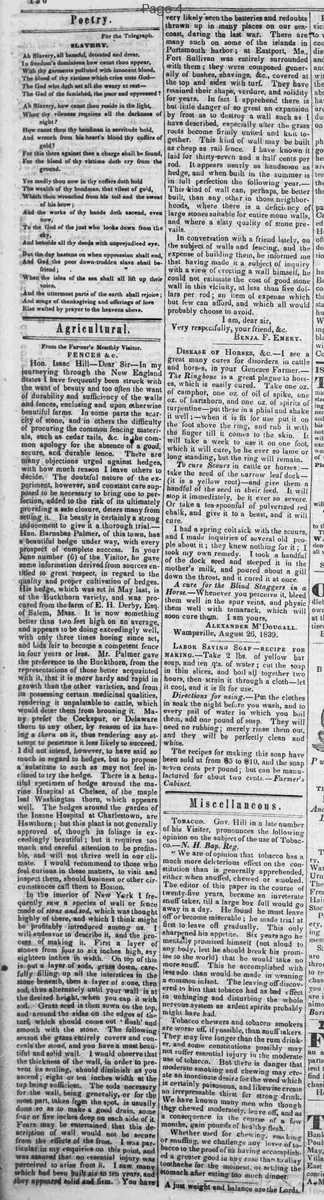
Hon. Isaac Hill--Dear Sir--In my journeying through the New England States I have frequently been struck with the want of beauty and too often the want of durability and sufficiency of the walls and fences, enclosing and upon otherwise beautiful farms. In some parts the scarcity of stone, and in others the difficulty of procuring the common fencing materials, such as cedar rails, &c. is the common apology for the absence of a good, secure, and durable fence. There are many objections urged against hedges, with how much reason I leave others to decide. The doubtful nature of the experiment, however, and constant care supposed to be necessary to bring one to perfection, added to the risk of its ultimately providing a safe closure, deters many from setting it. Its beauty is certainly a strong inducement to give it a thorough trial.
Hon. Barnabas Palmer, of this town, has a beautiful hedge under way, with every prospect of complete success. In your June number (6) of the Visitor, he gave some information derived from sources entitled to great respect, in regard to the quality and proper cultivation of hedges. His hedge, which was set in May last, is of the Buckthorn variety, and was procured from the farm of E. H. Derby, Esq. of Salem, Mass. It is now something better than two feet high on an average, and appears to be doing exceedingly well, with only three times hoeing since set, and bids fair to become a competent fence in four years or less. Mr. Palmer gave the preference to the Buckthorn, from the representations of those better acquainted with it, that it is more hardy and rapid in growth than the other varieties, and from its possessing certain medicinal qualities, rendering it unpalatable to cattle, which would deter them from browsing it. Many prefer the Cockspur, or Delaware thorn to any other, by reason of its having a thorn on it, thus rendering any attempt to penetrate it less likely to succeed.
I did not intend, however, to have said so much in regard to hedges, but to propose a substitute to such as may not feel inclined to try the hedge. There is a beautiful specimen of hedge around the marine Hospital at Chelsea, of the maple leaf Washington thorn, which appears well. The hedges around the garden of the Insane Hospital at Charlestown, are Hawthorn; but this plant is not generally approved of, though its foliage is exceedingly beautiful; but it requires too much and careful attention to be profitable, and will not thrive well in our climate. I would recommend to those who feel curious in these matters, to visit and inspect them, should business or other circumstances call them to Boston.
In the interior of New York I frequently saw a species of wall or fence made of stone and sod, which was thought highly of there, and which I think might be profitably introduced among us. I will endeavor to describe it, and the process of making it. First a layer of stones from four to six inches high, say eighteen inches in width. On top of this is put a layer of sods, grass down, carefully filling up all the interstices in the stone beneath, then a layer of stone, then sod, thus alternately until your wall is at the desired height, when you cap it with sod. Grass seed is then sown on the top, and around the sides on the edges of the turf, which should come out flush and smooth with the stone. The following season the grass entirely covers and conceals the stone, and you have a most beautiful and solid wall. I would observe that the thickness of the wall, in order to prevent its settling, should diminish as you ascend; eight or ten inches width at the top being sufficient. The sods necessary for the wall, being generally, or for the most part, taken from the spot, is usually done so as to make a good drain, some four or five inches deep on each side of it. Fears may be entertained that this description of wall would not be secure from the effects of the frost. I was particular in my enquiries on this point, and was assured that no essential injury was perceived to arise from it. I saw many which had been built six to ten years, and they appeared solid and firm. You have very likely seen the batteries and redoubts thrown up in many places on our sea-coast, during the last war. There are many such on some of the islands in Portsmouth harbor; at Eastport, Me., Fort Sullivan was entirely surrounded with them; they were composed generally of bushes, shavings, &c., covered at the top and sides with turf. They have retained their shape, verdure, and solidity for years. In fact I apprehend there is but little danger of so great an expansion by frost as to destroy a wall such as I have described, especially after the grass roots become firmly united and knit together. This kind of wall may be built as cheap as rail fence. I have known it laid for thirty-seven and a half cents per rod. It appears nearly as handsome as hedge, and when built in the summer is in full perfection the following year. This kind of wall can, perhaps, be better built, than any other in those neighborhoods, where there is a deficiency of large stones suitable for entire stone walls, and where a slaty quality of stone prevails.
In conversation with a friend lately, on the subject of walls and fencing, and the expense of building them, he informed me that having made it a subject of inquiry with a view of erecting a wall himself, he could not estimate the cost of good stone wall in this vicinity, at less than five dollars per rod; an item of expense which but few can afford, and which all would probably choose to avoid.
I am, dear sir,
Very respectfully, your friend, &c.
Benja. F. Emery.
From the Farmer's Monthly Visitor.
FENCES &C.
Hon. Isaac Hill--Dear Sir--In my journeying through the New England States I have frequently been struck with the want of beauty and too often the want of durability and sufficiency of the walls and fences, enclosing and upon otherwise beautiful farms. In some parts the scarcity of stone, and in others the difficulty of procuring the common fencing materials, such as cedar rails, &c. is the common apology for the absence of a good, secure, and durable fence. There are many objections urged against hedges, with how much reason I leave others to decide. The doubtful nature of the experiment, however, and constant care supposed to be necessary to bring one to perfection, added to the risk of its ultimately providing a safe closure, deters many from setting it. Its beauty is certainly a strong inducement to give it a thorough trial.
Hon. Barnabas Palmer, of this town, has a beautiful hedge under way, with every prospect of complete success. In your June number (6) of the Visitor, he gave some information derived from sources entitled to great respect, in regard to the quality and proper cultivation of hedges. His hedge, which was set in May last, is of the Buckthorn variety, and was procured from the farm of E. H. Derby, Esq. of Salem, Mass. It is now something better than two feet high on an average, and appears to be doing exceedingly well, with only three times hoeing since set, and bids fair to become a competent fence in four years or less. Mr. Palmer gave the preference to the Buckthorn, from the representations of those better acquainted with it, that it is more hardy and rapid in growth than the other varieties, and from its possessing certain medicinal qualities, rendering it unpalatable to cattle, which would deter them from browsing it. Many prefer the Cockspur, or Delaware thorn to any other, by reason of its having a thorn on it, thus rendering any attempt to penetrate it less likely to succeed.
I did not intend, however, to have said so much in regard to hedges, but to propose a substitute to such as may not feel inclined to try the hedge. There is a beautiful specimen of hedge around the marine Hospital at Chelsea, of the maple leaf Washington thorn, which appears well. The hedges around the garden of the Insane Hospital at Charlestown, are Hawthorn; but this plant is not generally approved of, though its foliage is exceedingly beautiful; but it requires too much and careful attention to be profitable, and will not thrive well in our climate. I would recommend to those who feel curious in these matters, to visit and inspect them, should business or other circumstances call them to Boston.
In the interior of New York I frequently saw a species of wall or fence made of stone and sod, which was thought highly of there, and which I think might be profitably introduced among us. I will endeavor to describe it, and the process of making it. First a layer of stones from four to six inches high, say eighteen inches in width. On top of this is put a layer of sods, grass down, carefully filling up all the interstices in the stone beneath, then a layer of stone, then sod, thus alternately until your wall is at the desired height, when you cap it with sod. Grass seed is then sown on the top, and around the sides on the edges of the turf, which should come out flush and smooth with the stone. The following season the grass entirely covers and conceals the stone, and you have a most beautiful and solid wall. I would observe that the thickness of the wall, in order to prevent its settling, should diminish as you ascend; eight or ten inches width at the top being sufficient. The sods necessary for the wall, being generally, or for the most part, taken from the spot, is usually done so as to make a good drain, some four or five inches deep on each side of it. Fears may be entertained that this description of wall would not be secure from the effects of the frost. I was particular in my enquiries on this point, and was assured that no essential injury was perceived to arise from it. I saw many which had been built six to ten years, and they appeared solid and firm. You have very likely seen the batteries and redoubts thrown up in many places on our sea-coast, during the last war. There are many such on some of the islands in Portsmouth harbor; at Eastport, Me., Fort Sullivan was entirely surrounded with them; they were composed generally of bushes, shavings, &c., covered at the top and sides with turf. They have retained their shape, verdure, and solidity for years. In fact I apprehend there is but little danger of so great an expansion by frost as to destroy a wall such as I have described, especially after the grass roots become firmly united and knit together. This kind of wall may be built as cheap as rail fence. I have known it laid for thirty-seven and a half cents per rod. It appears nearly as handsome as hedge, and when built in the summer is in full perfection the following year. This kind of wall can, perhaps, be better built, than any other in those neighborhoods, where there is a deficiency of large stones suitable for entire stone walls, and where a slaty quality of stone prevails.
In conversation with a friend lately, on the subject of walls and fencing, and the expense of building them, he informed me that having made it a subject of inquiry with a view of erecting a wall himself, he could not estimate the cost of good stone wall in this vicinity, at less than five dollars per rod; an item of expense which but few can afford, and which all would probably choose to avoid.
I am, dear sir,
Very respectfully, your friend, &c.
Benja. F. Emery.
What sub-type of article is it?
Agricultural Advice
Fencing Innovation
What keywords are associated?
Fences
Hedges
Buckthorn
Stone Walls
Sod Walls
Agricultural Enclosures
What entities or persons were involved?
Hon. Isaac Hill
Hon. Barnabas Palmer
E. H. Derby
Benja. F. Emery
Where did it happen?
New England States, Salem Mass., Chelsea, Charlestown, Interior Of New York, Portsmouth Harbor, Eastport Me.
Story Details
Key Persons
Hon. Isaac Hill
Hon. Barnabas Palmer
E. H. Derby
Benja. F. Emery
Location
New England States, Salem Mass., Chelsea, Charlestown, Interior Of New York, Portsmouth Harbor, Eastport Me.
Event Date
May Last
Story Details
Letter proposing hedges like Buckthorn and stone-sod walls as durable, beautiful alternatives to traditional fences, describing construction and benefits based on observations.