Thank you for visiting SNEWPapers!
Sign up free
Vermont Phœnix
Brattleboro, Bellows Falls, Ludlow, Windham County, Windsor County, Vermont
What is this article about?
Report of a Whig political convention in Townshend, Vermont, on February 16, 1840, supporting William Henry Harrison's presidential nomination from the Harrisburg Convention. Features speeches by delegates like Wm. Henry and J.R. Blake, resolutions endorsing Harrison and John Tyler, and praise for local hospitality amid cold weather.
Merged-components note: These components form a single coherent story reporting on the Harrison meeting at Townshend, with the first being a summary and the second providing the detailed account.
Clipping
OCR Quality
Full Text
He was followed by Mr. Blake of this village, who in an eloquent manner pictured the distressing state of the monied affairs of the country—the causes of it—and the prospects of success of the Whig cause.
Dr. Ranney on presenting the Resolutions made some very sensible remarks upon that prince of Humbugs, 'Smilie and Bank Reform.' We do wish every Farmer in the County could have heard him—he so clearly exposed this trick of the Loco party—a party composed of Stockholders in Banks, Bank Directors, Note Shavers, &c. &c. We hope the Dr. will furnish a copy for publication—it pleased us so much, we know it will our readers.
We were disappointed in not hearing the Political Song, but have the promise of it at Rockingham on the 25th of Feb., where the 'Hero of the Thames, my Boys,' is again to be toasted.
In the evening.—
Mr. Crawford described the military life of Gen. Harrison, the Battle of the Thames, &c. in true soldier-like style.
He was followed by Dr. Ranney, Judge White, Col. Townsley, and Judge Phelps—whose addresses were well received.
We cannot close without noticing the politeness and attention of the citizens of Townshend, particularly Mr. Taggart, 'mine host of the White House'—he was all attention,—in every part of his house, attending to the comfort of his guests,—providing large comfortable fires—his cheer excellent. His house is a fine spacious building, handsomely furnished—and with pleasure we recommend it to all travellers. Townshend should well be proud of such a house and landlord.
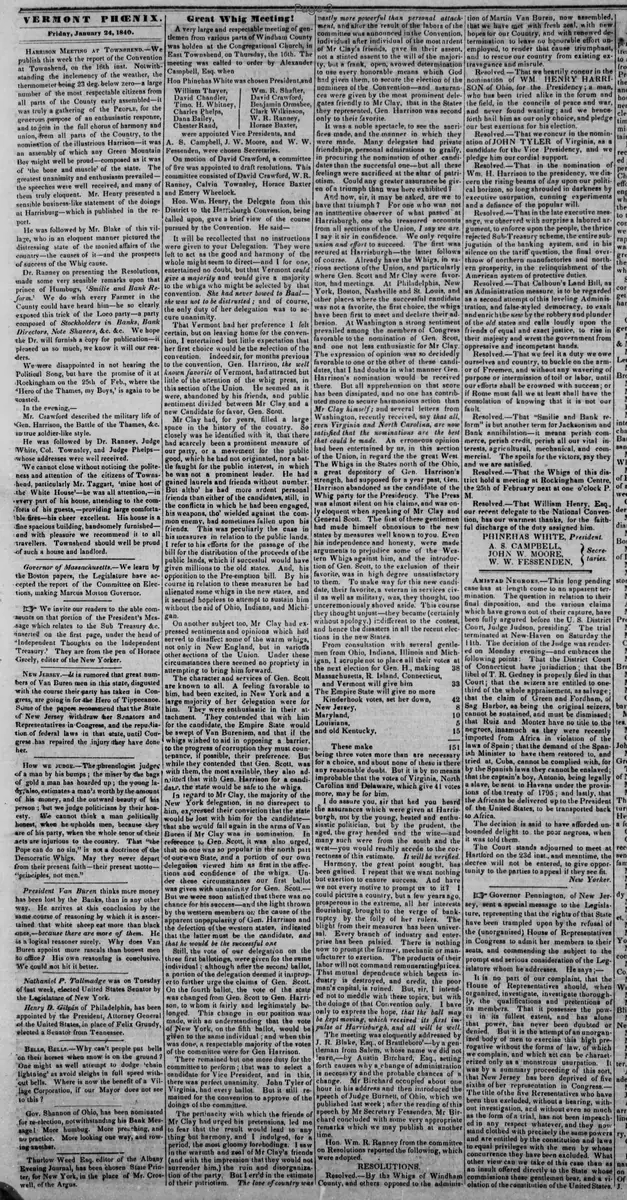
A very large and respectable meeting of gentlemen from various parts of Windham County was holden at the Congregational Church, in East Townshend, on Thursday, the 16th. The meeting was called to order by Alexander Campbell, Esq. when Hon Phinehas White was chosen President, and William Thayer, Wm. R. Shafter, David Chandler, David Crawford, Timo. H. Whitney, Benjamin Ormsbee, Charles Phelps, Clark Wilkinson, Dana Bailey, W. R. Ranney, Chester Rand, Horace Baxter, were appointed Vice Presidents, and A. S. Campbell, J. W. Moore, and W. W. Fessenden, were chosen Secretaries.
On motion of David Crawford, a committee of five was appointed to draft resolutions. This committee consisted of David Crawford, W. R. Ranney, Calvin Townsley, Horace Baxter and Emery Wheelock.
Hon. Wm. Henry, the Delegate from this District to the Harrisburg Convention, being called upon, gave a brief view of the course pursued by the Convention. He said—
It will be recollected that no instructions were given to your Delegation. They were left to act as the good and harmony of the whole might seem to direct—and I for one. entertained no doubt, but that Vermont could give a majority and would give a majority to the whigs who might be selected by that convention. She had never bowed to Baal—she was not to be distrusted; and of course, the only duty of her delegation was to secure unanimity.
That Vermont had her preference I felt certain, but on leaving home for the convention, I entertained but little expectation that her first choice would be the selection of the convention. Indeed sir, for months previous to the convention, Gen. Harrison, the well known favorite of Vermont, had attracted but little of the attention of the whig press, in this section of the Union. He seemed as it were, abandoned by his friends, and public sentiment divided between Mr Clay and a new Candidate for favor, Gen. Scott.
Mr Clay had, for years, filled a large space in the history of the country. So closely was he identified with it, that there had scarcely been a prominent measure of our party, or a movement for the public good, which he had not originated, nor a battle fought for the public interest, in which he was not a prominent leader. He had gained laurels and friends without number.
But altho' he had more ardent personal friends than either of the candidates, still, in the conflicts in which he had been engaged, his weapons, tho' wielded against the common enemy, had sometimes fallen upon his friends. This was peculiarly the case in his measures in relation to the public lands.
I refer to his efforts for the passage of the bill for the distribution of the proceeds of the public lands, which if successful would have given millions to the old states. And, his opposition to the Pre-emption bill. By his course in relation to these measures he had alienated some whigs in the new states, and it seemed hopeless to attempt to sustain him without the aid of Ohio, Indiana, and Michigan.
On another subject too, Mr Clay had expressed sentiments and opinions which had served to disaffect some of the warm whigs. not only in New England, but in various other sections of the Union. Under these circumstances there seemed no propriety in attempting to bring him forward.
The character and services of Gen. Scott are known to all. A feeling favorable to him, had been excited. in New York and a large majority of her delegation were for him. They were enthusiastic in their attachment. They contended that with him for the candidate, the Empire State would be swept of Van Burenism, and that if the whigs wished to aid in opposing a barrier. to the progress of corruption they must countenance, if possible, their preference. But while they contended that Gen. Scott. was with them, the most available, they also admitted that with Gen. Harrison for a candidate, the state would be safe to the whigs.
In regard to Mr Clay, the majority of the New York delegation, in no disrespect to him, expressed their conviction that the state would be lost with him for the candidate--- that she would fall again in the arms of Van Buren if Mr Clay was in nomination. In reference to Gen. Scott. it was also urged, that no one was so popular in the north part of-our own State, and a portion of our own delegation viewed him as first in the affections and confidence of the whigs. Under these circumstances our first ballot was given with unanimity or Gen. Scott.—
But we were soon satisfied that there was no chance for his success—and the light thrown by the western members on the cause of the apparent unpopularity of Gen. Harrison and the defection of the western states, indicated that the latter must be the candidate, and that he would be the successful one.
Still, the vote of our delegation on the three first ballotings, were given for the same individual : although after the second ballot, a portion of the delegation deemed it improper to further urge the claims of Gen. Scott.
On the fourth ballot, the vote of the state was changed from Gen. Scott to Gen. Harrison, to whom it fairly and legitimately belonged. This change in our position was made, with an understanding that the vote of New York, on the fifth ballot. would be given to the same individual ; and when this was done, a respectable majority of the votes of the committee were for Gen Harrison.
There remained but one more duty of the committee to perform; that was to select a candidate for Vice President, and in this, there was perfect unanimity. John Tyler of Virginia, had every ballot. But it still remained for the convention to approve of the doings of the committee,
The pertinacity with which the friends of Mr Clay had urged his pretensions, led me to fear that the result would lead to any thing but harmony, and I indulged, for a period, the most gloomy forebodings. I saw in the warmth and zeal of Mr Clay's friends (and with the impression that they would not surrender him,) the ruin and disorganization of the party. But I err'd in the estimate of their patriotism. The love of country was vastly more powerful than personal attachment, and after the result of the labors of the committee was announced in the Convention.
individual after individual of the most ardent of Mr Clay's friends, gave in their assent. not a stinted assent to the will of the majority, but a frank, open, avowed determination to use every honorable means which God had given them, to secure the election of the nominees of the Convention—and assurances were given by the most prominent delegates friendly to Mr Clay, that in the States they represented, Gen. Harrison was second only to their favorite.
It was—a noble spectacle, to see the sacrifices made, and the manner in which they were made. Many delegates had private friendships, personal admirations to gratify. in procuring the nomination of other candidates than the successful one—but all these feelings were sacrificed at the altar of patriotism. Could any greater assurance be given of a triumph than was here exhibited?
And now. sir. it may be asked. are we to have that triumph ? For one who was not an inattentive observer of what passed at Harrisburg, one who treasured accounts from all sections of the Union, I say we are. I say it sir in confidence. We only require union and effort to succeed. The first was secured at Harrisburg—the latter follows of course, Already have the Whigs, in various sections of the Union, and particularly where Gen. Scott and Mr Clay were favorites, had meetings. At Philadelphia, New York. Boston. Nashville and St. Louis, and other places where the successful candidate was not a favorite. the first choice. the whigs have been first to meet and declare their adhesion. At Washington a strong sentiment prevailed among the members of Congress favorable to the nomination of Gen. Scott and one not less enthusiastic for Mr Clay.
The expression of opinion was so decidedly favorable to one or the other of these candidates, that I had doubts in what manner Gen. Harrison's nomination would be received there. But all apprehension on that score has been dissipated, and no one has contributed more to secure harmonious action than Mr Clay himself: and several letters from Washington, recently received, say that all, even Virginia and North Carolina, are now satisfied that the nominations are the best that could be made. An erroneous opinion had been entertained by us, in this section of the Union, in regard the the great West.
The Whigs in the States north of the Ohio, a great depository of Gen. Harrison's strength, had supposed for a year past, Gen. Harrison abandoned as the candidate of the Whig party for the Presidency. The Press was almost silent on his claims, and was only eloquent when speaking of Mr Clay and General Scott. The first of these gentlemen had made himself obnoxious to the new states by measures well known to you. Even his independence and honesty, were made arguments to prejudice some of the Western Whigs against him, and the introduction of Gen. Scott, to the exclusion of their favorite, was in high degree unsatisfactory to them. To make way for this new candidate, their favorite, a veteran in services civil as well as military, was, they thought, too unceremoniously shoved aside. This course they thought unjust—they became (certainly without apology.) indifferent to the contest and hence the disasters in all the recent elections in the new States.
From consultation with several gentlemen from Ohio, Indiana, Illinois and Michigan, I scruple not to place all their votes at the next election or Gen. H., making 38
Massachusetts, R. Island, Connecticut, and Vermont will give him 33
The Empire State will give no more Kinderhook votes, set her down, 42
New Jersey. 8
Maryland, 10
Louisiana, 5
and old Kentucky. 15
These make 151 being three votes more than are necessary for a choice, and about none of these is there any reasonable doubt. But it is by no means improbable that the votes of Virginia, North Carolina and Delaware, which give 41 votes more, may be for him.
I do assure you, sir that had you heard the assurances which were given at Harrisburg, not by the young, heated and enthusiastic politician, but by the prudent. the aged, the gray headed and the wise—and many such were from the south and the west—you would readily accede to the correctness of this estimate. It will be verified.
Harmony, the great point sought, has been gained. I repeat that we want nothing but exertion to ensure success. And have we not every motive to prompt us to it I could picture a country. but a few years ago. prosperous in the extreme, all her interests flourishing, brought to the verge of bankruptcy by the folly of her rulers. The blight from their measures has been universal. Every branch of industry and enterprise has been palsied. There is nothing now to prompt the farmer, mechanic or manufacturer to exertion. The products of their labor will not command remunerating prices.
That mutual dependence which begets industry is destroyed, and credit, the poor man's capital, is ruined. But, sir, I intended not to meddle with these topics, but with the doings of that Convention only. I have only to express the hope, that the ball may be kept moving, which received its first impulse at Harrisburg, and all will be well.
The meeting was eloquently addressed by J. R. Blake, Esq., of Brattleboro' -by a gentleman from Salem, whose name we did not learn,-by Austin Birchard, Esq., setting forth causes why a change of administration is necessary and the probable chances of it. Mr Birchard occupied about one hour in his address and then introduced the speech of Judge Burnett, of Ohio, which we published last week; after the reading of this speech by Mr Secretary Fessenden, Mr Birchard concluded with some very appropriate remarks which we may publish at another time.
Hon. Wm. R. Ranney from the committee on Resolutions reported the following, which were adopted.
RESOLUTIONS.
Resolved.—By the Whigs of Windham County, and others opposed to the administration of Martin Van Buren, now assembled, that we have met with fresh zeal, with new hopes for our Country, and with renewed determination to leave no honorable effort unemployed, to render that cause triumphant, and to rescue our country from existing extravagance and misrule.
Resolved.—That we heartily concur in the nomination of WM. HENRY HARRISON of Ohio. for the Presidency; a man, who has been tried alike in the forum and the field, in the councils of peace and war, and never found wanting; and we henceforth hail him as our only choice, and pledge our best exertions for his election.
Resolved.—That we concur in the nomination of JOHN TYLER of Virginia, as a candidate for the Vice Presidency, and we pledge him our cordial support.
Resolved.—That in the nomination of Wm. H. Harrison to the presidency, we discern the rising beams of day upon our political horizon, so long shrouded in darkness by executive usurpation, cunning experiments and a defiance of the popular will.
Resolved.—That in the late executive message, we observed with surprise a labored argument, to enforce upon the people, the thrice rejected Sub-Treasury scheme, the entire subjugation of the banking system, and in his silence on the tariff question. the final overthrow of northern manufactories and northern prosperity, in the relinquishment of the American system of protective duties.
Resolved.—That Calhoun's Land Bill. as an Administration measure. is to-be regarded as a second attempt of this leveling Administration, and false-styled democracy, to exalt and enrich the new by the robbery and plunder of the old states and calls loudly upon the friends of equal and exact justice, to rise in their majesty and wrest the government from oppressive and incompetent hands.
Resolved.—That we feel it a duty we owe ourselves and country, to buckle on the armor of Freemen, and without any wavering of purpose or intermission of toil or labor, until our efforts shall be crowned with success; or if Rome must fall we at least shall have the consolation of knowing that it is not our fault.
Resolved. That "Smilie and Bank reform" is but another term for Jacksonism and Bank annihilation—it means perish commerce, perish credit, perish all our vital interests, agricultural, mechanical, and commercial. The spoils for the victors, say they and we are satisfied,
Resolved.—That the Whigs of this district hold a meeting at Rockingham Centre the 25th of February next at one o'clock P. M.
Resolved.—That William Henry, Esq.. our recent delegate to the National Convention, has our warmest thanks. for the faithful discharge of the duty assigned him.
PHINEHAS WHITE, President.
A. S. CAMPBELL,
JOHN W. MOORE
Secretaries.
W. W. FESSENDEN.
What sub-type of article is it?
What themes does it cover?
What keywords are associated?
What entities or persons were involved?
Where did it happen?
Story Details
Key Persons
Location
Townshend, Windham County, Vermont
Event Date
Thursday, The 16th Inst.
Story Details
Whig convention at Townshend endorses Harrison's nomination from Harrisburg, with speeches detailing convention proceedings, political critiques of Van Buren administration, electoral predictions, and adoption of resolutions supporting Harrison and Tyler while opposing Sub-Treasury and bank reforms.