Thank you for visiting SNEWPapers!
Sign up free
Gazette Of The United States, & Philadelphia Daily Advertiser
Philadelphia, Philadelphia County, Pennsylvania
What is this article about?
In the U.S. House of Representatives on January 24, debate ensued over a committee report on Edmund Randolph's letter to the President complaining of insults by army/navy officers over his debate remarks on reducing the army. Mr. Nicholas argued for recommittal, defending Randolph and House privileges.
Merged-components note: Continuation of the report on House of Representatives debate regarding Mr. Randolph's letter.
Clippings
1 of 2
OCR Quality
Full Text
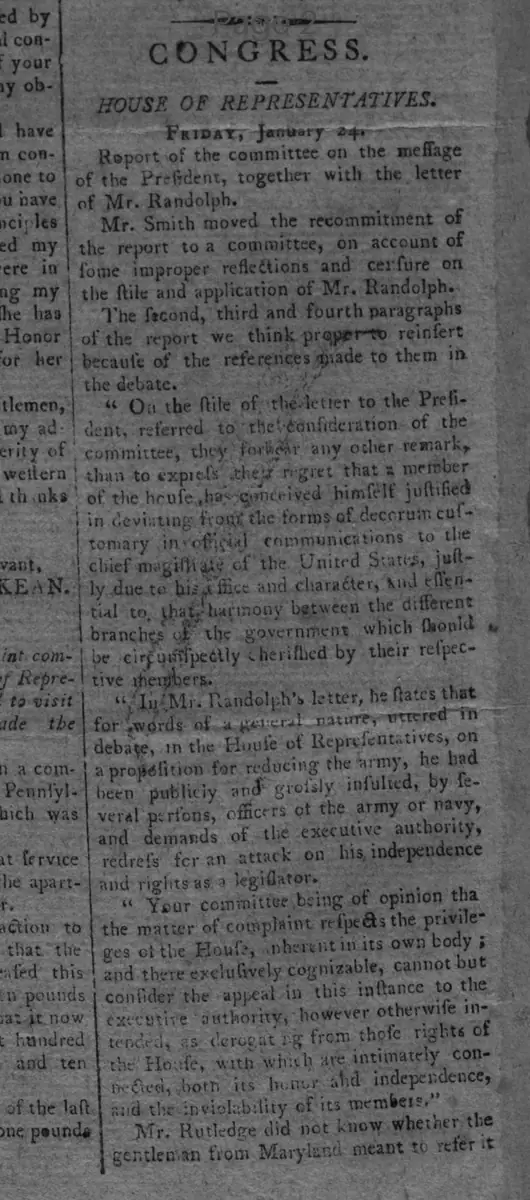
HOUSE OF REPRESENTATIVES.
FRIDAY, January 24
Report of the committee on the message of the President, together with the letter of Mr. Randolph.
Mr. Smith moved the recommittal of the report to a committee, on account of some improper reflections and censure on the style and application of Mr. Randolph.
The second, third and fourth paragraphs of the report we think proper to reinsert because of the references made to them in the debate.
On the style of the letter to the President, referred to the consideration of the committee, they forbear any other remark, than to express their regret that a member of the house has conceived himself justified in deviating from the forms of decorum customary in official communications to the chief magistrate of the United States, justly due to his office and character, and essential to, that harmony between the different branches of the government which should be circumscribedly preserved by their respective members.
In Mr. Randolph's letter, he states that for words of a several nature, uttered in debate, in the House of Representatives, on a proposition for reducing the army, he had been publicly and grossly insulted, by several persons, officers of the army or navy, and demands of the executive authority, redress for an attack on his independence and rights as a legislator.
Your committee being of opinion that the matter of complaint respects the privileges of the House, inherent in its own body; and there exclusively cognizable, cannot but consider the appeal in this instance to the executive authority. however otherwise intended, as derogating from those rights of the House, with which are intimately connected, both its honor and independence, and the inviolability of its members.
Mr. Rutledge did not know whether the gentleman from Maryland meant to refer it to the same committee who reported, if he did, he could expect no other report, because it was an opinion which they had given, and it was improbable they would change that opinion.
Mr. Nicholas believed that as the committee had given their opinion on the business, if the House disapproved of that opinion, the only way to express it was by recommitting the report, either to the same committee or to some other. For himself, he objected to every opinion the committee had given, but particularly to that on the style of the address of Mr. Randolph.
He should go on and state his ideas at large, and the reasons why the house ought not to act on the present report.
The house and committee appeared to possess but one opinion upon one of the points, that was, to procure every information respecting the nature of the intended insult upon one of its members, connected with his department in the house, for the purpose of bringing on a quarrel. It was unanimously determined to examine it, and there was no doubt of the propriety of that measure, and the fitness of the matter alleged for the house to act upon.
In his mind, Mr. Nicholas said, there could not be a more clear and necessary principle established than that a clear and apparent intention of bringing on a quarrel with one of the members of that House, on account of his public conduct, was an infringement of the rights and privileges of the house. It was a proper and right subject of enquiry, for if gentlemen were obliged to engage in defence of what they said in the house, out of doors, it was the same as though they were to expose themselves to personal violence and attack, and no less mischievous. In his idea it was a necessary preservative to freedom of debate, and security under it.
Mr. Nicholas here read the report.
In his opinion, Mr. N. said the decision of the committee on the subject, though it was not a positive denial of the principle which they and the house had before admitted, which the house acted upon, and which was essential to the freedom of debate-that decision went to destroy the whole principle.
He confessed that the acts in themselves were of a nature sufficient, provided the intention was not explained away by contradictory testimony to constitute the crime.
It became, therefore the question, as to the intention, and he supposed it was upon that question the committee had reported "a satisfactory explanation," respecting some part of the charge, "and others appeared to them to be of too equivocal a nature to justify reprehension and punishment."
Mr. Christie was in a situation to collect more of the conversation and conduct of these officers than any other person, except Mr. Van Rensselaer, whose deposition had not been taken: he said that from the conduct of these officers, he was determined to remain at the theatre, though he before intended to have gone out; to prevent if possible any disturbances. Their kind of conversation showed the most manifest and indubitable evidence of intention to insult Mr. Randolph, for talking of the men on the stage, one said "these raggamuffins are not Pennsylvanians, they are black Virginians."
Certainly this might with propriety be supposed to refer to gentlemen from that state, and could not be considered a spontaneous groundless assertion--again, after "repeating the words raggamuffin and mercenary" they said "they were not well drilled, but would be better by next session of Congress" how could this have come into the conversation, except in alluding to a member of Congress, and what was said in the house connecting both together? It was in general necessary to prevent witnesses giving their opinions respecting circumstances they might relate, but it was impossible to repress it here. all the witnesses expressed an opinion, and it was generally thought there was an intention of insult towards Mr. Randolph, and to produce with him an actual quarrel.
This kept Mr. Christie at the theatre, and he appeared to have good grounds for his apprehension.
Another, and a substantial objection Mr. Nicholas said he had to the report was, that Mr. Randolph's statement stood exactly upon the same ground with those of Mr. Reynolds and Mr. M Knight.
Was he not a competent witness; suppose he had been insulted or ill used when no person but himself was present, would his own testimony be rejected, and be be denied justice on that account? He should have supposed there were gentlemen of sufficient legal knowledge on the committee to know that his own deposition was not inadmissible, but very proper. Mr. Randolph's competence was clear, and he was a respectable witness. There never was a case in which the credulity of a gentleman was less liable to question than in this, for Mr. Randolph was very unwilling to bring forward the business, and had throughout evinced a reluctance. Mr. Randolph's testimony was extremely necessary and important, because the principal acts of outrage were only known to himself.
If there was no other objection to the report, this was a material one.
Mr. Randolph had stated himself to have "had a sudden and violent pull by the cape of the coat" Mr. Nicholas heard Mr. Randolph call out "who was that jerked my coat" and saw Mr. M Knight at the moment before throw himself forward with one arm extended. In order to a proper understanding of the concomitant evidence, Mr. Randolph's affidavit was therefore essentially necessary, but as it had not been taken, Mr. Nicholas said he could not go into it.
Mr. Nicholas then asked wherein the circumstances were "satisfactorily explained" as the committee had been pleased to say. How were they explained? He declared himself perfectly at a loss to know, except it might have been in the statements of Mr. Reynolds and Mr. M. Knight!
Not knowing of any explanation, he should be obliged to go through the testimony.
He read Mr. M Knight's statement.--There was not a denial, he said, of a single fact charged. It was perfectly conformable.
His not knowing Mr. Randolph, his not having known he was to be at the theatre, could not prove him innocent of the intention and act. Indeed he had proved something of a combination. He had stated himself to be just returned from Maryland, but he had forgotten one material fact, How came he to know of the use of the terms Ragamuffin and Mercenary. It certainly proved that though he stated himself to have been so much engaged in the short time after his return, yet he must have procured that knowledge somewhere before he went to the theatre.
Mr. Reynolds' statement, Mr. Nicholas thought went to prove the testimony as applied to the insult. He said that Mr. Randolph was pointed out to him. After that, it appeared from other testimony, Mr. Reynolds went into the box where Mr. Randolph was, and suddenly dropped down with violence by that gentleman's side.
By the acknowledgment of one of them in his statement the words "Ragamuffin" and "Mercenary," were frequently used by them. These statements, Mr. Nicholas thought, were good evidence of their intention, and of the reality and application of the insult, though they denied the facts of assault or intention. What else could be expected?
Lieutenant Thomson's declaration only went to prove that he knew of no insult given to Mr. Randolph, and that he did not see either of them address himself to Mr. Randolph, or speak particularly of him. The fact was that he did not appear to hear or see what Mr. Christie did, and therefore his evidence amounted to nothing.
Mr. Hurt proved nothing more than Mr. Reynolds had declared, and consequently his evidence was useless, except it was that Mr. Randolph was pointed out to them by some gentlemen.
Capt. Taylor's testimony showed nothing, but that at leaving the box Mr. M Knight made an effort, which he supposed was in consequence of a desire to get forward. This gentleman further said there was no concert to insult Mr. Randolph, and that he saw no insult given to him.
One thing Mr. Nicholas said he would here observe, that the evidence of gentlemen in the same company was not competent.
They could have refused to answer any question at all, lest they might implicate themselves, and therefore the only evidence to be expected from them was negative, and as they had answered by negative testimony only, it amounted to nothing. If they had proved there was a concert to insult Mr. Randolph, every one of the same party would be alike amenable, and therefore their testimony was inadmissible, for it could not be expected that they would criminate themselves. But in neither of the depositions of lieutenant Thomson nor captain Taylor, nor either of the Statements was there a denial of the frequent repetition of the words, nor a proof that they were not intended to insult Mr. Randolph.
What, Mr. Nicholas asked, would be the effect of such decisions as the committee have made?--Here was an apparent insult; such as impressed that opinion on the bystanders.
How did the committee get over it? Why, by saying that of the testimony, some parts were equivocal, and other parts were explained to their satisfaction.--How explained? He repeated it could be only by the persons themselves! The effect would be a declaration made to the world that though the House had the privilege of debate, yet if any person infringed upon, and violated that privilege, all he had to do was to explain away the criminal intention, to give his conduct a different direction, and he should be clear.
Where then would be the security and inviolability of debate? Should a gentleman for what he thought his duty forced him to say in the house, be exposed to public insult and abuse? Such a dangerous principle would not meet support.
Farther. Mr. Nicholas observed with concern, that whilst the most material part of the evidence was treated with evident disregard, the gentleman himself who was insulted should be treated by the committee with the greatest severity. In two instances they had passed a censure on his conduct though they had so slightly looked over the faults of those who insulted him.
The committee had sit thought themselves at liberty to censure Mr. Randolph's style. With respect to this, Mr. Nicholas said he knew of no particular style or form in which man was obliged to write to man.
Men had different modes of address to the President: some who wanted offices might think one style the most proper, others who were used to familiar intercourse with him would use another, there was no standard.
Mr. Nicholas said he believed Mr. Randolph had used the style, he always did, and which was most familiar to him.
Again, Mr. Randolph was censured for applying to the President, and not to the House, for redress.--This was strange doctrine. Suppose these gentlemen had gone farther, and been guilty of assault and battery, would not Mr. Randolph have then been obliged to appeal to the civil authority.
But when be had been insulted, and by some of the Military, he thought it most proper to apply to the head of the military, who could correct the disorderly conduct of those under his command. The President himself had acknowledged his cognizance of it in one respect, and said he had directed the proper authorities to examine into it. Could any thing be more clear, than that he thought it was a proper appeal? But in such parts as related to a breach of privilege, he thought the House had cognizance of it.
Mr. Nicholas thought it was very wrong to trouble the House with any thing that could be done by other parts of the government: all necessary applications were imprudent, inasmuch as it might tend to disturb the peace of the House. But it was a little extraordinary, that the committee who decided against the charge, should have made it a serious cause of reprehension, because it was not brought to them in the first instance. He could not help thinking it an unjust and unjustifiable report, and therefore hoped it would undergo an alteration.
But, Mr. N. observed, though there was complete testimony to prove the design of provocation, and the reality of the insult; and though he viewed it as breach of privilege on a member of the House in his official capacity. Yet, as no injury had been sustained-as this was the first instance of the kind, and as those officers were young, and might have considered themselves and their corps materially injured by Mr. Randolph's ardency for reducing the army, they possessing much zeal for their profession-for these reasons he was willing that the House should forbear to act upon it, and be satisfied with its having been brought up, in hopes that it would not be without its good effects.
But he was not willing any unjust implication should be placed on Mr. Randolph by the committee, on which account he wished the report might be recommitted, and not go out to the world in this very exceptionable shape.
What sub-type of article is it?
What keywords are associated?
What entities or persons were involved?
Domestic News Details
Event Date
January 24
Key Persons
Outcome
debate on motion to recommit the committee report; no final resolution mentioned, but nicholas argues for alteration to avoid unjust implications on randolph.
Event Details
House debate on committee report regarding Edmund Randolph's letter to the President about insults received from army/navy officers at a theatre over his House speech on army reduction. Committee criticizes Randolph's style and appeal to executive; Nicholas defends Randolph, argues for House privileges, critiques evidence handling, and moves for recommittal.