Thank you for visiting SNEWPapers!
Sign up free
Alexandria Gazette & Daily Advertiser
Alexandria, Virginia
What is this article about?
An article from the St. Louis Enquirer speculates on a probable war with North Western Indians due to the U.S. expedition to the Yellowstone River mouth, highlighting government preparations with two regiments, potential benefits to American fur trade over British, and strategies for Indian relations.
Clipping
OCR Quality
Full Text
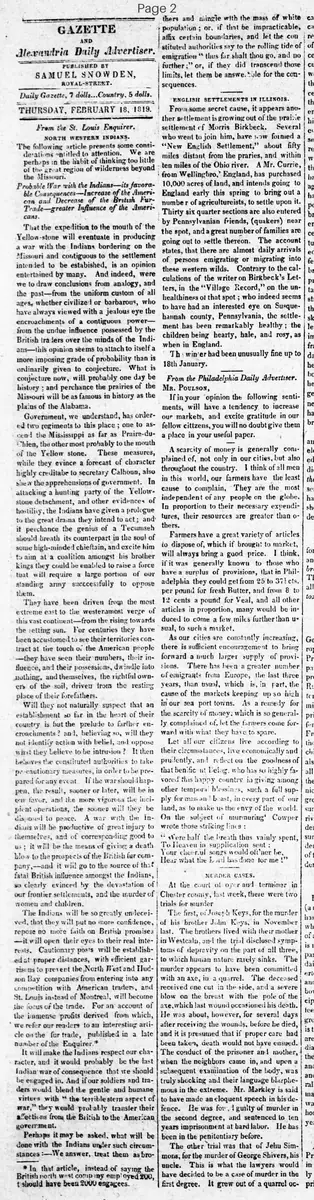
NORTH WESTERN INDIANS.
The following article presents some considerations entitled to attention. We are perhaps in the habit of thinking too little of the great region of wilderness beyond the Missouri.
Probable War with the Indians—its favorable Consequences—Increase of the American and Decrease of the British Fur Trade—greater Influence of the Americans.
That the expedition to the mouth of the Yellow-stone will eventuate in producing a war with the Indians bordering on the Missouri and contiguous to the settlement intended to be established, is an opinion entertained by many. And indeed, were we to draw conclusions from analogy, and the past—from the uniform custom of all ages, whether civilized or barbarous, who have always viewed with a jealous eye the encroachments of a contiguous power—from the undue influence possessed by the British traders over the minds of the Indians—this opinion seems to attach to itself a more imposing grade of probability than is ordinarily given to conjecture. What is conjecture now, will probably one day be history: and perchance the prairies of the Missouri will be as famous in history as the plains of the Alabama.
Government, we understand, has ordered two regiments to this place; one to ascend the Mississippi as far as Prairie-du-Chien, the other most probably to the mouth of the Yellow stone. These measures, while they evince a forecast of character highly creditable to secretary Calhoun, also shew the apprehensions of government. In attacking a hunting party of the Yellow-stone detachment, and other evidences of hostility, the Indians have given a prologue to the great drama they intend to act; and it perchance the genius of a Tecumseh should breathe its counterpart in the soul of some high-minded chieftain, and excite him to aim at a coalition amongst his brother kings they could be enabled to raise a force that will require a large portion of our standing army successfully to oppose them.
They have been driven from the most extreme east to the westernmost verge of this vast continent—from the rising towards the setting sun. For centuries they have been accustomed to see their territories contract at the touch of the American people—they have seen their numbers, their influence, and their possessions, dwindle into nothing. and themselves, the rightful owners of the soil, driven from the resting place of their forefathers.
Will they not naturally suspect that an establishment so far in the heart of their country is but the prelude to farther encroachments? and, believing so, will they not identify action with belief, and oppose what they believe to be intrusion? It then behooves the constituted authorities to take precautionary measures, in order to be prepared for any event If the war should happen, the result, sooner or later, will be in our favor. and the more vigorous the incipient operations, the sooner will they be disposed to peace. A war with the Indians will be productive of great injury to themselves, and of corresponding good to us; it will be the means of giving a death blow to the prospects of the British fur company,—and it will go to the source of that fatal British influence amongst the Indians, so clearly evinced by the devastation of our frontier settlements, and the murder of women and children.
The Indians will be so greatly undeceived, that they will put no more confidence, repose no more faith on British promises—it will open their eyes to their real interests. Cautionary posts will be established at proper distances, with efficient garrisons to prevent the North West and Hudson Bay companies from entering into any competition with American traders, and St. Louis instead of Montreal, will become the focus of the trade. For an account of the immense profits derived from which, we refer our readers to an interesting article on the fur trade. published in a late number of the Enquirer.*
It will make the Indians respect our character, and it would probably be the last Indian war of consequence that we should be engaged in. And if our soldiers and traders would blend the gentle and humane virtues with "the terrible stern aspect of war," they would probably transfer their affections from the British to the American government.
Perhaps it may be asked, what will be done with the Indians under such circumstances :—We answer, treat them as brothers and mingle with the mass of white population ; or, if that be impracticable, affix certain boundaries, and let the constituted authorities say to the rolling tide of emigration "thus far shalt thou go, and no further;" or, if they did transcend those limits, let them be answerable for the consequences.
* In that article, instead of saying the British north west comp ny employed 200, it should have been 2000 engagees.
What sub-type of article is it?
What keywords are associated?
What entities or persons were involved?
Where did it happen?
Domestic News Details
Primary Location
Missouri
Key Persons
Outcome
speculated war would favor americans, reduce british fur trade influence, establish american dominance in trade, potentially leading to lasting peace and respect from indians.
Event Details
Speculation on probable war with North Western Indians due to U.S. expedition and planned settlement at the mouth of the Yellowstone River; government orders two regiments for defense; British traders' influence cited as factor; potential for Indian coalition; historical displacement of Indians; proposed strategies include treating Indians as brothers, setting boundaries, or preparing for consequences.