Thank you for visiting SNEWPapers!
Sign up free
The New Hampshire Gazette And Historical Chronicle
Portsmouth, Greenland, Rockingham County, New Hampshire
What is this article about?
A colonial writer urges Americans to achieve economic independence from Britain by manufacturing their own goods, avoiding taxed imports, and promoting industry over violent resistance to recent oppressive taxes on trade and articles like glass and paper. Signed from Boston, December 21.
Merged-components note: Continuation of the same letter to the printers discussing economy, manufacturing, and independence from British taxes; text flows directly from one component to the next.
Clipping
OCR Quality
Full Text
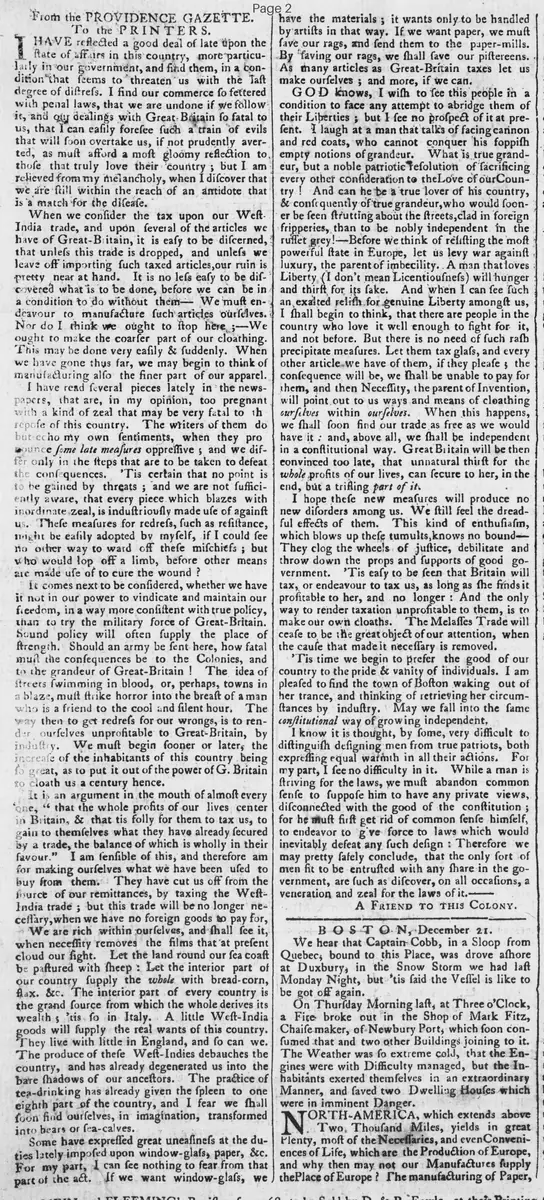
To the PRINTERS.
HAVE reflected a good deal of late upon the state of affairs in this country, more particularly in our government, and find them, in a condition that seems to threaten us with the last degree of distress. I find our commerce so fettered with penal laws, that we are undone if we follow it, and our dealings with Great Britain so fatal to us, that I can easily foresee such a train of evils that will soon overtake us, if not prudently averted, as must afford a most gloomy reflection to those that truly love their country; but I am relieved from my melancholy, when I discover that we are still within the reach of an antidote that is a match for the disease.
When we consider the tax upon our West India trade, and upon several of the articles we have of Great-Britain, it is easy to be discerned, that unless this trade is dropped, and unless we leave off importing such taxed articles, our ruin is pretty near at hand. It is no less easy to be discovered what is to be done, before we can be in a condition to do without them. We must endeavour to manufacture such articles ourselves.
Nor do I think we ought to stop here; We ought to make the coarser part of our cloathing. This may be done very easily & suddenly. When we have gone thus far, we may begin to think of manufacturing also the finer part of our apparel.
I have read several pieces lately in the news-papers, that are, in my opinion, too pregnant with a kind of zeal that may be very fatal to the repose of this country. The writers of them do but echo my own sentiments, when they pronounce some late measures oppressive; and we differ only in the steps that are to be taken to defeat the consequences. 'Tis certain that no point is to be gained by threats; and we are not sufficiently aware, that every piece which blazes with inordinate zeal, is industriously made use of against us. These measures for redress, such as resistance, might be easily adopted by myself, if I could see no other way to ward off these mischiefs; but who would lop off a limb, before other means are made use of to cure the wound?
It comes next to be considered, whether we have it not in our power to vindicate and maintain our freedom, in a way more consistent with true policy, than to try the military force of Great-Britain. Sound policy will often supply the place of strength. Should an army be sent here, how fatal must the consequences be to the Colonies, and to the grandeur of Great-Britain! The idea of streets swimming in blood, or, perhaps, towns in a blaze, must strike horror into the breast of a man who is a friend to the cool and silent hour. The way then to get redress for our wrongs, is to render ourselves unprofitable to Great-Britain, by industry. We must begin sooner or later; the increase of the inhabitants of this country being great, as to put it out of the power of G. Britain to cloath us a century hence.
It is an argument in the mouth of almost every one, "that the whole profits of our lives center in Britain. & that tis folly for them to tax us, to gain to themselves what they have already secured by a trade, the balance of which is wholly in their favour." I am sensible of this, and therefore am for making ourselves what we have been used to buy from them. They have cut us off from the source of our remittances, by taxing the West India trade; but this trade will be no longer necessary, when we have no foreign goods to pay for.
We are rich within ourselves, and shall see it, when necessity removes the films that at present cloud our sight. Let the land round our sea coast be pastured with Sheep: Let the interior part of our country supply the whole with bread-corn, Flax. &c. The interior part of every country is the grand source from which the whole derives its wealth as tis so in Italy. A little West-India goods will supply the real wants of this country. They live with little in England, and so can we. The produce of these West-Indies debauches the country, and has already degenerated us into the bare shadows of our ancestors. The practice of tea-drinking has already given the spleen to one eighth part of the country, and I fear we shall soon find ourselves, in imagination, transformed into bears or sea-calves.
Some have expressed great uneasiness at the duties lately imposed upon window-glass, paper, &c. For my part, I can see nothing to fear from that part of the act. If we want window-glass, we
have the materials: it wants only to be handled by artists in that way. If we want paper, we must save our rags, and send them to the paper-mills. By saving our rags, we shall save our pitereens. As many articles as Great-Britain taxes let us make ourselves; and more, if we can.
GOD knows, I wish to see this people in a condition to face any attempt to abridge them of their Liberties; but I see no prospect of it at present. I laugh at a man that talks of facing cannon and red coats, who cannot conquer his foppish empty notions of grandeur. What is true grandeur, but a noble patriotic resolution of sacrificing every other consideration to the Love of our Country! And can he be a true lover of his country, & consequently of true grandeur, who would sooner be seen strutting about the streets, clad in foreign fripperies, than to be nobly independent in the russet grey! Before we think of resisting the most powerful state in Europe, let us levy war against luxury, the parent of imbecility. A man that loves Liberty (I don't mean Licentiousness) will hunger and thirst for its sake. And when I can see such an exalted relish for genuine Liberty amongst us, I shall begin to think, that there are people in the country who love it well enough to fight for it, and not before. But there is no need of such rash precipitate measures. Let them tax glass, and every other article we have of them, if they please; the consequence will be, we shall be unable to pay for them, and then Necessity, the parent of Invention, will point out to us ways and means of cloathing ourselves within ourselves. When this happens, we shall soon find our trade as free as we would have it: and, above all, we shall be independent in a constitutional way. Great Britain will be then convinced too late, that unnatural thirst for the whole profits of our lives, can secure to her, in the end, but a trifling part of it.
I hope these new measures will produce no new disorders among us. We still feel the dreadful effects of them. This kind of enthusiasm, which blows up these tumults, knows no bound. They clog the wheels of justice, debilitate and throw down the props and supports of good government.
'Tis easy to be seen that Britain will tax, or endeavour to tax us, as long as she finds it profitable to her, and no longer: And the only way to render taxation unprofitable to them, is to make our own cloaths. The Molasses Trade will cease to be the great object of our attention, when the cause that made it necessary is removed.
'Tis time we begin to prefer the good of our country to the pride & vanity of individuals. I am pleased to find the town of Boston waking out of her trance, and thinking of retrieving her circumstances by industry. May we fall into the same constitutional way of growing independent,
I know it is thought, by some, very difficult to distinguish designing men from true patriots, both expressing equal warmth in all their actions. For my part, I see no difficulty in it. While a man is striving for the laws, we must abandon common sense to suppose him to have any private views, disconnected with the good of the constitution; for he must first get rid of common sense himself, to endeavor to give force to laws which would inevitably defeat any such design: Therefore we may pretty safely conclude, that the only sort of men fit to be entrusted with any share in the government, are such as discover, on all occasions, a veneration and zeal for the laws of it.
A FRIEND TO THIS COLONY.
BOSTON. December 21.
What sub-type of article is it?
What themes does it cover?
What keywords are associated?
What entities or persons were involved?
Letter to Editor Details
Author
A Friend To This Colony.
Recipient
To The Printers.
Main Argument
colonies should counter british taxes by ceasing imports, manufacturing their own goods including clothing and taxed items like glass and paper, and promoting industry to achieve economic independence without resorting to violent resistance.
Notable Details