Thank you for visiting SNEWPapers!
Sign up free
Literary
October 12, 1869
The Spirit Of Democracy
Woodsfield, Monroe County, Ohio
What is this article about?
An essay debunking the superstition that the ticking sound of the death-watch beetle foretells death, quoting Sir Thomas Browne's observations, Jonathan Swift's satirical verse, and references to Baxter, Gay, and Pope. Explains the insect's behavior scientifically.
Clipping
OCR Quality
95%
Excellent
Full Text
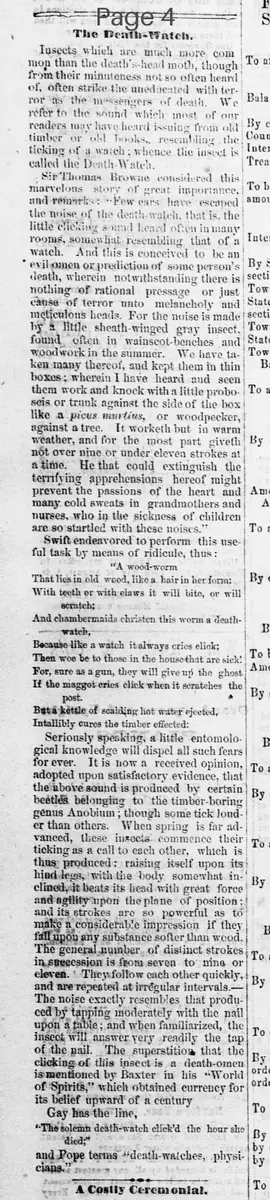
The Death-Watch.
Insects which are much more common than the death's-head moth, though from their minuteness not so often heard of, often strike the uneducated with terror as the messengers of death. We refer to the sound which most of our readers may have heard issuing from old timber or old books, resembling the ticking of a watch; whence the insect is called the Death Watch.
Sir Thomas Browne considered this marvelous story of great importance, and remarks: 'Few ears have escaped the noise of the death-watch, that is, the little clicking sound heard often in many rooms, somewhat resembling that of a watch. And this is conceived to be an evil omen or prediction of some person's death, wherein notwithstanding there is nothing of rational presage or just cause of terror unto melancholy and meticulous heads. For the noise is made by a little sheath-winged gray insect, found often in wainscot-benches and woodwork in the summer. We have taken many thereof, and kept them in thin boxes: wherein I have heard and seen them work and knock with a little proboscis or trunk against the side of the box like a picus martius, or woodpecker, against a tree. It worketh but in warm weather, and for the most part giveth not over nine or under eleven strokes at a time. He that could extinguish the terrifying apprehensions hereof might prevent the passions of the heart and many cold sweats in grandmothers and nurses, who in the sickness of children are so startled with these noises.'
Swift endeavored to perform this useful task by means of ridicule, thus:
"A wood-worm
That lies in old wood, like a hair in her form:
With teeth or with claws it will bite, or will scratch;
And chambermaids christen this worm a death-watch,
Because like a watch it always cries click:
Then woe be to those in the house that are sick,
For, sure as a gun, they will give up the ghost
If the maggot cries click when it scratches the post.
But a kettle of scalding hot water ejected,
Infallibly cures the timber affected:
Seriously speaking, a little entomological knowledge will dispel all such fears for ever. It is now a received opinion, adopted upon satisfactory evidence, that the above sound is produced by certain beetles belonging to the timber-boring genus Anobium; though some tick louder than others. When spring is far advanced, these insects commence their ticking as a call to each other, which is thus produced: raising itself upon its hind legs, with the body somewhat inclined, it beats its head with great force and agility upon the plane of position: and its strokes are so powerful as to make a considerable impression if they fall upon any substance softer than wood. The general number of distinct strokes in succession is from seven to nine or eleven. They follow each other quickly, and are repeated at irregular intervals. The noise exactly resembles that produced by tapping moderately with the nail upon a table; and when familiarized, the insect will answer very readily the tap of the nail. The superstition that the clicking of this insect is a death-omen is mentioned by Baxter in his "World of Spirits," which obtained currency for its belief upward of a century. Gay has the line,
The solemn death-watch click'd the hour she died;"
and Pope terms "death-watches, physicians."
Insects which are much more common than the death's-head moth, though from their minuteness not so often heard of, often strike the uneducated with terror as the messengers of death. We refer to the sound which most of our readers may have heard issuing from old timber or old books, resembling the ticking of a watch; whence the insect is called the Death Watch.
Sir Thomas Browne considered this marvelous story of great importance, and remarks: 'Few ears have escaped the noise of the death-watch, that is, the little clicking sound heard often in many rooms, somewhat resembling that of a watch. And this is conceived to be an evil omen or prediction of some person's death, wherein notwithstanding there is nothing of rational presage or just cause of terror unto melancholy and meticulous heads. For the noise is made by a little sheath-winged gray insect, found often in wainscot-benches and woodwork in the summer. We have taken many thereof, and kept them in thin boxes: wherein I have heard and seen them work and knock with a little proboscis or trunk against the side of the box like a picus martius, or woodpecker, against a tree. It worketh but in warm weather, and for the most part giveth not over nine or under eleven strokes at a time. He that could extinguish the terrifying apprehensions hereof might prevent the passions of the heart and many cold sweats in grandmothers and nurses, who in the sickness of children are so startled with these noises.'
Swift endeavored to perform this useful task by means of ridicule, thus:
"A wood-worm
That lies in old wood, like a hair in her form:
With teeth or with claws it will bite, or will scratch;
And chambermaids christen this worm a death-watch,
Because like a watch it always cries click:
Then woe be to those in the house that are sick,
For, sure as a gun, they will give up the ghost
If the maggot cries click when it scratches the post.
But a kettle of scalding hot water ejected,
Infallibly cures the timber affected:
Seriously speaking, a little entomological knowledge will dispel all such fears for ever. It is now a received opinion, adopted upon satisfactory evidence, that the above sound is produced by certain beetles belonging to the timber-boring genus Anobium; though some tick louder than others. When spring is far advanced, these insects commence their ticking as a call to each other, which is thus produced: raising itself upon its hind legs, with the body somewhat inclined, it beats its head with great force and agility upon the plane of position: and its strokes are so powerful as to make a considerable impression if they fall upon any substance softer than wood. The general number of distinct strokes in succession is from seven to nine or eleven. They follow each other quickly, and are repeated at irregular intervals. The noise exactly resembles that produced by tapping moderately with the nail upon a table; and when familiarized, the insect will answer very readily the tap of the nail. The superstition that the clicking of this insect is a death-omen is mentioned by Baxter in his "World of Spirits," which obtained currency for its belief upward of a century. Gay has the line,
The solemn death-watch click'd the hour she died;"
and Pope terms "death-watches, physicians."
What sub-type of article is it?
Essay
Satire
What themes does it cover?
Death Mortality
Moral Virtue
What keywords are associated?
Death Watch
Superstition
Beetle
Anobium
Thomas Browne
Jonathan Swift
Death Omen
Entomology
Literary Details
Title
The Death Watch.
Subject
On The Death Watch Insect And Its Superstitions
Form / Style
Explanatory Prose With Satirical Verse Quotation
Key Lines
Few Ears Have Escaped The Noise Of The Death Watch, That Is, The Little Clicking Sound Heard Often In Many Rooms, Somewhat Resembling That Of A Watch.
"A Wood Worm
That Lies In Old Wood, Like A Hair In Her Form:
With Teeth Or With Claws It Will Bite, Or Will Scratch;
And Chambermaids Christen This Worm A Death Watch,
The Solemn Death Watch Click'd The Hour She Died;
And Pope Terms "Death Watches, Physicians."