Thank you for visiting SNEWPapers!
Sign up free
Story
April 26, 1954
Trainman News
Indianapolis, Marion County, Indiana
What is this article about?
Article by J. F. Crosson explains railroad train rules, focusing on why trains cannot flag against their meeting points. Discusses Rule 94 limitations and risks of communication failures, using examples to argue against permissive flagging. Notes Canadian railroads' attempt to suppress author's book.
Clipping
OCR Quality
98%
Excellent
Full Text
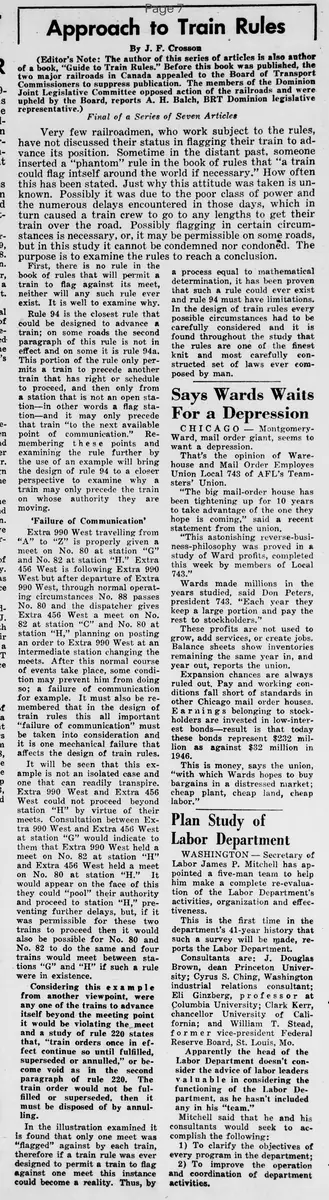
Approach to Train Rules
By J. F. Crosson
(Editor’s Note: The author of this series of articles is also author of a book, "Guide to Train Rules." Before this book was published, the two major railroads in Canada appealed to the Board of Transport Commissioners to suppress publication. The members of the Dominion Joint Legislative Committee opposed action of the railroads and were upheld by the Board, reports A. H. Balch, BRT Dominion legislative representative.)
Final of a Series of Seven Articles
Very few railroadmen, who work subject to the rules, have not discussed their status in flagging their train to advance its position. Sometime in the distant past, someone inserted a "phantom" rule in the book of rules that "a train could flag itself around the world if necessary." How often this has been stated. Just why this attitude was taken is unknown. Possibly it was due to the poor class of power and the numerous delays encountered in those days, which in turn caused a train crew to go to any lengths to get their train over the road. Possibly flagging in certain circumstances is necessary, or, it may be permissible on some roads, but in this study it cannot be condemned nor condoned. The purpose is to examine the rules to reach a conclusion.
First, there is no rule in the book of rules that will permit a train to flag against its meet, neither will any such rule ever exist. It is well to examine why. Rule 94 is the closest rule that could be designed to advance a train: on some roads the second paragraph of this rule is not in effect and on some it is rule 94a. This portion of the rule only permits a train to precede another train that has right or schedule to proceed, and then only from a station that is not an open station--in other words a flag station--and it may only precede that train "to the next available point of communication." Remembering these points and examining the rule further by the use of an example will bring the design of rule 94 to a closer perspective to examine why a train may only precede the train on whose authority they are moving.
‘Failure of Communication’
Extra 990 West travelling from "A" to "Z" is properly given a meet on No. 80 at station "G" and No. 82 at station "H." Extra 456 West is following Extra 990 West but after departure of Extra 990 West, through normal operating circumstances No. 88 passes No. 80 and the dispatcher gives Extra 456 West a meet on No. 82 at station "C" and No. 80 at station "H," planning on posting an order to Extra 990 West at an intermediate station changing the meets. After this normal course of events take place, some condition may prevent him from doing so; a failure of communication for example. It must also be remembered that in the design of train rules this all important "failure of communication" must be taken into consideration and it is one mechanical failure that affects the design of train rules.
It will be seen that this example is not an isolated case and one that can readily transpire. Extra 990 West and Extra 456 West could not proceed beyond station "H" by virtue of their meets. Consultation between Extra 990 West and Extra 456 West at station "G" would indicate to them that Extra 990 West held a meet on No. 82 at station "H" and Extra 456 West held a meet on No. 80 at station "H." It would appear on the face of this they could "pool" their authority and proceed to station "H," preventing further delays, but, if it was permissible for these two trains to proceed then it would also be possible for No. 80 and No. 82 to do the same and four trains would meet between stations "G" and "H" if such a rule were in existence.
Considering this example from another viewpoint, were any one of the trains to advance itself beyond the meeting point it would be violating the meet and a study of rule 220 states that, "train orders once in effect continue so until fulfilled, superseded or annulled," or become void as in the second paragraph of rule 220. The train order would not be fulfilled or superseded, then it must be disposed of by annulling.
In the illustration examined it is found that only one meet was "flagged" against by each train, therefore if a train rule was ever designed to permit a train to flag against one meet this instance could become a reality. Thus, by a process equal to mathematical determination, it has been proven that such a rule could ever exist and rule 94 must have limitations.
In the design of train rules every possible circumstances had to be carefully considered and it is found throughout the study that the rules are one of the finest knit and most carefully constructed set of laws ever composed by man.
By J. F. Crosson
(Editor’s Note: The author of this series of articles is also author of a book, "Guide to Train Rules." Before this book was published, the two major railroads in Canada appealed to the Board of Transport Commissioners to suppress publication. The members of the Dominion Joint Legislative Committee opposed action of the railroads and were upheld by the Board, reports A. H. Balch, BRT Dominion legislative representative.)
Final of a Series of Seven Articles
Very few railroadmen, who work subject to the rules, have not discussed their status in flagging their train to advance its position. Sometime in the distant past, someone inserted a "phantom" rule in the book of rules that "a train could flag itself around the world if necessary." How often this has been stated. Just why this attitude was taken is unknown. Possibly it was due to the poor class of power and the numerous delays encountered in those days, which in turn caused a train crew to go to any lengths to get their train over the road. Possibly flagging in certain circumstances is necessary, or, it may be permissible on some roads, but in this study it cannot be condemned nor condoned. The purpose is to examine the rules to reach a conclusion.
First, there is no rule in the book of rules that will permit a train to flag against its meet, neither will any such rule ever exist. It is well to examine why. Rule 94 is the closest rule that could be designed to advance a train: on some roads the second paragraph of this rule is not in effect and on some it is rule 94a. This portion of the rule only permits a train to precede another train that has right or schedule to proceed, and then only from a station that is not an open station--in other words a flag station--and it may only precede that train "to the next available point of communication." Remembering these points and examining the rule further by the use of an example will bring the design of rule 94 to a closer perspective to examine why a train may only precede the train on whose authority they are moving.
‘Failure of Communication’
Extra 990 West travelling from "A" to "Z" is properly given a meet on No. 80 at station "G" and No. 82 at station "H." Extra 456 West is following Extra 990 West but after departure of Extra 990 West, through normal operating circumstances No. 88 passes No. 80 and the dispatcher gives Extra 456 West a meet on No. 82 at station "C" and No. 80 at station "H," planning on posting an order to Extra 990 West at an intermediate station changing the meets. After this normal course of events take place, some condition may prevent him from doing so; a failure of communication for example. It must also be remembered that in the design of train rules this all important "failure of communication" must be taken into consideration and it is one mechanical failure that affects the design of train rules.
It will be seen that this example is not an isolated case and one that can readily transpire. Extra 990 West and Extra 456 West could not proceed beyond station "H" by virtue of their meets. Consultation between Extra 990 West and Extra 456 West at station "G" would indicate to them that Extra 990 West held a meet on No. 82 at station "H" and Extra 456 West held a meet on No. 80 at station "H." It would appear on the face of this they could "pool" their authority and proceed to station "H," preventing further delays, but, if it was permissible for these two trains to proceed then it would also be possible for No. 80 and No. 82 to do the same and four trains would meet between stations "G" and "H" if such a rule were in existence.
Considering this example from another viewpoint, were any one of the trains to advance itself beyond the meeting point it would be violating the meet and a study of rule 220 states that, "train orders once in effect continue so until fulfilled, superseded or annulled," or become void as in the second paragraph of rule 220. The train order would not be fulfilled or superseded, then it must be disposed of by annulling.
In the illustration examined it is found that only one meet was "flagged" against by each train, therefore if a train rule was ever designed to permit a train to flag against one meet this instance could become a reality. Thus, by a process equal to mathematical determination, it has been proven that such a rule could ever exist and rule 94 must have limitations.
In the design of train rules every possible circumstances had to be carefully considered and it is found throughout the study that the rules are one of the finest knit and most carefully constructed set of laws ever composed by man.
What sub-type of article is it?
Explanatory Article
Rule Analysis
What keywords are associated?
Train Flagging
Rule 94
Railroad Meets
Communication Failure
Train Orders
What entities or persons were involved?
J. F. Crosson
A. H. Balch
Where did it happen?
Canadian Railroads
Story Details
Key Persons
J. F. Crosson
A. H. Balch
Location
Canadian Railroads
Story Details
Author analyzes railroad rules prohibiting trains from flagging against meeting points, using examples of communication failures and Rule 94 to demonstrate safety risks and rule limitations, concluding rules are meticulously designed.