Thank you for visiting SNEWPapers!
Sign up free
Editorial
June 26, 1828
The Virginian
Lynchburg, Virginia
What is this article about?
An editorial criticizing Southern discontent with the 1828 tariff law, attributing agitation to figures like Thomas Cooper and Jackson supporters, warning against threats to the Union, and defending the tariff's benefits while urging loyalty to federal authority.
Clipping
OCR Quality
95%
Excellent
Full Text
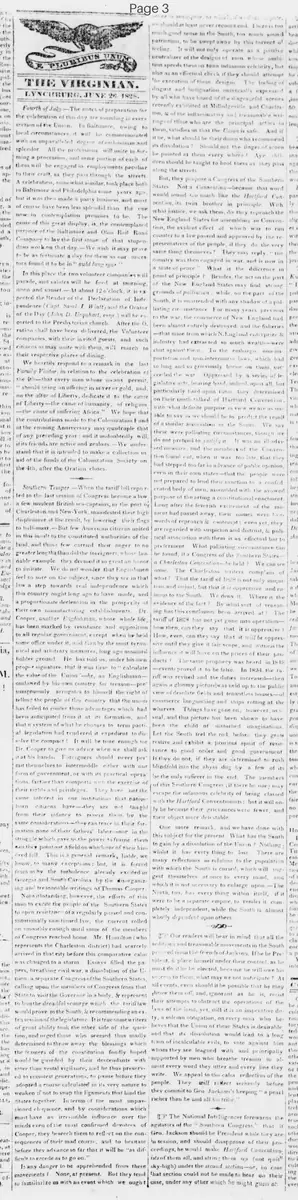
Southern Temper—When the tariff bill reported to the last session of Congress became a law a few insolent British sea-captains, to the port of Charleston and New-York, manifested their high displeasure at the result, by lowering their flags to half-mast—But few American citizens united in this insult to the constituted authorities of the land, and those few carried their anger to no greater lengths than did the foreigners, whose laudable example they deemed it so great an honor to imitate. We do not wonder that Englishmen feel so sore on the subject, since they see in that law a step towards real independence which this country ought long ago to have made, and a proportionate declension in the prosperity of their own manufacturing establishments. [T. Cooper, another Englishman, whose whole life has been marked by resistance and opposition to all regular government, except when he held some office under it, and then by the most tyrannical and arbitrary measures, long ago assumed bolder ground. He has told us, under his own proper signature, that it was time to "calculate the value of the Union"—he, an Englishman—outlawed by his own country for treason—presumptuously arrogates to himself the right of telling the people of this country that the union has failed to confer those advantages which had been anticipated from it at its formation, and that a system of what he chooses to term partial legislation had rendered it expedient to dissolve the compact. It will be time enough for Dr. Cooper to give us advice when we shall ask it at his hands. Foreigners should never permit themselves to intermeddle either with our form of government, or with its practical operations, farther than comports with the exercise of their rights and privileges. They have not the same interest in our institutions that native born citizens have—they are not taught from their infancy to revere them by the same considerations—they can trace in their formation none of their fathers' labor—nor in the struggle which gave us the power to frame them, on the point of a field on which one of their kindred fell. This is a general remark, liable, we know, to many exceptions: but, it is forced from us by the turbulence already excited in Georgia and South Carolina by the disorganizing and treasonable writings of Thomas Cooper. Notwithstanding, however, the efforts of this man to excite the people of the Southern States to open resistance to a regularly passed and constitutionally sanctioned law, the current rolled on smoothly enough until some of the members of Congress reached home. Mr. Hamilton (who represents the Charleston district) had scarcely arrived in that city before this comparative calm was changed to a storm. Essays filled the papers, breathing civil war, a dissolution of the Union, a separate Congress of the Southern States, calling upon the members of Congress from that State to visit the Governor in a body, & represent to him the dreadful scourge which the tariff law would prove to the South, & recommend an extra session of the legislature. It is true some writers of great ability took the other side of the question, and urged those who seemed thus madly determined to throw away the blessings which the framers of the constitution fondly hoped would be guarded by their descendants with more than vestal vigilance, and be thus preserved to remotest generations, to pause before they adopted a course calculated in its very nature to weaken if not to snap the ligaments that bind the States together. In terms of the most impassioned eloquence, and by considerations which must have an irresistible influence over the minds even of the most confirmed devotees of Cooper, they beseech them to reflect on the consequences of their mad course, and to hesitate before they advance so far that it will be "as difficult to recede as to go on."
Is any danger to be apprehended from these movements? None, at present. But they tend to familiarize us with an event which we ought never to anticipate. In reference to it we should at least never recommend. There is too much good sense in the South, too much sound patriotism, to be swept away by this torrent of feeling. It will not only operate as a passive neutralizer of the designs of men whose ambition speeds them on to an infamous celebrity, but also as an effectual check if they should attempt the execution of these designs. The feeling of disgust and indignation universally expressed by all who have heard of these disgraceful scenes recently exhibited at Milledgeville and Charleston, & of the inflammatory and treasonable writings of those who are the principal actors in them, satisfies us that the Union is safe. And if it be, what should be the doom of those who recommend its dissolution? Should not the finger of scorn be pointed at them everywhere? Aye, children should be taught to hoot them as they pass along the streets.
But, they propose a Congress of the Southern States. Not a Convention—because that word would sound too much like the Hartford Convention, its twin brother in principle. With what justice, we ask them, do they reproach the New England States for assembling in Convention, the evident effect of which was to run counter to a law passed and approved by the representatives of the people, if they do the very same thing themselves? They may reply "the country was then engaged in war and is now in a state of peace. What is the difference in point of principle? Besides the act on the part of the New England States may find strong grounds of palliation, while, on the part of the South, it is unattended with any shadow of a palliating circumstance. For many years previous to the war, the commerce of New England had been almost entirely destroyed, and the fisheries—that mine from which N. England enterprise & industry had extracted so much wealth—were shut against them. In the embargo, non importation and non-intercourse laws, which had so long and so grievously borne on them, succeeded the war. Oppressed by a series of legislative acts, bearing hard, indeed, upon all, but particularly hard upon them, they determined on their much talked of Hartford Convention, with what definite purpose in view we are as unable to say as we should be to predict the result of a similar association in the South. To say these were palliating circumstances, though we do not pretend to justify it. It was an ill advised measure, and the members of the Convention found out, when it was too late, that they had stepped too far in advance of public opinion, even in their own states—that the people were not prepared to lend their sanction to a confederated body of men, assembled with the avowed purpose of thwarting a constitutional enactment. Long after the feverish excitement of the moment had passed away, their names were by-words of reproach & contempt; even yet, they are regarded with suspicion and distrust, & political association with them is an effectual bar to preferment. What palliating circumstance can be found, if a Congress of the Southern States—a Charleston Convention—be held? We can see none. The Charleston writers complain of what? That the tariff of 1828 is not only iniquitous and unjust, but that it is oppressive and ruinous to the South. We deny it. Where is the evidence of the fact? By what sort of reasoning has this conclusion been arrived at? The tariff of 1828 has not yet gone into operation—how then, can they say that it is oppressive? How, even, can they say that it will be oppressive until they give it a fair scope, and witness the influence it will have on the prices of their products? The same prophecy was heard in 1816—events proved it to be false. In 1824, the tariff was revised and the duties increased—then again a gloomy picture was held up to the public view of desolate fields and tenantless houses—commerce languishing and ships rotting at the wharves. Things have gone on, however, as usual, and this picture has been shown to have been the child of disturbed imaginations. Let the South feel the rod, before they grow restive and exhibit a prurient spirit of resistance to good order and good government. If they do not, if they are determined to rush blindfold into the abyss dug by a few of its agitators, they will be the only sufferers in the end. The members of this Southern Congress (if there be one) may escape the infamous celebrity of being classed with the Hartford Conventionists: but it will only be because their grievances were fewer, and their object more detestable.
One more remark, and we have done with this subject for the present. What has the South to gain by a dissolution of the Union? Nothing: whilst it has everything to lose. There are many reflections in relation to the population with which the South is cursed, which will suggest themselves at once to every mind, and which it is not necessary to enlarge upon—The North, too, has everything within itself, if it were to be a separate empire, to render it completely independent, while the South is almost wholly dependent upon others.
Our readers will bear in mind that all the seditious and treasonable movements in the South proceeded from the friends of Jackson. If he be President, & place himself under their control, as he must do if he be elected, because he will owe his success to them, what may we not anticipate? At all events, even should it be possible that he may throw them off, and, ignorant as he is, resist their attempts to obstruct the operations of the laws of the Union, yet, still it is an imperative duty, a solemn obligation, on every man who believes that the Union of these States is desirable and that its dissolution would lead to a long train of incalculable evils, to vote against him whom they see leagued with and principally supported by men who breathe treason in almost every word they utter and every line they write. We appeal to the calm reflection of the people. They will reflect seriously before they commit to Gen. Jackson's keeping "a pearl richer than he and all his tribe."
The National Intelligencer forewarns the agitators of the "Southern Congress" that if Gen. Jackson should be President while they are in session, and should disapprove of their proceedings, he would make Hartford Conventionists of them all, and string them up (not quite sky-high) under the second section—or, in case that section could not be made to bear on their case, under any other which he might guess at.
Is any danger to be apprehended from these movements? None, at present. But they tend to familiarize us with an event which we ought never to anticipate. In reference to it we should at least never recommend. There is too much good sense in the South, too much sound patriotism, to be swept away by this torrent of feeling. It will not only operate as a passive neutralizer of the designs of men whose ambition speeds them on to an infamous celebrity, but also as an effectual check if they should attempt the execution of these designs. The feeling of disgust and indignation universally expressed by all who have heard of these disgraceful scenes recently exhibited at Milledgeville and Charleston, & of the inflammatory and treasonable writings of those who are the principal actors in them, satisfies us that the Union is safe. And if it be, what should be the doom of those who recommend its dissolution? Should not the finger of scorn be pointed at them everywhere? Aye, children should be taught to hoot them as they pass along the streets.
But, they propose a Congress of the Southern States. Not a Convention—because that word would sound too much like the Hartford Convention, its twin brother in principle. With what justice, we ask them, do they reproach the New England States for assembling in Convention, the evident effect of which was to run counter to a law passed and approved by the representatives of the people, if they do the very same thing themselves? They may reply "the country was then engaged in war and is now in a state of peace. What is the difference in point of principle? Besides the act on the part of the New England States may find strong grounds of palliation, while, on the part of the South, it is unattended with any shadow of a palliating circumstance. For many years previous to the war, the commerce of New England had been almost entirely destroyed, and the fisheries—that mine from which N. England enterprise & industry had extracted so much wealth—were shut against them. In the embargo, non importation and non-intercourse laws, which had so long and so grievously borne on them, succeeded the war. Oppressed by a series of legislative acts, bearing hard, indeed, upon all, but particularly hard upon them, they determined on their much talked of Hartford Convention, with what definite purpose in view we are as unable to say as we should be to predict the result of a similar association in the South. To say these were palliating circumstances, though we do not pretend to justify it. It was an ill advised measure, and the members of the Convention found out, when it was too late, that they had stepped too far in advance of public opinion, even in their own states—that the people were not prepared to lend their sanction to a confederated body of men, assembled with the avowed purpose of thwarting a constitutional enactment. Long after the feverish excitement of the moment had passed away, their names were by-words of reproach & contempt; even yet, they are regarded with suspicion and distrust, & political association with them is an effectual bar to preferment. What palliating circumstance can be found, if a Congress of the Southern States—a Charleston Convention—be held? We can see none. The Charleston writers complain of what? That the tariff of 1828 is not only iniquitous and unjust, but that it is oppressive and ruinous to the South. We deny it. Where is the evidence of the fact? By what sort of reasoning has this conclusion been arrived at? The tariff of 1828 has not yet gone into operation—how then, can they say that it is oppressive? How, even, can they say that it will be oppressive until they give it a fair scope, and witness the influence it will have on the prices of their products? The same prophecy was heard in 1816—events proved it to be false. In 1824, the tariff was revised and the duties increased—then again a gloomy picture was held up to the public view of desolate fields and tenantless houses—commerce languishing and ships rotting at the wharves. Things have gone on, however, as usual, and this picture has been shown to have been the child of disturbed imaginations. Let the South feel the rod, before they grow restive and exhibit a prurient spirit of resistance to good order and good government. If they do not, if they are determined to rush blindfold into the abyss dug by a few of its agitators, they will be the only sufferers in the end. The members of this Southern Congress (if there be one) may escape the infamous celebrity of being classed with the Hartford Conventionists: but it will only be because their grievances were fewer, and their object more detestable.
One more remark, and we have done with this subject for the present. What has the South to gain by a dissolution of the Union? Nothing: whilst it has everything to lose. There are many reflections in relation to the population with which the South is cursed, which will suggest themselves at once to every mind, and which it is not necessary to enlarge upon—The North, too, has everything within itself, if it were to be a separate empire, to render it completely independent, while the South is almost wholly dependent upon others.
Our readers will bear in mind that all the seditious and treasonable movements in the South proceeded from the friends of Jackson. If he be President, & place himself under their control, as he must do if he be elected, because he will owe his success to them, what may we not anticipate? At all events, even should it be possible that he may throw them off, and, ignorant as he is, resist their attempts to obstruct the operations of the laws of the Union, yet, still it is an imperative duty, a solemn obligation, on every man who believes that the Union of these States is desirable and that its dissolution would lead to a long train of incalculable evils, to vote against him whom they see leagued with and principally supported by men who breathe treason in almost every word they utter and every line they write. We appeal to the calm reflection of the people. They will reflect seriously before they commit to Gen. Jackson's keeping "a pearl richer than he and all his tribe."
The National Intelligencer forewarns the agitators of the "Southern Congress" that if Gen. Jackson should be President while they are in session, and should disapprove of their proceedings, he would make Hartford Conventionists of them all, and string them up (not quite sky-high) under the second section—or, in case that section could not be made to bear on their case, under any other which he might guess at.
What sub-type of article is it?
Economic Policy
Constitutional
Partisan Politics
What keywords are associated?
Tariff 1828
Southern Resistance
Union Dissolution
Thomas Cooper
Jackson Supporters
Hartford Convention
Economic Policy
Partisan Politics
What entities or persons were involved?
T. Cooper
Mr. Hamilton
Gen. Jackson
Southern States
Congress
Hartford Convention
National Intelligencer
Editorial Details
Primary Topic
Southern Opposition To The 1828 Tariff And Threats To Dissolve The Union
Stance / Tone
Strongly Pro Union And Pro Tariff, Critical Of Southern Agitators And Jackson Supporters
Key Figures
T. Cooper
Mr. Hamilton
Gen. Jackson
Southern States
Congress
Hartford Convention
National Intelligencer
Key Arguments
British Captains And Foreigners Oppose The Tariff As It Harms Their Manufacturing Interests
Thomas Cooper, An Outlawed Englishman, Stirs Treasonous Resistance In The South
Southern Essays Threaten Civil War And A Separate Congress, But Pro Union Voices Urge Caution
No Real Danger To The Union; Southern Patriotism Will Prevail
Hypocrisy In Criticizing Hartford Convention While Proposing A Southern Congress Without Palliating Circumstances
Tariff Of 1828 Not Yet Operative; Past Tariffs Did Not Ruin The South As Predicted
Dissolution Benefits South Nothing And Risks Much, Especially Regarding Enslaved Population
Agitation Led By Jackson Friends; Voting For Jackson Risks Union Dissolution