Thank you for visiting SNEWPapers!
Sign up free
Gazette Of The United States
New York, New York County, New York
What is this article about?
This editorial continuation critiques an author's views on ideal government by analyzing Roman historical examples of Cincinnatus and Curius Dentatus, arguing they support balanced government with aristocratic and popular checks rather than the author's unbalanced plan.
Merged-components note: Continuation of the essay on the right government of a commonwealth across components on the same page, forming a single analytical opinion piece.
Clipping
OCR Quality
Full Text
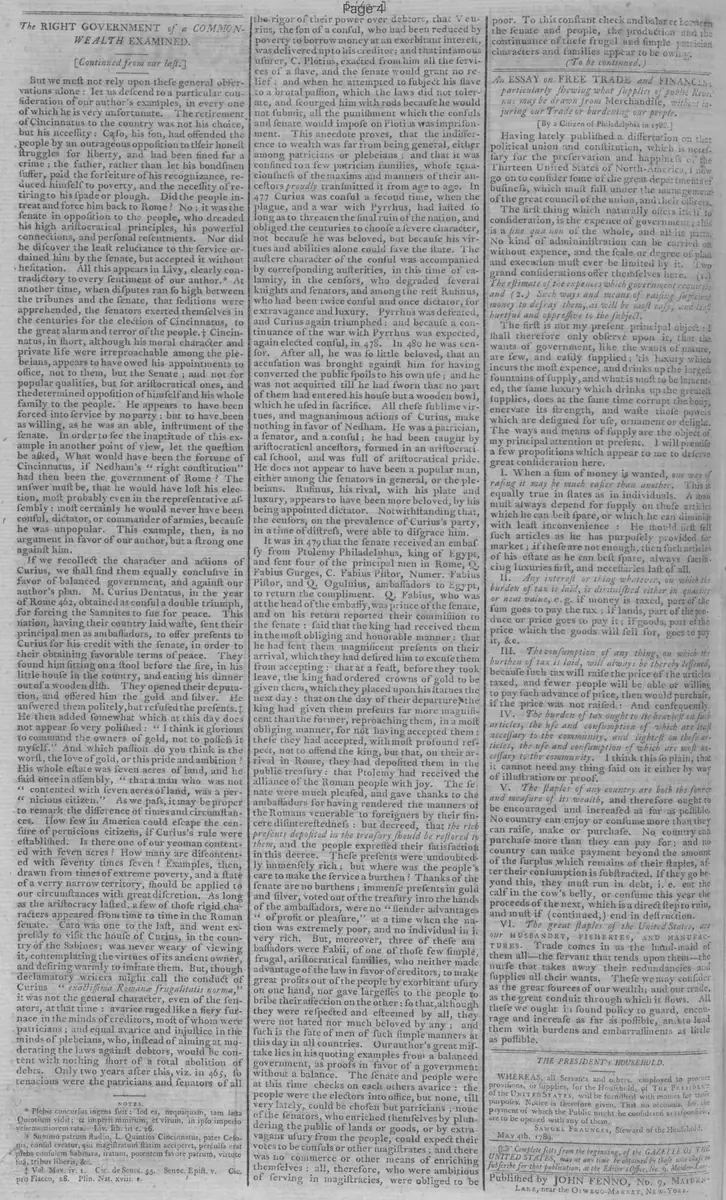
[Continued from our last.]
But we must not rely upon these general observations alone: let us descend to a particular consideration of our author's examples, in every one of which he is very unfortunate. The retirement of Cincinnatus to the country was not his choice, but his necessity: Cato, his son, had offended the people by an outrageous opposition to their honest struggles for liberty, and had been fined for a crime; the father, rather than let his bondsmen suffer, paid the forfeiture of his recognizance, reduced himself to poverty, and the necessity of retiring to his plough. Did the people entreat and force him back to Rome? No; it was the senate in opposition to the people, who dreaded his high aristocratical principles, his powerful connections, and personal resentments. Nor did he discover the least reluctance to the service ordained him by the senate, but accepted it without hesitation. All this appears in Livy, clearly contradictory to every sentiment of our author.* At another time, when disputes ran so high between the tribunes and the senate, that seditions were apprehended, the senators exerted themselves in the centuries for the election of Cincinnatus, to the great alarm and terror of the people.† Cincinnatus, in short, although his moral character and private life were irreproachable among the plebeians, appears to have owed his appointments to office, not to them, but the Senate; and not for popular qualities, but for aristocratical ones, and the determined opposition of himself and his whole family to the people. He appears to have been forced into service by no party; but to have been as willing, as he was an able, instrument of the senate. In order to see the inaptitude of this example in another point of view, let the question be asked, What would have been the fortune of Cincinnatus, if Nedham's "right constitution" had then been the government of Rome? The answer must be, that he would have lost his election, most probably even in the representative assembly: most certainly he would never have been consul, dictator, or commander of armies, because he was unpopular. This example, then, is no argument in favor of our author, but a strong one against him.
If we recollect the character and actions of Curius, we shall find them equally conclusive in favor of balanced government, and against our author's plan. M. Curius Dentatus, in the year of Rome 442, obtained as consul a double triumph, for forcing the Samnites to sue for peace. This nation, having their country laid waste, sent their principal men as ambassadors, to offer presents to Curius for his credit with the senate, in order to their obtaining favorable terms of peace. They found him sitting on a stool before the fire, in his little house in the country, and eating his dinner out of a wooden dish. They opened their deputation, and offered him the gold and silver. He answered them politely, but refused the presents.† He then added somewhat which at this day does not appear so very polished: "I think it glorious to command the owners of gold, not to possess it myself." And which passion do you think is the worst, the love of gold, or this pride and ambition? His whole estate was seven acres of land, and he said once in assembly, "that a man who was not "contented with seven acres of land, was a per- "nicious citizen." As we pass, it may be proper to remark the difference of times and circumstances. How few in America could escape the cen- sure of pernicious citizens, if Curius's rule were established. Is there one of our yeoman content- ed with seven acres? How many are discontent- ed with seventy times seven! Examples, then, drawn from times of extreme poverty, and a state of a very narrow territory, should be applied to our circumstances with great discretion. As long as the aristocracy lasted, a few of those rigid cha- racters appeared from time to time in the Roman senate. Cato was one to the last, and went ex- pressly to visit the house of Curius, in the coun- try of the Sabines; was never weary of viewing it, contemplating the virtues of its ancient owner, and desiring warmly to imitate them. But, though declamatory writers might call the conduct of Curius "exactissima Romanæ frugalitatis norma," it was not the general character, even of the en- ators, at that time: avarice raged like a fiery fur- nace in the minds of creditors, most of whom were patricians; and equal avarice and injustice in the minds of plebeians, who, instead of aiming at mo- derating the laws against debtors, would be con- tent with nothing short of a total abolition of debts. Only two years after this, viz. in 445, so tenacious were the patricians and senators of all
NOTES.
* Plebis concursus ingens fuit: sed ea, nequaquam, tam lacta Ouintium vidit; et imperii nimirum, et virum, in ipso imperio vehementiorem rata. Liv. lib. iii c. 26.
† Summo patrum studio, L. Quintius Cincinnatus, pater Cæso- nis, consul creatur, qui magistratum statim acciperet, pericula erat plebs consulem habitura, iratum, potentem favore patrum, virtute suâ, tribus liberis, &c.
Val. Max. iv. 1. Cic. de Senec. 55. Senec. Epit. v. Cic. pro Flacco, 28. Plin. Nat. xviii. 2.
the rigor of their power over debtors, that Veurius, the son of a consul, who had been reduced by poverty to borrow money at an exorbitant interest, was delivered up to his creditor; and that infamous usurer, C. Plotius, exacted from him all the services of a slave, and the senate would grant no relief: and when he attempted to subject his slave to a brutal passion, which the laws did not toler- ate, and scourged him with rods because he would not submit, all the punishment which the consuls and senate would impose on Plotius was imprison- ment. This anecdote proves, that the indifference to wealth was far from being general, either among patricians or plebeians; and that it was confined to a few patrician families, whose tena- ciousness of the maxims and manners of their an- cestors proudly transmitted it from age to age. In 447 Curius was consul a second time, when the plague, and a war with Pyrrhus, had lasted so long as to threaten the final ruin of the nation, and obliged the centuries to choose a severe character, not because he was beloved, but because his vir- tues and abilities alone could save the state. The austere character of the consul was accompanied by corresponding austerities, in this time of ca- lamity, in the censors, who degraded several knights and senators, and among the rest Rufinus, who had been twice consul and once dictator, for extravagance and luxury. Pyrrhus was defeated, and Curius again triumphed: and because a con- tinuance of the war with Pyrrhus was expected, again elected consul, in 448. In 450 he was cen- sor. After all, he was so little beloved, that an accusation was brought against him for having converted the public spoils to his own use; and he was not acquitted till he had sworn that no part of them had entered his house but a wooden bowl, which he used in sacrifice. All these sublime vir- tues, and magnanimous actions of Curius, make nothing in favor of Nedham. He was a patrician, a senator, and a consul; he had been taught by aristocratical ancestors, formed in an aristocrati- cal school, and was full of aristocratical pride. He does not appear to have been a popular man, either among the senators in general, or the ple- beians. Rufinus, his rival, with his plate and luxury, appears to have been more beloved, by his being appointed dictator. Notwithstanding that, the censors, on the prevalence of Curius's party, in a time of distress, were able to disgrace him. It was in 449 that the senate received an embas- sy from Ptolemy Philadelphus, king of Egypt, and sent four of the principal men in Rome, Q. Fabius Gurges, C. Fabius Pictor, Numer. Fabius Pictor, and Q. Ogulnius, ambassadors to Egypt, to return the compliment. Q. Fabius, who was at the head of the embassy, was prince of the senate, and on his return reported their commission to the senate: said that the king had received them in the most obliging and honorable manner: that he had sent them magnificent presents on their arrival, which they had desired him to excuse them from accepting: that at a feast, before they took leave, the king had ordered crowns of gold to be given them, which they placed upon his statues the next day: that on the day of their departure, the king had given them presents far more magni- ficent than the former, reproaching them, in a most obliging manner, for not having accepted them: these they had accepted, with most profound re- spect, not to offend the king, but that, on their ar- rival in Rome, they had deposited them in the public treasury: that Ptolemy had received the alliance of the Roman people with joy. The se- nate were much pleased, and gave thanks to the ambassadors for having rendered the manners of the Romans venerable to foreigners by their sin- cere disinterestedness: but decreed, that the rich presents deposited in the treasury should be restored to them, and the people expressed their satisfaction in this decree. These presents were undoubtedly immensely rich; but where was the people's care to make the service a burden? Thanks of the senate are no burdens; immense presents in gold and silver, voted out of the treasury into the hands of the ambassadors, were no "slender advantages of profit or pleasure," at a time when the na- tion was extremely poor, and no individual in it very rich. But, moreover, three of these am- bassadors were Fabii, of one of those few simple, frugal, aristocratical families, who neither made advantage of the law in favor of creditors, to make great profits out of the people by exorbitant usury on one hand, nor gave largesses to the people to bribe their affection on the other: so that, although they were respected and esteemed by all, they were not hated nor much beloved by any; and such is the fate of men of such simple manners at this day in all countries. Our author's great mis- take lies in his quoting examples from a balanced government, as proofs in favor of a government without a balance. The senate and people were at this time checks on each others avarice: the people were the electors into office, but none, till very lately, could be chosen but patricians; none of the senators, who enriched themselves by plun- dering the public of lands or goods, or by extra- vagant usury from the people, could expect their votes to be consuls or other magistrates; and there was no commerce or other means of enriching themselves: all, therefore, who were ambitious of serving in magistracies, were obliged to be poor. To this constant check and balance between the senate and people, the production and the continuance of these frugal and simple patrician characters and families appear to be owing.
(To be continued.)
What sub-type of article is it?
What keywords are associated?
What entities or persons were involved?
Editorial Details
Primary Topic
Critique Of Nedham's Government Plan Using Roman Examples Of Cincinnatus And Curius
Stance / Tone
Support For Balanced Government Against Unbalanced Constitution
Key Figures
Key Arguments