Thank you for visiting SNEWPapers!
Sign up free
Lynchburg Virginian
Lynchburg, Virginia
What is this article about?
Excerpt from North Carolina Governor Morehead's message discusses local affairs including internal improvements like the profitable Buncombe turnpike, justice administration, education, penitentiary, bank specie payments resumption, need for a national bank, protective tariff advocacy, and public land revenue distribution.
Clipping
OCR Quality
Full Text
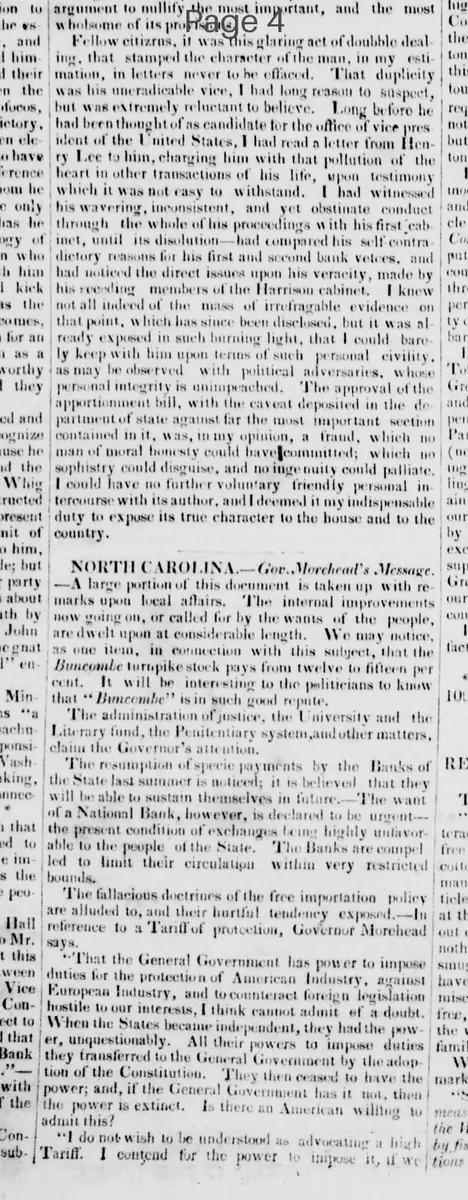
A large portion of this document is taken up with remarks upon local affairs. The internal improvements now going on, or called for by the wants of the people, are dwelt upon at considerable length. We may notice, as one item, in connection with this subject, that the Buncombe turnpike stock pays from twelve to fifteen per cent. It will be interesting to the politicians to know that "Buncombe" is in such good repute.
The administration of justice, the University and the Literary fund, the Penitentiary system, and other matters, claim the Governor's attention.
The resumption of specie payments by the Banks of the State last summer is noticed; it is believed that they will be able to sustain themselves in future.-The want of a National Bank, however, is declared to be urgent--the present condition of exchanges being highly unfavorable to the people of the State. The Banks are compelled to limit their circulation within very restricted bounds.
The fallacious doctrines of the free importation policy are alluded to, and their hurtful tendency exposed.-In reference to a Tariff of protection, Governor Morehead says.
"That the General Government has power to impose duties for the protection of American Industry, against European Industry, and to counteract foreign legislation hostile to our interests, I think cannot admit of a doubt. When the States became independent, they had the power, unquestionably. All their powers to impose duties they transferred to the General Government by the adoption of the Constitution. They then ceased to have the power; and, if the General Government has it not, then the power is extinct. Is there an American willing to admit this?
"I do not wish to be understood as advocating a high Tariff. I contend for the power to impose it, if we think our interests require it. I advocate the doctrine of Free Trade, as far as it is practicable: but when it ceases to be practicable, unless at a ruinous sacrifice to us, I abandon it."
These views are, according to our way of thinking, correct and just. There are two questions, one of principle, and one of policy, involved in the matter of a Tariff. As to the constitutional power of the government to impose protective duties, it should be regarded as a settled thing which admits of no doubt. The principle being thus recognized, the manner of laying duties and the extent of them would be determined by that wise regard for the interests of the people which ought to characterise legislators in all their doings. Here there is room for concession and mutual compromise. Why should not a sensible people be able to manage this subject discreetly and without furious strife?
Gov. Morehead advocates the distribution of the Public Land revenue among the States. The interposition of Executive power has defeated that policy for the present, "and we must submit," says the Message, "until the time shall arrive for us to exercise the powers vested in us, by removing the obstruction and taking possession of what is so justly our own."
Balt. Amer.
What sub-type of article is it?
What keywords are associated?
What entities or persons were involved?
Where did it happen?
Domestic News Details
Primary Location
North Carolina
Key Persons
Event Details
Governor Morehead's message addresses local affairs including internal improvements such as the Buncombe turnpike yielding 12-15% returns, administration of justice, University and Literary fund, Penitentiary system, resumption of specie payments by state banks last summer, urgent need for a National Bank due to unfavorable exchanges, criticism of free importation and advocacy for protective tariff power under the Constitution, and support for distributing public land revenue among states despite current executive obstruction.