Thank you for visiting SNEWPapers!
Sign up free
The Enquirer
Richmond, Henrico County, Virginia
What is this article about?
Editorial from the Aurora analyzes news of possible Russian peace supplication to Napoleon, satirizes Federalist fears of church threats, details military routes and strategies around Moscow during the French invasion, and speculates on consequences for Russia if conquered.
Merged-components note: Continuation of the analytical editorial from the Aurora on the Russian campaign and its implications; second component extends the discussion.
Clipping
OCR Quality
Full Text
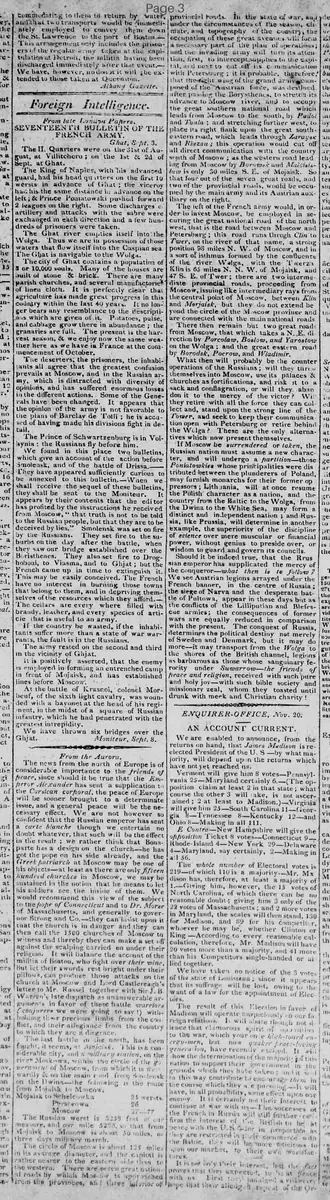
The news from the north of Europe is of considerable importance to the friends of peace, since should it be true that the Emperor Alexander has sent a supplication to the Corsican corporal, the peace of Europe will be sooner brought to a determinate issue, and a general peace will be the necessary effect. We are not however so confident that the Russian emperor has sent a carte blanche though we entertain no doubt whatever, that such will be the effect in the result ; we rather think that Bonaparte has a design on the church--he has got the pope on his side already, and the Greek patriarch at Moscow may be one of his objects--at least as there are only fifteen hundred churches in Moscow, we may be sustained in the notion that he means to let his soldiers see the inside of them. We would recommend this view of the subject to the folks of Connecticut and to Dr. Morse of Massachusetts. and generally to governor Strong and Co.--they can insist upon it that the church is in danger and they can then call the 1500 churches of Moscow to witness and thereby they can make a set off against the scalping carried on under their religion. It will balance the account of the militia of Boston, who fight over their wine, but let their swords rest bright under their pillows, can produce those attacks on the church at Moscow and Lord Castlereagh's letter to Mr. Russel together with Sir J. B. Warren's late dispatch as unanswerable arguments in favor of these battle warriors (conjurers we were going to say!) withholding their precious limbs from the conflict, and their allegiance from the country to which they are a disgrace.
The last battle in the north, has been fought, it seems, at Mojaisk. This is a considerable city. and a military station, on the river Moskowa, within the circle of the government of Moscow, from which it is westward & on the main road from Smolensk on the Dwina-the following is the route from Mojaisk to Moscow:
Mojaisk to Schelcowka 21 wersts.
Peresccowa 26
Moscow 27-74
The Russian werst is 5829 feet of our measure, and our mile 5280, so that from Mojaisk to Moscow is about 50 miles, or three days military march.
The circle of Moscow is about 125 miles. in its average diameter, but the capital is rather nearer to the eastern side than to the western. There are seven great national roads by which Moscow is approached from the provinces, and three principal on provincial roads.
In the state of war, and under the circumstances of the season, climate, and topography of the country; the occupation of these great avenues will form a necessary part of the plan of operations; and the invading army will turn its attention, first, to intercept supplies to the capital, and next to cut off its communication with Petersburg ; it is probable. therefore, that the right wing of the grand army composed of the Austrian force, was destined after passing the Borysthenes. to stretch its advance to Moscow river, and to occupy the great southern national road which leads from Moscow to the south, by Tula and Toala : and stretching further west, to place its right flank upon the great south eastern road, which leads through Zaraysk and Riazan ; this operation would cut off all direct communication with the country south of Moscow : as the western road leading from Moscow by Borowsk and Malojaroslawez is only 50 miles S. E. of Mojaisk. So that four out of the seven great roads, and two of the provincial roads. would be occupied by the main army and its Austrian auxiliary on the right.
The left of the French army would, in order to invest Moscow. be employed in securing the great national road of the north west. that is the road between Moscow and Petersburg; this road runs through Klin to Twer, on the river of that name, a strong position 95 miles N. W. of Moscow, and in a sort of isthmus formed by the confluence of the river Wolga, with the Twerza. Klin is 65 miles N. N. W. of Mojaisk, and 47 S. E. of Twer: there are two intermediate provincial roads, proceeding from Moscow, issuing like intermediary rays from the central point of Moscow, between Klin and Mojaisk, but they do not extend beyond the circle of the Moscow province and are connected with the main national roads There then remain but two great roads from Moscow, that which takes a N. E. direction by Porcolom, Boslow, and Yaroslow on the Wolga : and the great eastern road by Borodino, Pocrow, and Wladimir.
What then will probably be the counter operations of the Russians; will they throw themselves into Moscow, use its palaces & churches as fortifications, and risk it to a sack and conflagration, or will they. abandon it to the mercy of the victor? Will they retire with all the force they can collect and, stand upon the strong line of the Twer, and seek to keep their communication open with Petersburg or retire behind the Wolga? These are the only alternatives which now present themselves.
If Moscow be surrendered or taken, the Russian nation must assume a new character, and will undergo a partition--those Poniatowskies whose principalities were distributed between the plunderers of Poland, may furnish monarchs for their former oppressors; Lithuania, will at once resume the Polish character as a nation, and the country from the Baltic to the Wolga, from the Dwina to the White Sea, may form a distinct and independent nation ; and Russia, like Prussia. will determine in another example, the superiority of the discipline of science over mere muscular or financial power, without genius to preside over, or wisdom to guard and govern its councils.
Should it be indeed true, that the Russian emperor has. supplicated the mercy of the Conqueror-what then is to follow ?
We see Austrian legions arrayed under the French banner, in the centre of Russia: the siege of Narva and the desperate battle of Pultowa, appear in these days but as the conflicts of the Lilliputian and Brobdingnagian armies; the consequences of former wars are equally reduced in comparison with the present." The conquest of Russia, determines the political destiny not merely of Sweden and Denmark, but it may do more--it may transport from the Wolga to the shores of the British channel, legions as barbarous as those whose sanguinary ferocity under Suwarrow--the friends of peace and religion, received with such pure and holy joy-with such bible society and missionary zeal, whom they toasted until drunk with meek and Christian charity !
What sub-type of article is it?
What keywords are associated?
What entities or persons were involved?
Editorial Details
Primary Topic
Napoleon's Invasion Of Russia And Prospects For European Peace
Stance / Tone
Hopeful Yet Skeptical Of Peace, Satirical Toward American Federalists, Analytical Of Military Strategy
Key Figures
Key Arguments