Thank you for visiting SNEWPapers!
Sign up free
Story
March 3, 1891
Kansas Agitator
Garnett, Greeley, Topeka, Anderson County, Shawnee County, Kansas
What is this article about?
The Indian green-corn dance, known as the busk season, is a major annual religious ceremony involving purification rituals, a thanksgiving sacrifice of fish, deer heart, and corn, followed by separate and communal dances with strict circles for women, men, and strangers who must pay to cross lines.
Clipping
OCR Quality
98%
Excellent
Full Text
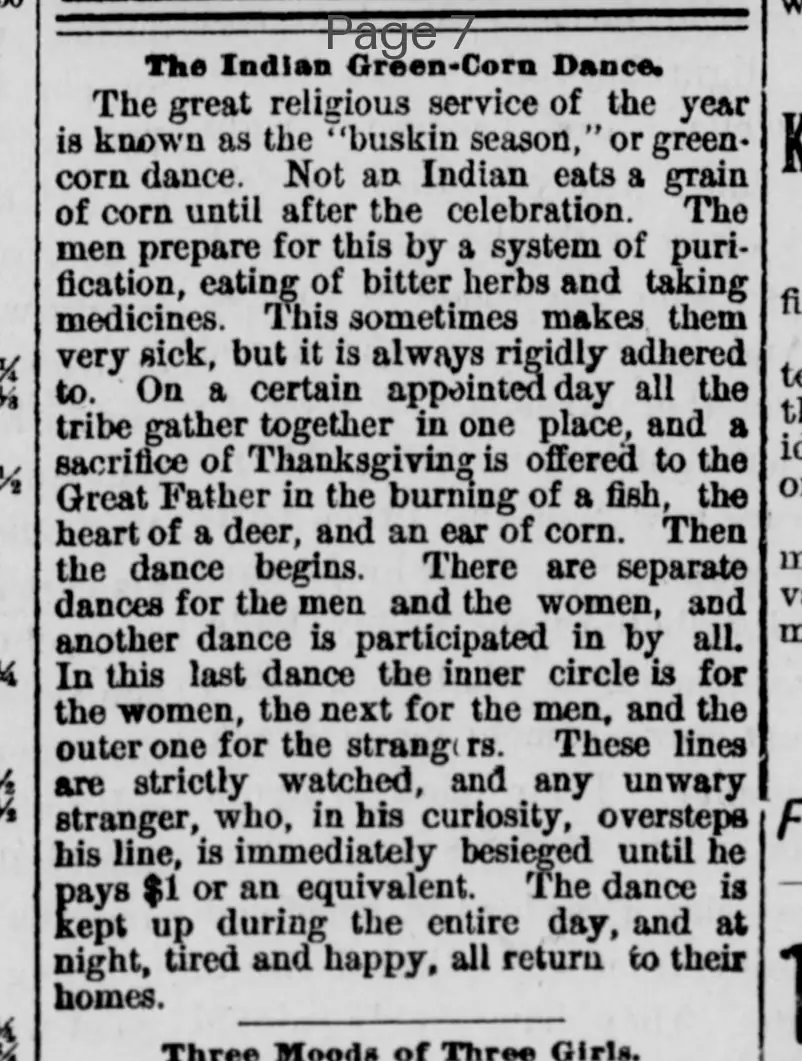
The Indian Green-Corn Dance
The great religious service of the year is known as the "busk" season, or green-corn dance. Not an Indian eats a grain of corn until after the celebration.
The men prepare for this by a system of purification, eating of bitter herbs and taking medicines. This sometimes makes them very sick, but it is always rigidly adhered to.
On a certain appointed day all the tribe gather together in one place, and a sacrifice of Thanksgiving is offered to the Great Father in the burning of a fish, the heart of a deer, and an ear of corn. Then the dance begins.
There are separate dances for the men and the women, and another dance is participated in by all.
In this last dance the inner circle is for the women, the next for the men, and the outer one for the strangers. These lines are strictly watched, and any unwary stranger, who, in his curiosity, oversteps his line, is immediately besieged until he pays $1 or an equivalent. The dance is kept up during the entire day, and at night, tired and happy, all return to their homes.
The great religious service of the year is known as the "busk" season, or green-corn dance. Not an Indian eats a grain of corn until after the celebration.
The men prepare for this by a system of purification, eating of bitter herbs and taking medicines. This sometimes makes them very sick, but it is always rigidly adhered to.
On a certain appointed day all the tribe gather together in one place, and a sacrifice of Thanksgiving is offered to the Great Father in the burning of a fish, the heart of a deer, and an ear of corn. Then the dance begins.
There are separate dances for the men and the women, and another dance is participated in by all.
In this last dance the inner circle is for the women, the next for the men, and the outer one for the strangers. These lines are strictly watched, and any unwary stranger, who, in his curiosity, oversteps his line, is immediately besieged until he pays $1 or an equivalent. The dance is kept up during the entire day, and at night, tired and happy, all return to their homes.
What sub-type of article is it?
Curiosity
Historical Event
What themes does it cover?
Providence Divine
What keywords are associated?
Green Corn Dance
Busk Season
Indian Ritual
Purification
Thanksgiving Sacrifice
Communal Dance
Story Details
Event Date
Busk Season
Story Details
The tribe gathers for purification with herbs and medicines, offers a sacrifice of fish, deer heart, and corn to the Great Father, then performs separate dances for men and women and a communal dance with circles for women, men, and strangers who pay if they overstep.