Thank you for visiting SNEWPapers!
Sign up free
Story
March 7, 1803
Alexandria Advertiser And Commercial Intelligencer
Alexandria, Virginia
What is this article about?
In a U.S. Senate debate on Feb. 16, Mr. White of Delaware supports resolutions addressing Spain's violation of the 1795 treaty by closing the New Orleans deposit to American commerce, amid fears of French takeover of Louisiana, urging action to secure Mississippi navigation rights.
Clipping
OCR Quality
75%
Good
Full Text
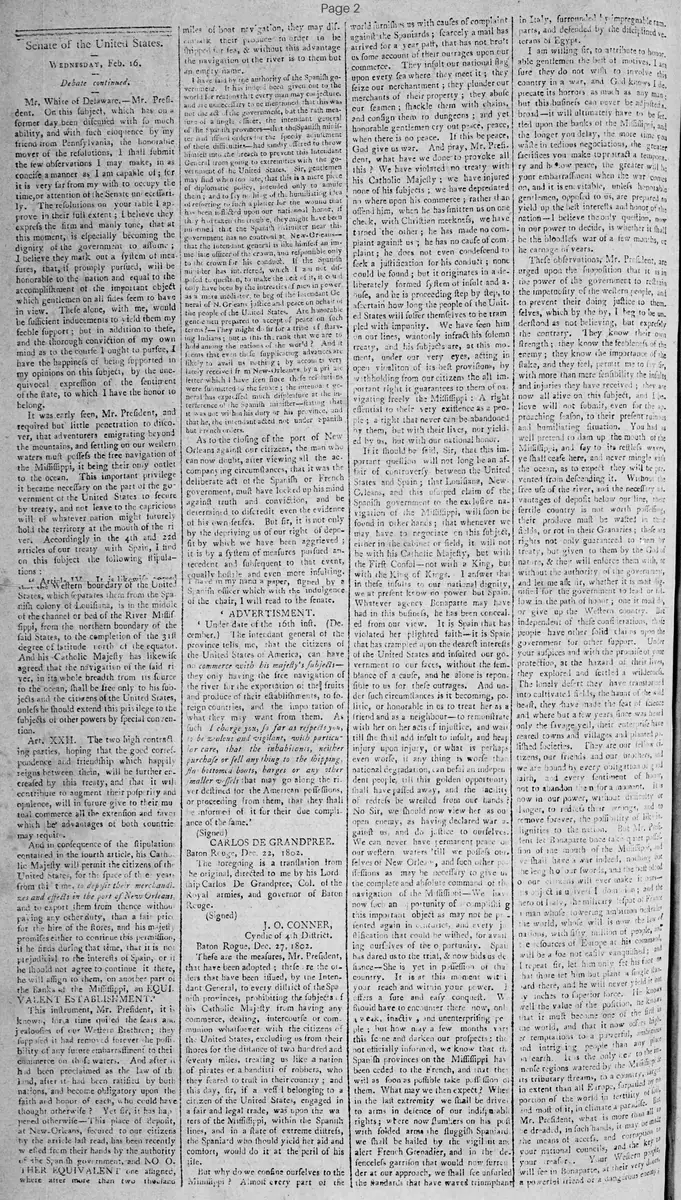
Senate of the United States.
WEDNESDAY, Feb. 16.
Debate continued.
Mr. White of Delaware.—Mr. President. On this subject, which has on a former day been discussed with so much ability, and with such eloquence by my friend from Pennsylvania, the honorable mover of the resolutions, I shall submit the few observations I may make, in as concise a manner as I am capable of; for it is very far from my wish to occupy the time, or attention of the Senate unnecessarily. The resolutions on your table I approve in their full extent; I believe they express the firm and manly tone, that at this moment, is especially becoming the dignity of the government to assume; I believe they mark out a system of measures, that, if promptly pursued, will be honorable to the nation and equal to the accomplishment of the important object which gentlemen on all sides seem to have in view. These alone, with me, would be sufficient inducements to yield them my feeble support; but in addition to these, and the thorough conviction of my own mind as to the course I ought to pursue, I have the happiness of being supported in my opinions on this object, by the unequivocal expression of the sentiments of the state, to which I have the honor to belong.
It was early seen, Mr. President, and required but little penetration to discover, that adventurers emigrating beyond the mountains, and settling on our western waters must possess the free navigation of the Mississippi, it being their only outlet to the ocean. This important privilege it became necessary on the part of the government of the United States to secure by treaty, and not leave to the capricious will of whatever nation might eventually hold the territory at the mouth of the river. Accordingly in the 4th and 22d articles of our treaty with Spain, I find on this subject the following stipulations:
Art. IV. It is likewise agreed
that the Western boundary of the United States, which separates them from the Spanish colony of Louisiana, is in the middle of the channel or bed of the River Mississippi, from the northern boundary of the said States, to the completion of the 31st degree of latitude north of the equator. And his Catholic Majesty has likewise agreed that the navigation of the said river, in its whole breadth from its source to the ocean, shall be free only to his subjects and the citizens of the United States, unless he should extend this privilege to the subjects of other powers by special convention.
Art. XXII. The two high contracting parties, hoping that the good correspondence and friendship which happily reigns between them, will be further increased by this treaty, and that it will contribute to augment their prosperity and opulence, will in future give to their mutual commerce all the extension and favor which the advantages of both countries may require.
And in consequence of the stipulations contained in the fourth article, his Catholic Majesty will permit the citizens of the United States, for the space of three years from this time, to deposit their merchandise and effects in the port of New Orleans, and to export them from thence without paying any other duty, than a fair price for the hire of the stores, and his majesty promises either to continue this permission, if he finds during that time, that it is not prejudicial to the interests of Spain, or if he should not agree to continue it there, he will assign to them, on another part of the Banks of the Mississippi, an EQUIVALENT ESTABLISHMENT.
This instrument, Mr. President, it is known, for a time quieted the fears and jealousies of our Western Brethren; they supposed it had removed forever the possibility of any future embarrassment to their commerce on the waters. And after it had been proclaimed as the law of the land, after it had been ratified by both nations, and become obligatory upon the faith and honor of each, who could have thought otherwise? Yet sir, it has happened otherwise—This place of deposit, at New-Orleans, secured to our citizens by the article last read, has been recently wrested from their hands by the authority of the Spanish government, and NO OTHER EQUIVALENT one assigned,
where after more than two thousand miles of boat navigation, they may deposit their produce in order to be shipped for sea, & without this advantage the navigation of the river is to them but an empty name.
[world for reasons that every man may conjecture.] I have said by the authority of the Spanish government. It has indeed been given out to the world that this was not the act of the government, but the rash measure of a single officer, the intendant general of the Spanish provinces—that the Spanish minister himself [into the breach to prevent this intendant of these difficulties—had simply offered to throw ter he had issued orders for the speedy adjustment General from going to extremities with the government of the United States.] Sir, gentlemen of diplomatic policy, intended only to amuse may find when too late, that this is a mere piece them; and to say no thing of the humiliating idea has been inflicted upon our national honor, if of resorting to such a plaister for the wound that [iormed.] That the Spanish minister near this th y had taken the trouble, they might have been government has no controul at New-Orleans— that the Intendant general is like himself an immediate officer of the crown, and responsible only to the crown for his conduct. If the Spanish minister has interfered, which I am not disposed to question, to make the most of it, it could only have been by the intreaties of men in power. as a mere mediator, to beg of the Intendant General of N. Orleans justice and peace on behalf of gentl en men prepared to accept of peace on such the people of the United States. Are honorable terms?—They might do sir for a tribe of starving Indians; but is this the rank that we are to hold among the nations of the world? And it seems that even those supplicating advances are likely to avail us nothing; by accounts very lately received from New-Orleans, by a private letter which I have seen since these resolutions were submitted to the Senate; the intendant general has expressed much displeasure at the interference of the Spanish minister—stating that it was not within his duty or his province, and that he, the intendant acted not under Spanish but French orders.
As to the closing of the port of New Orleans against our citizens, the man who can now doubt, after viewing all the accompanying circumstances, that it was the deliberate act of the Spanish or French government, must have locked up his mind against truth and conviction, and be determined to discredit even the evidence of his own senses. But sir, it is not only by the depriving us of our right of deposit by which we have been aggrieved: it is by a system of measures pursued antecedent and subsequent to that event, equally hostile and even more insulting. I hold in my hand a paper, signed by a Spanish officer which with the indulgence of the chair, I will read to the Senate.
ADVERTISEMENT.
Under date of the 16th inst. (December.) The intendant general of the province tells me, that the citizens of the United States of America, can have no commerce with his majesty's subjects— they only having the free navigation of the river for the exportation of their fruits and produce of their establishments, to foreign countries, and the importation of what they may want from them. As such I charge you, so far as respects you, to be zealous and vigilant, with particular care, that the inhabitants, neither purchase or sell any thing to the shipping or bottomed boats, barges or any other smaller vessels that may go along the river destined for the American possessions, or proceeding from them, that they shall be informed of it for their due compliance of the same.'
(Signed)
CARLOS DE GRANDPRÉE.
Baton Rouge, Dec. 22, 1802.
The foregoing is a translation from the original, directed to me by his Lordship Carlos De Grandpré, Col. of the Royal armies, and governor of Baton Rouge.
(Signed)
J. O. CONNER,
Syndic of 4th District.
Baton Rouge, Dec. 27, 1802.
These are the measures, Mr. President, that have been adopted; these are the orders that have been issued, by the Intendant General, to every district of the Spanish provinces, prohibiting the subjects of his Catholic Majesty from having any commerce, dealing, intercourse or communion whatsoever with the citizens of the United States, excluding us from their shores for the distance of two hundred and seventy miles, treating us like a nation of pirates or a banditti of robbers, who they feared to trust in their country; and this day, sir, if a vessel belonging to a citizen of the United States, engaged in a fair and legal trade, was upon the waters of the Mississippi, within the Spanish lines, and in a state of extreme distress, the Spaniard who should yield her aid and comfort, would do it at the peril of his life.
But why do we confine ourselves to the Mississippi? Almost every part of the world furnish us with causes of complaint against the Spaniards; scarcely a mail has arrived for a year past, that has not brought us some account of their outrages upon our commerce. They insult our national flag upon every sea where they meet it; they seize our merchantmen; they plunder our merchants of their property; they abuse our seamen; shackle them with chains, and consign them to dungeons; and yet honorable gentlemen cry out peace, peace, when there is no peace. If this be peace, God give us war. And pray, Mr. President, what have we done to provoke all this? We have violated no treaty with his Catholic Majesty: we have injured none of his subjects; we have depredated nowhere upon his commerce; rather than offend him, when he has smitten us on one cheek, with Christian meekness, we have turned the other: he has made no complaint against us; he has no cause of complaint: he does not even condescend to seek a justification for his conduct; none could be found; but it originates in a deliberately formed system of insult and abuse, and he is proceeding step by step, to ascertain how long the people of the United States will suffer themselves to be trampled with impunity. We have seen him on our lines, wantonly infract his solemn treaty, and his subjects are, at this moment, under our very eyes, acting in open violation of its best provisions, by withholding from our citizens the all important right it guarantees to them of navigating freely the Mississippi: A right essential to their very existence as a people; a right that never can be abandoned by them, but with their lives, nor yielded by us, but with our national honor.
If it should be said, Sir, that this important question will not long be an affair of controversy between the United States and Spain; that Louisiana, New-Orleans, and this usurped claim of the Spanish government to the exclusive navigation of the Mississippi, will soon be found in other hands: that whenever we may have to negotiate on this subject, either in the cabinet or field, it will not be with his Catholic Majesty, but with the First Consul—not with a King, but with the King of Kings. I answer that in these insults to our national dignity, we at present know no power but Spain. Whatever agency Bonaparte may have had in this business, he has been concealed from our view. It is Spain that has violated her plighted faith—it is Spain that has trampled upon the dearest interests of the United States and insulted our government to our faces, without the semblance of a cause. and he alone is responsible to us for these outrages. And under such circumstances is it becoming, politic, or honorable in us to treat her as a friend and as a neighbour—to remonstrate with her on her acts of injustice, and wait till she shall add insult to insult, and heap injury upon injury, or what is perhaps even worse, if any thing is worse than national degradation, can befall an independent people, till this golden opportunity shall have passed away, and the ability of redress be wrested from our hands No Sir. we should now view her as our open enemy, as having declared war against us, and do justice to ourselves. We can never have permanent peace on our western waters 'till we possess ourselves of New Orleans, and such other possessions as may be necessary to give us the complete and absolute command of the navigation of the Mississippi-We have now such an opportunity of accomplishing this important object as may not be presented again in centuries, and every circumstance that could be wished, for availing ourselves of the opportunity. Spain has dared us to the trial, & now bids us defiance—She is yet in possession of that country. It is at this moment within your reach and within your power. It offers a sure and easy conquest. We should have to encounter there now, only a weak, inactive, and unenterprising people; but how many a few months vary this scene and darken our prospects: the not officially informed, we know that the Spanish provinces on the Mississippi have been ceded to the French, and that they will as soon as possible take possession of them. What may we then expect? Where in the last extremity we shall be driven to arms in defence of our indispensable rights; where now slumbers on his post with folded arms the sluggish Spaniard we shall be hailed by the vigilant and alert French Grenadier. and in the defenceless garrison that would now surrender at our approach, we shall see unvaried the standards that have waved triumphant in Italy, surrounded by impregnable ramparts, and defended by the disciplined veterans of Egypt.
I am willing sir, to attribute to honorable gentlemen the best of motives. I am sure they do not wish to involve this country in a war, and God knows I deprecate its horrors as much as any man; but this business can never be adjusted abroad—it will ultimately have to be settled upon the banks of the Mississippi, and the longer you delay, the more time you waste in tedious negotiations, the greater sacrifices you make to protract a temporary and hollow peace, the greater will be your embarrassment when the war comes on, and it is inevitable, unless honorable gentlemen, opposed to us, are prepared to yield up the best interests and honor of the nation—I believe the only question, now in our power to decide, is whether it shall be the bloodless war of a few months, or the carnage of years.
These observations; Mr. President, are urged upon the supposition that it is in the power of the government to restrain the impetuosity of the western people, and to prevent their doing justice to themselves, which by the by, I beg to be understood as not believing, but expressly the contrary. They know their own strength; they know the feebleness of the enemy; they know the importance of the stake, and they feel, permit me to say Sir. with more than mere sensibility the insults and injuries they have received; they are now all alive on this subject, and I believe will not submit, even for the approaching season, to their present ruinous and humiliating situation. You had as well pretend to dam up the mouth of the Mississippi, and say to its restless waves, ye shall cease here, and never mingle with the ocean, as to expect they will be prevented from descending it. Without the free use of the river, and the necessary advantages of deposit below our line, their fertile country is not worth possessing, their produce must be wasted in their fields, or rot in their granaries; these are rights not only guaranteed to them by treaty, but given to them by the God of nature, & they will enforce them with, or without the authority of the government, and let me ask sir, whether it is most dignified for the government to lead or follow in the path of honor; one it must do, or give up the Western country. But independent of these considerations, those people have other solid claims upon the government for other support. Under your auspices and with the promise of your protection, at the hazard of their lives, they explored and settled a wilderness. The lonely desert they have transformed into cultivated fields. the haunt of the wild beast, they have made the seat of science and where but a few years since was heard only the savage yell, their enterprise have reared towns and villages and planted polished societies. They are our fellow citizens, our friends and our brothers, and we are bound by every obligation of good faith, and every sentiment of honor, not to abandon them for a moment. It is now in our power, without difficulty or danger, to redress their wrongs, and to remove forever, the possibility of like indignities to the nation. But Mr. President let Bonaparte once take quiet possession of the mouth of the Mississippi, and we shall have a war indeed, nothing short of the length of our sword is, and the best blood of our citizens will ever make it ours— his object is universal dominion: and the hero of Italy, the military despot of France the world, whose will is now the law of nations, whose towering ambition with fifty millions of people, and the resources of Europe at his command, I repeat sir, let him only set his foot on that shore let him but plant a single cannon there, and he will never yield it but with the last throe of his existence. He knows well the value of the position. He knows it must become one of the first in the world, and that it now offers higher temptations to a powerful, ambitious and intriguing people than any place its tributary streams, to a country, larger in extent than all Europe, surpassed by no portion of the world in fertility of soil, and most of it, in climate a paradise. But Mr. President, what is more than all (will see in Bonaparte, at their very doors. the means of access, and your national councils, your treasure. Your Western people, and the key to corruption to powerful friend or a dangerous enemy a
WEDNESDAY, Feb. 16.
Debate continued.
Mr. White of Delaware.—Mr. President. On this subject, which has on a former day been discussed with so much ability, and with such eloquence by my friend from Pennsylvania, the honorable mover of the resolutions, I shall submit the few observations I may make, in as concise a manner as I am capable of; for it is very far from my wish to occupy the time, or attention of the Senate unnecessarily. The resolutions on your table I approve in their full extent; I believe they express the firm and manly tone, that at this moment, is especially becoming the dignity of the government to assume; I believe they mark out a system of measures, that, if promptly pursued, will be honorable to the nation and equal to the accomplishment of the important object which gentlemen on all sides seem to have in view. These alone, with me, would be sufficient inducements to yield them my feeble support; but in addition to these, and the thorough conviction of my own mind as to the course I ought to pursue, I have the happiness of being supported in my opinions on this object, by the unequivocal expression of the sentiments of the state, to which I have the honor to belong.
It was early seen, Mr. President, and required but little penetration to discover, that adventurers emigrating beyond the mountains, and settling on our western waters must possess the free navigation of the Mississippi, it being their only outlet to the ocean. This important privilege it became necessary on the part of the government of the United States to secure by treaty, and not leave to the capricious will of whatever nation might eventually hold the territory at the mouth of the river. Accordingly in the 4th and 22d articles of our treaty with Spain, I find on this subject the following stipulations:
Art. IV. It is likewise agreed
that the Western boundary of the United States, which separates them from the Spanish colony of Louisiana, is in the middle of the channel or bed of the River Mississippi, from the northern boundary of the said States, to the completion of the 31st degree of latitude north of the equator. And his Catholic Majesty has likewise agreed that the navigation of the said river, in its whole breadth from its source to the ocean, shall be free only to his subjects and the citizens of the United States, unless he should extend this privilege to the subjects of other powers by special convention.
Art. XXII. The two high contracting parties, hoping that the good correspondence and friendship which happily reigns between them, will be further increased by this treaty, and that it will contribute to augment their prosperity and opulence, will in future give to their mutual commerce all the extension and favor which the advantages of both countries may require.
And in consequence of the stipulations contained in the fourth article, his Catholic Majesty will permit the citizens of the United States, for the space of three years from this time, to deposit their merchandise and effects in the port of New Orleans, and to export them from thence without paying any other duty, than a fair price for the hire of the stores, and his majesty promises either to continue this permission, if he finds during that time, that it is not prejudicial to the interests of Spain, or if he should not agree to continue it there, he will assign to them, on another part of the Banks of the Mississippi, an EQUIVALENT ESTABLISHMENT.
This instrument, Mr. President, it is known, for a time quieted the fears and jealousies of our Western Brethren; they supposed it had removed forever the possibility of any future embarrassment to their commerce on the waters. And after it had been proclaimed as the law of the land, after it had been ratified by both nations, and become obligatory upon the faith and honor of each, who could have thought otherwise? Yet sir, it has happened otherwise—This place of deposit, at New-Orleans, secured to our citizens by the article last read, has been recently wrested from their hands by the authority of the Spanish government, and NO OTHER EQUIVALENT one assigned,
where after more than two thousand miles of boat navigation, they may deposit their produce in order to be shipped for sea, & without this advantage the navigation of the river is to them but an empty name.
[world for reasons that every man may conjecture.] I have said by the authority of the Spanish government. It has indeed been given out to the world that this was not the act of the government, but the rash measure of a single officer, the intendant general of the Spanish provinces—that the Spanish minister himself [into the breach to prevent this intendant of these difficulties—had simply offered to throw ter he had issued orders for the speedy adjustment General from going to extremities with the government of the United States.] Sir, gentlemen of diplomatic policy, intended only to amuse may find when too late, that this is a mere piece them; and to say no thing of the humiliating idea has been inflicted upon our national honor, if of resorting to such a plaister for the wound that [iormed.] That the Spanish minister near this th y had taken the trouble, they might have been government has no controul at New-Orleans— that the Intendant general is like himself an immediate officer of the crown, and responsible only to the crown for his conduct. If the Spanish minister has interfered, which I am not disposed to question, to make the most of it, it could only have been by the intreaties of men in power. as a mere mediator, to beg of the Intendant General of N. Orleans justice and peace on behalf of gentl en men prepared to accept of peace on such the people of the United States. Are honorable terms?—They might do sir for a tribe of starving Indians; but is this the rank that we are to hold among the nations of the world? And it seems that even those supplicating advances are likely to avail us nothing; by accounts very lately received from New-Orleans, by a private letter which I have seen since these resolutions were submitted to the Senate; the intendant general has expressed much displeasure at the interference of the Spanish minister—stating that it was not within his duty or his province, and that he, the intendant acted not under Spanish but French orders.
As to the closing of the port of New Orleans against our citizens, the man who can now doubt, after viewing all the accompanying circumstances, that it was the deliberate act of the Spanish or French government, must have locked up his mind against truth and conviction, and be determined to discredit even the evidence of his own senses. But sir, it is not only by the depriving us of our right of deposit by which we have been aggrieved: it is by a system of measures pursued antecedent and subsequent to that event, equally hostile and even more insulting. I hold in my hand a paper, signed by a Spanish officer which with the indulgence of the chair, I will read to the Senate.
ADVERTISEMENT.
Under date of the 16th inst. (December.) The intendant general of the province tells me, that the citizens of the United States of America, can have no commerce with his majesty's subjects— they only having the free navigation of the river for the exportation of their fruits and produce of their establishments, to foreign countries, and the importation of what they may want from them. As such I charge you, so far as respects you, to be zealous and vigilant, with particular care, that the inhabitants, neither purchase or sell any thing to the shipping or bottomed boats, barges or any other smaller vessels that may go along the river destined for the American possessions, or proceeding from them, that they shall be informed of it for their due compliance of the same.'
(Signed)
CARLOS DE GRANDPRÉE.
Baton Rouge, Dec. 22, 1802.
The foregoing is a translation from the original, directed to me by his Lordship Carlos De Grandpré, Col. of the Royal armies, and governor of Baton Rouge.
(Signed)
J. O. CONNER,
Syndic of 4th District.
Baton Rouge, Dec. 27, 1802.
These are the measures, Mr. President, that have been adopted; these are the orders that have been issued, by the Intendant General, to every district of the Spanish provinces, prohibiting the subjects of his Catholic Majesty from having any commerce, dealing, intercourse or communion whatsoever with the citizens of the United States, excluding us from their shores for the distance of two hundred and seventy miles, treating us like a nation of pirates or a banditti of robbers, who they feared to trust in their country; and this day, sir, if a vessel belonging to a citizen of the United States, engaged in a fair and legal trade, was upon the waters of the Mississippi, within the Spanish lines, and in a state of extreme distress, the Spaniard who should yield her aid and comfort, would do it at the peril of his life.
But why do we confine ourselves to the Mississippi? Almost every part of the world furnish us with causes of complaint against the Spaniards; scarcely a mail has arrived for a year past, that has not brought us some account of their outrages upon our commerce. They insult our national flag upon every sea where they meet it; they seize our merchantmen; they plunder our merchants of their property; they abuse our seamen; shackle them with chains, and consign them to dungeons; and yet honorable gentlemen cry out peace, peace, when there is no peace. If this be peace, God give us war. And pray, Mr. President, what have we done to provoke all this? We have violated no treaty with his Catholic Majesty: we have injured none of his subjects; we have depredated nowhere upon his commerce; rather than offend him, when he has smitten us on one cheek, with Christian meekness, we have turned the other: he has made no complaint against us; he has no cause of complaint: he does not even condescend to seek a justification for his conduct; none could be found; but it originates in a deliberately formed system of insult and abuse, and he is proceeding step by step, to ascertain how long the people of the United States will suffer themselves to be trampled with impunity. We have seen him on our lines, wantonly infract his solemn treaty, and his subjects are, at this moment, under our very eyes, acting in open violation of its best provisions, by withholding from our citizens the all important right it guarantees to them of navigating freely the Mississippi: A right essential to their very existence as a people; a right that never can be abandoned by them, but with their lives, nor yielded by us, but with our national honor.
If it should be said, Sir, that this important question will not long be an affair of controversy between the United States and Spain; that Louisiana, New-Orleans, and this usurped claim of the Spanish government to the exclusive navigation of the Mississippi, will soon be found in other hands: that whenever we may have to negotiate on this subject, either in the cabinet or field, it will not be with his Catholic Majesty, but with the First Consul—not with a King, but with the King of Kings. I answer that in these insults to our national dignity, we at present know no power but Spain. Whatever agency Bonaparte may have had in this business, he has been concealed from our view. It is Spain that has violated her plighted faith—it is Spain that has trampled upon the dearest interests of the United States and insulted our government to our faces, without the semblance of a cause. and he alone is responsible to us for these outrages. And under such circumstances is it becoming, politic, or honorable in us to treat her as a friend and as a neighbour—to remonstrate with her on her acts of injustice, and wait till she shall add insult to insult, and heap injury upon injury, or what is perhaps even worse, if any thing is worse than national degradation, can befall an independent people, till this golden opportunity shall have passed away, and the ability of redress be wrested from our hands No Sir. we should now view her as our open enemy, as having declared war against us, and do justice to ourselves. We can never have permanent peace on our western waters 'till we possess ourselves of New Orleans, and such other possessions as may be necessary to give us the complete and absolute command of the navigation of the Mississippi-We have now such an opportunity of accomplishing this important object as may not be presented again in centuries, and every circumstance that could be wished, for availing ourselves of the opportunity. Spain has dared us to the trial, & now bids us defiance—She is yet in possession of that country. It is at this moment within your reach and within your power. It offers a sure and easy conquest. We should have to encounter there now, only a weak, inactive, and unenterprising people; but how many a few months vary this scene and darken our prospects: the not officially informed, we know that the Spanish provinces on the Mississippi have been ceded to the French, and that they will as soon as possible take possession of them. What may we then expect? Where in the last extremity we shall be driven to arms in defence of our indispensable rights; where now slumbers on his post with folded arms the sluggish Spaniard we shall be hailed by the vigilant and alert French Grenadier. and in the defenceless garrison that would now surrender at our approach, we shall see unvaried the standards that have waved triumphant in Italy, surrounded by impregnable ramparts, and defended by the disciplined veterans of Egypt.
I am willing sir, to attribute to honorable gentlemen the best of motives. I am sure they do not wish to involve this country in a war, and God knows I deprecate its horrors as much as any man; but this business can never be adjusted abroad—it will ultimately have to be settled upon the banks of the Mississippi, and the longer you delay, the more time you waste in tedious negotiations, the greater sacrifices you make to protract a temporary and hollow peace, the greater will be your embarrassment when the war comes on, and it is inevitable, unless honorable gentlemen, opposed to us, are prepared to yield up the best interests and honor of the nation—I believe the only question, now in our power to decide, is whether it shall be the bloodless war of a few months, or the carnage of years.
These observations; Mr. President, are urged upon the supposition that it is in the power of the government to restrain the impetuosity of the western people, and to prevent their doing justice to themselves, which by the by, I beg to be understood as not believing, but expressly the contrary. They know their own strength; they know the feebleness of the enemy; they know the importance of the stake, and they feel, permit me to say Sir. with more than mere sensibility the insults and injuries they have received; they are now all alive on this subject, and I believe will not submit, even for the approaching season, to their present ruinous and humiliating situation. You had as well pretend to dam up the mouth of the Mississippi, and say to its restless waves, ye shall cease here, and never mingle with the ocean, as to expect they will be prevented from descending it. Without the free use of the river, and the necessary advantages of deposit below our line, their fertile country is not worth possessing, their produce must be wasted in their fields, or rot in their granaries; these are rights not only guaranteed to them by treaty, but given to them by the God of nature, & they will enforce them with, or without the authority of the government, and let me ask sir, whether it is most dignified for the government to lead or follow in the path of honor; one it must do, or give up the Western country. But independent of these considerations, those people have other solid claims upon the government for other support. Under your auspices and with the promise of your protection, at the hazard of their lives, they explored and settled a wilderness. The lonely desert they have transformed into cultivated fields. the haunt of the wild beast, they have made the seat of science and where but a few years since was heard only the savage yell, their enterprise have reared towns and villages and planted polished societies. They are our fellow citizens, our friends and our brothers, and we are bound by every obligation of good faith, and every sentiment of honor, not to abandon them for a moment. It is now in our power, without difficulty or danger, to redress their wrongs, and to remove forever, the possibility of like indignities to the nation. But Mr. President let Bonaparte once take quiet possession of the mouth of the Mississippi, and we shall have a war indeed, nothing short of the length of our sword is, and the best blood of our citizens will ever make it ours— his object is universal dominion: and the hero of Italy, the military despot of France the world, whose will is now the law of nations, whose towering ambition with fifty millions of people, and the resources of Europe at his command, I repeat sir, let him only set his foot on that shore let him but plant a single cannon there, and he will never yield it but with the last throe of his existence. He knows well the value of the position. He knows it must become one of the first in the world, and that it now offers higher temptations to a powerful, ambitious and intriguing people than any place its tributary streams, to a country, larger in extent than all Europe, surpassed by no portion of the world in fertility of soil, and most of it, in climate a paradise. But Mr. President, what is more than all (will see in Bonaparte, at their very doors. the means of access, and your national councils, your treasure. Your Western people, and the key to corruption to powerful friend or a dangerous enemy a
What sub-type of article is it?
Historical Event
What themes does it cover?
Justice
Misfortune
Survival
What keywords are associated?
Mississippi Navigation
New Orleans Deposit
Spanish Treaty Violation
French Cession Louisiana
Senate Debate
Western Commerce
What entities or persons were involved?
Mr. White Of Delaware
Friend From Pennsylvania
Bonaparte
Carlos De Grandpré
J. O. Conner
Where did it happen?
United States Senate, Mississippi River, New Orleans, Baton Rouge, Louisiana
Story Details
Key Persons
Mr. White Of Delaware
Friend From Pennsylvania
Bonaparte
Carlos De Grandpré
J. O. Conner
Location
United States Senate, Mississippi River, New Orleans, Baton Rouge, Louisiana
Event Date
Feb. 16; Dec. 1802
Story Details
Mr. White supports Senate resolutions condemning Spain's closure of the New Orleans deposit, violating the 1795 treaty, and warns of French takeover under Bonaparte, urging seizure of the territory to secure American commerce and honor on the Mississippi.