Thank you for visiting SNEWPapers!
Sign up free
Story
February 22, 1929
Nogales International
Nogales, Santa Cruz County, Arizona
What is this article about?
Rev. Samuel D. Price discusses Jesus' principles for the Kingdom of God and the Church, its origins from disciples, parabolic teachings like the mustard seed, biblical references, remarkable growth to one-third of world population, and the need for members to coordinate with Christ as Head.
Clipping
OCR Quality
95%
Excellent
Full Text
Mark 4:26-32: Ephesians 1:22, 23; 4:4-6, 11. 16
Rev. Samuel D. Price, D.D.
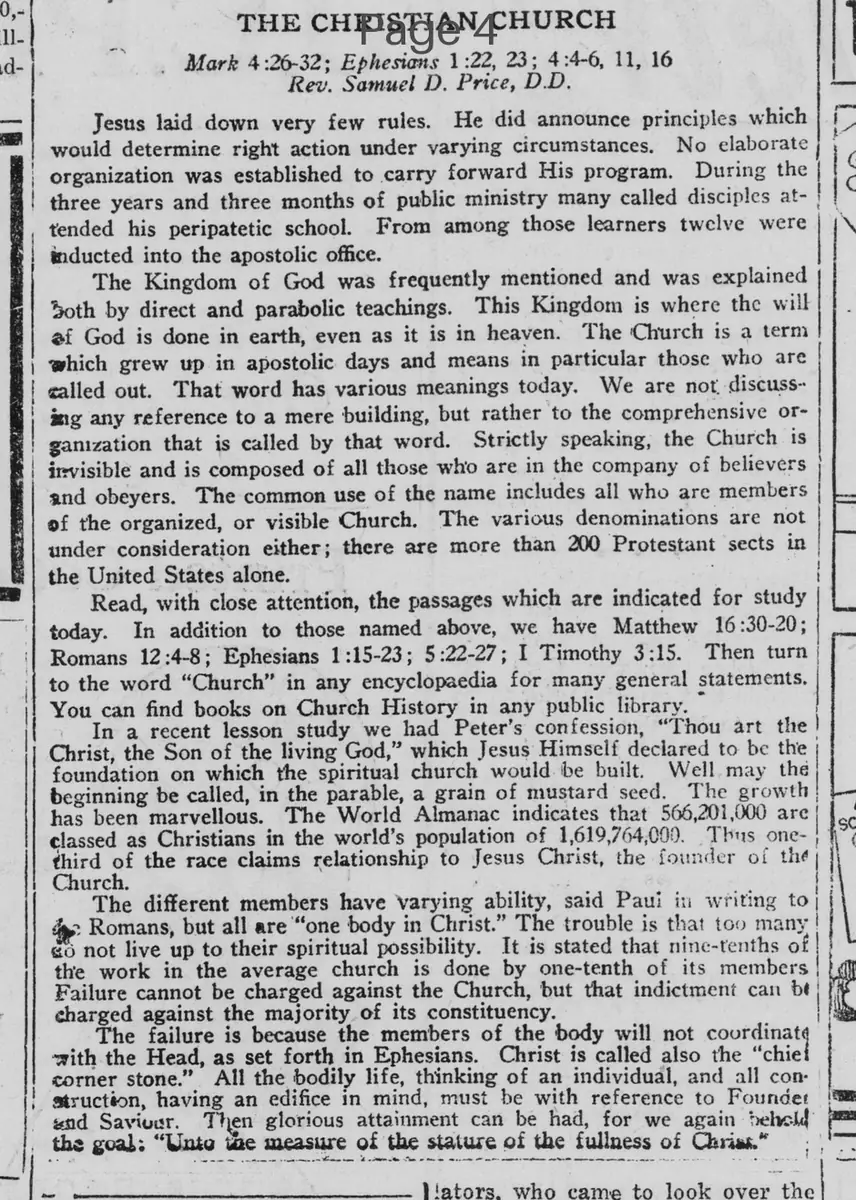
Jesus laid down very few rules. He did announce principles which
would determine right action under varying circumstances. No elaborate
organization was established to carry forward His program. During the
three years and three months of public ministry many called disciples at-
tended his peripatetic school. From among those learners twelve were
inducted into the apostolic office.
The Kingdom of God was frequently mentioned and was explained
both by direct and parabolic teachings. This Kingdom is where the will
of God is done in earth, even as it is in heaven. The Church is a term
which grew up in apostolic days and means in particular those who are
called out. That word has various meanings today. We are not discussing
any reference to a mere building, but rather to the comprehensive or-
ganization that is called by that word. Strictly speaking. the Church is
invisible and is composed of all those who are in the company of believers
and obeyers. The common use of the name includes all who are members
of the organized, or visible Church. The various denominations are not
under consideration either; there are more than 200 Protestant sects in
the United States alone.
Read, with close attention, the passages which are indicated for study
today. In addition to those named above, we have Matthew 16:30-20;
Romans 12:4-8; Ephesians 1:15-23; 5:22-27; I Timothy 3:15. Then turn
to the word "Church" in any encyclopaedia for many general statements.
You can find books on Church History in any public library.
In a recent lesson study we had Peter's confession, "Thou art the
Christ. the Son of the living God," which Jesus Himself declared to be the
foundation on which the spiritual church would be built. Well may the
beginning be called, in the parable, a grain of mustard seed. The growth
has been marvellous. The World Almanac indicates that 566.201,000 are
classed as Christians in the world's population of 1,619,764,000. Thus one-
third of the race claims relationship to Jesus Christ, the founder of the
Church.
The different members have varying ability, said Paul in writing to
Romans, but all are "one body in Christ." The trouble is that too many
do not live up to their spiritual possibility. It is stated that nine-tenths of
the work in the average church is done by one-tenth of its members
Failure cannot be charged against the Church, but that indictment can be
charged against the majority of its constituency.
The failure is because the members of the body will not coordinate
with the Head, as set forth in Ephesians. Christ is called also the "chief
corner stone." All the bodily life, thinking of an individual, and all con-
struction, having an edifice in mind, must be with reference to Founder
and Saviour. Then glorious attainment can be had, for we again behold
the goal: "Unto the measure of the stature of the fullness of Christ."
Rev. Samuel D. Price, D.D.
Jesus laid down very few rules. He did announce principles which
would determine right action under varying circumstances. No elaborate
organization was established to carry forward His program. During the
three years and three months of public ministry many called disciples at-
tended his peripatetic school. From among those learners twelve were
inducted into the apostolic office.
The Kingdom of God was frequently mentioned and was explained
both by direct and parabolic teachings. This Kingdom is where the will
of God is done in earth, even as it is in heaven. The Church is a term
which grew up in apostolic days and means in particular those who are
called out. That word has various meanings today. We are not discussing
any reference to a mere building, but rather to the comprehensive or-
ganization that is called by that word. Strictly speaking. the Church is
invisible and is composed of all those who are in the company of believers
and obeyers. The common use of the name includes all who are members
of the organized, or visible Church. The various denominations are not
under consideration either; there are more than 200 Protestant sects in
the United States alone.
Read, with close attention, the passages which are indicated for study
today. In addition to those named above, we have Matthew 16:30-20;
Romans 12:4-8; Ephesians 1:15-23; 5:22-27; I Timothy 3:15. Then turn
to the word "Church" in any encyclopaedia for many general statements.
You can find books on Church History in any public library.
In a recent lesson study we had Peter's confession, "Thou art the
Christ. the Son of the living God," which Jesus Himself declared to be the
foundation on which the spiritual church would be built. Well may the
beginning be called, in the parable, a grain of mustard seed. The growth
has been marvellous. The World Almanac indicates that 566.201,000 are
classed as Christians in the world's population of 1,619,764,000. Thus one-
third of the race claims relationship to Jesus Christ, the founder of the
Church.
The different members have varying ability, said Paul in writing to
Romans, but all are "one body in Christ." The trouble is that too many
do not live up to their spiritual possibility. It is stated that nine-tenths of
the work in the average church is done by one-tenth of its members
Failure cannot be charged against the Church, but that indictment can be
charged against the majority of its constituency.
The failure is because the members of the body will not coordinate
with the Head, as set forth in Ephesians. Christ is called also the "chief
corner stone." All the bodily life, thinking of an individual, and all con-
struction, having an edifice in mind, must be with reference to Founder
and Saviour. Then glorious attainment can be had, for we again behold
the goal: "Unto the measure of the stature of the fullness of Christ."
What sub-type of article is it?
Historical Event
Biography
What themes does it cover?
Providence Divine
Moral Virtue
Triumph
What keywords are associated?
Kingdom Of God
Church History
Christian Growth
Mustard Seed Parable
Body In Christ
Spiritual Coordination
What entities or persons were involved?
Jesus
Rev. Samuel D. Price
Peter
Paul
Story Details
Key Persons
Jesus
Rev. Samuel D. Price
Peter
Paul
Story Details
Jesus establishes principles for the Kingdom of God through teachings and parables like the mustard seed; the Church emerges from disciples, grows invisibly and visibly to include one-third of the world population; members must coordinate with Christ as Head for full attainment.