Thank you for visiting SNEWPapers!
Sign up free
Editorial
April 12, 1802
Jenks's Portland Gazette
Portland, Cumberland County, Maine
What is this article about?
This editorial, continuing a series, defends diplomatic agents to Holland and Berlin, temporary navy agents during the French quasi-war, and revenue inspectors under prior U.S. administrations against charges of unnecessary multiplication of offices. It argues these were justified by historical, commercial, and enforcement needs, critiquing Jefferson's implications as partisan slander.
Clipping
OCR Quality
95%
Excellent
Full Text
From the New-York Evening Post.
Examination.
NUMBER X.
[The same subject continued]
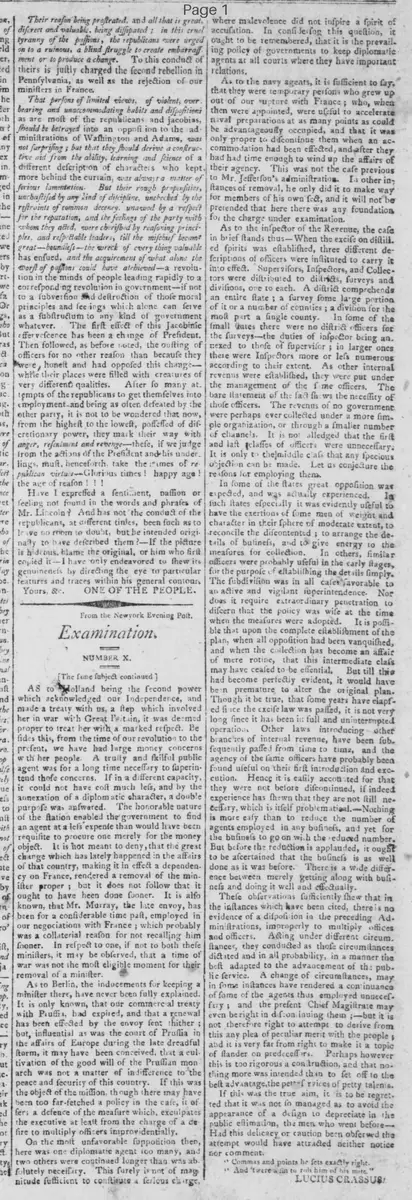
AS to Holland being the second power which acknowledged our Independence, and made a treaty with us, a step which involved her in war with Great Britain, it was deemed proper to treat her with a marked respect. Besides this, from the time of our revolution to the present, we have had large money concerns with her people. A trusty and skilful public agent was for a long time necessary to superintend those concerns. If in a different capacity, it could not have cost much less, and by the annexation of a diplomatic character, a double purpose was answered. The honorable nature of the station enabled the government to find an agent at a less expense than would have been requisite to procure one merely for the money object. It is not meant to deny, that the great change which has lately happened in the affairs of that country, making it in effect a dependency on France, rendered a removal of the minister proper; but it does not follow that it ought to have been done sooner. It is also known, that Mr. Murray, the late envoy, has been for a considerable time past, employed in our negociations with France; which probably was a collateral reason for not recalling him sooner. In respect to one, if not to both these ministers, it may be observed, that a time of war was not the most eligible moment for their removal of a minister.
As to Berlin, the inducements for keeping a minister there, have never been fully explained. It is only known, that our commercial treaty with Prussia, had expired, and that a renewal has been effected by the envoy sent thither: but, influential as was the court of Prussia in the affairs of Europe during the late dreadful storm, it may have been conceived, that a cultivation of the good will of the Prussian monarch was not a matter of indifference to the peace and security of this country. If this was the object of the mission, though there may have been too far-fetched a policy in the case, it offers a defence of the measure which, exculpates the executive at least from the charge of a desire to multiply officers improvidently.
On the most unfavorable supposition then, here was one diplomatic agent too many, and two others were continued longer than was absolutely necessary. This surely is not of magnitude sufficient to constitute a serious charge. where malevolence did not inspire a spirit of accusation. In considering this question, it ought to be remembered, that it is the prevailing policy of governments to keep diplomatic agents at all courts where they have important relations.
As to the navy agents, it is sufficient to say, that they were temporary persons who grew up out of our rupture with France; who, when then were appointed, were useful to accelerate naval preparations at as many points as could be advantageously occupied, and that it was only proper to discontinue them when an accommodation had been effected, and after they had had time enough to wind up the affairs of their agency. This was not the case previous to Mr. Jefferson's administration. In other instances of removal, he only did it to make way for members of his own sect, and it will not be pretended that here there was any foundation for the charge under examination.
As to the inspector of the Revenue, the case in brief stands thus--When the excise on distilled spirits was established, three different descriptions of officers were instituted to carry it into effect. Supervisors, Inspectors, and Collectors were distributed to districts, surveys and divisions, one to each. A district comprehends an entire state; a survey some large portion of it or a number of counties; a division for the most part a single county. In some of the small states there were no district officers for the surveys--the duties of inspector being annexed to those of supervisor; in larger ones there were Inspectors more or less numerous according to their extent. As other internal revenues were established, they were put under the management of the same officers. The bare statement of the fact shews the necessity of those officers. The revenues of no government were perhaps ever collected under a more simple organization, or through a smaller number of channels. It is not alleged that the first and last classes of officers were unnecessary: It is only to the middle class that any plausible objection can be made. Let us conjecture the reasons for employing them.
In some of the states great opposition was expected, and was actually experienced. In such states especially it was evidently useful to have the exertions of some men of weight and character in their sphere of moderate extent, to reconcile the discontented; to arrange the details of business, and to give energy to the measures for collection. In others, similar officers were probably useful in the early stages, for the purpose of establishing the details implied. The subdivision was in all cases favorable to an active and vigilant superintendence. Nor does it require extraordinary penetration to discern that the policy was wise at the time when the measures were adopted. It is possible that upon the complete establishment of the plan, when all opposition had been vanquished, and when the collection has become an affair of mere routine, that this intermediate class may have ceased to be essential. But till this had become perfectly evident, it would have been premature to alter the original plan. Though it be true, that some years have elapsed since the excise law was passed, it is not very long since it has been in full and uninterrupted operation Other laws introducing other branches of internal revenue, have been subsequently passed from time to time, and the agency of the same officers have probably been found useful on their first introduction and execution. Hence it is easily accounted for that they were not before discontinued, if indeed experience has shewn that they are not still necessary, which is itself problematical.--Nothing is more easy than to reduce the number of agents employed in any business, and yet for the business to go on with the reduced number. But before the reduction is applauded, it ought to be ascertained that the business is as well done as it was before. There is a wide difference between merely getting along with business and doing it well and effectually.
These observations sufficiently shew that in the instances which have been cited, there is no evidence of a disposition in the preceding Administrations, improperly to multiply offices and officers. Acting under different circumstances, they conducted as those circumstances dictated and in all probability, in a manner the best adapted to the advancement of the public service. A change of circumstances, may in some instances have rendered a continuance of some of the agents thus employed unnecessary; and the present Chief Magistrate may even be right in discontinuing them;--but it is not therefore right to attempt to derive from this any plea of peculiar merit with the people; and it is very far from right to make it a topic of slander on predecessors. Perhaps however this is too rigorous a construction, and that nothing more was intended than to set off to the best advantage, the performances of petty talents. If this was the true aim, it is to be regretted that it was not so managed as to avoid the appearance of a design to depreciate in the public estimation, the men who went before-- Had this delicacy or caution been observed the attempt would have attracted neither notice nor comment.
Examination.
NUMBER X.
[The same subject continued]
AS to Holland being the second power which acknowledged our Independence, and made a treaty with us, a step which involved her in war with Great Britain, it was deemed proper to treat her with a marked respect. Besides this, from the time of our revolution to the present, we have had large money concerns with her people. A trusty and skilful public agent was for a long time necessary to superintend those concerns. If in a different capacity, it could not have cost much less, and by the annexation of a diplomatic character, a double purpose was answered. The honorable nature of the station enabled the government to find an agent at a less expense than would have been requisite to procure one merely for the money object. It is not meant to deny, that the great change which has lately happened in the affairs of that country, making it in effect a dependency on France, rendered a removal of the minister proper; but it does not follow that it ought to have been done sooner. It is also known, that Mr. Murray, the late envoy, has been for a considerable time past, employed in our negociations with France; which probably was a collateral reason for not recalling him sooner. In respect to one, if not to both these ministers, it may be observed, that a time of war was not the most eligible moment for their removal of a minister.
As to Berlin, the inducements for keeping a minister there, have never been fully explained. It is only known, that our commercial treaty with Prussia, had expired, and that a renewal has been effected by the envoy sent thither: but, influential as was the court of Prussia in the affairs of Europe during the late dreadful storm, it may have been conceived, that a cultivation of the good will of the Prussian monarch was not a matter of indifference to the peace and security of this country. If this was the object of the mission, though there may have been too far-fetched a policy in the case, it offers a defence of the measure which, exculpates the executive at least from the charge of a desire to multiply officers improvidently.
On the most unfavorable supposition then, here was one diplomatic agent too many, and two others were continued longer than was absolutely necessary. This surely is not of magnitude sufficient to constitute a serious charge. where malevolence did not inspire a spirit of accusation. In considering this question, it ought to be remembered, that it is the prevailing policy of governments to keep diplomatic agents at all courts where they have important relations.
As to the navy agents, it is sufficient to say, that they were temporary persons who grew up out of our rupture with France; who, when then were appointed, were useful to accelerate naval preparations at as many points as could be advantageously occupied, and that it was only proper to discontinue them when an accommodation had been effected, and after they had had time enough to wind up the affairs of their agency. This was not the case previous to Mr. Jefferson's administration. In other instances of removal, he only did it to make way for members of his own sect, and it will not be pretended that here there was any foundation for the charge under examination.
As to the inspector of the Revenue, the case in brief stands thus--When the excise on distilled spirits was established, three different descriptions of officers were instituted to carry it into effect. Supervisors, Inspectors, and Collectors were distributed to districts, surveys and divisions, one to each. A district comprehends an entire state; a survey some large portion of it or a number of counties; a division for the most part a single county. In some of the small states there were no district officers for the surveys--the duties of inspector being annexed to those of supervisor; in larger ones there were Inspectors more or less numerous according to their extent. As other internal revenues were established, they were put under the management of the same officers. The bare statement of the fact shews the necessity of those officers. The revenues of no government were perhaps ever collected under a more simple organization, or through a smaller number of channels. It is not alleged that the first and last classes of officers were unnecessary: It is only to the middle class that any plausible objection can be made. Let us conjecture the reasons for employing them.
In some of the states great opposition was expected, and was actually experienced. In such states especially it was evidently useful to have the exertions of some men of weight and character in their sphere of moderate extent, to reconcile the discontented; to arrange the details of business, and to give energy to the measures for collection. In others, similar officers were probably useful in the early stages, for the purpose of establishing the details implied. The subdivision was in all cases favorable to an active and vigilant superintendence. Nor does it require extraordinary penetration to discern that the policy was wise at the time when the measures were adopted. It is possible that upon the complete establishment of the plan, when all opposition had been vanquished, and when the collection has become an affair of mere routine, that this intermediate class may have ceased to be essential. But till this had become perfectly evident, it would have been premature to alter the original plan. Though it be true, that some years have elapsed since the excise law was passed, it is not very long since it has been in full and uninterrupted operation Other laws introducing other branches of internal revenue, have been subsequently passed from time to time, and the agency of the same officers have probably been found useful on their first introduction and execution. Hence it is easily accounted for that they were not before discontinued, if indeed experience has shewn that they are not still necessary, which is itself problematical.--Nothing is more easy than to reduce the number of agents employed in any business, and yet for the business to go on with the reduced number. But before the reduction is applauded, it ought to be ascertained that the business is as well done as it was before. There is a wide difference between merely getting along with business and doing it well and effectually.
These observations sufficiently shew that in the instances which have been cited, there is no evidence of a disposition in the preceding Administrations, improperly to multiply offices and officers. Acting under different circumstances, they conducted as those circumstances dictated and in all probability, in a manner the best adapted to the advancement of the public service. A change of circumstances, may in some instances have rendered a continuance of some of the agents thus employed unnecessary; and the present Chief Magistrate may even be right in discontinuing them;--but it is not therefore right to attempt to derive from this any plea of peculiar merit with the people; and it is very far from right to make it a topic of slander on predecessors. Perhaps however this is too rigorous a construction, and that nothing more was intended than to set off to the best advantage, the performances of petty talents. If this was the true aim, it is to be regretted that it was not so managed as to avoid the appearance of a design to depreciate in the public estimation, the men who went before-- Had this delicacy or caution been observed the attempt would have attracted neither notice nor comment.
What sub-type of article is it?
Partisan Politics
Foreign Affairs
Economic Policy
What keywords are associated?
Diplomatic Agents
Navy Agents
Revenue Inspectors
Partisan Slander
Administrative Necessity
Jefferson Administration
Foreign Relations
Internal Revenue
What entities or persons were involved?
Mr. Jefferson
Mr. Murray
Prussian Monarch
Holland
France
Great Britain
Prussia
Berlin
Editorial Details
Primary Topic
Defense Of Diplomatic, Naval, And Revenue Appointments Under Prior Administrations
Stance / Tone
Defensive Of Predecessors, Critical Of Jefferson's Partisan Implications
Key Figures
Mr. Jefferson
Mr. Murray
Prussian Monarch
Holland
France
Great Britain
Prussia
Berlin
Key Arguments
Holland's Early Recognition Of U.S. Independence And Financial Ties Justified Long Term Diplomatic Agent
Berlin Mission Renewed Commercial Treaty And Cultivated Prussian Goodwill Amid European Turmoil
Navy Agents Were Temporary, Useful During French Rupture, Discontinued Appropriately After Peace
Revenue Inspectors Essential For Excise Enforcement Amid Opposition, Subdivision Aided Vigilance
Prior Administrations Acted Prudently Under Circumstances, Reductions Now Do Not Prove Past Improvidence
Jefferson's Removals Often Favored His Sect, Not Merit; Claims Of Merit Are Slanderous