Thank you for visiting SNEWPapers!
Sign up free
The National Intelligencer And Washington Advertiser
Washington, District Of Columbia
What is this article about?
President Jefferson relays to Congress a letter from Mississippi Territory Secretary Cowles Mead about Aaron Burr's suspicious activities near Bayou Pierre on January 13, 1807. Reports include court proceedings on habeas corpus motions for Samuel Swartwout and Dr. Erick Bollman in the Supreme Court, and Judge Fitzhugh's opinion committing them for treason. Various letters from Tennessee and New Orleans express loyalty and dismiss fears of Burr's conspiracy.
Merged-components note: These components together form a complete article on Washington City news from February 11, including the President's message on Burr, court proceedings on habeas corpus for Swartwout and Bollman, and Judge Fitzhugh's full opinion on their commitment for treason. The second component directly continues the text from the first. Relabeled the second from 'story' to 'domestic_news' as it is part of the ongoing national news coverage of the Burr conspiracy.
Clippings
1 of 2
OCR Quality
Full Text
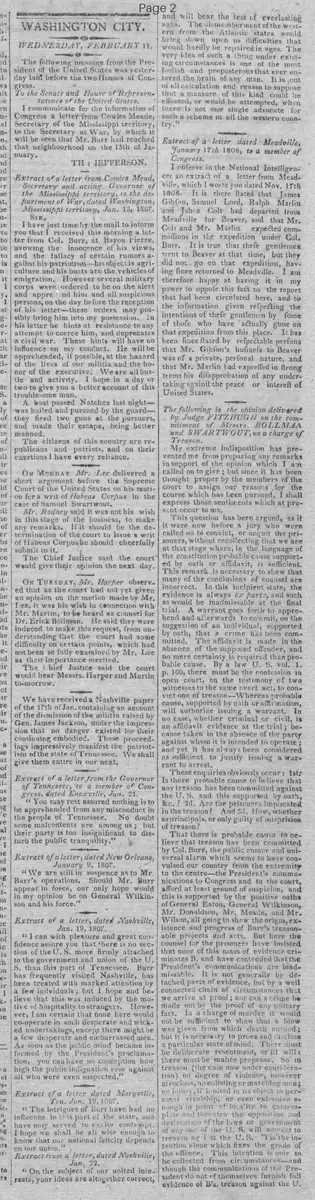
WEDNESDAY, FEBRUARY 11.
The following message from the President of the United States was yesterday laid before the two Houses of Congress.
To the Senate and House of Representatives of the United States:
I communicate for the information of Congress a letter from Cowles Meade, Secretary of the Mississippi territory, to the Secretary at War, by which it will be seen that Mr. Burr had reached that neighbourhood on the 13th of January
TH: JEFFERSON.
Extract of a letter from Cowles Mead Secretary and acting Governor of the Mississippi territory, to the department of War, dated Washington, Mississippi territory, Jan. 13, 1807.
SIR,
I have just time by the mail to inform you that I received this morning a letter from Col. Burr, at Bayou Pierre. avowing the innocence of his views, and the fallacy of certain rumors against his patriotism—his object is agriculture and his boats are the vehicles of emigration. However several military corps were ordered to be on the alert and apprehend him and all suspicious persons, on the day before the reception of his letter—these orders may possibly bring him into my possession. In his letter he hints at resistance to any attempt to coerce him, and deprecates a civil war. These hints will have no influence on my conduct. He will be apprehended, if possible, at the hazard of the lives of our militia and the honor of the executive. We are all bustle and activity. I hope in a day or two to give you a better account of this troublesome man.
A boat passed Natchez last night—was hailed and pursued by the guard—they fired two guns at the pursuers, and made their escape, being better manned,
The citizens of this country are republicans and patriots, and on their exertions I have every reliance.
On Monday Mr. Lee delivered a short argument before the Supreme Court of the United States on his motion for a writ of Habeas Corpus in the case of Samuel Swartwout.
Mr. Rodney said it was not his wish in this stage of the business, to make any remarks. If it should be the determination of the court to issue a writ of Habeas Corpus he should cheerfully submit to it.
The Chief Justice said the court would give their opinion the next day.
On Tuesday, Mr. Harper observed that as the court had not yet given an opinion on the motion made by Mr. Lee, it was his wish in connection with Mr, Martin, to be heard as counsel for Dr. Erick Bollman, He said they were induced to make this request, from understanding that the court had some difficulty on certain points, which had not been so fully examined by Mr. Lee as their importance merited.
The Chief Justice said the court would hear Messrs. Harper and Martin to-morrow.
We have received a Nashville paper of the 17th of Jan. containing an account of the dismission of the militia raised by Gen. James Jackson, under the impression that no danger existed for their continuing embodied. These proceedings impressively manifest the patriotism of the state of Tennessee. We shall give them entire in our next.
Extract of a letter from the Governor of Tennessee, to a member of Congress, dated Knoxville, Jan. 21.
"You may rest assured nothing is to be apprehended from any misconduct in the people of Tennessee. No doubt some malcontents are among us; but their party is too insignificant to disturb the public tranquility."
Extract of a letter, dated New Orleans, January 9, 1807.
"We are still in suspence as to Mr. Burr's operations. Should Mr. Burr appear in force, our only hope would in my opinion be on General Wilkinson and his force."
Extract of a letter, dated Nashville Jan. 19, 1807.
"I can with pleasure and great confidence assure you that there is no section of the U.S. more firmly attached to the government and union of the U. S. than this part of Tennessee. Burr has frequently visited Nashville, has been treated with marked attention by a few individuals; but I hope and believe that this was induced by the motive of hospitality to strangers. However, I am certain that none here would co-operate in such desperate and wicked undertakings, except there might be a few desperate and embarrassed men. As soon as the public mind became informed by the President's proclamation, you can have no conception how high the public indignation rose against all who were even suspected."
Extract of a letter dated Maryville. Ten. Jan. 13, 1807.
"The intrigues of Burr have had no influence in this part of the state, and have only served to excite contempt. I hope we shall be all wise enough to know that our national felicity depends on our union."
Extract from a letter, dated Nashville, Jan. 22.
"On the subject of our united interests, your ideas are altogether correct, and will bear the test of everlasting ages. The dismemberment of the western from the Atlantic states would bring down upon us difficulties that would hardly be repaired in ages. The very idea of such a thing under existing circumstances is one of the most foolish and preposterous that ever entered the brain of any man. It is out of all calculation and reason to suppose that a measure of this kind could be effected, or would be attempted, when there is not one single advocate for such a scheme in all the western country."
Extract of a letter dated Meadville. January 17th 1806, to a member of Congress:
I observe in the National Intelligencer an extract of a letter from Meadville, which I wrote you dated Nov. 17th 1806. It is there stated that James Gibson, Samuel Lord, Ralph Marlin and Jabez Colt had departed from Meadville for Beaver, and that Mr. Colt and Mr. Marlin expected commissions in the expedition under Col. Burr. It is true that these gentlemen went to Beaver at that time, but they did not go on that expedition, having since returned to Meadville. I am therefore happy at having it in my power to oppose this fact to the report that had been circulated here, and to the information given respecting the intentions of these gentlemen by some of those who have actually gone on that expedition from this place. It has been since stated by respectable persons that Mr. Gibson's business to Beaver was of a private, personal nature, and that Mr. Marlin had expressed in strong terms his disapprobation of any undertaking against the peace or interest of United States.
The following is the opinion delivered by Judge FITZHUGH on the commitment of Messrs. BOLLMAN and SWARTWOUT, on a charge of Treason.
My extreme indisposition has prevented me from preparing any remarks in support of the opinion which I am called on to give ; but since it has been thought proper by the members of the court to assign our reasons for the course which has been pursued, I shall express those sentiments which at present occur to me.
This question has been argued, as if it were now before a jury who were called on to convict, or acquit the prisoners, without recollecting that we are at that stage where, in the language of the constitution probable cause supported by oath or affidavit, is sufficient. This remark is necessary to shew that many of the conclusions of counsel are incorrect. In this incipient state, the evidence is always ex parte, and such as would be inadmissable at the final trial. A warrant goes forth to apprehend and afterwards to commit, on the suggestion of an individual, supported by oath, that a crime has been committed. The affidavit is made in the absence of the supposed offender, and no more certainty is required than probable cause. By a law U. S. vol, 1. p. 100, there must be the confession in open court, or the testimony of two witnesses to the same overt act, to convict one of treason—Whereas probable cause, supported by oath or affirmation, will authorize issuing a warrant. In no case, whether criminal or civil, is an affidavit evidence at the trial; because taken in the absence of the party against whom it is intended to operate; and yet it has always been considered as sufficient to justify issuing a warrant to arrest.
These enquiries obviously occur: 1st: Is there probable cause to believe that any treason has been committed against the U.S. and this supported by oath. &c. ? 2d. Are the prisoners implicated in the treason? And 3d. How, whether as principals, or only guilty of misprision of treason?
That there is probable cause to believe that treason has been committed by Col. Burr, the public rumor and universal alarm which seems to have convulsed our country from the extremity to the centre—the President's communications to Congress and to the court, afford at least ground of suspicion, and this is supported by the positive oaths of General Eaton, General Wilkinson, Mr. Donaldson, Mr. Meade, and Mr. Wilson, all going to shew the origin, existence and progress of Burr's treasonable projects and acts. But here the counsel for the prisoners have insisted that none of this mass of evidence criminate B. and have contended that the President's communications are inadmissible. It is not generally by detached parts of evidence, but by a well connected chain of circumstances that we arrive at proof; nor can a crime be made out by the proof of any solitary fact. In a charge of murder it would not be sufficient to shew that a blow was given from which death ensued; but it is necessary to prove and disclose a particular state of mind. There must be deliberate resentment, or ill will: there must be malice prepense. So in treason (the case now under consideration) no degree of violence, however atrocious, no enlisting or marching men; no injury, if limited in its object to personal rivalship, or even extensive enough in point of locality to contemplate and threaten the opposition and destruction of the laws or government of any one of the U. S. will amount to treason against the U.S. 'Tis the intention alone which fixes the grade of the offence. This intention is only to be collected from circumstances—and though the communications of the President do not of themselves furnish full evidence of B's. treason against the U.
Sir, yet they must be considered entitled to some weight in leading to the conclusion that there is probable cause; but when in addition to this, it is considered that the most solemn obligation is imposed by the constitution on the President to make communications of this nature to Congress, and that he has also in further discharge of his constitutional duties ordered out the militia, which on ordinary and trivial occasions he is not justifiable in doing, a person must be strangely incredulous who will not admit that there is probable cause of suspicion that a dangerous insurrection or treason exists in our country. A report thus sanctioned by duty and oath, if made to this court by one of its officers, would be respected, and why shall not a communication from the first executive officer of the Union be credited when he announces to the nation information in the line of his duty? But this general ground of alarm is rendered more specific by the affidavits which have been exhibited to us. If the persons who have been sworn on this occasion are to be believed, (and no one has yet questioned their credibility) they prove a scheme laid by Burr to usurp the government of the U. S. to sever the western states from the Union: to establish an empire west of the Alleghany mountains, of which he, Burr, was to be the sovereign, and New Orleans the emporium, and to invade and revolutionize Mexico. That in prosecution of those projects he wrote a letter to General Wilkinson, the commander in chief of the American army, with the avowed object and design of alienating him from his duty, and inviting him to embark in the undertaking, and holding out to him the most flattering and sanguine assurances and prospects of success. Horrid as this attempt was, yet if the information had reached no further, I should have no hesitation in saying that it would have been nothing more than a conspiracy to commit treason, or some other offence: But when Burr assures Wilkinson that he had obtained funds and actually commenced the enterprize; that detachments from various points and under different pretences would rendezvous on the Ohio, the 1st of Nov.—that his plan was to move down rapidly from the Falls the 15th of Nov. with the first 500 or 1000 men in light boats now constructing for that purpose:
—When, in addition to this, Wilson and Meade swear that when they left New Orleans, the one the 15th, the other 19th Dec. the strongest apprehension and belief universally prevailed among the inhabitants that Burr and his confederates had prepared an armed force, and were marching to attack and plunder the city; and that they knew that Wilkinson was decidedly of opinion, from the most satisfactory information, that Burr was advancing, and under that belief, he was putting the place in a posture of defence. With this coincidence of circumstances and this strength of testimony appear, there can be little doubt of the existence and the extent of Burr's views, and of his having embodied and enlisted men with views hostile to the government of his country, and that he has done acts which amount to levying war on the U. S.
Burr's treason then being established, we are to enquire whether the prisoners were his confederates. They are represented, under oath, to have been the bearers of the duplicates of Burr's letters in cypher to Wilkinson, and to possess Burr's confidence; they use arguments in addition to those in the letter, to invite Wilkinson's to accede to their views: admit that they have corresponded with Burr on the subject since the delivery of the letter: That Swartwout informed Wilkinson that Burr, with a powerful association, extending from New York to New Orleans, was levying an armed body of 7000 men from New York and the western states and territories, with a view to carry an expedition against the Mexican provinces, and that 500 men under colonel Swartwout and major Tyler were to descend the Alleghany, for whose accommodation light boats had been built and were ready—said that New Orleans would be revolutionized when the people were ready to join them, and that there would be some seizing.
Here then is evidence of a connection with colonel Burr of a treasonable nature. What is it? The act of Congress defines misprision of treason to be a neglect to disclose the knowledge of a treason. But the prisoners have not only known of the treason; but carried a treasonable letter, knowing its contents; endeavored to further Burr's views and wishes, and to seduce Wilkinson from his duty. The offence exceeds misprision of treason, and as there is no intermediate class of offences of a treasonable nature between misprision and treason, it must be treason.
It has been observed by the counsel for the prisoners that no judge could commit on an affidavit made before any other judge. This distinction is certainly new, and I believe unprecedented. In all general warrants for arresting a supposed offender, the direction to the officer is to bring the party before the person issuing the warrant, or some other justice of peace, &c. which would be at least nugatory, if no person could inspect or regard the affidavit except the person before whom it was made. Therefore I conclude that Wilkinson's affidavits made before justices of the peace of New Orleans, whose commissions appear to be properly authenticated by the secretary of state, are evidence at this stage of our enquiry.
I am therefore of opinion, that the prisoners should be committed for treason against the United States, in levying War against them.
What sub-type of article is it?
What keywords are associated?
What entities or persons were involved?
Where did it happen?
Domestic News Details
Primary Location
Washington City
Event Date
Wednesday, February 11
Key Persons
Outcome
prisoners bollman and swartwout committed for treason against the united states; militia dismissed in tennessee; orders to apprehend burr and suspicious persons; boat escaped pursuit near natchez.
Event Details
President Jefferson communicates a letter from Cowles Mead reporting Burr's arrival near Bayou Pierre and orders to apprehend him. Supreme Court hears arguments on habeas corpus for Swartwout and Bollman. Judge Fitzhugh opines on probable cause for their commitment on treason charges related to Burr's conspiracy to sever western states and invade Mexico. Letters from Tennessee and New Orleans affirm loyalty and dismiss threats from Burr's intrigues.