Thank you for visiting SNEWPapers!
Sign up free
Editorial
February 1, 1840
The Congregationalist
Hartford, Hartford County, Connecticut
What is this article about?
Excerpt from McCrie's sermon on Apostle Paul's disinterested spirit, highlighting his readiness to sacrifice personal well-being for Christian mission, enduring ingratitude, and wishing conversion for all, including King Agrippa.
Clipping
OCR Quality
98%
Excellent
Full Text
PAUL'S DISINTERESTEDNESS.
The disinterested spirit of Paul did not appear only in his readiness to renounce every pecuniary claim. He was prepared and stood always ready to make a sacrifice of his ease, his health, his strength, his reputation, his life, in prosecution of his high calling, and for the advancement of those among whom he labored; nor could their ingratitude and insensibility to his services cool the ardor of his generous determination to do them good: " I will very gladly spend and be spent for you: though the more abundantly I love you, the less I be loved."
Nor was this disinterested benevolence confined to those who were Christians. If the maxim be just, " out of the abundance of the heart the mouth speaketh," then his unpremeditated reply to King Agrippa is a convincing proof of this. Struck with his fervent appeal to him, and with the character of his whole appearance and defence, the king could not refrain from exclaiming, "Almost thou persuadest me to be a Christian."
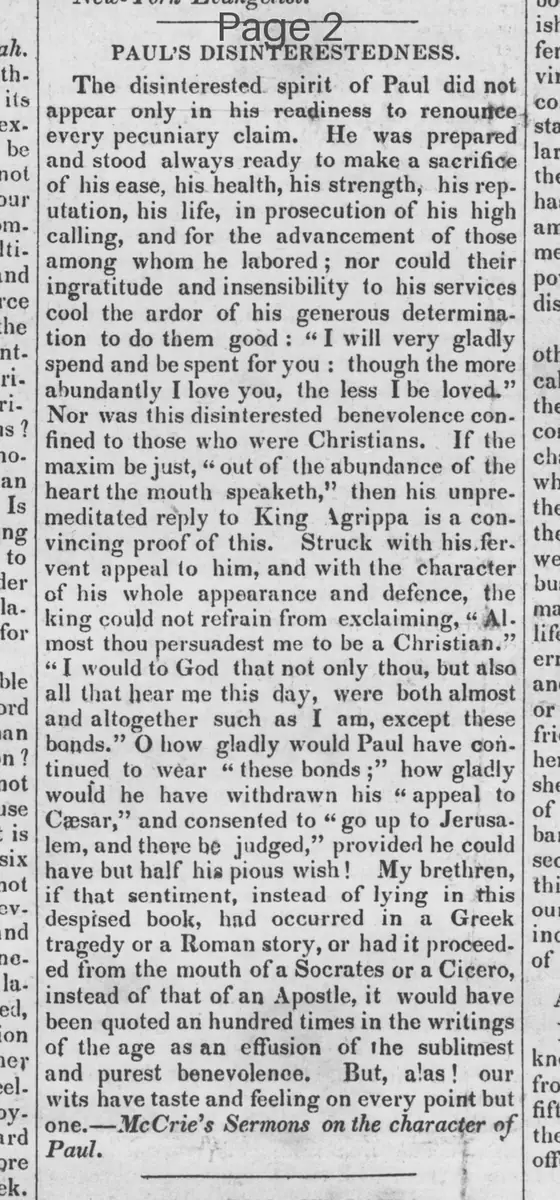
" I would to God that not only thou, but also all that hear me this day, were both almost and altogether such as I am, except these bands." O how gladly would Paul have continued to wear " these bonds ;" how gladly would he have withdrawn his "appeal to Cæsar,"and consented to " go up to Jerusalem, and there be judged,"provided he could have but half his pious wish! My brethren, if that sentiment, instead of lying in this despised book, had occurred in a Greek tragedy or a Roman story, or had it proceeded from the mouth of a Socrates or a Cicero, instead of that of an Apostle, it would have been quoted an hundred times in the writings of the age as an effusion of the sublimest and purest benevolence. But, alas! our wits have taste and feeling on every point but one.—McCrie's Sermons on the character of Paul.
The disinterested spirit of Paul did not appear only in his readiness to renounce every pecuniary claim. He was prepared and stood always ready to make a sacrifice of his ease, his health, his strength, his reputation, his life, in prosecution of his high calling, and for the advancement of those among whom he labored; nor could their ingratitude and insensibility to his services cool the ardor of his generous determination to do them good: " I will very gladly spend and be spent for you: though the more abundantly I love you, the less I be loved."
Nor was this disinterested benevolence confined to those who were Christians. If the maxim be just, " out of the abundance of the heart the mouth speaketh," then his unpremeditated reply to King Agrippa is a convincing proof of this. Struck with his fervent appeal to him, and with the character of his whole appearance and defence, the king could not refrain from exclaiming, "Almost thou persuadest me to be a Christian."
" I would to God that not only thou, but also all that hear me this day, were both almost and altogether such as I am, except these bands." O how gladly would Paul have continued to wear " these bonds ;" how gladly would he have withdrawn his "appeal to Cæsar,"and consented to " go up to Jerusalem, and there be judged,"provided he could have but half his pious wish! My brethren, if that sentiment, instead of lying in this despised book, had occurred in a Greek tragedy or a Roman story, or had it proceeded from the mouth of a Socrates or a Cicero, instead of that of an Apostle, it would have been quoted an hundred times in the writings of the age as an effusion of the sublimest and purest benevolence. But, alas! our wits have taste and feeling on every point but one.—McCrie's Sermons on the character of Paul.
What sub-type of article is it?
Moral Or Religious
What keywords are associated?
Paul
Disinterestedness
Benevolence
Christian Sacrifice
Ingratitude
King Agrippa
What entities or persons were involved?
Paul
King Agrippa
Mccrie
Editorial Details
Primary Topic
Paul's Disinterested Spirit And Benevolence
Stance / Tone
Admiring And Exhortative
Key Figures
Paul
King Agrippa
Mccrie
Key Arguments
Paul Ready To Sacrifice Ease, Health, Strength, Reputation, Life For His Calling
Paul's Love Persists Despite Ingratitude
Paul's Reply To Agrippa Shows Universal Benevolence
Paul Wishes All Hearers To Become Christians Like Him, Except His Bonds
Such Sentiment Would Be Praised If From Pagan Philosophers, But Dismissed From Apostle