Thank you for visiting SNEWPapers!
Sign up free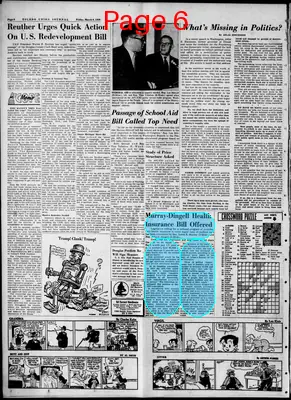
Toledo Union Journal
Toledo, Lucas County, Ohio
What is this article about?
Sen. James E. Murray (D-Mont.) and Rep. John D. Dingell (D-Mich.) introduced a bill for a national contributory health insurance program, with employers and employees sharing 1.5% costs on first $6,000 earnings to cover medical care for workers and families, including self-employed and retirees. It addresses rising medical costs and gaps in voluntary insurance.
Clipping
OCR Quality
Full Text
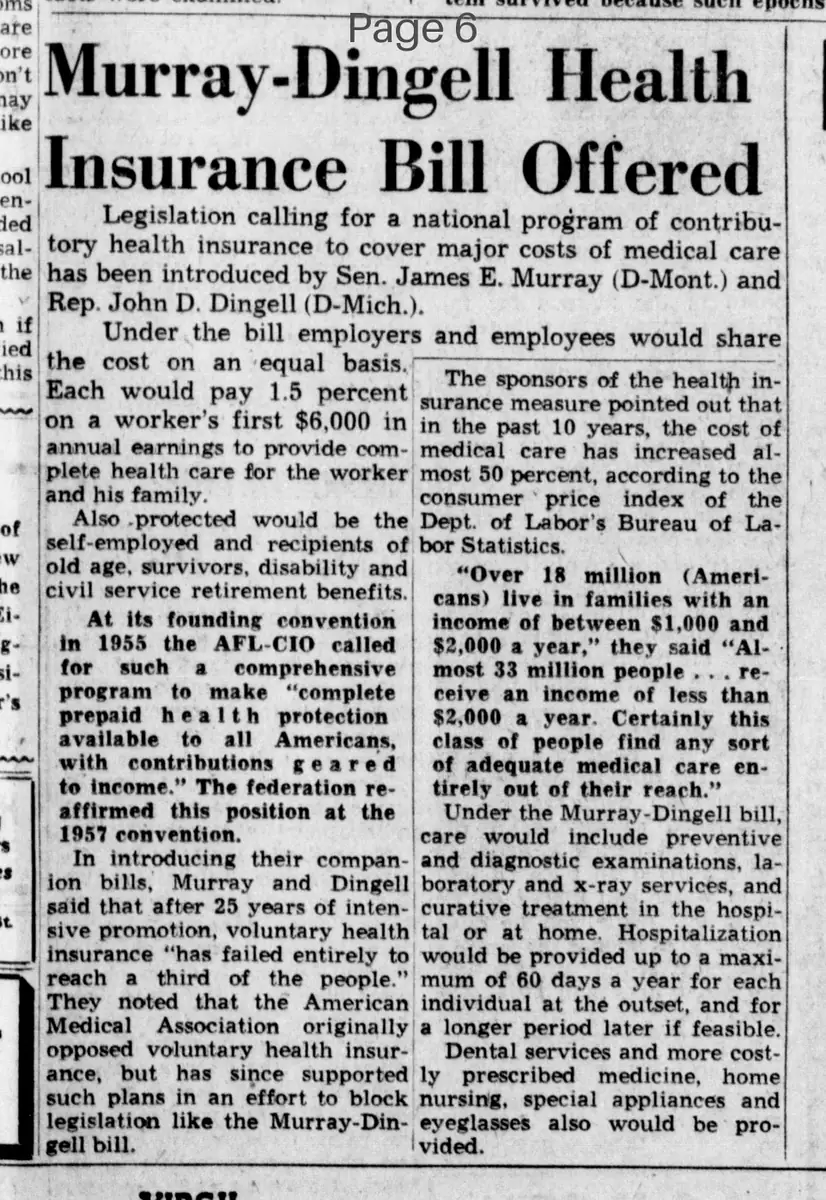
Legislation calling for a national program of contributory health insurance to cover major costs of medical care has been introduced by Sen. James E. Murray (D-Mont.) and Rep. John D. Dingell (D-Mich.).
Under the bill employers and employees would share the cost on an equal basis. Each would pay 1.5 percent on a worker's first $6,000 in annual earnings to provide complete health care for the worker and his family.
Also protected would be the self-employed and recipients of old age, survivors, disability and civil service retirement benefits.
At its founding convention in 1955 the AFL-CIO called for such a comprehensive program to make "complete prepaid health protection available to all Americans, with contributions geared to income." The federation reaffirmed this position at the 1957 convention.
In introducing their companion bills, Murray and Dingell said that after 25 years of intensive promotion, voluntary health insurance "has failed entirely to reach a third of the people."
They noted that the American Medical Association originally opposed voluntary health insurance, but has since supported such plans in an effort to block legislation like the Murray-Dingell bill.
The sponsors of the health insurance measure pointed out that in the past 10 years, the cost of medical care has increased almost 50 percent, according to the consumer price index of the Dept. of Labor's Bureau of Labor Statistics.
"Over 18 million (Americans) live in families with an income of between $1,000 and $2,000 a year," they said "Almost 33 million people . . . receive an income of less than $2,000 a year. Certainly this class of people find any sort of adequate medical care entirely out of their reach."
Under the Murray-Dingell bill, care would include preventive and diagnostic examinations, laboratory and x-ray services, and curative treatment in the hospital or at home. Hospitalization would be provided up to a maximum of 60 days a year for each individual at the outset, and for a longer period later if feasible.
Dental services and more costly prescribed medicine, home nursing, special appliances and eyeglasses also would be provided.
What sub-type of article is it?
What keywords are associated?
What entities or persons were involved?
Domestic News Details
Key Persons
Event Details
Legislation introduced for national contributory health insurance covering major medical costs, with equal cost-sharing by employers and employees at 1.5% on first $6,000 earnings, extending to self-employed and benefit recipients. Includes preventive care, hospitalization up to 60 days, dental, medicines, nursing, appliances, and eyeglasses. Addresses failures of voluntary insurance and rising costs.